
RGM-B, also known as DRAGON, is a 40 kDa member of the repulsive guidance molecule (RGM) family of GPI-linked neuronal and muscle membrane proteins (1, 2). It is synthesized as a preproprotein that consists of a 48 amino acid (aa) signal sequence, a 367 aa mature region, and a 21 aa C-terminal prosegment (3). RGM-B contains two potential N-linked glycosylation sites and an abbreviated von Willebrand factor domain. Potential proteolytic cleavage within the VWF domain is supported by R&D Systems’ in house data (4). Within the region following the VWF domain, mouse RGM-B shares 49% and 43% aa sequence identity with RGM-A and RGM-C, respectively. It shares 90%, 79%, 92%, and 93% aa sequence identity with bovine, chicken, human, and rhesus macaque RGM-B, respectively. RGM-B is expressed in the developing and adult nervous system, particularly in the dorsal root ganglia and mantle layer of the spinal cord (3-5). In mouse, it shows a complementary, non-overlapping distribution with RGM-A (2-5). RGM-B is also expressed in fetal and adult enteric ganglia and in postnatal intestinal epithelium (6). RGM-B expression has been detected in neuronal cell bodies and proximal axonal segments (4) but is also present on the cell surface, where it interacts homophilically and mediates neuronal adhesion (3). RGM-B additionally functions as a BMP coreceptor. It directly binds BMP-2 and -4 but not other TGF-beta family proteins (7). RGM-B associates with BMP type I (ALK-2, -3, -6) and type II (Activin RIIA, Activin RIIB) receptors and enhances BMP signaling (7).


Key Product Details
Species Reactivity
Validated:
Mouse
Cited:
Human, Mouse
Applications
Validated:
Immunohistochemistry, Western Blot
Cited:
Western Blot, Flow Cytometry
Label
Unconjugated
Antibody Source
Polyclonal Sheep IgG
Loading...
Product Specifications
Immunogen
Mouse myeloma cell line NS0-derived recombinant mouse RGM-B
Gly49-Ser414
Accession # Q7TQ33
Gly49-Ser414
Accession # Q7TQ33
Specificity
Detects mouse RGM-B in direct ELISAs and Western blots. In direct ELISAs and Western blots, less than 5% cross-reactivity with recombinant mouse (rm) RGM-A and rmRGM-C is observed.
Clonality
Polyclonal
Host
Sheep
Isotype
IgG
Scientific Data Images for Mouse RGM-B Antibody
RGM-B in Mouse Brain.
RGM-B was detected in perfusion fixed frozen sections of mouse brain (trigeminal ganglia) using 1.7 µg/mL Sheep Anti-Mouse RGM-B Antigen Affinity-purified Polyclonal Antibody (Catalog # AF3597) overnight at 4 °C. Tissue was stained with the Anti-Sheep HRP-DAB Cell & Tissue Staining Kit (brown; Catalog # CTS019) and counterstained with hematoxylin (blue). View our protocol for Chromogenic IHC Staining of Frozen Tissue Sections.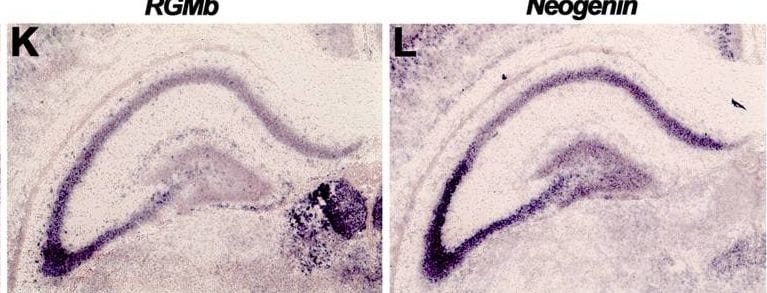
Detection of RGM-B by Immunohistochemistry
Subregion-specific expression of RGMs and Neogenin in the hippocampus.In situ hybridization (A–C, J–L) and immunohistochemistry (D–I, M–O) on coronal mouse brain sections at E16.5 (A–I) and P5 (J–O). Sections in D–I and M–O are counterstained in blue with fluorescent Nissl. (A–F) RGMa mRNA and protein are expressed in the ventricular zone (VZ), dentate gyrus (DG) and cornu ammonis (CA) region. Strong expression of RGMb mRNA and protein is detected in the pial surface lining the hippocampal fissure (HF). Neogenin transcripts and protein are widely expressed in the developing hippocampus (Hip). (G–I) Immunostaining with isotype matched controls. (J–L) In situ hybridization at P5 shows strong but differential expression patterns of RGMa, RGMb and Neogenin in the CA pyramidal cell layers (Pyr). In addition, strong expression of Neogenin is detected in the granular layer (GC) of the DG. (M–O) Immunohistochemistry reveals expression of RGMa and weak expression of RGMb in the stratum lacunosum moleculare (SLM) and fimbria (FIM). Neogenin strongly labels different hippocampal layers. CX, cortex; Hb, habenula; HC, hippocampal commissure; PO, polymorph layer; SO, stratum oriens; SR, stratum radiatum; Th, thalamus. Scale bar A–C: 400 µm, D–F: 300 µm, G–I: 300 µm, J–L: 500 µm and M–O: 400 µm. Image collected and cropped by CiteAb from the following open publication (https://pubmed.ncbi.nlm.nih.gov/23457482), licensed under a CC-BY license. Not internally tested by R&D Systems.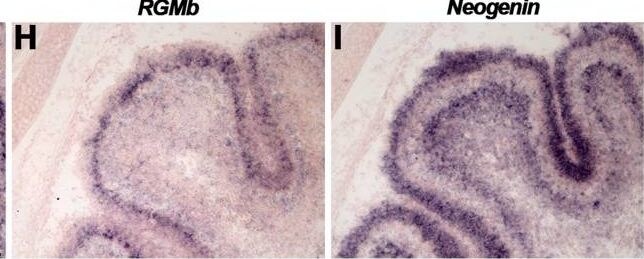
Detection of RGM-B by Immunohistochemistry
Differential expression of RGMs and Neogenin in the cerebellum.In situ hybridization (A–C, G–I, M–O) and immunohistochemistry (D–F, J–L, P–R) on coronal mouse brain sections at E16.5 (A–F), P5 (G–L) and in the adult (M–R). (A–I, M–O) In situ hybridization and immunohistochemistry reveals strong and broad expression of RGMa, RGMb and Neogenin in the cerebellum (CB). (J–L) Immunostaining shows expression of RGMa and Neogenin in all cerebellar layers at P5. RGMb is expressed in the internal granular layer (IGL), Purkinje cell layer (PCL) and external granular layer (EGL). (P–R) In the adult, RGMa, RGMb and Neogenin protein are expressed in Purkinje cells (PCs) and axons in the granular cell layer (GCL), PCL and molecular layer (ML). Neogenin strongly labels PC dendrites in the ML. DCN, deep cerebellar nuclei; WM, white matter; VZ, ventricular zone. Scale bar A–C: 300 µm, D–F: 250 µm, G–I: 150 µm, J–L: 150 µm, M–O: 100 µm and P–R: 50 µm. Image collected and cropped by CiteAb from the following open publication (https://pubmed.ncbi.nlm.nih.gov/23457482), licensed under a CC-BY license. Not internally tested by R&D Systems.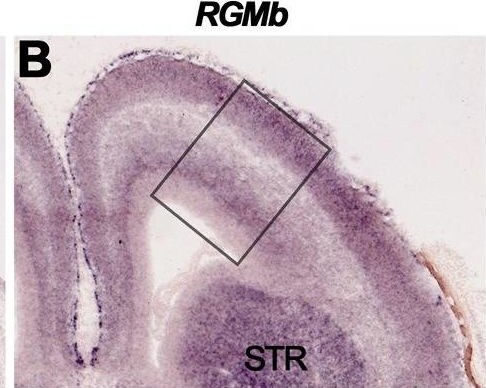
Detection of RGM-B by Immunohistochemistry
RGMa, RGMb and Neogenin display partially complementary patterns of expression in the developing cortex and on cortical projections.In situ hybridization (A–C′) and immunohistochemistry (D–L) on coronal mouse brain sections at E16.5. Panels A′–C′ and D′–F′ show higher magnifications of the boxed areas in A–C and D–F, respectively. Sections in D–L are counterstained in blue with fluorescent Nissl. (A–C′) In situ hybridization reveals strong expression of RGMa and Neogenin, and moderate expression of RGMb, in the embryonic mouse cortex. Arrow in A indicates neurons of the lateral migratory stream. (D–I) RGMa and Neogenin protein are strongly expressed in the cortex and on various cortical axon projections. Strong staining for RGMb (E), and Neogenin (F), is detected in the corpus callosum (CC). The internal capsule (IC) stains strongly for RGMa (G). (J–L) Immunostaining with isotype-matched control antibodies did show significant staining. CP, cortical plate; FIM, fimbria; IZ, intermediate zone; LV, lateral ventricle; MZ, marginal zone; SP, subplate; STR, striatum; SVZ, subventricular zone; VZ, ventricular zone. Scale bar A–C 400 µm, A′–C′ 200 µm, D–F 300 µm, D′–F′ 150 µm, G-I 300 µm and J-M 300 µm. Image collected and cropped by CiteAb from the following open publication (https://pubmed.ncbi.nlm.nih.gov/23457482), licensed under a CC-BY license. Not internally tested by R&D Systems.Applications for Mouse RGM-B Antibody
Application
Recommended Usage
Immunohistochemistry
5-15 µg/mL
Sample: Perfusion fixed frozen sections of mouse brain (trigeminal ganglia)
Sample: Perfusion fixed frozen sections of mouse brain (trigeminal ganglia)
Western Blot
0.1 µg/mL
Sample: Recombinant Mouse RGM-B (Catalog # 3597-RG)
Sample: Recombinant Mouse RGM-B (Catalog # 3597-RG)
Formulation, Preparation, and Storage
Purification
Antigen Affinity-purified
Reconstitution
Reconstitute at 0.2 mg/mL in sterile PBS. For liquid material, refer to CoA for concentration.
Loading...
Formulation
Lyophilized from a 0.2 μm filtered solution in PBS with Trehalose. See Certificate of Analysis for details.<br/>*Small pack size (-SP) is supplied either lyophilized or as a 0.2 µm filtered solution in PBS.
Shipping
Lyophilized product is shipped at ambient temperature. Liquid small pack size (-SP) is shipped with polar packs. Upon receipt, store immediately at the temperature recommended below.
Stability & Storage
Use a manual defrost freezer and avoid repeated freeze-thaw cycles.
- 12 months from date of receipt, -20 to -70 °C as supplied.
- 1 month, 2 to 8 °C under sterile conditions after reconstitution.
- 6 months, -20 to -70 °C under sterile conditions after reconstitution.
Calculators
Background: RGM-B
References
- Monnier, P.P. et al. (2002) Nature 419:392.
- Schmidtmer, J. and D. Engelkamp (2004) Gene Exp. Patterns 4:105.
- Samad, T.A. et al. (2004) J. Neurosci. 24:2027.
- Niederkofler, V. et al. (2004) J. Neurosci. 24:808.
- Oldekamp, J. et al. (2004) Gene Exp. Patterns 4:283.
- Metzger, M. et al. (2005) Dev. Dyn. 234:169.
- Samad, T.A. et al. (2005) J. Biol. Chem. 280:14122.
Long Name
Repulsive Guidance Molecule B
Alternate Names
Dragon, RGMB
Gene Symbol
RGMB
UniProt
Additional RGM-B Products
Product Documents for Mouse RGM-B Antibody
Certificate of Analysis
To download a Certificate of Analysis, please enter a lot or batch number in the search box below.
Note: Certificate of Analysis not available for kit components.
Product Specific Notices for Mouse RGM-B Antibody
For research use only
Related Research Areas
Citations for Mouse RGM-B Antibody
 Powered by Bioz
Customer Reviews for Mouse RGM-B Antibody
There are currently no reviews for this product. Be the first to review Mouse RGM-B Antibody and earn rewards!
Have you used Mouse RGM-B Antibody?
Submit a review and receive an Amazon gift card!
$25/€18/£15/$25CAN/¥2500 for a review with an image
$10/€7/£6/$10CAN/¥1110 for a review without an image
Submit a review
Protocols
Find general support by application which include: protocols, troubleshooting, illustrated assays, videos and webinars.
- Antigen Retrieval Protocol (PIER)
- Antigen Retrieval for Frozen Sections Protocol
- Appropriate Fixation of IHC/ICC Samples
- Cellular Response to Hypoxia Protocols
- Chromogenic IHC Staining of Formalin-Fixed Paraffin-Embedded (FFPE) Tissue Protocol
- Chromogenic Immunohistochemistry Staining of Frozen Tissue
- ClariTSA™ Fluorophore Kits
- Detection & Visualization of Antibody Binding
- Fluorescent IHC Staining of Frozen Tissue Protocol
- Graphic Protocol for Heat-induced Epitope Retrieval
- Graphic Protocol for the Preparation and Fluorescent IHC Staining of Frozen Tissue Sections
- Graphic Protocol for the Preparation and Fluorescent IHC Staining of Paraffin-embedded Tissue Sections
- Graphic Protocol for the Preparation of Gelatin-coated Slides for Histological Tissue Sections
- IHC Sample Preparation (Frozen sections vs Paraffin)
- Immunofluorescent IHC Staining of Formalin-Fixed Paraffin-Embedded (FFPE) Tissue Protocol
- Immunohistochemistry (IHC) and Immunocytochemistry (ICC) Protocols
- Immunohistochemistry Frozen Troubleshooting
- Immunohistochemistry Paraffin Troubleshooting
- Preparing Samples for IHC/ICC Experiments
- Preventing Non-Specific Staining (Non-Specific Binding)
- Primary Antibody Selection & Optimization
- Protocol for Heat-Induced Epitope Retrieval (HIER)
- Protocol for Making a 4% Formaldehyde Solution in PBS
- Protocol for VisUCyte™ HRP Polymer Detection Reagent
- Protocol for the Preparation & Fixation of Cells on Coverslips
- Protocol for the Preparation and Chromogenic IHC Staining of Frozen Tissue Sections
- Protocol for the Preparation and Chromogenic IHC Staining of Frozen Tissue Sections - Graphic
- Protocol for the Preparation and Chromogenic IHC Staining of Paraffin-embedded Tissue Sections
- Protocol for the Preparation and Chromogenic IHC Staining of Paraffin-embedded Tissue Sections - Graphic
- Protocol for the Preparation and Fluorescent IHC Staining of Frozen Tissue Sections
- Protocol for the Preparation and Fluorescent IHC Staining of Paraffin-embedded Tissue Sections
- Protocol for the Preparation of Gelatin-coated Slides for Histological Tissue Sections
- R&D Systems Quality Control Western Blot Protocol
- TUNEL and Active Caspase-3 Detection by IHC/ICC Protocol
- The Importance of IHC/ICC Controls
- Troubleshooting Guide: Immunohistochemistry
- Troubleshooting Guide: Western Blot Figures
- Western Blot Conditions
- Western Blot Protocol
- Western Blot Protocol for Cell Lysates
- Western Blot Troubleshooting
- Western Blot Troubleshooting Guide
- View all Protocols, Troubleshooting, Illustrated assays and Webinars
Loading...