
TM4SF1 (Transmembrane 4 L6 family Member 1; also L6 and M3s1) is a 23-28 kDa member of the L6 tetraspanin family of molecules. It is expressed by fibroblasts, endothelial cells and a variety of tumor cells. TM4SF1 is embedded in both the plasma membrane and the membrane of late endocytic organelles. Here, it appears to be ubiquitinated, and to regulate endocytosis, an action that impacts effective cell migration. TM4SF1 is reported to interact with alpha 5 and beta 1 integrins, and this may impact cell motility. It also suppresses the expression of CD63 and CD82, two molecules that impede cell mobility. Mouse TM4SF1 is a 202 amino acid (aa) 4‑transmembrane (TM) glycoprotein. It contains a short N-terminal cytoplasmic region (aa 1-9), followed by four TM regions and another C-terminal cytoplasmic region (aa 183-202). There is one potential isoform variant that shows an alternative start site at Met60. Over aa 116-161, mouse TM4SF1 shares 73% and 96% aa sequence identity with human and rat TM4SF1, respectively.
Mouse TM4SF1/L6 Antibody
R&D Systems | Catalog # AF7514

Scientific images may be resized, cropped, or adjusted for brightness or contrast for presentation purposes. These updates are limited to presentation and do not affect the underlying scientific interpretation of the data. Where available, additional source data may be provided upon request.
Key Product Details
Species Reactivity
Validated:
Cited:
Applications
Validated:
Cited:
Label
Antibody Source
Product Specifications
Immunogen
Ala116-Thr161
Accession # Q64302
Specificity
Clonality
Host
Isotype
Scientific Data Images for Mouse TM4SF1/L6 Antibody
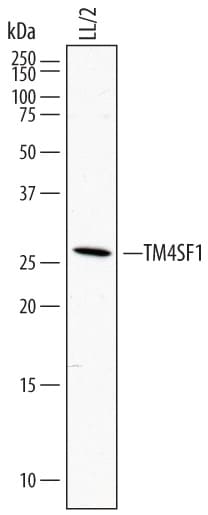
Detection of Mouse TM4SF1 by Western Blot.
Western blot shows lysates of LL/2 mouse Lewis lung carcinoma cell line. PVDF membrane was probed with 1 µg/mL of Sheep Anti-Mouse TM4SF1 Antigen Affinity-purified Polyclonal Antibody (Catalog # AF7514) followed by HRP-conjugated Anti-Sheep IgG Secondary Antibody (HAF016). A specific band was detected for TM4SF1 at approximately 26 kDa (as indicated). This experiment was conducted under reducing conditions and using Immunoblot Buffer Group 1.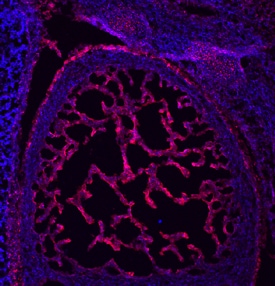
TM4SF1 in Mouse Embryo.
TM4SF1 was detected in immersion fixed frozen sections of mouse embryo (13 d.p.c.) using Sheep Anti-Mouse TM4SF1 Antigen Affinity-purified Polyclonal Antibody (Catalog # AF7514) at 10 µg/mL overnight at 4 °C. Tissue was stained using the NorthernLights™ 557-conjugated Anti-Sheep IgG Secondary Antibody (red;NL010) and counterstained with DAPI (blue). Specific staining was localized to the trabeculae of the developing heart. View our protocol for Fluorescent IHC Staining of Frozen Tissue Sections.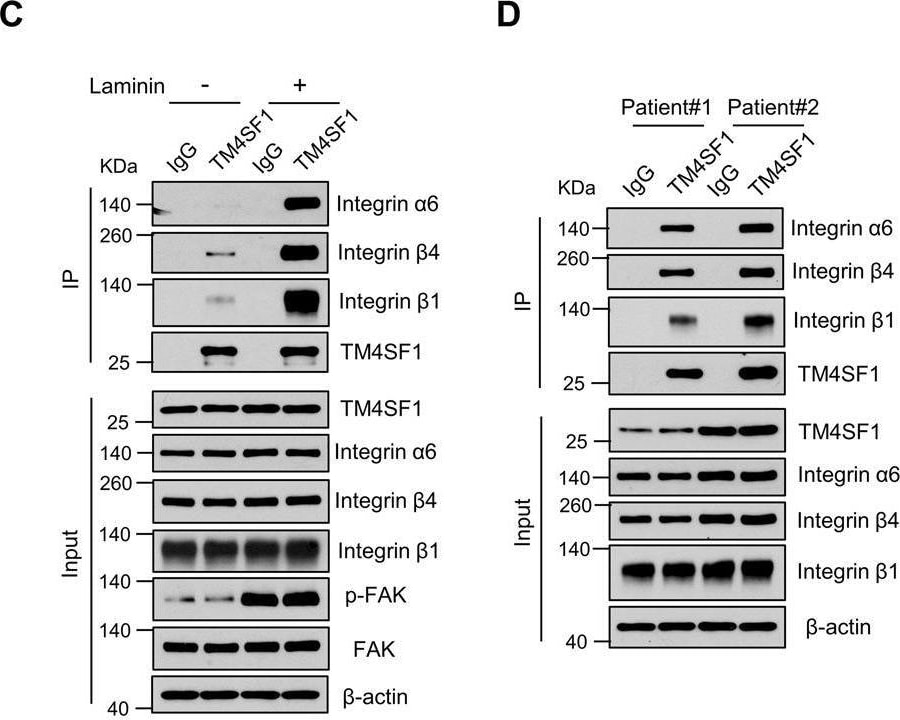
Detection of Human TM4SF1 by Western Blot
Laminin promotes the interaction between TM4SF1 and integrin alpha 6 in Eca109 cells.A Con- and TM4SF1 overexpressed- Eca109 cell lysates (under laminin-coating condition) were immunoblotted by anti-p-FAK, anti-FAK, anti-p-PI3K p85 (Try458), anti- PI3K p85, anti-pAKT, and anti-AKT antibodies. B List of TM4SF1-associated cell membrane proteins in Eca109 cells under laminin-coating condition, identified by mass spectrometric analysis. C Co-IP of endogenous TM4SF1 with endogenous integrin alpha 6, beta 4, and beta 1 in cell lysate. TM4SF1 was immunoprecipitated from Eca109 cells, which were cultured on the dishes with or without laminin-coating, and immunoblotted with antibodies against integrin alpha 6, beta 4, beta 1, and TM4SF1. The input was immunoblotted with antibodies against integrin alpha 6, beta 4, beta 1, p-FAK, FAK, TM4SF1, and beta -actin. D Co-IP of endogenous TM4SF1 with endogenous integrin alpha 6, beta 4, and beta 1 in ESCC patient tissues. TM4SF1 was immunoprecipitated from homogenized ESCC patient tissues lysate and immunoblotted with antibodies against integrin alpha 6, beta 4, beta 1, and TM4SF1. Image collected and cropped by CiteAb from the following open publication (https://pubmed.ncbi.nlm.nih.gov/35835740), licensed under a CC-BY license. Not internally tested by R&D Systems.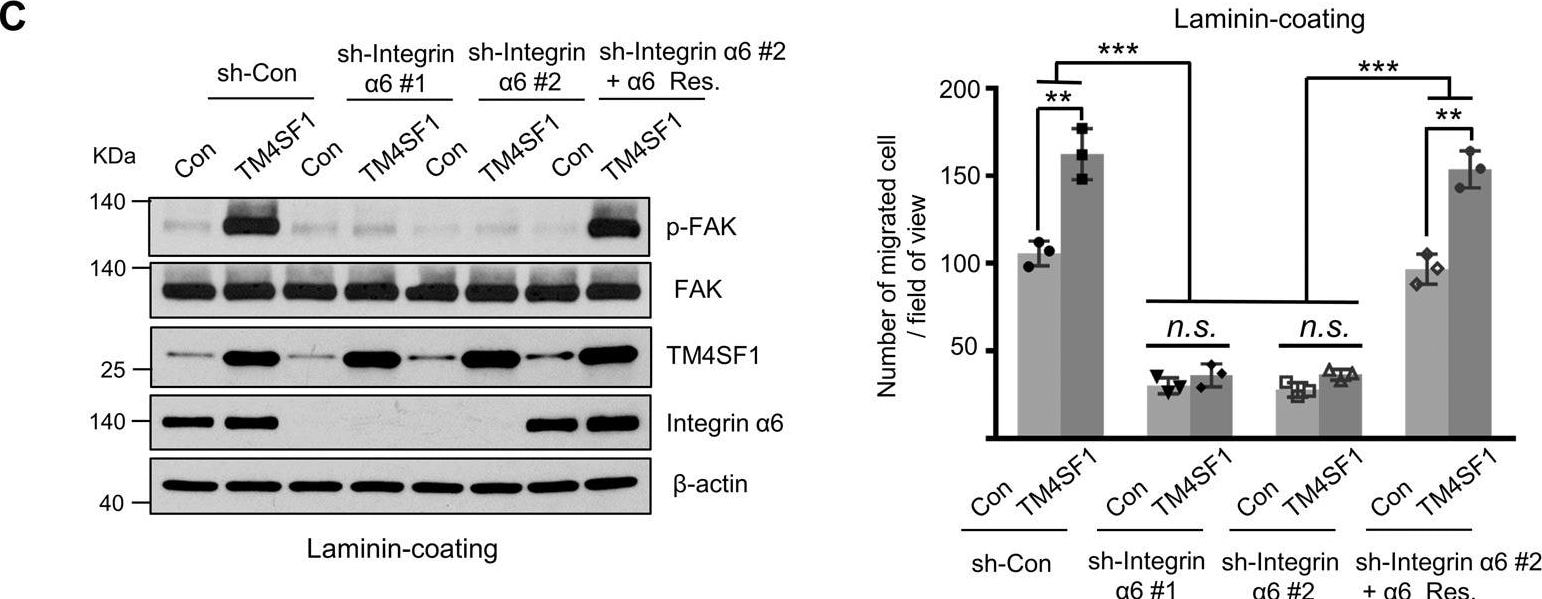
Detection of Human TM4SF1 by Western Blot
The Laminin-TM4SF1-integrin alpha 6-FAK signaling axis mediates ESCC cell migration. A–C Immunoblotting of p-FAK, FAK, TM4SF1, integrin alpha 6, and beta -actin in (left panel) and migration ability of (right panel) TM4SF1-overexpressed, integrin alpha 6-overexpressed, and TM4SF1/integrin alpha 6 double overexpressed Eca109 cells (A), Con-, TM4SF1-knockdown-, related TM4SF1 rescued-, integrin alpha 6- overexpressed, and TM4SF1-rescued/integrin alpha 6- overexpressed KYSE-410 cells (B), and integrin alpha 6-knockdown- and related alpha 6 rescued- Con or TM4SF1 overexpressed Eca109 cells (C) under laminin coating condition (LE: long exposure; SE: short exposure). Representative photos were taken, and then the migrated cells were counted. Statistical significance was determined by a two-tailed unpaired t test. Error bars are means ± s.d. (right panel; n = 3; *P < 0.05; **P < 0.01; ***P < 0.001). D Immunoblotting of p-FAK, FAK, TM4SF1, integrin alpha 6, and beta -actin in (upper panel) and migration ability of (lower panel) TM4SF1-overexpressed, integrin alpha 6-overexpressed, and TM4SF1/integrin alpha 6 double overexpressed KYSE-410 cells pre-treated with or without VS-4718 (1 μM) for 24 h. Representative photos were taken and then the migrated cells were counted. Statistical significance was determined by a two-tailed unpaired t test. Error bars are means ± s.d. (right panel; n = 3; n.s., not statistically significant; *P < 0.05; ***P < 0.001). Image collected and cropped by CiteAb from the following open publication (https://pubmed.ncbi.nlm.nih.gov/35835740), licensed under a CC-BY license. Not internally tested by R&D Systems.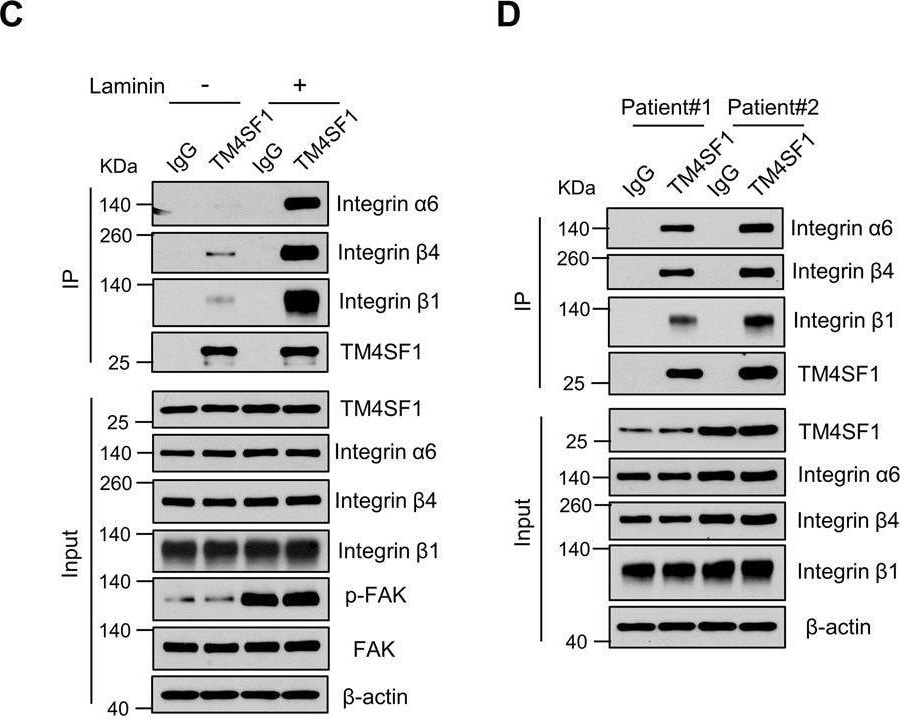
Detection of Human TM4SF1 by Western Blot
Laminin promotes the interaction between TM4SF1 and integrin alpha 6 in Eca109 cells.A Con- and TM4SF1 overexpressed- Eca109 cell lysates (under laminin-coating condition) were immunoblotted by anti-p-FAK, anti-FAK, anti-p-PI3K p85 (Try458), anti- PI3K p85, anti-pAKT, and anti-AKT antibodies. B List of TM4SF1-associated cell membrane proteins in Eca109 cells under laminin-coating condition, identified by mass spectrometric analysis. C Co-IP of endogenous TM4SF1 with endogenous integrin alpha 6, beta 4, and beta 1 in cell lysate. TM4SF1 was immunoprecipitated from Eca109 cells, which were cultured on the dishes with or without laminin-coating, and immunoblotted with antibodies against integrin alpha 6, beta 4, beta 1, and TM4SF1. The input was immunoblotted with antibodies against integrin alpha 6, beta 4, beta 1, p-FAK, FAK, TM4SF1, and beta -actin. D Co-IP of endogenous TM4SF1 with endogenous integrin alpha 6, beta 4, and beta 1 in ESCC patient tissues. TM4SF1 was immunoprecipitated from homogenized ESCC patient tissues lysate and immunoblotted with antibodies against integrin alpha 6, beta 4, beta 1, and TM4SF1. Image collected and cropped by CiteAb from the following open publication (https://pubmed.ncbi.nlm.nih.gov/35835740), licensed under a CC-BY license. Not internally tested by R&D Systems.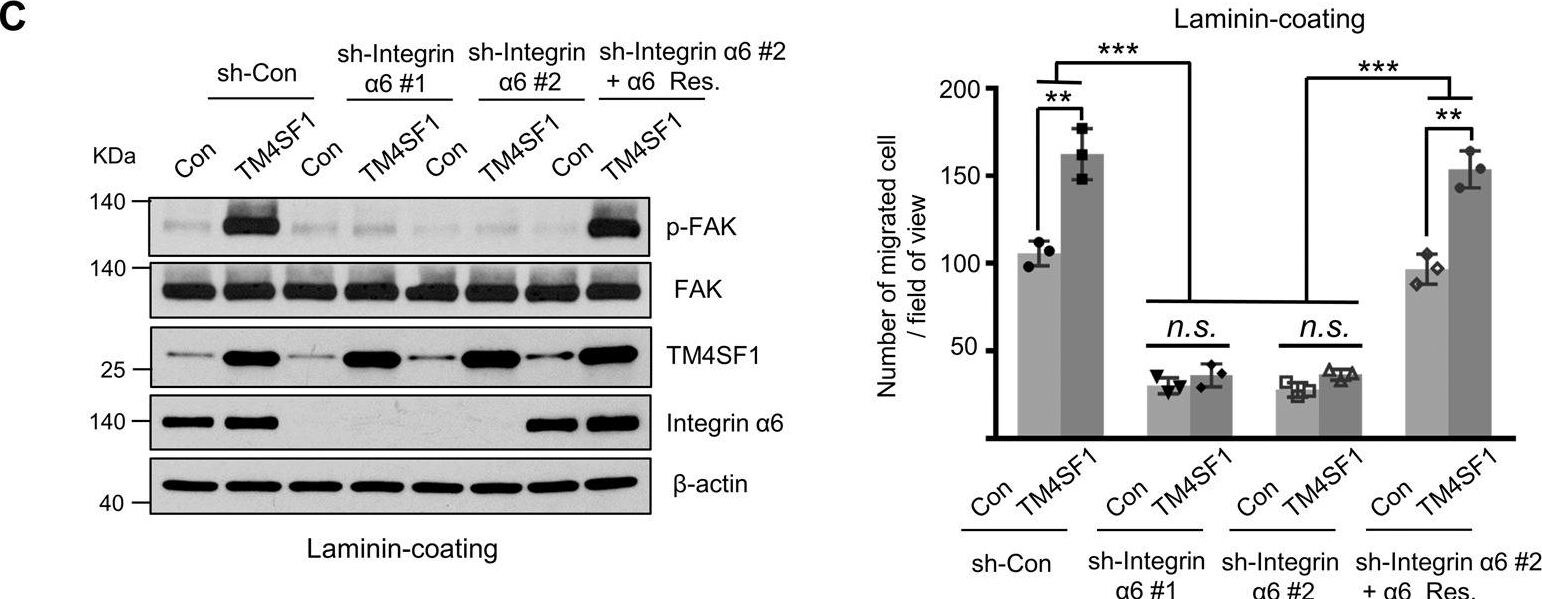
Detection of Human TM4SF1 by Western Blot
The Laminin-TM4SF1-integrin alpha 6-FAK signaling axis mediates ESCC cell migration. A–C Immunoblotting of p-FAK, FAK, TM4SF1, integrin alpha 6, and beta -actin in (left panel) and migration ability of (right panel) TM4SF1-overexpressed, integrin alpha 6-overexpressed, and TM4SF1/integrin alpha 6 double overexpressed Eca109 cells (A), Con-, TM4SF1-knockdown-, related TM4SF1 rescued-, integrin alpha 6- overexpressed, and TM4SF1-rescued/integrin alpha 6- overexpressed KYSE-410 cells (B), and integrin alpha 6-knockdown- and related alpha 6 rescued- Con or TM4SF1 overexpressed Eca109 cells (C) under laminin coating condition (LE: long exposure; SE: short exposure). Representative photos were taken, and then the migrated cells were counted. Statistical significance was determined by a two-tailed unpaired t test. Error bars are means ± s.d. (right panel; n = 3; *P < 0.05; **P < 0.01; ***P < 0.001). D Immunoblotting of p-FAK, FAK, TM4SF1, integrin alpha 6, and beta -actin in (upper panel) and migration ability of (lower panel) TM4SF1-overexpressed, integrin alpha 6-overexpressed, and TM4SF1/integrin alpha 6 double overexpressed KYSE-410 cells pre-treated with or without VS-4718 (1 μM) for 24 h. Representative photos were taken and then the migrated cells were counted. Statistical significance was determined by a two-tailed unpaired t test. Error bars are means ± s.d. (right panel; n = 3; n.s., not statistically significant; *P < 0.05; ***P < 0.001). Image collected and cropped by CiteAb from the following open publication (https://pubmed.ncbi.nlm.nih.gov/35835740), licensed under a CC-BY license. Not internally tested by R&D Systems.Applications for Mouse TM4SF1/L6 Antibody
Immunohistochemistry
Sample: Immersion fixed frozen sections of mouse embryo (13 d.p.c.)
Western Blot
Sample: LL/2 mouse Lewis lung carcinoma cell line
Formulation, Preparation, and Storage
Purification
Reconstitution
Sterile PBS to a final concentration of 0.2 mg/mL. For liquid material, refer to CoA for concentration.
Formulation
Shipping
Stability & Storage
- 12 months from date of receipt, -20 to -70 °C as supplied.
- 1 month, 2 to 8 °C under sterile conditions after reconstitution.
- 6 months, -20 to -70 °C under sterile conditions after reconstitution.
Calculators
Background: TM4SF1/L6
Long Name
Alternate Names
Gene Symbol
UniProt
Additional TM4SF1/L6 Products
Product Documents for Mouse TM4SF1/L6 Antibody
Certificate of Analysis
To download a Certificate of Analysis, please enter a lot or batch number in the search box below.
Note: Certificate of Analysis not available for kit components.
Product Specific Notices for Mouse TM4SF1/L6 Antibody
For research use only
Related Research Areas
Citations for Mouse TM4SF1/L6 Antibody
 Powered by Bioz
Customer Reviews for Mouse TM4SF1/L6 Antibody
There are currently no reviews for this product. Be the first to review Mouse TM4SF1/L6 Antibody and earn rewards!
Have you used Mouse TM4SF1/L6 Antibody?
Submit a review and receive an Amazon gift card!
$25/€18/£15/$25CAN/¥2500 for a review with an image
$10/€7/£6/$10CAN/¥1110 for a review without an image
Submit a review
Protocols
Find general support by application which include: protocols, troubleshooting, illustrated assays, videos and webinars.
- Antigen Retrieval Protocol (PIER)
- Antigen Retrieval for Frozen Sections Protocol
- Appropriate Fixation of IHC/ICC Samples
- Cellular Response to Hypoxia Protocols
- Chromogenic IHC Staining of Formalin-Fixed Paraffin-Embedded (FFPE) Tissue Protocol
- Chromogenic Immunohistochemistry Staining of Frozen Tissue
- ClariTSA™ Fluorophore Kits
- Detection & Visualization of Antibody Binding
- Fluorescent IHC Staining of Frozen Tissue Protocol
- Graphic Protocol for Heat-induced Epitope Retrieval
- Graphic Protocol for the Preparation and Fluorescent IHC Staining of Frozen Tissue Sections
- Graphic Protocol for the Preparation and Fluorescent IHC Staining of Paraffin-embedded Tissue Sections
- Graphic Protocol for the Preparation of Gelatin-coated Slides for Histological Tissue Sections
- IHC Sample Preparation (Frozen sections vs Paraffin)
- Immunofluorescent IHC Staining of Formalin-Fixed Paraffin-Embedded (FFPE) Tissue Protocol
- Immunohistochemistry (IHC) and Immunocytochemistry (ICC) Protocols
- Immunohistochemistry Frozen Troubleshooting
- Immunohistochemistry Paraffin Troubleshooting
- Preparing Samples for IHC/ICC Experiments
- Preventing Non-Specific Staining (Non-Specific Binding)
- Primary Antibody Selection & Optimization
- Protocol for Heat-Induced Epitope Retrieval (HIER)
- Protocol for Making a 4% Formaldehyde Solution in PBS
- Protocol for VisUCyte™ HRP Polymer Detection Reagent
- Protocol for the Preparation & Fixation of Cells on Coverslips
- Protocol for the Preparation and Chromogenic IHC Staining of Frozen Tissue Sections
- Protocol for the Preparation and Chromogenic IHC Staining of Frozen Tissue Sections - Graphic
- Protocol for the Preparation and Chromogenic IHC Staining of Paraffin-embedded Tissue Sections
- Protocol for the Preparation and Chromogenic IHC Staining of Paraffin-embedded Tissue Sections - Graphic
- Protocol for the Preparation and Fluorescent IHC Staining of Frozen Tissue Sections
- Protocol for the Preparation and Fluorescent IHC Staining of Paraffin-embedded Tissue Sections
- Protocol for the Preparation of Gelatin-coated Slides for Histological Tissue Sections
- R&D Systems Quality Control Western Blot Protocol
- TUNEL and Active Caspase-3 Detection by IHC/ICC Protocol
- The Importance of IHC/ICC Controls
- Troubleshooting Guide: Immunohistochemistry
- Troubleshooting Guide: Western Blot Figures
- Western Blot Conditions
- Western Blot Protocol
- Western Blot Protocol for Cell Lysates
- Western Blot Troubleshooting
- Western Blot Troubleshooting Guide
- View all Protocols, Troubleshooting, Illustrated assays and Webinars