
Uromodulin (also Tamm-Horsfall glycoprotein or THP) is a 105‑120 kDa urinary glycoprotein. It is secreted by renal tubule epithelium, acts as a binding protein for IL‑1, TNF-alpha and C1q, activates resting monocytes, and promotes neutrophil phagocytosis. Uromodulin forms high molecular weight oligomers that line the kidney tubules. Mouse Uromodulin is GPI-linked. Its proprecursor is 619 amino acids (aa) in length. It contains three EGF-like domains (aa 28‑148), a ZP domain that mediates oligomerization (aa 335‑590), and a cleavable C-terminal propeptide (aa 619‑642). There are multiple splice variants. One shows an alternate start site at Met343, and there are two substitutions, a 17 aa substitution for aa 601‑642, and a 166 aa substitution for aa 441‑642. Over aa 25‑618, mouse Uromodulin shares 78% and 89% aa identical to human and rat Uromodulin, respectively.
Mouse Uromodulin Antibody
R&D Systems | Catalog # AF5175


Key Product Details
Validated by
Biological Validation
Species Reactivity
Validated:
Mouse
Cited:
Mouse, Rat, Transgenic Mouse
Applications
Validated:
Immunohistochemistry, Western Blot, Simple Western
Cited:
Immunohistochemistry, Western Blot, Immunocytochemistry
Label
Unconjugated
Antibody Source
Polyclonal Sheep IgG
Loading...
Product Specifications
Immunogen
Mouse myeloma cell line NS0-derived recombinant mouse Uromodulin
Ser24-Ala618
Accession # Q91X17
Ser24-Ala618
Accession # Q91X17
Specificity
Detects mouse Uromodulin in direct ELISAs and Western blots.
Clonality
Polyclonal
Host
Sheep
Isotype
IgG
Scientific Data Images for Mouse Uromodulin Antibody
Detection of Mouse Uromodulin by Western Blot.
Western blot shows lysates of mouse kidney tissue. PVDF membrane was probed with 1 µg/mL of Sheep Anti-Mouse Uromodulin Antigen Affinity-purified Polyclonal Antibody (Catalog # AF5175) followed by HRP-conjugated Anti-Sheep IgG Secondary Antibody (HAF016). A specific band was detected for Uromodulin at approximately 115 kDa (as indicated). This experiment was conducted under reducing conditions and using Immunoblot Buffer Group 8.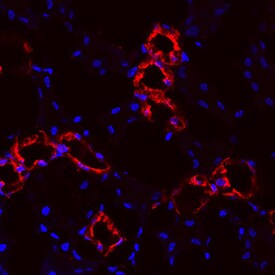
Uromodulin in Mouse Kidney.
Uromodulin was detected in immersion fixed frozen sections of mouse kidney using Sheep Anti-Mouse Uromodulin Antigen Affinity-purified Polyclonal Antibody (Catalog # AF5175) at 10 µg/mL overnight at 4 °C. Tissue was stained using the NorthernLights™ 557-conjugated Anti-Sheep IgG Secondary Antibody (red; NL010) and counterstained with DAPI (blue). Specific staining was localized to convoluted tubule epithelial cells. View our protocol for Fluorescent IHC Staining of Frozen Tissue Sections.
Detection of Mouse Uromodulin by Simple WesternTM.
Simple Western shows lysates of mouse kidney, loaded at 0.5 mg/ml. A specific band was detected for Uromodulin at approximately 182 kDa (as indicated) using 20 µg/mL of Sheep Anti-Mouse Uromodulin Antigen Affinity-purified Polyclonal Antibody (Catalog # AF5175). This experiment was conducted under reducing conditions and using the 12-230kDa separation system.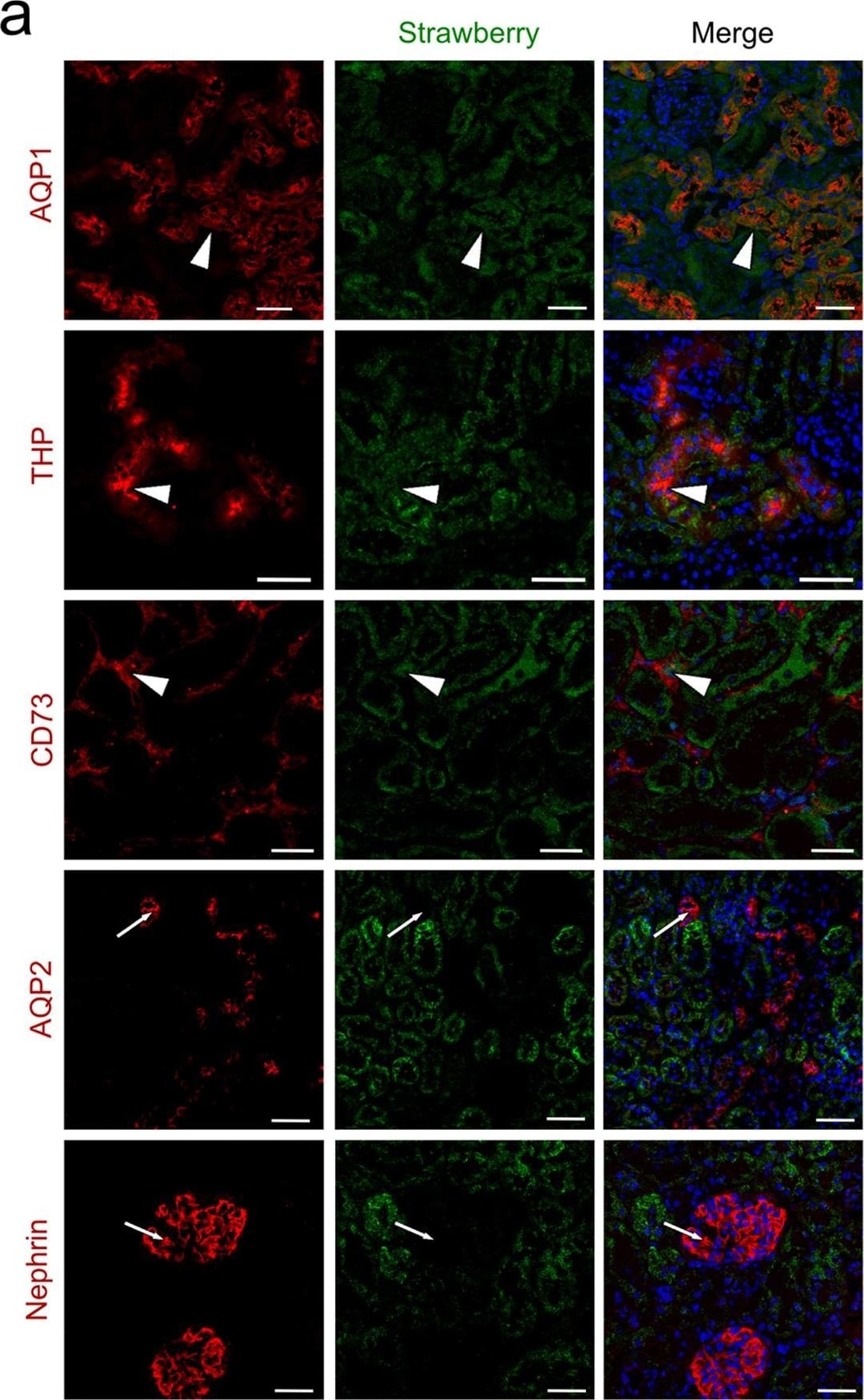
Detection of Mouse Uromodulin by Immunocytochemistry/Immunofluorescence
Intraparenchymal delivery of lentiviral vectors preferentially infects epithelial cells of both kidneys and urinary bladder.(a) Confocal images of Strawberry expression in renal sections of ELS infected kidneys 60 days post injection. Sections were stained with the indicated antibodies and merged images with DAPI (blue) are presented. Preferential transduction was observed in proximal (AQP1) and distal (THP) renal tubular epithelial cells and renal fibroblasts (CD73) (white arrowheads). Strawberry was not localised to collecting ducts (AQP2) or podocytes (Nephrin) (white arrows). Scale bars, 50 μm. (b) Confocal images of Strawberry expression in the liver, spleen, lung, urinary bladder and left and right kidney of ELS infected animals 60 days post left intrarenal injection (top panels) and uninjected control animals (bottom panels). Sections were stained with an antibody against Strawberry (green) and merged images with DAPI (blue) are presented. Scale bars, 50 μm. Image collected and cropped by CiteAb from the following publication (https://pubmed.ncbi.nlm.nih.gov/26046460), licensed under a CC-BY license. Not internally tested by R&D Systems.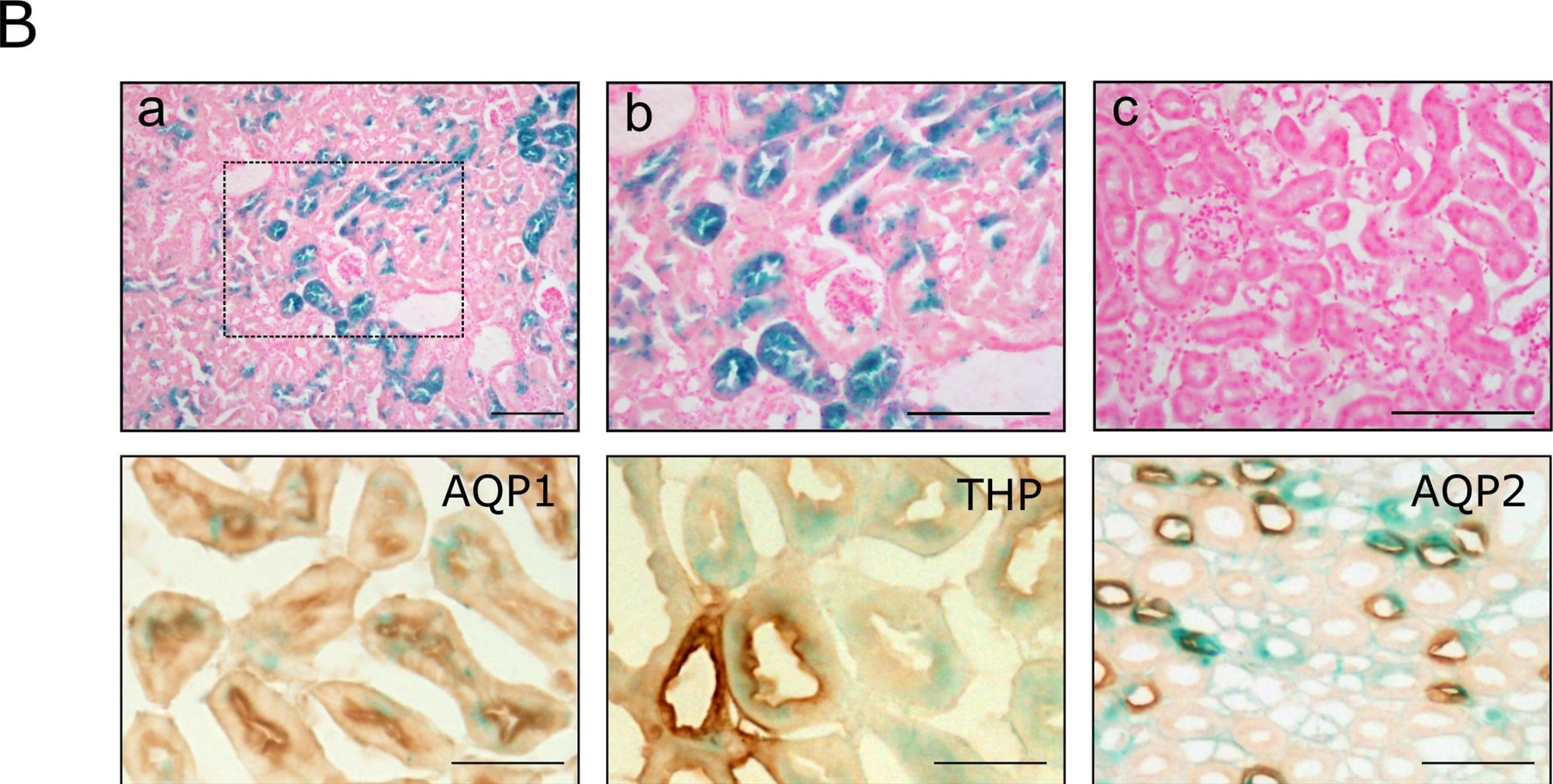
Detection of Mouse Uromodulin by Immunohistochemistry
Pax8-CreERT2 mediated beta -galactosidase expression.(A) Enzymatic X-gal staining of cryosections of kidneys (top panels) derived from 10 week old Pax8-CreERT2/Rosa26R mice either induced with tamoxifen (a, renal parenchyma; b, collecting ducts) or uninduced (c). Tamoxifen administration did not induce beta -galactosidase expression in any of the other major organs examined (representative tissues presented in bottom panels). (B) beta -galactosidase positivity was exclusively found in the tubular epithelium of the kidney of tamoxifen treated mice, with no staining observed in glomeruli or bloods vessels (a, framed area is shown enlarged in b). Kidneys from vehicle treated mice were negative (c). Co-localisation studies revealed X-gal expression within tubules of all renal tubular compartment (proximal tubules—AQP1, distal tubules–THP and collecting ducts–AQP2). Scale bars, 100μm. Image collected and cropped by CiteAb from the following publication (https://pubmed.ncbi.nlm.nih.gov/26866916), licensed under a CC-BY license. Not internally tested by R&D Systems.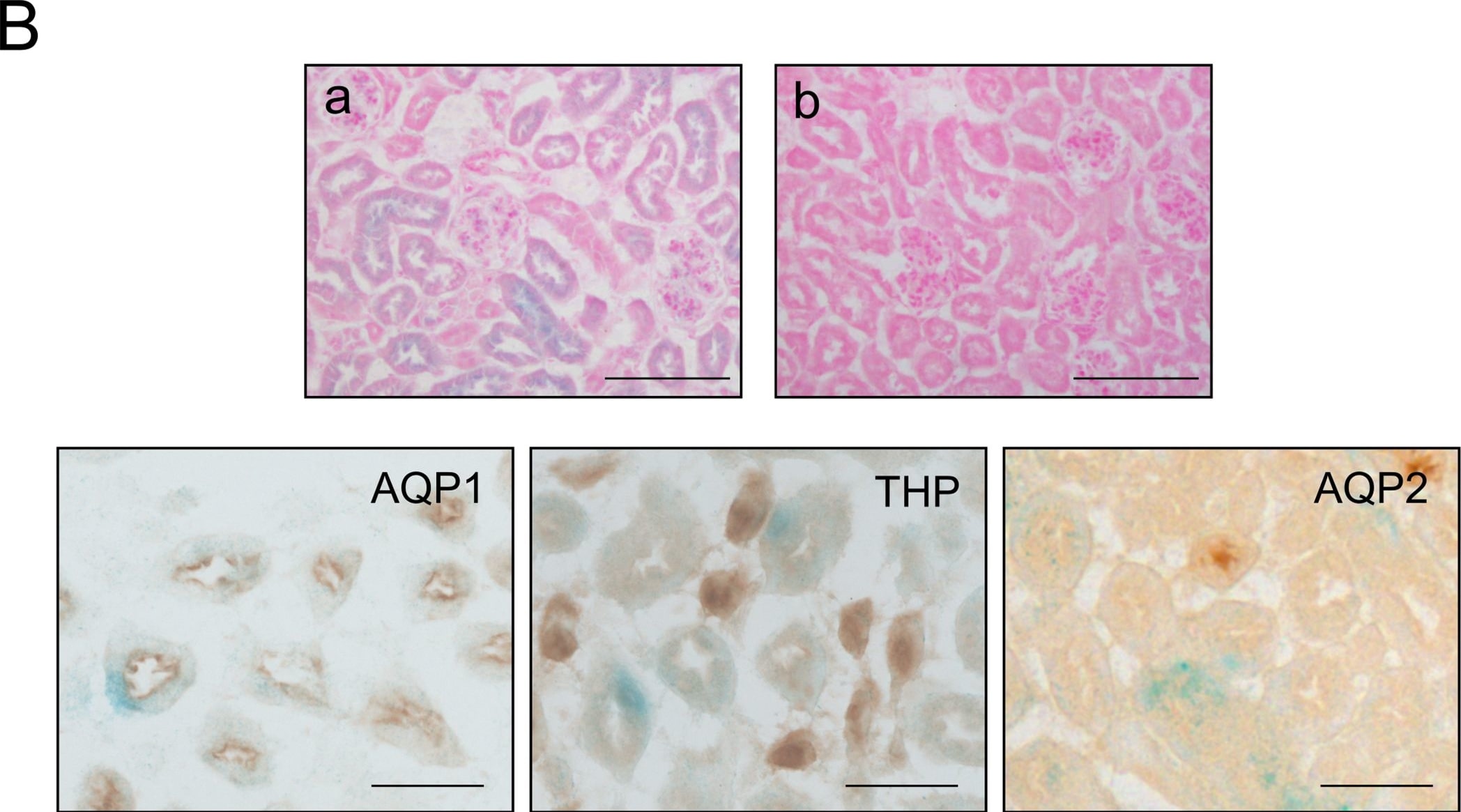
Detection of Mouse Uromodulin by Immunohistochemistry
Slc22a6-CreERT2 mediated beta -galactosidase expression.(A) Enzymatic X-gal staining of cryosections of kidneys (top panels) derived from 10 week old Slc22a6-CreERT2/Rosa26R mice either induced with tamoxifen (a, renal cortex; b, medulla) or uninduced (c, renal cortex). Tamoxifen administration did not induce beta -galactosidase expression in any of the other major organs examined (representative tissues presented in bottom panels). (B) beta -galactosidase positivity was exclusively found in the tubular epithelium of the kidney of tamoxifen treated mice (a); kidneys from vehicle treated mice were negative (b). Co-localisation studies revealed specific X-gal expression within proximal tubular epithelium (AQP1) with no expression detected in distal tubules (THP) or collecting ducts (AQP2). Scale bars, 100μm. Image collected and cropped by CiteAb from the following publication (https://pubmed.ncbi.nlm.nih.gov/26866916), licensed under a CC-BY license. Not internally tested by R&D Systems.Applications for Mouse Uromodulin Antibody
Application
Recommended Usage
Immunohistochemistry
5-15 µg/mL
Sample: Immersion fixed frozen sections of mouse kidney
Sample: Immersion fixed frozen sections of mouse kidney
Simple Western
20 µg/mL
Sample: Mouse kidney tissue
Sample: Mouse kidney tissue
Western Blot
1 µg/mL
Sample: Mouse kidney tissue
Sample: Mouse kidney tissue
Formulation, Preparation, and Storage
Purification
Antigen Affinity-purified
Reconstitution
Reconstitute at 0.2 mg/mL in sterile PBS. For liquid material, refer to CoA for concentration.
Loading...
Formulation
Lyophilized from a 0.2 μm filtered solution in PBS with Trehalose. See Certificate of Analysis for details.<br/>*Small pack size (-SP) is supplied either lyophilized or as a 0.2 µm filtered solution in PBS.
Shipping
Lyophilized product is shipped at ambient temperature. Liquid small pack size (-SP) is shipped with polar packs. Upon receipt, store immediately at the temperature recommended below.
Stability & Storage
Use a manual defrost freezer and avoid repeated freeze-thaw cycles.
- 12 months from date of receipt, -20 to -70 °C as supplied.
- 1 month, 2 to 8 °C under sterile conditions after reconstitution.
- 6 months, -20 to -70 °C under sterile conditions after reconstitution.
Calculators
Background: Uromodulin
Alternate Names
ADMCKD2, FJHN, HNFJ, MCKD2, THGP, THP, UMOD, Uromucoid
Gene Symbol
UMOD
UniProt
Additional Uromodulin Products
Product Documents for Mouse Uromodulin Antibody
Certificate of Analysis
To download a Certificate of Analysis, please enter a lot or batch number in the search box below.
Note: Certificate of Analysis not available for kit components.
Product Specific Notices for Mouse Uromodulin Antibody
For research use only
Citations for Mouse Uromodulin Antibody
 Powered by Bioz
Customer Reviews for Mouse Uromodulin Antibody
There are currently no reviews for this product. Be the first to review Mouse Uromodulin Antibody and earn rewards!
Have you used Mouse Uromodulin Antibody?
Submit a review and receive an Amazon gift card!
$25/€18/£15/$25CAN/¥2500 for a review with an image
$10/€7/£6/$10CAN/¥1110 for a review without an image
Submit a review
Protocols
Find general support by application which include: protocols, troubleshooting, illustrated assays, videos and webinars.
- Antigen Retrieval Protocol (PIER)
- Antigen Retrieval for Frozen Sections Protocol
- Appropriate Fixation of IHC/ICC Samples
- Cellular Response to Hypoxia Protocols
- Chromogenic IHC Staining of Formalin-Fixed Paraffin-Embedded (FFPE) Tissue Protocol
- Chromogenic Immunohistochemistry Staining of Frozen Tissue
- ClariTSA™ Fluorophore Kits
- Detection & Visualization of Antibody Binding
- Fluorescent IHC Staining of Frozen Tissue Protocol
- Graphic Protocol for Heat-induced Epitope Retrieval
- Graphic Protocol for the Preparation and Fluorescent IHC Staining of Frozen Tissue Sections
- Graphic Protocol for the Preparation and Fluorescent IHC Staining of Paraffin-embedded Tissue Sections
- Graphic Protocol for the Preparation of Gelatin-coated Slides for Histological Tissue Sections
- IHC Sample Preparation (Frozen sections vs Paraffin)
- Immunofluorescent IHC Staining of Formalin-Fixed Paraffin-Embedded (FFPE) Tissue Protocol
- Immunohistochemistry (IHC) and Immunocytochemistry (ICC) Protocols
- Immunohistochemistry Frozen Troubleshooting
- Immunohistochemistry Paraffin Troubleshooting
- Preparing Samples for IHC/ICC Experiments
- Preventing Non-Specific Staining (Non-Specific Binding)
- Primary Antibody Selection & Optimization
- Protocol for Heat-Induced Epitope Retrieval (HIER)
- Protocol for Making a 4% Formaldehyde Solution in PBS
- Protocol for VisUCyte™ HRP Polymer Detection Reagent
- Protocol for the Preparation & Fixation of Cells on Coverslips
- Protocol for the Preparation and Chromogenic IHC Staining of Frozen Tissue Sections
- Protocol for the Preparation and Chromogenic IHC Staining of Frozen Tissue Sections - Graphic
- Protocol for the Preparation and Chromogenic IHC Staining of Paraffin-embedded Tissue Sections
- Protocol for the Preparation and Chromogenic IHC Staining of Paraffin-embedded Tissue Sections - Graphic
- Protocol for the Preparation and Fluorescent IHC Staining of Frozen Tissue Sections
- Protocol for the Preparation and Fluorescent IHC Staining of Paraffin-embedded Tissue Sections
- Protocol for the Preparation of Gelatin-coated Slides for Histological Tissue Sections
- R&D Systems Quality Control Western Blot Protocol
- TUNEL and Active Caspase-3 Detection by IHC/ICC Protocol
- The Importance of IHC/ICC Controls
- Troubleshooting Guide: Immunohistochemistry
- Troubleshooting Guide: Western Blot Figures
- Western Blot Conditions
- Western Blot Protocol
- Western Blot Protocol for Cell Lysates
- Western Blot Troubleshooting
- Western Blot Troubleshooting Guide
- View all Protocols, Troubleshooting, Illustrated assays and Webinars
Loading...