Key Product Details

Validated by

Biological Validation

Species Reactivity

Validated:

Mouse

Cited:

Mouse

Applications

Validated:

Western Blot, Simple Western

Cited:

Immunohistochemistry, Western Blot

Label

Unconjugated

Antibody Source

Monoclonal Rat IgG1 Clone # 112702
Loading...

Product Specifications

Immunogen

Mouse myeloma cell line NS0-derived recombinant mouse VCAM-1
Phe25-Glu698
Accession # P29533

Specificity

Detects mouse VCAM-1 in direct ELISAs and Western blots. Does not cross-react with recombinant human (rh) VCAM-1, rmICAM-1, rhICAM-2, rmICAM-2, rhICAM-3, or rhPECAM.

Clonality

Monoclonal

Host

Rat

Isotype

IgG1

Scientific Data Images for Mouse VCAM‑1/CD106 Antibody

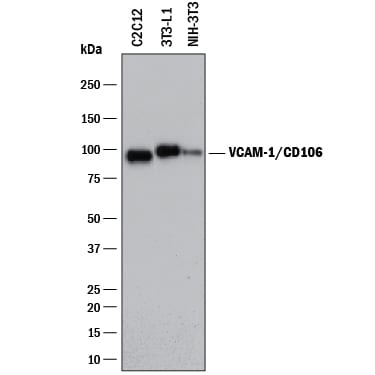
Detection of Mouse VCAM-1/CD106 antibody by Western Blot.

Detection of Mouse VCAM‑1/CD106 by Western Blot.

Western blot shows lysates of 3T3-L1 mouse embryonic fibroblast adipose-like cell line, C2C12 mouse myoblast cell line, and NIH-3T3 mouse embryonic fibroblast cell line. PVDF membrane was probed with 2 µg/mL of Rat Anti-Mouse VCAM-1/CD106 Monoclonal Antibody (Catalog # MAB6434) followed by HRP-conjugated Anti-Rat IgG Secondary Antibody (Catalog # HAF005). A specific band was detected for VCAM-1/ CD106 at approximately 95 kDa (as indicated). This experiment was conducted under reducing conditions and using Immunoblot Buffer Group 1.

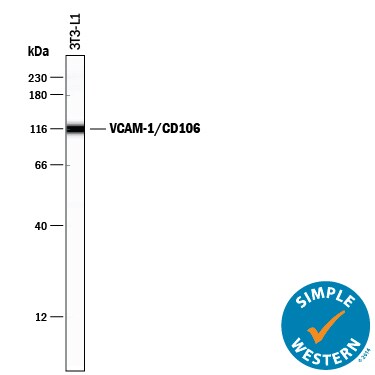
Detection of Mouse VCAM-1/CD106 antibody by Simple WesternTM.

Detection of Mouse VCAM‑1/CD106 by Simple WesternTM.

Simple Western lane view shows lysate of 3T3-L1 mouse embryonic fibroblast adipose-like cell line, loaded at 0.2 mg/mL. A specific band was detected for VCAM-1/CD106 at approximately 117 kDa (as indicated) using 100 µg/mL of Rat Anti-Mouse VCAM-1/CD106 Monoclonal Antibody (Catalog # MAB6434) followed by 1:50 dilution of HRP-conjugated Anti-Rat IgG Secondary Antibody (Catalog # HAF005). This experiment was conducted under reducing conditions and using the 12-230 kDa separation system.

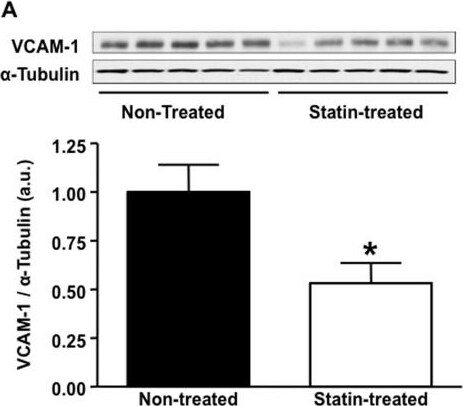
Detection of Mouse VCAM-1/CD106 by Western Blot

Detection of Mouse VCAM-1/CD106 by Western Blot

Effect of statin treatment on aortic expression of VCAM-1.(A) VCAM-1 protein expression in the ascending aorta assessed by Western blot in non-treated (lanes 1–5) versus statin treated (lanes 6–10) animals, n = 5 per group, *p<0.01 vs non-treated animals. Representative examples of fluorescent immunohistochemistry images of the base of the aorta demonstrating endothelial VCAM-1 expression (red fluorescence) in a non-treated animal (B) and a statin treated animal (C), the green fluorescence is autofluorescence delineating vessel anatomy. Image collected and cropped by CiteAb from the following publication (https://pubmed.ncbi.nlm.nih.gov/23554922), licensed under a CC-BY license. Not internally tested by R&D Systems.

Applications for Mouse VCAM‑1/CD106 Antibody

Application
Recommended Usage

Simple Western

100 µg/mL
Sample: C2C12 mouse myoblast cell line, 3T3‑L1 mouse embryonic fibroblast adipose-like cell line, and NIH‑3T3 mouse embryonic fibroblast cell line

Western Blot

2 µg/mL
Sample: 3T3‑L1 mouse embryonic fibroblast adipose-like cell line, C2C12 mouse myoblast cell line, and NIH‑3T3 mouse embryonic fibroblast cell line

Formulation, Preparation, and Storage

Purification

Protein A or G purified from hybridoma culture supernatant

Reconstitution

Reconstitute at 0.5 mg/mL in sterile PBS. For liquid material, refer to CoA for concentration.


Loading...

Formulation

Lyophilized from a 0.2 μm filtered solution in PBS with Trehalose. *Small pack size (SP) is supplied either lyophilized or as a 0.2 µm filtered solution in PBS.

Shipping

Lyophilized product is shipped at ambient temperature. Liquid small pack size (-SP) is shipped with polar packs. Upon receipt, store immediately at the temperature recommended below.

Stability & Storage

Use a manual defrost freezer and avoid repeated freeze-thaw cycles.
  • 12 months from date of receipt, -20 to -70 °C as supplied.
  • 1 month, 2 to 8 °C under sterile conditions after reconstitution.
  • 6 months, -20 to -70 °C under sterile conditions after reconstitution.

Calculators

The reconstitution calculator allows you to quickly calculate the volume of a reagent to reconstitute your vial. Simply enter the mass of reagent and the target concentration and the calculator will determine the rest.

=
÷

Background: VCAM-1/CD106

VCAM-1 (CD106), a member of the immunoglobulin superfamily, is a cell surface protein expressed by activated endothelial cells and certain leukocytes (such as macrophages). VCAM-1 expression is induced by IL-1 beta, IL-4, TNF-alpha, and IFN-gamma. VCAM-1 binds to leukocyte integrins VLA-4 and alpha 4 beta 7. The human and mouse VCAM-1 proteins share approximately 76% amino acid similarity.

During the inflammatory adhesion mechanism, activated integrins halt rolling leukocytes and attach them firmly to the vascular endothelium. They do this by binding to their ligands, for example VCAM-1, on endothelium. The VCAM-1: VLA-4/ alpha 4 beta 7 interaction is also thought to be involved in the extravasation of white blood cells through the blood vessel wall to sites of inflammation.

ELISA techniques have shown that detectable levels of soluble VCAM-1 are present in the biological fluids of apparently normal individuals. Furthermore, a number of studies have reported that levels of VCAM-1 may be elevated or lowered in subjects with a variety of pathological conditions.

Long Name

Vascular Cell Adhesion Molecule 1

Alternate Names

CD106, VCAM1

Entrez Gene IDs

7412 (Human); 22329 (Mouse)

Gene Symbol

VCAM1

UniProt

Additional VCAM-1/CD106 Products

Product Documents for Mouse VCAM‑1/CD106 Antibody

Certificate of Analysis

To download a Certificate of Analysis, please enter a lot or batch number in the search box below.

Note: Certificate of Analysis not available for kit components.

Product Specific Notices for Mouse VCAM‑1/CD106 Antibody

For research use only

Citations for Mouse VCAM‑1/CD106 Antibody

Customer Reviews for Mouse VCAM‑1/CD106 Antibody

There are currently no reviews for this product. Be the first to review Mouse VCAM‑1/CD106 Antibody and earn rewards!

Have you used Mouse VCAM‑1/CD106 Antibody?

Submit a review and receive an Amazon gift card!

$25/€18/£15/$25CAN/¥2500 Yen for a review with an image

$10/€7/£6/$10CAN/¥1110 Yen for a review without an image

Submit a review
Amazon Gift Card

FAQs

No product specific FAQs exist for this product.

View all FAQs for Antibodies