
CD44 is a ubiquitously expressed protein that is the major receptor for hyaluronan and exerts control over cell growth and migration (1-5). Rat CD44 has a 21 amino acid (aa) signal sequence, an extracellular domain (ECD) with a 100 aa hyaluronan‑binding disulfide-stabilized link region and a 48‑463 aa stem region, a 21 aa transmembrane domain, and a 72 aa cytoplasmic domain. Within the stem, ten variably spliced exons (v1-10, exons 6‑15) produce multiple protein isoforms (1-5). The standard or hematopoietic form, CD44H, does not include the variable segments (1-5). Cancer aggressiveness and T cell activation have been correlated with expression of specific isoforms (2, 4). With variable N- and O-glycosylation and splicing within the stalk, CD44 can range from 80 to 200 kDa (1, 2). Within the ECD of CD44H, rat CD44 (aa 23‑271) shares 90%, 73%, 72%, 75% and 70% identity with corresponding mouse, human, equine, canine and bovine CD44, respectively. The many reported functions of CD44 fall within three categories (1, 2). First, CD44 binds hyaluronan and other ligands within the extracellular matrix and can function as a “platform” for growth factors and metalloproteinases. Second, CD44 is a co-receptor that modifies activity of receptors including MET and the ErbB family of tyrosine kinases. Third, the CD44 intracellular domain links the plasma membrane to the actin cytoskeleton via the ERM proteins, ezrin, radixin and moesin. CD44 can be synthesized in a soluble form (4) or may be cleaved at multiple sites by either membrane-type matrix metalloproteinases, or ADAM proteases to produce soluble ectodomains (6, 7). The cellular portion may then undergo gamma secretase-dependent intramembrane cleavage to form an A beta ‑like transmembrane portion and a cytoplasmic signaling portion that affects gene expression (8, 9). These cleavage events are thought to promote metastasis by enhancing tumor cell motility and growth (1, 2, 6).

Scientific images may be resized, cropped, or adjusted for brightness or contrast for presentation purposes. These updates are limited to presentation and do not affect the underlying scientific interpretation of the data. Where available, additional source data may be provided upon request.
Key Product Details
Species Reactivity
Validated:
Cited:
Applications
Validated:
Cited:
Label
Antibody Source
Product Specifications
Immunogen
Gln22-Glu271
Accession # O70509
Specificity
Clonality
Host
Isotype
Scientific Data Images for Rat CD44 Antibody
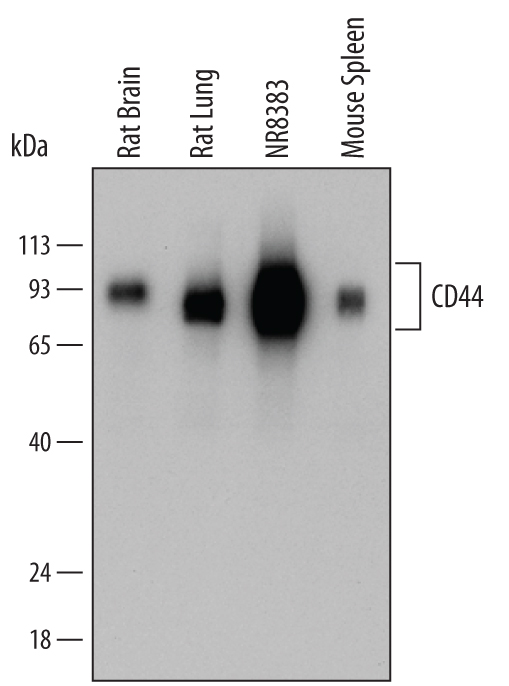
Detection of Mouse and Rat CD44 by Western Blot.
Western blot shows lysates of rat brain tissue, rat lung tissue, NR8383 rat alveolar macrophage cell line, and mouse spleen tissue. PVDF membrane was probed with 0.1 µg/mL of Sheep Anti-Rat CD44 Antigen Affinity-purified Polyclonal Antibody (Catalog # AF6577) followed by HRP-conjugated Anti-Sheep IgG Secondary Antibody (Catalog # HAF016). Specific bands were detected for CD44 at approximately 80-100 kDa (as indicated). This experiment was conducted under reducing conditions and using Immunoblot Buffer Group 1.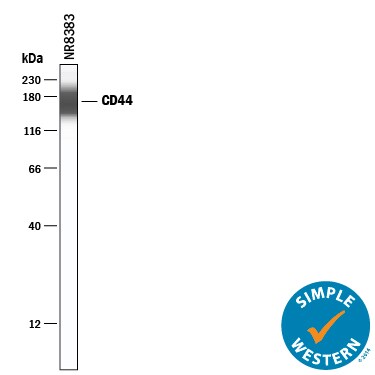
Detection of Rat CD44 by Simple WesternTM.
Simple Western lane view shows lysates of NR8383 rat alveolar macrophage cell line, loaded at 0.2 mg/mL. A specific band was detected for CD44 at approximately 169 kDa (as indicated) using 10 µg/mL of Sheep Anti-Rat CD44 Antigen Affinity-purified Polyclonal Antibody (Catalog # AF6577) followed by 1:50 dilution of HRP-conjugated Anti-Sheep IgG Secondary Antibody (Catalog # HAF016). This experiment was conducted under reducing conditions and using the 12-230 kDa separation system.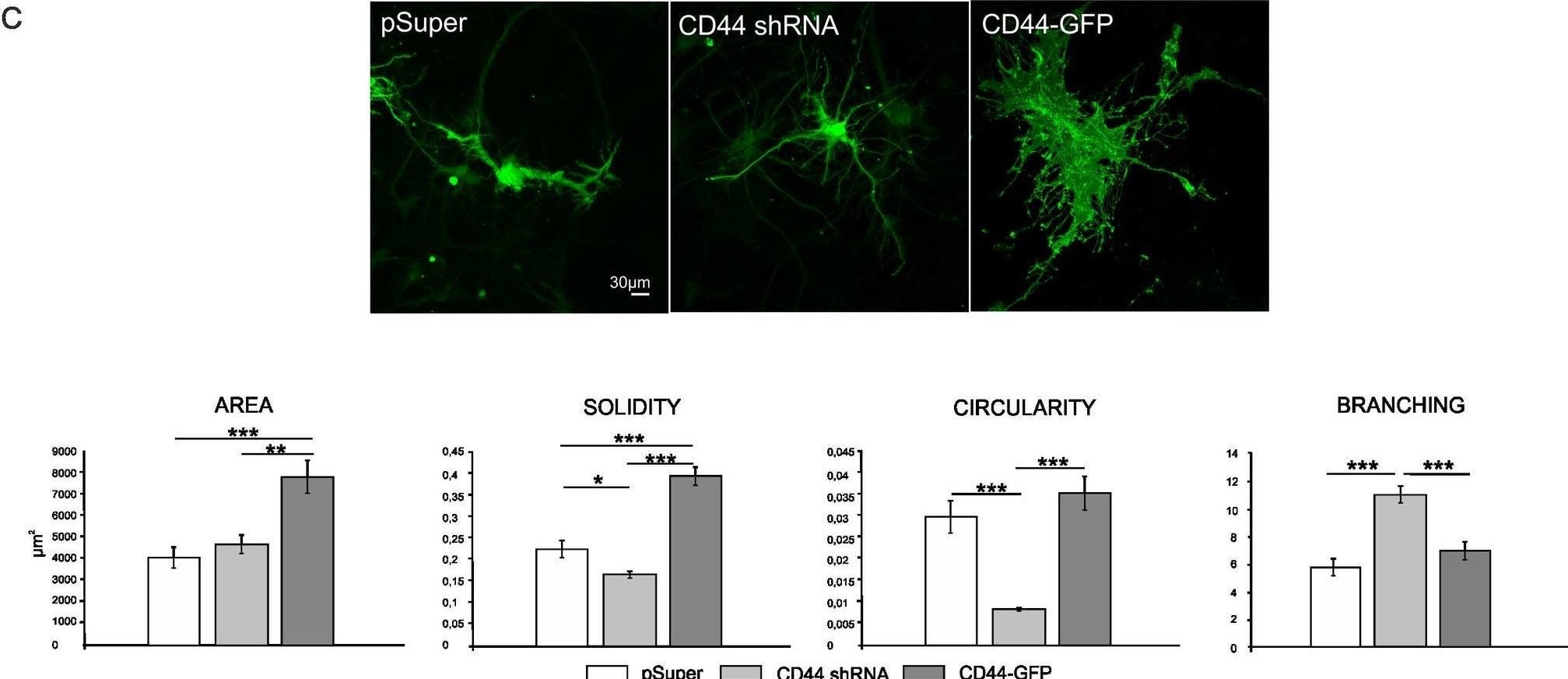
Detection of CD44 by Immunocytochemistry/ Immunofluorescence
CD44 regulates astrocyte morphology. A: Validation of CD44shRNA and CD44-GFP constructs. Astrocytes were transfected with pSuper, CD44shRNA or CD44-GFP constructs (together with beta -actin-GFP plasmid) and then immunostained with anti-CD44 antibody (red). The level of CD44 expression was evaluated by measuring CD44 immunofluorescence (IF) signal intensity with the use of ImageJ program. One way ANOVA, F(2.71) = 71.187, p<0.001, Dunnett C post hoc tests. Scale: 30 μm. B: Morphological analysis of shape-describing parameters of astrocytes in 2D cultures co-transfected with pSuper, CD44shRNA or CD44shRNA/CD44Rescue constructs together with beta -actin-GFP plasmid. One way ANOVA test was performed, area: F(3.150) = 8.169; p<0.001, solidity: F(3.153) = 21.454; p<0.001, circularity: F(3.153) = 18.873; p<0.001, Dunnett’s C post hoc tests, branching: F(3.151) = 33,478; p<0.001, Sidak post hoc test. Scale: 30 μm. C: The morphological analysis of shape-describing parameters of astrocytes in 3D cultures transfected with pSuper or CD44shRNA constructs (together with beta -actin-GFP plasmid) or CD44-GFP. One way ANOVA test was performed, area: F(2.92) = 12.311; p<0.001, Sidak post hoc test; solidity: F(2.95) = 42.208; p<0.001, Dunnett’s C post hoc test, circularity: F(2.94) = 20.609; p<0.001, Dunnett’s C post hoc test, branching: F(2.95) = 17.703; p<0.001, Sidak post hoc test. Scale: 30 μm. Image collected and cropped by CiteAb from the following open publication (https://pubmed.ncbi.nlm.nih.gov/27163367), licensed under a CC-BY license. Not internally tested by R&D Systems.Applications for Rat CD44 Antibody
Simple Western
Sample: NR8383 rat alveolar macrophage cell line
Western Blot
Sample: Rat brain tissue, rat lung tissue, NR8383 rat alveolar macrophage cell line, and mouse spleen tissue
Formulation, Preparation, and Storage
Purification
Reconstitution
Sterile PBS to a final concentration of 0.2 mg/mL. For liquid material, refer to CoA for concentration.
Formulation
Shipping
Stability & Storage
- 12 months from date of receipt, -20 to -70 °C as supplied.
- 1 month, 2 to 8 °C under sterile conditions after reconstitution.
- 6 months, -20 to -70 °C under sterile conditions after reconstitution.
Calculators
Background: CD44
References
- Pure, E. and R.K. Assoian (2009) Cell. Signal. 21:651.
- Ponta, H. et al. (2003) Nat. Rev. Mol. Cell Biol. 4:33.
- Screaton, G.R. et al. (1992) Proc. Natl. Acad. Sci. USA 89:12160.
- Lynch, K.W. (2004) Nat. Rev. Immunol. 4:931.
- Yu, Q. and B.P. Toole (1996) J. Biol. Chem. 271:20603.
- Nagano, O. and H. Saya (2004) Cancer Sci. 95:930.
- Nakamura, H. et al. (2004) Cancer Res. 64:876.
- Murakami, D. et al. (2003) Oncogene 22:1511.
- Lammich, S. et al. (2002) J. Biol. Chem. 277:44754.
Alternate Names
Gene Symbol
UniProt
Additional CD44 Products
Product Documents for Rat CD44 Antibody
Certificate of Analysis
To download a Certificate of Analysis, please enter a lot or batch number in the search box below.
Note: Certificate of Analysis not available for kit components.
Product Specific Notices for Rat CD44 Antibody
For research use only
Related Research Areas
Citations for Rat CD44 Antibody
 Powered by Bioz
Customer Reviews for Rat CD44 Antibody
There are currently no reviews for this product. Be the first to review Rat CD44 Antibody and earn rewards!
Have you used Rat CD44 Antibody?
Submit a review and receive an Amazon gift card!
$25/€18/£15/$25CAN/¥2500 for a review with an image
$10/€7/£6/$10CAN/¥1110 for a review without an image
Submit a review
Protocols
Find general support by application which include: protocols, troubleshooting, illustrated assays, videos and webinars.
- Cellular Response to Hypoxia Protocols
- R&D Systems Quality Control Western Blot Protocol
- Troubleshooting Guide: Western Blot Figures
- Western Blot Conditions
- Western Blot Protocol
- Western Blot Protocol for Cell Lysates
- Western Blot Troubleshooting
- Western Blot Troubleshooting Guide
- View all Protocols, Troubleshooting, Illustrated assays and Webinars
Associated Pathways


