

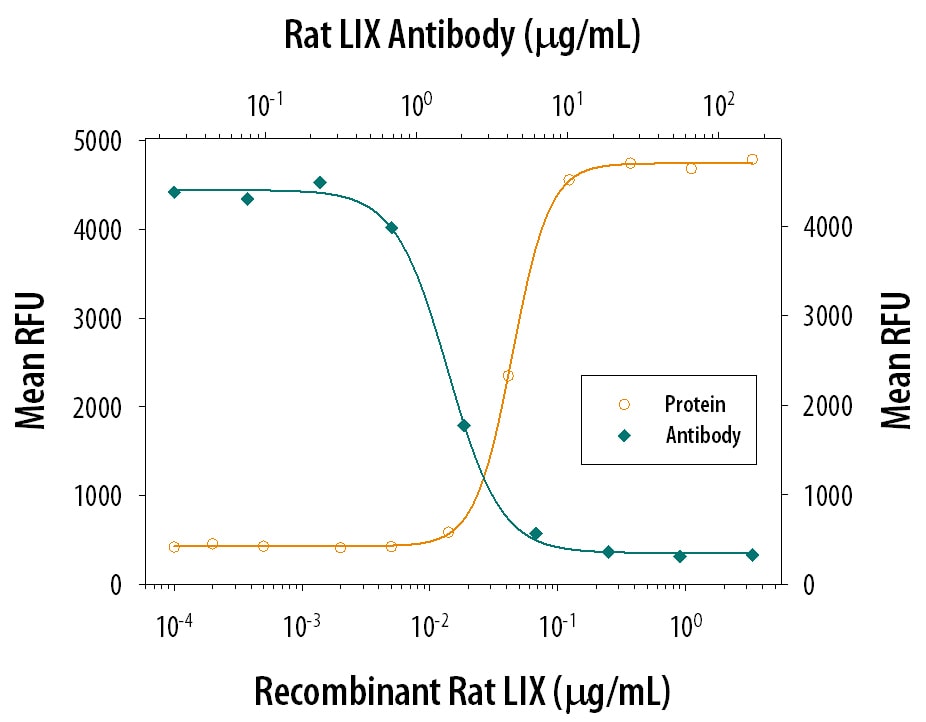
LIX (Liposaccharide-Induced CXC chemokine; also GARG-8) is a secreted 8-10 kDa member of the Intercrine alpha (or CxC) family of chemokines. It is widely expressed, being produced by diverse cell types such as fibroblasts, thymic epithelium, platelets, vascular endothelium, hepatocytes, lung type II alveolar cells and ileal columnar epithelium. As a chemokine, LIX demonstrates chemotactic properties. It induces the chemotaxis of neutrophils and endothelial cells, and also promotes TNF-alpha secretion from mast cells and macrophages. Notably, circulating LIX is not derived from fibroblasts, but platelets. This suggests that neutrophil homeostasis/chemotaxis is a function of local resident cell activation and LIX secretion, not generally circulating LIX. Rat LIX is synthesized as a 130 amino acid (aa) precursor that contains a 37 aa signal sequence plus a 93 aa mature region (aa 38-130) that likely possesses a cleavable 13 aa C-terminus (SwissProt #:P97885). The mature region possesses a receptor-binding ELR/GluLeuArg motif between aa 47-50, and an alpha -family characteristic CxC motif between aa 50-52. Although there are no known splice variants of rat LIX, based on mouse, considerable proteolytic processing likely occurs at both the N- and C-termini over aa 38-130. This may reduce the MW in SDS-Page by as much as 3 kDa. The majority of LIX could be expected to start between aa 43-46, and this is likely to be positively correlated with bioactivity. Over aa 38-117, rat LIX shares 73% aa sequence identity with mouse LIX. Although not a strict ortholog, rat LIX also shares 64% aa sequence identity with human GCP-2.
 Powered by Bioz
