
Cell Cycle
Cyclins & CDKs | DNA Replication Factors | Cell Cycle Regulatory Kinases | Tumor Suppressor Proteins | DNA Damage-induced Checkpoint Proteins | Transcriptional Regulators | Chromosome Condensation & Segregation | Spindle Assembly Checkpoint and APC/C | Mitotic Machinery: Structural and Motor Proteins | Cytokinesis | Additional Products for Cell Cycle Research | Literature | Related Information
Overview of the Cell Cycle and Key Stages
The cell division cycle is a carefully orchestrated series of events that occur in a timely and orderly fashion. It is divided into four stages, G1, S, G2, and M. The G1 and G2 stages stand for 'Gap 1' and 'Gap 2' respectively. The S stage, which stands for 'synthesis', is when DNA replication occurs. The M stage short for 'mitosis', is when nuclear division occurs, ensuring each daughter nucleus receives a full set of chromosomes. This is followed by cytokinesis, the physical separation of the cell’s cytoplasm, resulting in the formation of two daughter cells. We offer a broad range of antibodies, proteins, small molecules, and assays to help advance your cell cycle research.
Core Cell Cycle Regulators: Cyclins, CDKs, and CDK Inhibitors
Cell cycle progression is governed by key checkpoints at the G1/S boundary, within S phase, and during the G2/M transition. Passage through these checkpoints depends on the presence of stimulatory signals and the absence of DNA damage. The core regulatory network controlling these checkpoints consists of:
- Cyclin-dependent kinases (CDKs)
- Cyclins
- CDC25 phosphatases
- CDK inhibitors
CDK activation by cyclin binding and CDC25-mediated removal of inhibitory phosphates drives cell cycle transitions, while CDK inhibitors provide essential regulation to prevent aberrant proliferation. Cullin proteins function as critical scaffolds in ubiquitin ligase complexes that target these core regulators and other key cell cycle proteins for proteasomal degradation, ensuring timely progression through cell cycle checkpoints.
| Cyclins | ||
| Cyclin-dependent Kinases (CDKs) | ||
| Cyclin-dependent Kinase Inhibitor Proteins (CKIs) | ||
| Cullin-RING Ubiquitin Ligase Complexes Regulating Cell Cycle Progression | ||
| Phosphatases Involved in Cyclin-CDK Regulation | ||
| Cell Cycle Inhibitors | ||
DNA Replication Factors
DNA replication is a critical event in the cell cycle that ensures the accurate duplication of the genome before cell division. This highly coordinated process involves the activity of numerous proteins that initiate, elongate, and complete DNA synthesis, enabling faithful transmission of genetic information to daughter cells. The following molecules play essential roles in the various stages of DNA replication.
| Origin Recognition and Licensing | ||
| Helicase Activation, Replisome Assembly, and Single-strand DNA Binding | ||
| DNA Polymerases and Priming | ||
| Sliding Clamp and Clamp Loader | ||
| Okazaki Fragment Processing and Ligation | ||
| Topological Stress Relief | ||
Cell Cycle Regulatory Kinases
Cell cycle progression and accuracy rely on a diverse group of regulatory kinases that ensure precise DNA replication, chromosome segregation, and cell division. These kinases control key transitions by phosphorylating target proteins, altering their activity, localization, or stability. Together, they form a complex network that maintains cell cycle fidelity. Key kinases involved in cell cycle regulation are outlined below.
| Aurora Kinases: Promotion of spindle assembly, chromosome alignment, and cytokinesis | |
| BUB1, BUB R1, and Mps1 Kinases: Spindle assembly checkpoint regulation | |
| CDC7/Dbf4 Kinase Complex: Initiation of DNA replication | |
| Chk1 and Chk2 Kinases: Regulation of normal cell cycle progression and DNA damage checkpoints | |
| Haspin Kinase: Phosphorylation of centromeric histones for proper chromosome segregation | |
| MASTL Kinase: Maintenance of mitotic phosphorylation to ensure mitotic progression | |
| NIMA-related Kinases: Promotion of mitotic entry and progression | |
| Polo-like Kinases: Coordination of multiple stages of mitosis | |
| Wee1 and Myt Kinases: Inhibition of CDK activity | |
Tumor Suppressor Proteins Involved in Cell Cycle Regulation
Mutations in proteins controlling the cell cycle can lead to uncontrolled cell division, resulting in cancer, a disease where regulation of the cell cycle goes awry and normal cell growth and behavior is lost. Tumor suppressor proteins such as p53 and retinoblastoma protein (RB) play pivotal roles in maintaining cellular integrity by regulating key checkpoints in the cell cycle.
- p53 acts as a critical sensor of cellular stress and DNA damage, initiating cell cycle arrest, DNA repair, or apoptosis to prevent propagation of damaged cells. A p53 mutation is the most frequent mutation leading to cancer.
- RB controls progression through the G1/S transition by restraining E2F transcription factors, thereby regulating genes essential for DNA synthesis.
Since dysfunction of these tumor suppressor proteins is frequently implicated in cancer, they are essential targets for understanding disease mechanisms and developing therapeutic interventions.
| Tumor Suppressors & Related Products | ||
DNA Damage-induced Checkpoint Proteins
DNA damage-induced checkpoint proteins are essential guardians of genomic integrity, orchestrating the cell’s response to DNA lesions by halting the cell cycle and facilitating repair mechanisms. These critical proteins act at key checkpoints to prevent the propagation of DNA errors, thereby maintaining cellular health and preventing oncogenic transformation. Below are key proteins involved in DNA damage-induced checkpoints, each playing a unique role in detecting damage, signaling, and coordinating repair.
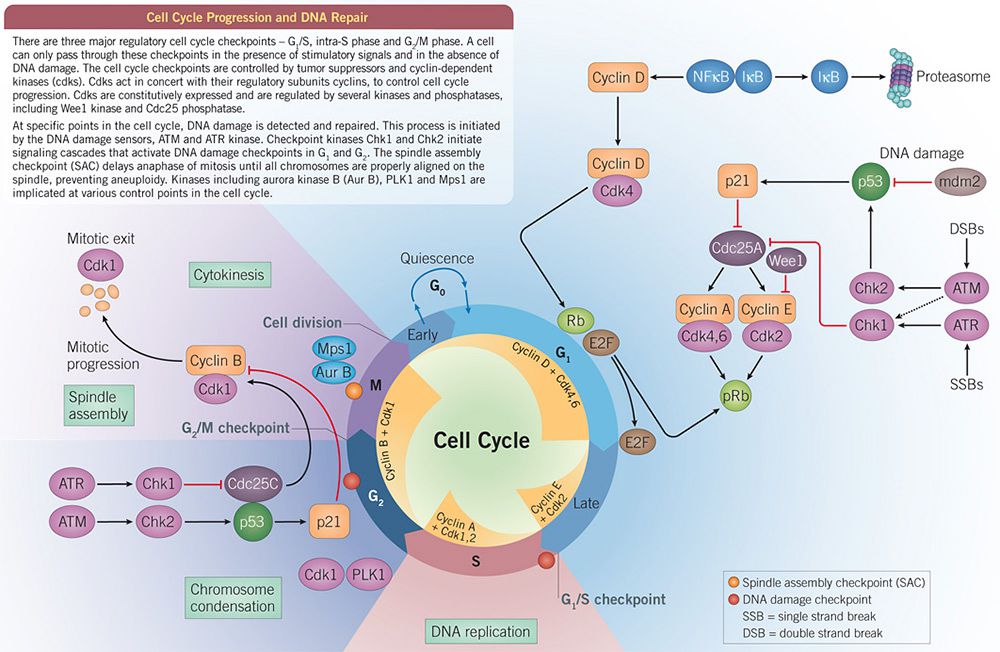
Figure 1: At specific points in the cell cycle, DNA damage is detected and repaired. The process is initiated by the DNA damage sensors, ATM and ATR kinase. Checkpoint kinases Chk1 and Chk2 initiate signaling cascades that activate DNA damage checkpoints in G1 and G2. The spindle assembly checkpoint (SAC) delays anaphase of mitosis until all chromosomes are properly aligned on the spindle, preventing aneuploidy. Kinases including aurora kinase B (Aur B), PLK1 and Mps1 are implicated at various control points in the cell cycle.
Transcriptional Regulators of the Cell Cycle
Transcriptional regulation is a fundamental mechanism governing the cell cycle, ensuring timely and coordinated expression of genes required for cell growth, DNA synthesis, and division. Key transcription factors, such as the E2F/DP family and c-Myc/Max heterodimers, function as master regulators controlling the transcription of essential cell cycle genes. Additionally, members of the ATF, c-Jun, c-Fos, and NF-Y families integrate intracellular and extracellular signaling cues to fine-tune gene expression programs. Together, these transcriptional regulators ensure proper cell cycle progression and mediate cellular responses to environmental stimuli.
Chromosome Condensation and Segregation
Chromosome condensation and segregation are fundamental processes ensuring accurate distribution of genetic material during cell division. Cohesins and condensins are multiprotein complexes that maintain sister chromatid cohesion and enable chromosome condensation for proper alignment and segregation. Kinetochore proteins connect chromosomes to spindle microtubules, mediating attachment, movement, and checkpoint signaling. Together, these components maintain genomic stability and ensure successful cell cycle progression, preventing errors like aneuploidy or cell death.
Coordination of the Spindle Assembly Checkpoint and APC/C in Mitosis
The spindle assembly checkpoint (SAC) ensures accurate chromosome segregation by monitoring kinetochore attachment and delaying anaphase until all chromosomes are properly bi-oriented. It inhibits the anaphase-promoting complex/cyclosome (APC/C), a multi-subunit E3 ubiquitin ligase, that drives mitotic progression by targeting key proteins such as securin for degradation. Checkpoint proteins including Mad1, Mad2, Bub1, Bub3, BubR1, and Mps1 block APC/C activation when attachments are incorrect, preventing premature progression. Upon correct attachment and SAC silencing, APC/C triggers the degradation of securin and other substrates, activating separase to initiate sister chromatid separation and transition into anaphase. This coordinated regulation maintains genomic stability by preventing chromosome missegregation.
Mitotic Machinery: Structural and Motor Proteins
The mitotic machinery ensures accurate chromosome segregation and cell division during the cell cycle. Key components include kinesins and tubulins, which coordinate mitotic spindle assembly and function. Kinesins serve as molecular motors, transporting cargo along microtubules and generating forces for spindle formation and chromosome movement. Tubulins polymerize to form the spindle fibers that separate chromosomes into daughter cells. Microtubule-binding compounds modulate spindle stability and dynamics, impacting mitosis progression and fidelity.
| Centriole/Centrosome Proteins | ||
| Dyneins and Dynactins | ||
| Kinesins | ||
| Microtubule-Associated Proteins | ||
| Tubulins | ||
Cytokinesis
Cytokinesis is the final step of cell division, involving the physical separation of the cytoplasm to form two daughter cells. This process is tightly regulated by a network of proteins that orchestrate contractile ring formation, membrane remodeling, and abscission. Central to cytokinesis are Rho family GTPases, which regulate actin cytoskeleton dynamics, and septins, which form filamentous structures that scaffold the division site. Key regulators coordinate the assembly and constriction of the contractile apparatus to ensure successful cell cleavage.
Cell Cycle and DNA Damage Research Product Guide
This product guide provides a review of the cell cycle and DNA damage research area and lists over 150 products, including research tools for:
- Cell Cycle and Mitosis
- DNA Damage Repair
- Targeted Protein Degradation
- Ubiquitin Proteasome Pathway
- Chemotherapy Targets
Cell Cycle & DNA Damage Repair Poster

In normal cells, each stage of the cell cycle is tightly regulated, however in cancer cells many genes and proteins that are involved in the regulation of the cell cycle are mutated or over expressed. This poster summarizes the stages of the cell cycle and DNA repair. It also highlights strategies for enhancing replicative stress in cancer cells to force mitotic catastrophe and cell death.