
BLIMP1/PRDM1 Antibody (3H2-E8) - BSA Free
Novus Biologicals | Catalog # NB600-235

![Western Blot: BLIMP1/PRDM1 Antibody (3H2-E8)BSA Free [NB600-235]](https://resources.rndsystems.com/images/products/BLIMP1-PRDM1-Antibody-3H2-E8-Western-Blot-NB600-235-img0031.jpg "Western Blot: BLIMP1/PRDM1 Antibody (3H2-E8)BSA Free [NB600-235]")
Scientific images may be resized, cropped, or adjusted for brightness or contrast for presentation purposes. These updates are limited to presentation and do not affect the underlying scientific interpretation of the data. Where available, additional source data may be provided upon request.
Key Product Details
Validated by
Species Reactivity
Validated:
Cited:
Applications
Validated:
Cited:
Label
Antibody Source
Format
Product Specifications
Immunogen
Reactivity Notes
Localization
Marker
Clonality
Host
Isotype
Scientific Data Images for BLIMP1/PRDM1 Antibody (3H2-E8) - BSA Free
![Immunocytochemistry/ Immunofluorescence: BLIMP1/PRDM1 Antibody (3H2-E8) - BSA Free [NB600-235]](https://resources.rndsystems.com/images/products/BLIMP1-PRDM1-Antibody-3H2-E8-Immunocytochemistry-Immunofluorescence-NB600-235-img0028.jpg "Immunocytochemistry/ Immunofluorescence: BLIMP1/PRDM1 Antibody (3H2-E8) - BSA Free [NB600-235]")
Immunocytochemistry/ Immunofluorescence: BLIMP1/PRDM1 Antibody (3H2-E8) - BSA Free [NB600-235]
Immunocytochemistry/Immunofluorescence: BLIMP1/PRDM1 Antibody (3H2-E8) [NB600-235] - A431 cells were fixed for 10 minutes using 10% formalin and then permeabilized for 5 minutes using 1X PBS + 0.5% Triton-X100. The cells were incubated with anti-BLIMP1 (3H2-E8) at 10 ug/ml overnight at 4C and detected with an anti-mouse IgG Dylight 488 (Green) at a 1:500 dilution. Nuclei were counterstained with DAPI (Blue). Cells were imaged using a 40X objective.![Immunohistochemistry-Paraffin: BLIMP1/PRDM1 Antibody (3H2-E8) - BSA Free [NB600-235]](https://resources.rndsystems.com/images/products/BLIMP1-PRDM1-Antibody-3H2-E8-Immunohistochemistry-Paraffin-NB600-235-img0025.jpg "Immunohistochemistry-Paraffin: BLIMP1/PRDM1 Antibody (3H2-E8) - BSA Free [NB600-235]")
Immunohistochemistry-Paraffin: BLIMP1/PRDM1 Antibody (3H2-E8) - BSA Free [NB600-235]
Immunohistochemistry-Paraffin: BLIMP1/PRDM1 Antibody (3H2-E8) [NB600-235] - Analysis using paraffin-embedded human tonsil tissue with BLIMP1/PRDM1 antibody at dilution of 1:50. Detection is completed through VC001 (DAB) and Counterstained by hematoxylin; labeling is predominantly in germinal centers.Images may not be copied, printed or otherwise disseminated without express written permission of Novus Biologicals a bio-techne brand.
![Flow Cytometry: BLIMP1/PRDM1 Antibody (3H2-E8) - BSA Free [NB600-235]](https://resources.rndsystems.com/images/products/BLIMP1-PRDM1-Antibody-3H2-E8-BSA-Free-Flow-Cytometry-NB600-235-img0032.jpg "Flow Cytometry: BLIMP1/PRDM1 Antibody (3H2-E8) - BSA Free [NB600-235]")
Flow Cytometry: BLIMP1/PRDM1 Antibody (3H2-E8) - BSA Free [NB600-235]
Flow Cytometry: BLIMP1/PRDM1 Antibody (3H2-E8) - BSA Free [NB600-235] - An intracellular stain was performed on A431 cells with BLIMP1/PRDM1 Antibody (3H2-E8) NB600-235 (blue) and a matched isotype control MAB002 (orange). Cells were fixed with 4% PFA and then permeabilized with 0.1% saponin. Cells were incubated in an antibody dilution of 2.5 ug/mL for 30 minutes at room temperature, followed by Mouse IgG (H+L) Cross-Adsorbed Secondary Antibody, Dylight 550 (84540, Thermo Fisher).![Western Blot: BLIMP1/PRDM1 Antibody (3H2-E8)BSA Free [NB600-235]](https://resources.rndsystems.com/images/products/BLIMP1-PRDM1-Antibody-3H2-E8-Western-Blot-NB600-235-img0009.jpg "Western Blot: BLIMP1/PRDM1 Antibody (3H2-E8)BSA Free [NB600-235]")
Western Blot: BLIMP1/PRDM1 Antibody (3H2-E8)BSA Free [NB600-235]
Western Blot: BLIMP1/PRDM1 Antibody (3H2-E8) [NB600-235] - Detection of Blimp-1 in murine plasmacytoma cell lysate (P3X) using NB 600-235. 1881: murine pre-B cell lysate (negative control). Photo courtesy of DA Savitsky, Columbia University.![Immunocytochemistry/ Immunofluorescence: BLIMP1/PRDM1 Antibody (3H2-E8) - BSA Free [NB600-235]](https://resources.rndsystems.com/images/products/BLIMP1-PRDM1-Antibody-3H2-E8-Immunocytochemistry-Immunofluorescence-NB600-235-img0014.jpg "Immunocytochemistry/ Immunofluorescence: BLIMP1/PRDM1 Antibody (3H2-E8) - BSA Free [NB600-235]")
Immunocytochemistry/ Immunofluorescence: BLIMP1/PRDM1 Antibody (3H2-E8) - BSA Free [NB600-235]
Immunocytochemistry/Immunofluorescence: BLIMP1/PRDM1 Antibody (3H2-E8) [NB600-235] - Double IF for Blimp-1 (green) and Ki-67 (proliferation, red) with DAPI counterstain, at 10x magnification (scale bar is 10um). Positive surface epithelium and centrocytes are labelled. Photo courtesy of Dr. Giorgio Cattoretti, Institute for Cancer Genetics, Columbia University, NY.![Immunocytochemistry/ Immunofluorescence: BLIMP1/PRDM1 Antibody (3H2-E8) - BSA Free [NB600-235]](https://resources.rndsystems.com/images/products/BLIMP1-PRDM1-Antibody-3H2-E8-Immunocytochemistry-Immunofluorescence-NB600-235-img0027.jpg "Immunocytochemistry/ Immunofluorescence: BLIMP1/PRDM1 Antibody (3H2-E8) - BSA Free [NB600-235]")
Immunocytochemistry/ Immunofluorescence: BLIMP1/PRDM1 Antibody (3H2-E8) - BSA Free [NB600-235]
Immunocytochemistry/Immunofluorescence: BLIMP1/PRDM1 Antibody (3H2-E8) [NB600-235] - HeLa cells were fixed for 10 minutes using 10% formalin and then permeabilized for 5 minutes using 1X PBS + 0.05% Triton-X100. The cells were incubated with anti-BLIMP1/PRDM1 (3H2-E8) conjugated to DyLight 550 [NB600-235R] at 20ug/ml for 1 hour at room temperature. Nuclei were counterstained with DAPI (Blue). Cells were imaged using a 40X objective.![Flow Cytometry: BLIMP1/PRDM1 Antibody (3H2-E8) - BSA Free [NB600-235]](https://resources.rndsystems.com/images/products/BLIMP1-PRDM1-Antibody-3H2-E8-Flow-Cytometry-NB600-235-img0011.jpg "Flow Cytometry: BLIMP1/PRDM1 Antibody (3H2-E8) - BSA Free [NB600-235]")
Flow Cytometry: BLIMP1/PRDM1 Antibody (3H2-E8) - BSA Free [NB600-235]
Flow Cytometry: BLIMP1/PRDM1 Antibody (3H2-E8) [NB600-235] - IL-10+Blimp-1-, IL-10+Blimp-1+, IL-10-Blimp-1+ and IL-10-Blimp-1- cells, % total living single splenic CD19+ cells of 3 total mice (Tedder Lab; Duke Univ).![Flow Cytometry: BLIMP1/PRDM1 Antibody (3H2-E8) - BSA Free [NB600-235]](https://resources.rndsystems.com/images/products/BLIMP1-PRDM1-Antibody-3H2-E8-Flow-Cytometry-NB600-235-img0013.jpg "Flow Cytometry: BLIMP1/PRDM1 Antibody (3H2-E8) - BSA Free [NB600-235]")
Flow Cytometry: BLIMP1/PRDM1 Antibody (3H2-E8) - BSA Free [NB600-235]
Flow Cytometry: BLIMP1/PRDM1 Antibody (3H2-E8) [NB600-235] - Blimp-1 expression by IL-10+ (black line), IL-10- (dotted line) or CD8+ (thin, shaded line) cells (Tedder Lab; Duke Univ)![Flow Cytometry: BLIMP1/PRDM1 Antibody (3H2-E8) - BSA Free [NB600-235]](https://resources.rndsystems.com/images/products/BLIMP1-PRDM1-Antibody-3H2-E8-Flow-Cytometry-NB600-235-img0015.jpg "Flow Cytometry: BLIMP1/PRDM1 Antibody (3H2-E8) - BSA Free [NB600-235]")
Flow Cytometry: BLIMP1/PRDM1 Antibody (3H2-E8) - BSA Free [NB600-235]
Flow Cytometry: BLIMP1/PRDM1 Antibody (3H2-E8) [NB600-235] - Blimp-1 expression by CD19+ (thick black line) or CD8+ (thin, shaded line). (Tedder Lab; Duke Univ).![Flow Cytometry: BLIMP1/PRDM1 Antibody (3H2-E8) - BSA Free [NB600-235]](https://resources.rndsystems.com/images/products/BLIMP1-PRDM1-Antibody-3H2-E8-Flow-Cytometry-NB600-235-img0024.jpg "Flow Cytometry: BLIMP1/PRDM1 Antibody (3H2-E8) - BSA Free [NB600-235]")
Flow Cytometry: BLIMP1/PRDM1 Antibody (3H2-E8) - BSA Free [NB600-235]
Flow Cytometry: BLIMP1/PRDM1 Antibody (3H2-E8) [NB600-235] - Analysis using the Biotin conjugate of NB600-235. Staining of Blimp-1 in mouse spleen. Image courtesy of product review by Branislav Krljanac.![Flow Cytometry: BLIMP1/PRDM1 Antibody (3H2-E8) - BSA Free [NB600-235]](https://resources.rndsystems.com/images/products/BLIMP1-PRDM1-Antibody-3H2-E8-Flow-Cytometry-NB600-235-img0029.jpg "Flow Cytometry: BLIMP1/PRDM1 Antibody (3H2-E8) - BSA Free [NB600-235]")
Flow Cytometry: BLIMP1/PRDM1 Antibody (3H2-E8) - BSA Free [NB600-235]
Flow Cytometry: BLIMP1/PRDM1 Antibody (3H2-E8) [NB600-235] - An intracellular stain was performed on U266 cells with BLIMP1/PRDM1 Antibody (3H2-E8) NB600-235 (blue) and a matched isotype control (orange). Cells were fixed with 4% PFA and permeabilized with 0.1% Saponin. Cells were incubated in an antibody dilution of 2.5 ug/mL for 30 minutes at room temperature, followed by mouse F(ab)2 IgG (H+L) APC-conjugated secondary antibody (F0101B, R&D Systems).![Flow Cytometry: BLIMP1/PRDM1 Antibody (3H2-E8)BSA Free [NB600-235]](https://resources.rndsystems.com/images/products/BLIMP1-PRDM1-Antibody-3H2-E8-Flow-Cytometry-NB600-235-img0030.jpg "Flow Cytometry: BLIMP1/PRDM1 Antibody (3H2-E8)BSA Free [NB600-235]")
Flow Cytometry: BLIMP1/PRDM1 Antibody (3H2-E8)BSA Free [NB600-235]
Flow Cytometry: BLIMP1/PRDM1 Antibody (3H2-E8) [NB600-235] - An intracellular stain was performed on A431 cells with BLIMP1/PRDM1 [3H2-E8] Antibody NB600-235C (blue) and a matched isotype control (orange). Cells were fixed with 4% PFA and then permeabilized with 0.1% saponin. Cells were incubated in an antibody dilution of 5 ug/mL for 30 minutes at room temperature. Both antibodies were conjugated to DyLight 650.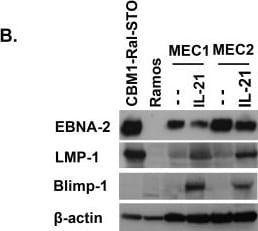
Western Blot: BLIMP1/PRDM1 Antibody (3H2-E8) - BSA Free [NB600-235] -
Western Blot: BLIMP1/PRDM1 Antibody (3H2-E8) - BSA Free [NB600-235] - The effect of IL-21 & CD40L exposure on MEC1 & MEC2 cells.Expression of EBNA-2 & LMP-1 in IL-21 treated cells (A, B). (A) Simultaneous immunofluorescence staining of EBNA-2 (Green) & LMP-1 (Red); magnification (×100), scale bar 25 µm. Note the downregulation of EBNA-2 & upregultion of LMP-1 after IL-21 treatment. (B) Expression of EBNA-2, LMP-1 & Blimp-1 by immunoblotting; positive control: CBM1-Ral-STO, negative control: Ramos. 1.5×10⁵ cells were loaded in the control lanes & 5×10⁵ were loaded in both untreated & IL-21 treated MEC1 & MEC2 lanes. Note low expression of EBNA-2 & high expression of LMP-1 after IL-21 treatment & induction of Blimp-1 after IL-21 treatment. (C) Activity of the W & C promoters that regulate EBNA-2 expression & LMP-1 mRNA expression by Q-PCR. Note the difference in EBNA-2 regulation; the MEC2 cell uses both Wp & Cp while in MEC1 only Wp is active. (D) Expression of EBNA-2 & LMP-1 in cells exposed to CD40L. Simultaneous immunofluorescence staining; for details see (A). Note: EBNA-2 & LMP-1 are downregulated by CD40L in both lines. (E) CD40L induced modulation of surface marker by FACS analysis. Image collected & cropped by CiteAb from the following publication (https://dx.plos.org/10.1371/journal.pone.0106008), licensed under a CC-BY license. Not internally tested by Novus Biologicals.Applications for BLIMP1/PRDM1 Antibody (3H2-E8) - BSA Free
Chromatin Immunoprecipitation (ChIP)
ELISA
Flow Cytometry
Immunocytochemistry/ Immunofluorescence
Immunohistochemistry
Immunohistochemistry-Frozen
Immunohistochemistry-Paraffin
Western Blot
Reviewed Applications
Read 2 reviews rated 3.5 using NB600-235 in the following applications:
Flow Cytometry Panel Builder
Bio-Techne Knows Flow Cytometry
Save time and reduce costly mistakes by quickly finding compatible reagents using the Panel Builder Tool.
Advanced Features
- Spectra Viewer - Custom analysis of spectra from multiple fluorochromes
- Spillover Popups - Visualize the spectra of individual fluorochromes
- Antigen Density Selector - Match fluorochrome brightness with antigen density

Formulation, Preparation, and Storage
Purification
Formulation
Format
Preservative
Concentration
Shipping
Stability & Storage
Background: BLIMP1/PRDM1
Long Name
Alternate Names
Gene Symbol
Additional BLIMP1/PRDM1 Products
Product Documents for BLIMP1/PRDM1 Antibody (3H2-E8) - BSA Free
Certificate of Analysis
To download a Certificate of Analysis, please enter a lot or batch number in the search box below.
Product Specific Notices for BLIMP1/PRDM1 Antibody (3H2-E8) - BSA Free
This product is for research use only and is not approved for use in humans or in clinical diagnosis. Primary Antibodies are guaranteed for 1 year from date of receipt.
Related Research Areas
Citations for BLIMP1/PRDM1 Antibody (3H2-E8) - BSA Free
 Powered by Bioz
Customer Reviews for BLIMP1/PRDM1 Antibody (3H2-E8) - BSA Free (2)
Have you used BLIMP1/PRDM1 Antibody (3H2-E8) - BSA Free?
Submit a review and receive an Amazon gift card!
$25/€18/£15/$25CAN/¥2500 for a review with an image
$10/€7/£6/$10CAN/¥1110 for a review without an image
Submit a review
-
Application: Immunohistochemistry-ParaffinSample Tested: Porcine embryoSpecies: OtherVerified Customer | Posted 05/31/2010
-
Application: ImmunofluorescenceSample Tested: Blimp1Species: OtherVerified Customer | Posted 02/17/2009
There are no reviews that match your criteria.
Protocols
View specific protocols for BLIMP1/PRDM1 Antibody (3H2-E8) - BSA Free (NB600-235):
Sample Preparation.
1. Grow cells to 60-85% confluency. Flow cytometry requires between 2 x 10⁵ and 1 x 10⁶ cells for optimal performance.
2. If cells are adherent, harvest gently by washing once with staining buffer and then scraping. Avoid using trypsin as this can disrupt certain epitopes of interest. If enzymatic harvest is required, use Accutase, Collagenase, or TrypLE Express for a less damaging option.
3. Reserve 100 uL for counting, then transfer cell volume into a 50 mL conical tube and centrifuge for 8 minutes at 400 RCF.
a. Count cells using a hemocytometer and a 1:1 trypan blue exclusion stain to determine cell viability before starting the flow protocol. If cells appear blue, do not proceed.
4. Re-suspend cells to a concentration of 1 x 10⁶ cells/mL in staining buffer (NBP2-26247).
5. Aliquot out 100 uL samples in accordance with your experimental samples.
Tip: When cell surface and intracellular staining are required in the same sample, it is advisable that the cell surface staining be performed first since the fixation and permeabilization steps might reduce the availability of surface antigens.
Intracellular Staining.
Tip: When performing intracellular staining, it is important to use appropriate fixation and permeabilization reagents based upon the target and its subcellular location. Generally, our Intracellular Flow Assay Kit (NBP2-29450) is a good place to start as it contains an optimized combination of reagents for intracellular staining as well as an inhibitor of intracellular protein transport (necessary if staining secreted proteins). Certain targets may require more gentle or transient permeabilization protocols such as the commonly employed methanol or saponin-based methods.
Protocol for Cytoplasmic Targets:
1. Fix the cells by adding 100 uL fixation solution (such as 4% PFA) to each sample for 10-15 minutes.
2. Permeabilize cells by adding 100 uL of a permeabilization buffer to every 1 x 10⁶ cells present in the sample. Mix well and incubate at room temperature for 15 minutes.
a. For cytoplasmic targets, use a gentle permeabilization solution such as 1X PBS + 0.5% Saponin or 1X PBS + 0.5% Tween-20.
b. To maintain the permeabilized state throughout your experiment, use staining buffer + 0.1% of the permeabilization reagent (i.e. 0.1% Tween-20 or 0.1% Saponin).
3. Following the 15 minute incubation, add 2 mL of the staining buffer + 0.1% permeabilizer to each sample.
4. Centrifuge for 1 minute at 400 RCF.
5. Discard supernatant and re-suspend in 100 uL of staining buffer + 0.1% permeabilizer.
6. Add appropriate amount of each antibody (eg. 1 test or 1 ug per sample, as experimentally determined).
7. Mix well and incubate at room temperature for 30 minutes- 1 hour. Gently mix samples every 10-15 minutes.
8. Following the primary/conjugate incubation, add 1-2 mL/sample of staining buffer +0.1% permeabilizer and centrifuge for 1 minute at 400 RCF.
9. Wash twice by re-suspending cells in staining buffer (2 mL for tubes or 200 uL for wells) and centrifuging at 400 RCF for 5 minutes. Discard supernatant.
10. Add appropriate amount of secondary antibody (as experimentally determined) to each sample.
11. Incubate at room temperature in dark for 20 minutes.
12. Add 1-2 mL of staining buffer and centrifuge at 400 RCF for 1 minute and discard supernatant.
13. Wash twice by re-suspending cells in staining buffer (2 mL for tubes or 200 uL for wells) and centrifuging at 400 RCF for 5 minutes. Discard supernatant.
14. Resuspend in an appropriate volume of staining buffer (usually 500 uL per sample) and proceed with analysis on your flow cytometer.
Culture cells to appropriate density in 35 mm culture dishes or 6-well plates.
1. Remove culture medium and wash the cells briefly in PBS. Add 10% formalin to the dish and fix at room temperature for 10 minutes.
2. Remove the formalin and wash the cells in PBS.
3. Permeablize the cells with 0.1% Triton X100 or other suitable detergent for 10 min.
4. Remove the permeablization buffer and wash three times for 10 minutes each in PBS. Be sure to not let the specimen dry out.
5. To block nonspecific antibody binding, incubate in 10% normal goat serum from 1 hour to overnight at room temperature.
6. Add primary antibody at appropriate dilution and incubate overnight at 4C.
7. Remove primary antibody and replace with PBS. Wash three times for 10 minutes each.
8. Add secondary antibody at appropriate dilution. Incubate for 1 hour at room temperature.
9. Remove secondary antibody and replace with PBS. Wash three times for 10 minutes each.
10. Counter stain DNA with DAPi if required.
Antigen Unmasking:
Bring slides to a boil in 10 mM sodium citrate buffer (pH 6.0) then maintain at a sub-boiling temperature for 10 minutes. Cool slides on bench-top for 30 minutes (keep slides in the sodium citrate buffer at all times).
Staining:
1. Wash sections in deionized water three times for 5 minutes each.
2. Wash sections in PBS for 5 minutes.
3. Block each section with 100-400 ul blocking solution (1% BSA in PBS) for 1 hour at room temperature.
4. Remove blocking solution and add 100-400 ul diluted primary antibody. Incubate overnight at 4 C.
5. Remove antibody solution and wash sections in wash buffer three times for 5 minutes each.
6. Add 100-400 ul HRP polymer conjugated secondary antibody. Incubate 30 minutes at room temperature.
7. Wash sections three times in wash buffer for 5 minutes each.
8. Add 100-400 ul DAB substrate to each section and monitor staining closely.
9. As soon as the sections develop, immerse slides in deionized water.
10. Counterstain sections in hematoxylin.
11. Wash sections in deionized water two times for 5 minutes each.
12. Dehydrate sections.
13. Mount coverslips.
1. Perform SDS-PAGE on samples to be analyzed, loading 10-25 ug of total protein per lane.
2. Transfer proteins to PVDF membrane according to the instructions provided by the manufacturer of the membrane and transfer apparatus.
3. Stain the membrane with Ponceau S (or similar product) to assess transfer success, and mark molecular weight standards where appropriate.
4. Rinse the blot TBS -0.05% Tween 20 (TBST).
5. Block the membrane in 5% Non-fat milk in TBST (blocking buffer) for at least 1 hour.
6. Wash the membrane in TBST three times for 10 minutes each.
7. Dilute primary antibody in 1% Non-fat milk and incubate overnight at 4C with gentle rocking.
8. Wash the membrane in TBST three times for 10 minutes each.
9. Incubate the membrane in diluted HRP conjugated secondary antibody in blocking buffer (as per manufacturer's instructions) for 1 hour at room temperature.
10. Wash the blot in TBST three times for 10 minutes each (this step can be repeated as required to reduce background).
11. Apply the detection reagent of choice in accordance with the manufacturers instructions.
Find general support by application which include: protocols, troubleshooting, illustrated assays, videos and webinars.
- 7-Amino Actinomycin D (7-AAD) Cell Viability Flow Cytometry Protocol
- Antigen Retrieval Protocol (PIER)
- Antigen Retrieval for Frozen Sections Protocol
- Appropriate Fixation of IHC/ICC Samples
- Cellular Response to Hypoxia Protocols
- ChIP Protocol Video
- Chromatin Immunoprecipitation (ChIP) Protocol
- Chromatin Immunoprecipitation Protocol
- Chromogenic IHC Staining of Formalin-Fixed Paraffin-Embedded (FFPE) Tissue Protocol
- Chromogenic Immunohistochemistry Staining of Frozen Tissue
- ClariTSA™ Fluorophore Kits
- Detection & Visualization of Antibody Binding
- ELISA Sample Preparation & Collection Guide
- ELISA Troubleshooting Guide
- Extracellular Membrane Flow Cytometry Protocol
- Flow Cytometry Protocol for Cell Surface Markers
- Flow Cytometry Protocol for Staining Membrane Associated Proteins
- Flow Cytometry Staining Protocols
- Flow Cytometry Troubleshooting Guide
- Fluorescent IHC Staining of Frozen Tissue Protocol
- Graphic Protocol for Heat-induced Epitope Retrieval
- Graphic Protocol for the Preparation and Fluorescent IHC Staining of Frozen Tissue Sections
- Graphic Protocol for the Preparation and Fluorescent IHC Staining of Paraffin-embedded Tissue Sections
- Graphic Protocol for the Preparation of Gelatin-coated Slides for Histological Tissue Sections
- How to Run an R&D Systems DuoSet ELISA
- How to Run an R&D Systems Quantikine ELISA
- How to Run an R&D Systems Quantikine™ QuicKit™ ELISA
- ICC Cell Smear Protocol for Suspension Cells
- ICC Immunocytochemistry Protocol Videos
- ICC for Adherent Cells
- IHC Sample Preparation (Frozen sections vs Paraffin)
- Immunocytochemistry (ICC) Protocol
- Immunocytochemistry Troubleshooting
- Immunofluorescence of Organoids Embedded in Cultrex Basement Membrane Extract
- Immunofluorescent IHC Staining of Formalin-Fixed Paraffin-Embedded (FFPE) Tissue Protocol
- Immunohistochemistry (IHC) and Immunocytochemistry (ICC) Protocols
- Immunohistochemistry Frozen Troubleshooting
- Immunohistochemistry Paraffin Troubleshooting
- Immunoprecipitation Protocol
- Intracellular Flow Cytometry Protocol Using Alcohol (Methanol)
- Intracellular Flow Cytometry Protocol Using Detergents
- Intracellular Nuclear Staining Flow Cytometry Protocol Using Detergents
- Intracellular Staining Flow Cytometry Protocol Using Alcohol Permeabilization
- Intracellular Staining Flow Cytometry Protocol Using Detergents to Permeabilize Cells
- Preparing Samples for IHC/ICC Experiments
- Preventing Non-Specific Staining (Non-Specific Binding)
- Primary Antibody Selection & Optimization
- Propidium Iodide Cell Viability Flow Cytometry Protocol
- Protocol for Heat-Induced Epitope Retrieval (HIER)
- Protocol for Liperfluo
- Protocol for Making a 4% Formaldehyde Solution in PBS
- Protocol for VisUCyte™ HRP Polymer Detection Reagent
- Protocol for the Characterization of Human Th22 Cells
- Protocol for the Characterization of Human Th9 Cells
- Protocol for the Fluorescent ICC Staining of Cell Smears - Graphic
- Protocol for the Fluorescent ICC Staining of Cultured Cells on Coverslips - Graphic
- Protocol for the Preparation & Fixation of Cells on Coverslips
- Protocol for the Preparation and Chromogenic IHC Staining of Frozen Tissue Sections
- Protocol for the Preparation and Chromogenic IHC Staining of Frozen Tissue Sections - Graphic
- Protocol for the Preparation and Chromogenic IHC Staining of Paraffin-embedded Tissue Sections
- Protocol for the Preparation and Chromogenic IHC Staining of Paraffin-embedded Tissue Sections - Graphic
- Protocol for the Preparation and Fluorescent ICC Staining of Cells on Coverslips
- Protocol for the Preparation and Fluorescent ICC Staining of Non-adherent Cells
- Protocol for the Preparation and Fluorescent ICC Staining of Stem Cells on Coverslips
- Protocol for the Preparation and Fluorescent IHC Staining of Frozen Tissue Sections
- Protocol for the Preparation and Fluorescent IHC Staining of Paraffin-embedded Tissue Sections
- Protocol for the Preparation of Gelatin-coated Slides for Histological Tissue Sections
- Protocol for the Preparation of a Cell Smear for Non-adherent Cell ICC - Graphic
- Protocol: Annexin V and PI Staining by Flow Cytometry
- Protocol: Annexin V and PI Staining for Apoptosis by Flow Cytometry
- Quantikine HS ELISA Kit Assay Principle, Alkaline Phosphatase
- Quantikine HS ELISA Kit Principle, Streptavidin-HRP Polymer
- R&D Systems Quality Control Western Blot Protocol
- Sandwich ELISA (Colorimetric) – Biotin/Streptavidin Detection Protocol
- Sandwich ELISA (Colorimetric) – Direct Detection Protocol
- TUNEL and Active Caspase-3 Detection by IHC/ICC Protocol
- The Importance of IHC/ICC Controls
- Troubleshooting Guide: ELISA
- Troubleshooting Guide: Fluorokine Flow Cytometry Kits
- Troubleshooting Guide: Immunohistochemistry
- Troubleshooting Guide: Western Blot Figures
- Western Blot Conditions
- Western Blot Protocol
- Western Blot Protocol for Cell Lysates
- Western Blot Troubleshooting
- Western Blot Troubleshooting Guide
- View all Protocols, Troubleshooting, Illustrated assays and Webinars
FAQs for BLIMP1/PRDM1 Antibody (3H2-E8) - BSA Free
-
Q: Do you have any images (dot plot chart or histogram) of human cells stained with this ab for flow cytometry?
A: Unfortunately, I do not have any additional images for this product on my records. This is one of our best selling products with great customer feedback and citations in at least 24 peer reviewed publications in journals of high repute. We stand by the quality of our products and all our products are 100% guaranteed. We are always there to help in case you face any trouble in generating your desired outcome out of the use of our products.
-
Q: Do you have any references which show this works in human for IF?
A: The research publication that has evidence for IF use of the above mentioned antibody in samples of human origin is: Julaton VT, Reijo Pera RA. NANOS3 function in human germ cell development. Hum Mol Genet. 2011 Jun 1;20(11):2238-50. Epub 2011 Mar 19.
-
Q: Does your Blimp-1 Antibody (NB600-235) recognize both the alpha and beta form of BLIMP-1
A: By WB, this antibody recognizes a band ~98 kD and may recognize one ~80 kDa (the beta form).
-
Q: May we ask if NB600-235 is suitable for ChIP?
A:
NB600-235 have been validated in IP, so since BLIMP-1 is a DNA binding protein, this antibody should be suitable for ChIP. If you would be interested in testing this novel application, please take a look at our Innovator's Reward program.
-
Q: Do you have any images (dot plot chart or histogram) of human cells stained with this ab for flow cytometry?
A: Unfortunately, I do not have any additional images for this product on my records. This is one of our best selling products with great customer feedback and citations in at least 24 peer reviewed publications in journals of high repute. We stand by the quality of our products and all our products are 100% guaranteed. We are always there to help in case you face any trouble in generating your desired outcome out of the use of our products.
-
Q: Do you have any references which show this works in human for IF?
A: The research publication that has evidence for IF use of the above mentioned antibody in samples of human origin is: Julaton VT, Reijo Pera RA. NANOS3 function in human germ cell development. Hum Mol Genet. 2011 Jun 1;20(11):2238-50. Epub 2011 Mar 19.
-
Q: Does your Blimp-1 Antibody (NB600-235) recognize both the alpha and beta form of BLIMP-1
A: By WB, this antibody recognizes a band ~98 kD and may recognize one ~80 kDa (the beta form).
-
Q: May we ask if NB600-235 is suitable for ChIP?
A:
NB600-235 have been validated in IP, so since BLIMP-1 is a DNA binding protein, this antibody should be suitable for ChIP. If you would be interested in testing this novel application, please take a look at our Innovator's Reward program.
-
Q: Do you have any images (dot plot chart or histogram) of human cells stained with this ab for flow cytometry?
A: Unfortunately, I do not have any additional images for this product on my records. This is one of our best selling products with great customer feedback and citations in at least 24 peer reviewed publications in journals of high repute. We stand by the quality of our products and all our products are 100% guaranteed. We are always there to help in case you face any trouble in generating your desired outcome out of the use of our products.
-
Q: Do you have any references which show this works in human for IF?
A: The research publication that has evidence for IF use of the above mentioned antibody in samples of human origin is: Julaton VT, Reijo Pera RA. NANOS3 function in human germ cell development. Hum Mol Genet. 2011 Jun 1;20(11):2238-50. Epub 2011 Mar 19.
-
Q: Does your Blimp-1 Antibody (NB600-235) recognize both the alpha and beta form of BLIMP-1
A: By WB, this antibody recognizes a band ~98 kD and may recognize one ~80 kDa (the beta form).
-
Q: May we ask if NB600-235 is suitable for ChIP?
A:
NB600-235 have been validated in IP, so since BLIMP-1 is a DNA binding protein, this antibody should be suitable for ChIP. If you would be interested in testing this novel application, please take a look at our Innovator's Reward program.
-
Q: Do you have any images (dot plot chart or histogram) of human cells stained with this ab for flow cytometry?
A: Unfortunately, I do not have any additional images for this product on my records. This is one of our best selling products with great customer feedback and citations in at least 24 peer reviewed publications in journals of high repute. We stand by the quality of our products and all our products are 100% guaranteed. We are always there to help in case you face any trouble in generating your desired outcome out of the use of our products.
-
Q: Do you have any references which show this works in human for IF?
A: The research publication that has evidence for IF use of the above mentioned antibody in samples of human origin is: Julaton VT, Reijo Pera RA. NANOS3 function in human germ cell development. Hum Mol Genet. 2011 Jun 1;20(11):2238-50. Epub 2011 Mar 19.
-
Q: Does your Blimp-1 Antibody (NB600-235) recognize both the alpha and beta form of BLIMP-1
A: By WB, this antibody recognizes a band ~98 kD and may recognize one ~80 kDa (the beta form).
-
Q: May we ask if NB600-235 is suitable for ChIP?
A:
NB600-235 have been validated in IP, so since BLIMP-1 is a DNA binding protein, this antibody should be suitable for ChIP. If you would be interested in testing this novel application, please take a look at our Innovator's Reward program.