
FGF acidic, also known as FGF1, ECGF, and HBGF-1, is a 17 kDa nonglycosylated member of the FGF family of mitogenic peptides. FGF acidic, which is produced by multiple cell types, stimulates the proliferation of all cells of mesodermal origin and many cells of neuroectodermal, ectodermal, and endodermal origin. It plays a number of roles in development, regeneration, and angiogenesis (1‑3). Bovine FGF acidic shares 53% amino acid sequence identity with FGF basic and 11%‑31% with other bovine FGFs. It shares 92%, 91%, 88%, and 91% aa sequence identity with human, mouse, porcine, and rat FGF acidic, respectively, and exhibits considerable species crossreactivity. During its nonclassical secretion, FGF acidic associates with S100A13, copper ions, and the C2A domain of synaptotagmin 1 (4). It is released extracellularly as a disulfide-linked homodimer and is stored in complex with extracellular heparan sulfate (5). The ability of heparan sulfate to bind FGF acidic is determined by its pattern of sulfation, and alterations in this pattern during embryognesis thereby regulate FGF acidic bioactivity (6). The association of FGF acidic with heparan sulfate is a prerequisite for its subsequent interaction with FGF receptors (7, 8). Ligation triggers receptor dimerization, transphosphorylation, and internalization of receptor/FGF complexes (9). Internalized FGF acidic can translocate to the cytosol with the assistance of Hsp90 and then migrate to the nucleus by means of its two nuclear localization signals (10‑12). The phosphorylation of FGF acidic by nuclear PKC delta triggers its active export to the cytosol where it is dephosphorylated and degraded (13, 14). Intracellular FGF acidic functions as a survival factor by inhibiting p53 activity and proapoptotic signaling (15).
Bovine FGF acidic/FGF1 Antibody
R&D Systems | Catalog # AB-32-NA

Scientific images may be resized, cropped, or adjusted for brightness or contrast for presentation purposes. These updates are limited to presentation and do not affect the underlying scientific interpretation of the data. Where available, additional source data may be provided upon request.
Key Product Details
Species Reactivity
Validated:
Cited:
Applications
Validated:
Cited:
Label
Antibody Source
Product Specifications
Immunogen
Specificity
Clonality
Host
Isotype
Endotoxin Level
Scientific Data Images for Bovine FGF acidic/FGF1 Antibody
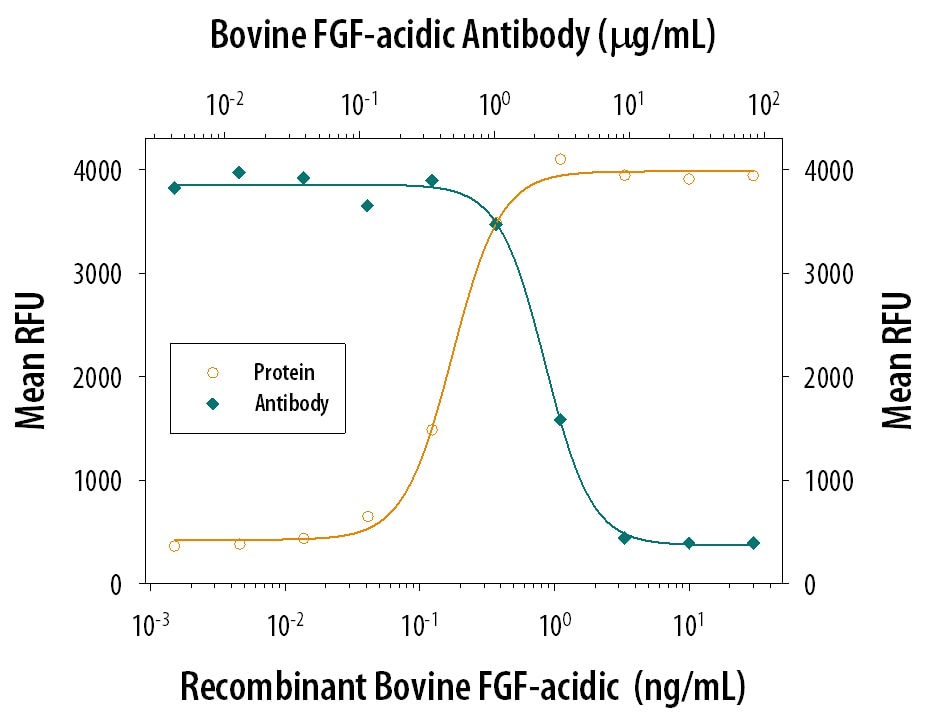
Cell Proliferation Induced by FGF acidic/FGF1 and Neutral-ization by Bovine FGF acidic/FGF1 Antibody.
Bovine FGF acidic/FGF1 (Catalog # 132-FA) stimulates proliferation in the NR6R-3T3 mouse fibroblast cell line in a dose-dependent manner (orange line). Proliferation elicited by Bovine FGF acidic/FGF1 (0.75 ng/mL) is neutralized (green line) by increasing concentrations of Rabbit Anti-Bovine FGF acidic/FGF1 Polyclonal Antibody (Catalog # AB-32-NA). The ND50 is typically 1-3 µg/mL.Applications for Bovine FGF acidic/FGF1 Antibody
Western Blot
Sample: Bovine FGF acidic/FGF1 (Catalog # 132-FA)
Neutralization
Formulation, Preparation, and Storage
Purification
Reconstitution
Reconstitute at 1 mg/mL in sterile PBS.
Formulation
Shipping
Stability & Storage
- 12 months from date of receipt, -20 to -70 °C as supplied.
- 1 month, 2 to 8 °C under sterile conditions after reconstitution.
- 6 months, -20 to -70 °C under sterile conditions after reconstitution.
Calculators
Background: FGF acidic/FGF1
References
- Gimenez-Gallego, G. et al. (1985) Science 230:1385.
- Galzie, Z. et al. (1997) Biochem. Cell Biol. 75:669.
- Presta, M. et al. (2005) Cytokine Growth Factor Rev. 16:159.
- Rajalingam, D. et al. (2007) Biochemistry 46:9225.
- Guerrini, M. et al. (2007) Curr. Pharm. Des. 13:2045.
- Allen, B.L. and A.C. Rapraeger (2003) J. Cell Biol. 163:637.
- Robinson, C.J. et al. (2005) J. Biol. Chem. 280:42274.
- Mohammadi, M. et al. (2005) Cytokine Growth Factor Rev. 16:107.
- Wiedlocha, A. and V. Sorensen (2004) Curr. Top. Microbiol. Immunol. 286:45.
- Wesche, J. et al. (2006) J. Biol. Chem. 281:11405.
- Imamura, T. et al. (1990) Science 249:1567.
- Wesche, J. et al. (2005) Biochemistry 44:6071.
- Wiedlocha, A. et al. (2005) Mol. Biol. Cell 16:794.
- Nilsen, T. et al. (2007) J. Biol. Chem. 282:26245.
- Bouleau, S. et al. (2005) Oncogene 24:7839.
Long Name
Alternate Names
Gene Symbol
Additional FGF acidic/FGF1 Products
Product Documents for Bovine FGF acidic/FGF1 Antibody
Certificate of Analysis
To download a Certificate of Analysis, please enter a lot or batch number in the search box below.
Note: Certificate of Analysis not available for kit components.
Product Specific Notices for Bovine FGF acidic/FGF1 Antibody
For research use only
Related Research Areas
Citations for Bovine FGF acidic/FGF1 Antibody
 Powered by Bioz
Customer Reviews for Bovine FGF acidic/FGF1 Antibody
There are currently no reviews for this product. Be the first to review Bovine FGF acidic/FGF1 Antibody and earn rewards!
Have you used Bovine FGF acidic/FGF1 Antibody?
Submit a review and receive an Amazon gift card!
$25/€18/£15/$25CAN/¥2500 for a review with an image
$10/€7/£6/$10CAN/¥1110 for a review without an image
Submit a review
Protocols
Find general support by application which include: protocols, troubleshooting, illustrated assays, videos and webinars.
- Cellular Response to Hypoxia Protocols
- R&D Systems Quality Control Western Blot Protocol
- Troubleshooting Guide: Western Blot Figures
- Western Blot Conditions
- Western Blot Protocol
- Western Blot Protocol for Cell Lysates
- Western Blot Troubleshooting
- Western Blot Troubleshooting Guide
- View all Protocols, Troubleshooting, Illustrated assays and Webinars