
CCR7 Antibody (SR36-04)
Novus Biologicals | Catalog # NBP2-67324
Recombinant Monoclonal Antibody

![Western Blot: CCR7 Antibody (SR36-04) [NBP2-67324]](https://resources.rndsystems.com/images/products/CCR7-Antibody-SR36-04-Western-Blot-NBP2-67324-img0009.jpg "Western Blot: CCR7 Antibody (SR36-04) [NBP2-67324]")
Scientific images may be resized, cropped, or adjusted for brightness or contrast for presentation purposes. These updates are limited to presentation and do not affect the underlying scientific interpretation of the data. Where available, additional source data may be provided upon request.
Loading...
Key Product Details
Validated by
Knockout/Knockdown, Biological Validation
Species Reactivity
Validated:
Human, Mouse, Rat
Cited:
Mouse
Applications
Validated:
Immunohistochemistry, Immunohistochemistry-Paraffin, Western Blot, Immunocytochemistry/ Immunofluorescence, Immunoprecipitation, Knockdown Validated
Cited:
IF/IHC
Label
Unconjugated
Antibody Source
Recombinant Monoclonal Rabbit IgG Clone # SR36-04 expressed in HEK293
Loading...
Product Specifications
Immunogen
Synthetic peptide within Human CCR7 aa 13-62 / 378. (SwissProt: P32248 Human; SwissProt: P47774 Mouse; Unigene:229736 Rat)
Localization
Cell membrane
Clonality
Monoclonal
Host
Rabbit
Isotype
IgG
Scientific Data Images for CCR7 Antibody (SR36-04)
Western Blot: CCR7 Antibody (SR36-04) [NBP2-67324]
Western Blot: CCR7 Antibody (SR36-04) [NBP2-67324] - Analysis of CCR7 on different lysates. Proteins were transferred to a PVDF membrane and blocked with 5% BSA in PBS for 1 hour at room temperature. The primary antibody (1/500) was used in 5% BSA at room temperature for 2 hours. Goat Anti-Rabbit IgG - HRP Secondary Antibody at 1:5,000 dilution was used for 1 hour at room temperature. Positive control: Lane 1: Jurkat cell lysateLane 2: MCF-7 cell lysate Lane 3: PC-12 cell lysate Lane 4: Daudi cell lysate![Immunocytochemistry/ Immunofluorescence: CCR7 Antibody (SR36-04) [NBP2-67324]](https://resources.rndsystems.com/images/products/CCR7-Antibody-SR36-04-Immunocytochemistry-Immunofluorescence-NBP2-67324-img0006.jpg "Immunocytochemistry/ Immunofluorescence: CCR7 Antibody (SR36-04) [NBP2-67324]")
![Immunohistochemistry-Paraffin: CCR7 Antibody (SR36-04) [NBP2-67324]](https://resources.rndsystems.com/images/products/CCR7-Antibody-SR36-04-Immunohistochemistry-Paraffin-NBP2-67324-img0004.jpg "Immunohistochemistry-Paraffin: CCR7 Antibody (SR36-04) [NBP2-67324]")
Immunohistochemistry-Paraffin: CCR7 Antibody (SR36-04) [NBP2-67324]
Immunohistochemistry-Paraffin: CCR7 Antibody (SR36-04) [NBP2-67324] - Analysis of paraffin-embedded human tonsil tissue using anti-CCR7 antibody. Counter stained with hematoxylin.![Western Blot: CCR7 Antibody (SR36-04) [NBP2-67324]](https://resources.rndsystems.com/images/products/CCR7-Antibody-SR36-04-Western-Blot-NBP2-67324-img0008.jpg "Western Blot: CCR7 Antibody (SR36-04) [NBP2-67324]")
![Immunocytochemistry/ Immunofluorescence: CCR7 Antibody (SR36-04) [NBP2-67324]](https://resources.rndsystems.com/images/products/CCR7-Antibody-SR36-04-Immunocytochemistry-Immunofluorescence-NBP2-67324-img0001.jpg "Immunocytochemistry/ Immunofluorescence: CCR7 Antibody (SR36-04) [NBP2-67324]")
Immunocytochemistry/ Immunofluorescence: CCR7 Antibody (SR36-04) [NBP2-67324]
Immunocytochemistry/Immunofluorescence: CCR7 Antibody (SR36-04) [NBP2-67324] - Staining CCR7 in Hela cells (green). The nuclear counter stain is DAPI (blue). Cells were fixed in paraformaldehyde, permeabilised with 0.25% Triton X100/PBS.![Immunocytochemistry/ Immunofluorescence: CCR7 Antibody (SR36-04) [NBP2-67324]](https://resources.rndsystems.com/images/products/CCR7-Antibody-SR36-04-Immunocytochemistry-Immunofluorescence-NBP2-67324-img0002.jpg "Immunocytochemistry/ Immunofluorescence: CCR7 Antibody (SR36-04) [NBP2-67324]")
Immunocytochemistry/ Immunofluorescence: CCR7 Antibody (SR36-04) [NBP2-67324]
Immunocytochemistry/Immunofluorescence: CCR7 Antibody (SR36-04) [NBP2-67324] - Staining CCR7 in MCF-7 cells (green). The nuclear counter stain is DAPI (blue). Cells were fixed in paraformaldehyde, permeabilised with 0.25% Triton X100/PBS.![Immunohistochemistry-Paraffin: CCR7 Antibody (SR36-04) [NBP2-67324]](https://resources.rndsystems.com/images/products/CCR7-Antibody-SR36-04-Immunohistochemistry-Paraffin-NBP2-67324-img0003.jpg "Immunohistochemistry-Paraffin: CCR7 Antibody (SR36-04) [NBP2-67324]")
Immunohistochemistry-Paraffin: CCR7 Antibody (SR36-04) [NBP2-67324]
Immunohistochemistry-Paraffin: CCR7 Antibody (SR36-04) [NBP2-67324] - Analysis of paraffin-embedded human spleen tissue using anti-CCR7 antibody. Counter stained with hematoxylin.![Knockdown Validated: CCR7 Antibody (SR36-04) [NBP2-67324]](https://resources.rndsystems.com/images/products/CCR7-Antibody-SR36-04-Knockdown-Validated-NBP2-67324-img0007.jpg "Western Blot: CCR7 Antibody (SR36-04) [NBP2-67324]")
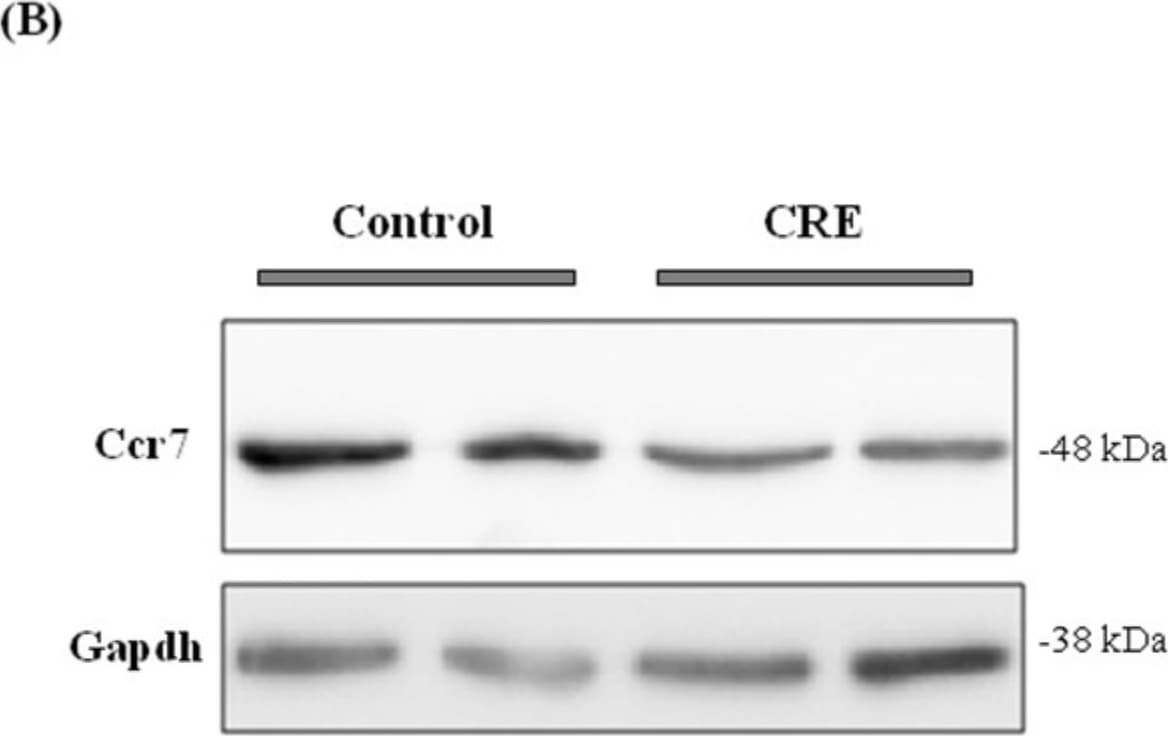
Western Blot: CCR7 Antibody (SR36-04) [NBP2-67324] -
Western Blot: CCR7 Antibody (SR36-04) [NBP2-67324] - Curcumae radix extract treatment exhibited anti-metastatic effects on primary tumor of MMTV-PyMT transgenic mouse. (A) Quantitative analysis of real-time PCR was done using genes associated with breast cancer metastasis. The expression levels of Ccr7, c-Fos, Mmp9, Ccl21, & Ccl19 were determined by qRT-PCR. The Hprt gene was used as input control, respectively, * p < 0.05 & ** p < 0.005 vs. control. (B) Western blot of proteins extracted from tumor tissues in the PyMT transgenic model against Ccr7 & Gapdh. Histogram data was presented as mean ± SEM. * p < 0.05 vs. control. (C) Western blot of proteins extracted from tumor tissues against Phosphorylated Akt, Phosphorylated Ampk, Her2, ERalpha, Gapdh & beta -actin. (D) Quantitative analysis of real time PCR was done by using genes associated with apoptosis. The expression levels of Jun, Akt, & Tnf were determined by qRT-PCR. Data are representative of three independent experiments & are expressed as the mean ± SD. Image collected & cropped by CiteAb from the following publication (https://pubmed.ncbi.nlm.nih.gov/30781353), licensed under a CC-BY license. Not internally tested by Novus Biologicals.![CCR7 Antibody (SR36-04) Western Blot: CCR7 Antibody (SR36-04) [NBP2-67324]](https://resources.rndsystems.com/images/products/nbp2-67324_-western-blot-639204597492177644.jpg "Western Blot: CCR7 Antibody (SR36-04) [NBP2-67324]")
Western Blot: CCR7 Antibody (SR36-04) [NBP2-67324]
Western blot analysis on different lysates with NBP2-67324 at 1/5,000 dilution. Lane 1: HDLM-2 cell lysate Lane 2: Jurkat cell lysate Lane 3: Daudi cell lysate Lane 4: MCF7 cell lysate Lane 5: Mouse spleen tissue lysate Lane 6: Mouse pancreas tissue lysate (low expression) Lane 7: Rat spleen tissue lysate Lysates/proteins at 20 µg/Lane. Predicted band size: 43 kDa Observed band size: 43 kDa Exposure time: 24 seconds; 4-20% SDS-PAGE gel. Proteins were transferred to a PVDF membrane and blocked with 5% NFDM/TBST for 1 hour at room temperature. NBP2-67324 at 1/5,000 dilution was used in 5% NFDM/TBST at 4℃ overnight. Goat Anti-Rabbit IgG [HRP] Secondary Antibody at 1:50,000 dilution was used for 1 hour at room temperature.![CCR7 Antibody (SR36-04) Western Blot: CCR7 Antibody (SR36-04) [NBP2-67324]](https://resources.rndsystems.com/images/products/nbp2-67324_-western-blot-639204598087311895.jpg "Western Blot: CCR7 Antibody (SR36-04) [NBP2-67324]")
Western Blot: CCR7 Antibody (SR36-04) [NBP2-67324]
Western blot analysis on different lysates with NBP2-67324 at 1/2,000 dilution. Lane 1: Raji cell lysate Lane 2: Daudi cell lysate Lane 3: EL4 cell lysate Lane 4: RAW264.7 cell lysate Lane 5: C6 cell lysate Lane 6: Rat spleen tissue lysate Lysates/proteins at 15 µg/Lane. Predicted band size: 43 kDa Observed band size: 43 kDa Exposure time: 10 seconds; 4-20% SDS-PAGE gel. Proteins were transferred to a PVDF membrane and blocked with 5% NFDM/TBST for 1 hour at room temperature. NBP2-67324 at 1/2,000 dilution was used in 5% NFDM/TBST at 4℃ overnight. Goat Anti-Rabbit IgG [HRP] Secondary Antibody at 1:50,000 dilution was used for 1 hour at room temperature.Applications for CCR7 Antibody (SR36-04)
Application
Recommended Usage
Immunocytochemistry/ Immunofluorescence
1:200
Immunohistochemistry-Paraffin
1:200
Western Blot
1:500-1:5000
Application Notes
IP-Assay-dependent
Formulation, Preparation, and Storage
Purification
Protein A purified
Formulation
TBS (pH7.4), 0.05% BSA, 40% Glycerol
Preservative
0.05% Sodium Azide
Concentration
1 mg/ml
Shipping
The product is shipped with polar packs. Upon receipt, store it immediately at the temperature recommended below.
Stability & Storage
Store at 4C short term. Aliquot and store at -20C long term. Avoid freeze-thaw cycles.
Background: CCR7
The primary role of the CCR7/CCL19/CCL21 chemokine signaling axis is homing T cells and DCs to lymph nodes and lymphoid tissues to initiate an immune response (1,2,5,6). In the context of cancer, the CCR7 signaling axis appears to have two opposing roles (2). Downregulation of CCR7 on CD8+ T cells contributes to effector cell migration and anti-cancer activities via cytotoxic tumor-infiltrating lymphocytes (2). However, upregulation of CCR7 by cancer cells can result in cancer cell migration and metastasis (2). Overexpression of CCR7 has been implicated in a variety of cancers including breast, cervical, gastric, head and neck cell carcinoma, and prostate (1,2,7). Studies in breast cancer have found that hypoxia increases CCR7 expression, and this activation can affect cancer cell invasion, extravasation, proliferation, angiogenesis, and metastasis through induction of multiple signaling transduction pathways such as PI3K/AKT, MAPK, and JAK/STAT (5,7).
Given its important role in inflammation and immune response, several strategies have been employed to target the CCR7 signaling axis for cancer immunotherapy (2). Some cancer immunotherapies under investigation include intra-tumoral administration of CCL19 and CCL21, introduction of patient-derived cells transfected to express CCR7 or its ligands, and vaccines (2). Further interrogation of CCR7/CCL19/CCL21 signaling axis is required to develop better therapeutic strategies for cancer treatment.
References:
1. Comerford, I., Harata-Lee, Y., Bunting, M. D., Gregor, C., Kara, E. E., & McColl, S. R. (2013). A myriad of functions and complex regulation of the CCR7/CCL19/CCL21 chemokine axis in the adaptive immune system. Cytokine & growth factor reviews, 24(3), 269-283. https://doi.org/10.1016/j.cytogfr.2013.03.001
2. Salem, A., Alotaibi, M., Mroueh, R., Basheer, H. A., & Afarinkia, K. (2021). CCR7 as a therapeutic target in Cancer. Biochimica et biophysica acta. Reviews on cancer, 1875(1), 188499. https://doi.org/10.1016/j.bbcan.2020.188499
3. Yan, Y., Chen, R., Wang, X., Hu, K., Huang, L., Lu, M., & Hu, Q. (2019). CCL19 and CCR7 Expression, Signaling Pathways, and Adjuvant Functions in Viral Infection and Prevention. Frontiers in cell and developmental biology, 7, 212. https://doi.org/10.3389/fcell.2019.00212
4. Uniprot (P32248)
5. Korbecki, J., Grochans, S., Gutowska, I., Barczak, K., & Baranowska-Bosiacka, I. (2020). CC Chemokines in a Tumor: A Review of Pro-Cancer and Anti-Cancer Properties of Receptors CCR5, CCR6, CCR7, CCR8, CCR9, and CCR10 Ligands. International journal of molecular sciences, 21(20), 7619. https://doi.org/10.3390/ijms21207619
6. Sanchez-Sanchez, N., Riol-Blanco, L., & Rodriguez-Fernandez, J. L. (2006). The multiple personalities of the chemokine receptor CCR7 in dendritic cells. Journal of immunology (Baltimore, Md. : 1950), 176(9), 5153-5159. https://doi.org/10.4049/jimmunol.176.9.5153
7. Rizeq, B., & Malki, M. I. (2020). The Role of CCL21/CCR7 Chemokine Axis in Breast Cancer Progression. Cancers, 12(4), 1036. https://doi.org/10.3390/cancers12041036
Alternate Names
BLR2, CC-CKR-7, CCR7, CD197, CDw197, CMKBR7, EBI1
Gene Symbol
CCR7
Additional CCR7 Products
Product Documents for CCR7 Antibody (SR36-04)
Certificate of Analysis
To download a Certificate of Analysis, please enter a lot or batch number in the search box below.
Product Specific Notices for CCR7 Antibody (SR36-04)
This product is for research use only and is not approved for use in humans or in clinical diagnosis. Primary Antibodies are guaranteed for 1 year from date of receipt.
Citations for CCR7 Antibody (SR36-04)
 Powered by Bioz
Customer Reviews for CCR7 Antibody (SR36-04)
There are currently no reviews for this product. Be the first to review CCR7 Antibody (SR36-04) and earn rewards!
Have you used CCR7 Antibody (SR36-04)?
Submit a review and receive an Amazon gift card!
$25/€18/£15/$25CAN/¥2500 for a review with an image
$10/€7/£6/$10CAN/¥1110 for a review without an image
Submit a review
Protocols
Find general support by application which include: protocols, troubleshooting, illustrated assays, videos and webinars.
- Antigen Retrieval Protocol (PIER)
- Antigen Retrieval for Frozen Sections Protocol
- Appropriate Fixation of IHC/ICC Samples
- Cellular Response to Hypoxia Protocols
- Chromogenic IHC Staining of Formalin-Fixed Paraffin-Embedded (FFPE) Tissue Protocol
- Chromogenic Immunohistochemistry Staining of Frozen Tissue
- ClariTSA™ Fluorophore Kits
- Detection & Visualization of Antibody Binding
- Fluorescent IHC Staining of Frozen Tissue Protocol
- Graphic Protocol for Heat-induced Epitope Retrieval
- Graphic Protocol for the Preparation and Fluorescent IHC Staining of Frozen Tissue Sections
- Graphic Protocol for the Preparation and Fluorescent IHC Staining of Paraffin-embedded Tissue Sections
- Graphic Protocol for the Preparation of Gelatin-coated Slides for Histological Tissue Sections
- ICC Cell Smear Protocol for Suspension Cells
- ICC Immunocytochemistry Protocol Videos
- ICC for Adherent Cells
- IHC Sample Preparation (Frozen sections vs Paraffin)
- Immunocytochemistry (ICC) Protocol
- Immunocytochemistry Troubleshooting
- Immunofluorescence of Organoids Embedded in Cultrex Basement Membrane Extract
- Immunofluorescent IHC Staining of Formalin-Fixed Paraffin-Embedded (FFPE) Tissue Protocol
- Immunohistochemistry (IHC) and Immunocytochemistry (ICC) Protocols
- Immunohistochemistry Frozen Troubleshooting
- Immunohistochemistry Paraffin Troubleshooting
- Immunoprecipitation Protocol
- Preparing Samples for IHC/ICC Experiments
- Preventing Non-Specific Staining (Non-Specific Binding)
- Primary Antibody Selection & Optimization
- Protocol for Heat-Induced Epitope Retrieval (HIER)
- Protocol for Making a 4% Formaldehyde Solution in PBS
- Protocol for VisUCyte™ HRP Polymer Detection Reagent
- Protocol for the Fluorescent ICC Staining of Cell Smears - Graphic
- Protocol for the Fluorescent ICC Staining of Cultured Cells on Coverslips - Graphic
- Protocol for the Preparation & Fixation of Cells on Coverslips
- Protocol for the Preparation and Chromogenic IHC Staining of Frozen Tissue Sections
- Protocol for the Preparation and Chromogenic IHC Staining of Frozen Tissue Sections - Graphic
- Protocol for the Preparation and Chromogenic IHC Staining of Paraffin-embedded Tissue Sections
- Protocol for the Preparation and Chromogenic IHC Staining of Paraffin-embedded Tissue Sections - Graphic
- Protocol for the Preparation and Fluorescent ICC Staining of Cells on Coverslips
- Protocol for the Preparation and Fluorescent ICC Staining of Non-adherent Cells
- Protocol for the Preparation and Fluorescent ICC Staining of Stem Cells on Coverslips
- Protocol for the Preparation and Fluorescent IHC Staining of Frozen Tissue Sections
- Protocol for the Preparation and Fluorescent IHC Staining of Paraffin-embedded Tissue Sections
- Protocol for the Preparation of Gelatin-coated Slides for Histological Tissue Sections
- Protocol for the Preparation of a Cell Smear for Non-adherent Cell ICC - Graphic
- R&D Systems Quality Control Western Blot Protocol
- TUNEL and Active Caspase-3 Detection by IHC/ICC Protocol
- The Importance of IHC/ICC Controls
- Troubleshooting Guide: Immunohistochemistry
- Troubleshooting Guide: Western Blot Figures
- Western Blot Conditions
- Western Blot Protocol
- Western Blot Protocol for Cell Lysates
- Western Blot Troubleshooting
- Western Blot Troubleshooting Guide
- View all Protocols, Troubleshooting, Illustrated assays and Webinars


