
Donkey anti-Goat IgG Secondary Antibody [NL637]
R&D Systems | Catalog # NL002

Scientific images may be resized, cropped, or adjusted for brightness or contrast for presentation purposes. These updates are limited to presentation and do not affect the underlying scientific interpretation of the data. Where available, additional source data may be provided upon request.
Key Product Details
Species Reactivity
Applications
Label
Antibody Source
Product Specifications
Immunogen
Specificity
Clonality
Host
Isotype
Scientific Data Images for Donkey anti-Goat IgG Secondary Antibody [NL637]
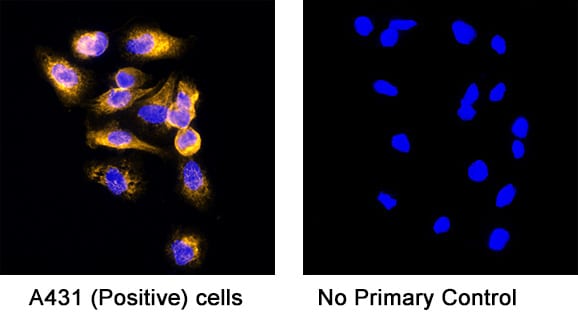
Detection of Goat IgG Primary Antibody by Immunocytochemistry.
Detection of human EGFR by incubating cells with 5 μg/mL of Goat anti-Human EGFR polyclonal antibody (AF231) at room temperature for 1 hour followed by incubation with 1:200 dilution of Donkey Anti-Goat IgG NorthernLights™ NL637-conjugated secondary antibody for 1 hour at room temperature. Note strong positive staining in A431 cells (left panel, positive control) and a lack of non-specific background staining in the absence of primary antibodies (right panel, negative control).Applications for Donkey anti-Goat IgG Secondary Antibody [NL637]
Immunocytochemistry
Formulation, Preparation, and Storage
Purification
Formulation
Shipping
Stability & Storage
- 12 months from date of receipt, 2 to 8 °C as supplied.
Background: IgG
Long Name
Alternate Names
Additional IgG Products
Product Documents for Donkey anti-Goat IgG Secondary Antibody [NL637]
Certificate of Analysis
To download a Certificate of Analysis, please enter a lot or batch number in the search box below.
Note: Certificate of Analysis not available for kit components.
Product Specific Notices for Donkey anti-Goat IgG Secondary Antibody [NL637]
For research use only
Citations for Donkey anti-Goat IgG Secondary Antibody [NL637]
 Powered by Bioz
Customer Reviews for Donkey anti-Goat IgG Secondary Antibody [NL637]
There are currently no reviews for this product. Be the first to review Donkey anti-Goat IgG Secondary Antibody [NL637] and earn rewards!
Have you used Donkey anti-Goat IgG Secondary Antibody [NL637]?
Submit a review and receive an Amazon gift card!
$25/€18/£15/$25CAN/¥2500 for a review with an image
$10/€7/£6/$10CAN/¥1110 for a review without an image
Submit a review
Protocols
Find general support by application which include: protocols, troubleshooting, illustrated assays, videos and webinars.
- Appropriate Fixation of IHC/ICC Samples
- Cellular Response to Hypoxia Protocols
- ClariTSA™ Fluorophore Kits
- Detection & Visualization of Antibody Binding
- ICC Cell Smear Protocol for Suspension Cells
- ICC Immunocytochemistry Protocol Videos
- ICC for Adherent Cells
- Immunocytochemistry (ICC) Protocol
- Immunocytochemistry Troubleshooting
- Immunofluorescence of Organoids Embedded in Cultrex Basement Membrane Extract
- Immunohistochemistry (IHC) and Immunocytochemistry (ICC) Protocols
- Preparing Samples for IHC/ICC Experiments
- Preventing Non-Specific Staining (Non-Specific Binding)
- Primary Antibody Selection & Optimization
- Protocol for VisUCyte™ HRP Polymer Detection Reagent
- Protocol for the Fluorescent ICC Staining of Cell Smears - Graphic
- Protocol for the Fluorescent ICC Staining of Cultured Cells on Coverslips - Graphic
- Protocol for the Preparation and Fluorescent ICC Staining of Cells on Coverslips
- Protocol for the Preparation and Fluorescent ICC Staining of Non-adherent Cells
- Protocol for the Preparation and Fluorescent ICC Staining of Stem Cells on Coverslips
- Protocol for the Preparation of a Cell Smear for Non-adherent Cell ICC - Graphic
- TUNEL and Active Caspase-3 Detection by IHC/ICC Protocol
- The Importance of IHC/ICC Controls
- View all Protocols, Troubleshooting, Illustrated assays and Webinars
FAQs for Donkey anti-Goat IgG Secondary Antibody [NL637]
-
Q: Are products derived from donkey serum listed on the Convention on International Trade in Endangered Species of Wild Fauna and Flora (CITES)?
A: All products derived from donkeys were produced from the sera of domestic donkeys of a genus and species not protected by CITES. No CITES permit is required for the transportation of these materials.