CD45, previously called LCA (Leukocyte Common Antigen), T200, or Ly5 in mice, is member C of the class 1 (Receptor‑like) Protein Tyrosine Phosphatase family (PTPRC) (1, 2). It is a variably glycosylated 180‑220 kDa transmembrane protein that is abundantly expressed on all nucleated cells of hematopoietic origin (1‑3). CD45 has several isoforms, expressed according to cell type, developmental stage and antigenic exposure (1‑5). The longest form, CD45RABC (called B220 in mouse), is expressed on B lymphocytes (5). The CD45RABC cDNA encodes 1304 amino acids (aa), including a 23 aa signal sequence, a 552 aa extracellular domain containing the splicing region, a cysteine‑rich region and two fibronectin type III domains, a 22 aa transmembrane sequence, and a 707 aa cytoplasmic domain that contains two phosphatase domains, D1 and D2. Only D1 has phosphatase activity. CD45R0 is the shortest form, lacking exons 4, 5 and 6 which encode aa 32‑191. It is expressed on memory cells, while intermediate sizes are expressed on other T cells (3, 4, 6). CD45 has been best studied in T cells, where it determines T cell receptor signaling thresholds (3, 6‑8). CD45 is moved into or out of the Immunological Synapse (IS) membrane microdomain depending on the relative influence of interaction with the extracellular galectin lattice or the intracellular actin cytoskeleton (9, 10). Galectin interaction can be fine‑tuned by varying usage of the heavily O‑glycosylated spliced regions and sialylation of N‑linked carbohydrates (4, 9). Within the IS, CD45 dephosphorylates and negatively regulates the Src family kinase, Lck (8‑10). In other leukocytes, CD45 influences differentiation and links immunoreceptor signaling with cytokine secretion and cell survival, partially overlapping in function with DEP‑1/CD148 (11‑14). CD45 deletion causes in severe immunodeficiency, while point mutations may be associated with autoimmune disorders (6, 7).
Human CD45 Antibody (2D1) [PE]
R&D Systems | Catalog # FAB1430P

Scientific images may be resized, cropped, or adjusted for brightness or contrast for presentation purposes. These updates are limited to presentation and do not affect the underlying scientific interpretation of the data. Where available, additional source data may be provided upon request.
Key Product Details
Species Reactivity
Validated:
Cited:
Applications
Validated:
Cited:
Label
Antibody Source
Product Specifications
Immunogen
Specificity
Clonality
Host
Isotype
Scientific Data Images for Human CD45 Antibody (2D1) [PE]
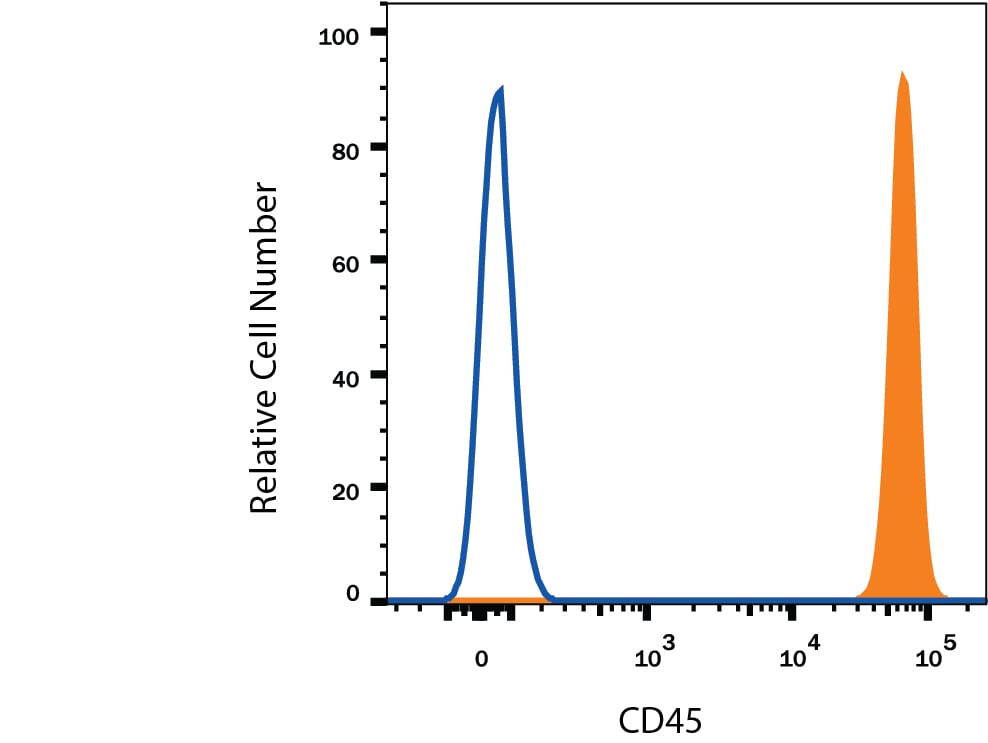
Detection of CD45 in Human Blood Lymphocytes by Flow Cytometry.
Human peripheral blood lymphocytes were stained with Mouse Anti-Human CD45 PE-conjugated Monoclonal Antibody (Catalog # FAB1430P, filled histogram) or isotype control antibody (Catalog # IC002P, open histogram). View our protocol for Staining Membrane-associated Proteins.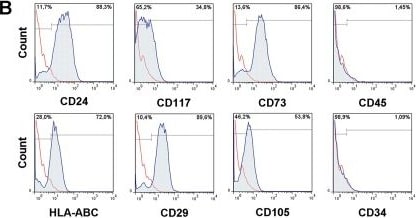
Detection of Human CD45 by Flow Cytometry
Isolation and characterization of amniotic derived mesenchymal stem cells with renal marker expression(A) Light microscopic image of mesenchymal stem cells isolated from amniotic fluid. A subpopulation of these cells (with renal markers) displays a trumpet shaped phenotype (scale bar = 200 μm). (B) hAFSCs were characterized by flow cytometry (positive for CD24, CD117, CD73, HLA-ABC, CD29, and CD105 but not for CD45, or CD34). (C) Confocal imaging of hAFSCs for renal markers SIX2 and PAX2. (D) Expression of Six2 and Pax2 (left panel) in hAFSCs compared to human embryonic kidney (hEK). Agarose gel analysis of PCR fragments (SIX2: 336 bp; PAX2: 65 bp; KSP: 152bp; GAPDH: 189 bp) (E). hAFSCs were differentiated along adipogenic, osteogenic and chondrogenic lineages (left to right). In the adipogenic differentiation the cells formed lipid vesicles stained with oil red O (left) (magnification 100X). Calcium deposits stained with Alizarin confirmed osteogenesis (center). Micromasses stained with alcian blue confirmed chondrogenesis (right) (scale bar = 200 μm). Quantification of chondrogenic and osteogenic differentiation using dye extraction and quantification with spectrophotometry before and after differentiation (left panel). qPCR analysis of chondrogenic markers (Sox9, Col II) and osteogenic markers (ALP, Runx2 and OST) before and after differentiation (right panel). Image collected and cropped by CiteAb from the following publication (https://dx.plos.org/10.1371/journal.pone.0136145), licensed under a CC-BY license. Not internally tested by R&D Systems.Applications for Human CD45 Antibody (2D1) [PE]
Flow Cytometry
Sample: Human peripheral blood lymphocytes
Reviewed Applications
Read 1 review rated 4 using FAB1430P in the following applications:
Spectra Viewer
Plan Your Experiments
Use our spectra viewer to interactively plan your experiments, assessing multiplexing options. View the excitation and emission spectra for our fluorescent dye range and other commonly used dyes.
Spectra Viewer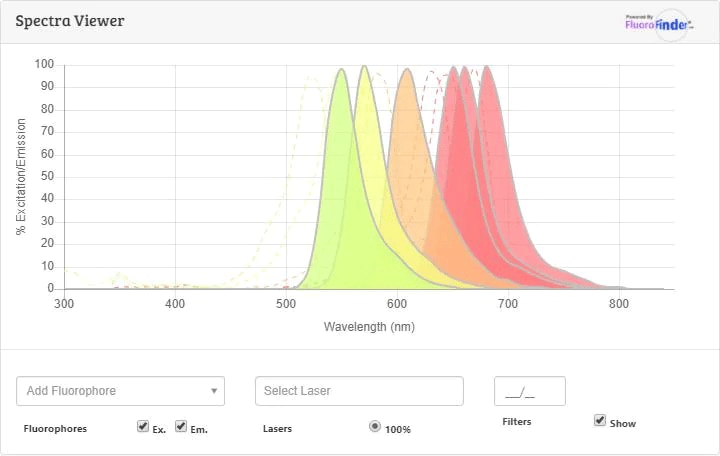
Flow Cytometry Panel Builder
Bio-Techne Knows Flow Cytometry
Save time and reduce costly mistakes by quickly finding compatible reagents using the Panel Builder Tool.
Advanced Features
- Spectra Viewer - Custom analysis of spectra from multiple fluorochromes
- Spillover Popups - Visualize the spectra of individual fluorochromes
- Antigen Density Selector - Match fluorochrome brightness with antigen density

Formulation, Preparation, and Storage
Purification
Formulation
Shipping
Stability & Storage
- 12 months from date of receipt, 2 to 8 °C as supplied.
Background: CD45
References
- Anderson, J.N. et al. (2004) FASEB J. 18:8.
- Streuli, M. et al. (1987) J. Exp. Med. 166:1548.
- Hermiston, M.L. et al. (2003) Annu. Rev. Immunol. 21:107.
- Earl, L.A. and L.G. Baum (2008) Immunol. Cell Biol. 86:608.
- Ralph, S.J. et al. (1987) EMBO J. 6:1251.
- Falahti, R. and D. Leitenberg (2008) J. Immunol. 181:6082.
- Tchilian, E.Z. and P.C.L. Beverley (2006) Trends Immunol. 27:146.
- McNiell, L. et al. (2007) Immunity 27:425.
- Chen, I-J. et al. (2007) J. Biol. Chem. 282:35361.
- Freiberg, B.A. et al. (2002) Nat. Immunol. 3:911.
- Zhu, J.W. et al. (2008) Immunity 28:183.
- Huntington, N.D. et al. (2006) Nat. Immunol. 7:190.
- Hesslein, D.G. et al. (2006) Proc. Natl. Acad. Sci. USA 103:7012.
- Cross, J.L. et al. (2008) J. Immunol. 180:8020.
Long Name
Alternate Names
Gene Symbol
Additional CD45 Products
Product Documents for Human CD45 Antibody (2D1) [PE]
Certificate of Analysis
To download a Certificate of Analysis, please enter a lot or batch number in the search box below.
Note: Certificate of Analysis not available for kit components.
Product Specific Notices for Human CD45 Antibody (2D1) [PE]
For research use only
Related Research Areas
Citations for Human CD45 Antibody (2D1) [PE]
 Powered by Bioz
Customer Reviews for Human CD45 Antibody (2D1) [PE] (1)
Have you used Human CD45 Antibody (2D1) [PE]?
Submit a review and receive an Amazon gift card!
$25/€18/£15/$25CAN/¥2500 for a review with an image
$10/€7/£6/$10CAN/¥1110 for a review without an image
Submit a review
-
Application: Flow CytometrySample Tested: Human embryonic stem cells (H9 from Wicell)Species: HumanVerified Customer | Posted 08/16/2016
There are no reviews that match your criteria.
Protocols
Find general support by application which include: protocols, troubleshooting, illustrated assays, videos and webinars.
- 7-Amino Actinomycin D (7-AAD) Cell Viability Flow Cytometry Protocol
- Extracellular Membrane Flow Cytometry Protocol
- Flow Cytometry Protocol for Cell Surface Markers
- Flow Cytometry Protocol for Staining Membrane Associated Proteins
- Flow Cytometry Staining Protocols
- Flow Cytometry Troubleshooting Guide
- Intracellular Flow Cytometry Protocol Using Alcohol (Methanol)
- Intracellular Flow Cytometry Protocol Using Detergents
- Intracellular Nuclear Staining Flow Cytometry Protocol Using Detergents
- Intracellular Staining Flow Cytometry Protocol Using Alcohol Permeabilization
- Intracellular Staining Flow Cytometry Protocol Using Detergents to Permeabilize Cells
- Propidium Iodide Cell Viability Flow Cytometry Protocol
- Protocol for Liperfluo
- Protocol for the Characterization of Human Th22 Cells
- Protocol for the Characterization of Human Th9 Cells
- Protocol: Annexin V and PI Staining by Flow Cytometry
- Protocol: Annexin V and PI Staining for Apoptosis by Flow Cytometry
- Troubleshooting Guide: Fluorokine Flow Cytometry Kits
- View all Protocols, Troubleshooting, Illustrated assays and Webinars
Associated Pathways