
CDCP1, also known as SIMA135, is a novel 140 kDa type I transmembrane glycoprotein with three CUB protein-protein interaction domains in its 635 aa extracellular region. The 148 aa cytoplasmic region contains canonical phosphorylation sites for Src kinase family members and binding sites for SH3 domains. By alternative splicing, a secreted 310 aa residue form of CDCP1 also exists. The amino-terminal region of approximately 265 aa of the type I membrane CDCP1 can also be proteolytically cleaved. CDCP1 is found on the surface of epithelial and bone marrow-derived stem cells. The extracellular region of human CDCP1 shares 84% aa identity with that of the mouse protein.

Scientific images may be resized, cropped, or adjusted for brightness or contrast for presentation purposes. These updates are limited to presentation and do not affect the underlying scientific interpretation of the data. Where available, additional source data may be provided upon request.
Key Product Details
Species Reactivity
Validated:
Human
Cited:
Human
Applications
Validated:
Western Blot, Immunoprecipitation
Cited:
Immunohistochemistry, Western Blot, Immunocytochemistry
Label
Unconjugated
Antibody Source
Monoclonal Mouse IgG1 Clone # 309137
Loading...
Product Specifications
Immunogen
Mouse myeloma cell line NS0-derived recombinant human CDCP1 isoform 1
Ala33-Leu666
Accession # NP_073753
Ala33-Leu666
Accession # NP_073753
Specificity
Detects human CDCP1 in direct ELISAs and Western blots. Recognizes an epitope found between aa 33‑369 of human CDCP1.
Clonality
Monoclonal
Host
Mouse
Isotype
IgG1
Scientific Data Images for Human CDCP1 Antibody (309137)
Detection of CDCP1 by Western Blot
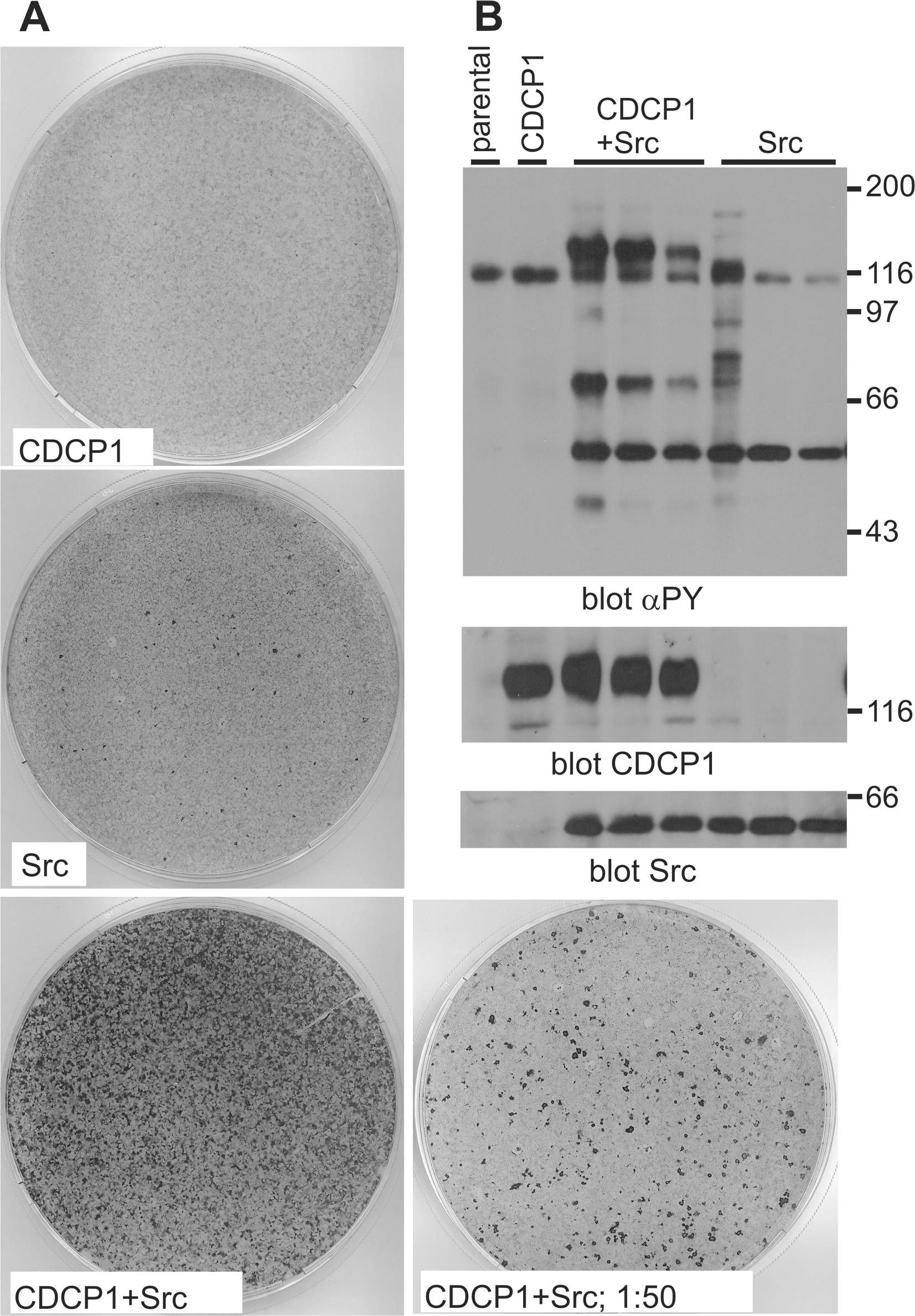
Co-overexpression of Src and CDCP1 leads to focus formation.(A) Fifty thousand NIH3T3 cells were infected with 500.000 retroviruses encoding CDCP1 or Src individually or together. After 48 h the cells were reseeded in a 10 cm-dish and grown for 3 weeks, with 3 media changes per week. In parallel, a 2% aliquot was taken from the CDCP1/Src infected cells and reseeded together with 150.000 parental NIH3T3 cells (1∶50 dilution). Finally, the cells were stained with crystal violett. (B) Parental NIH3T3 cells, cells infected with the CDCP1 encoding retrovirus or individual foci derived from infections at lower m.o.i. than in A that had been isolated and expanded, were lysed, aliquots with similar amounts of protein run on an SDS-PAGE, proteins transferred to nitrocellulose and the filter blotted with the indicated antibodies. alpha PY, anti-phosphotyrosine. Size markers (kDa) are indicated. Image collected and cropped by CiteAb from the following open publication (https://pubmed.ncbi.nlm.nih.gov/23300860), licensed under a CC-BY license. Not internally tested by R&D Systems.Applications for Human CDCP1 Antibody (309137)
Application
Recommended Usage
Immunoprecipitation
25 µg/mL
Sample: Conditioned cell culture medium spiked with Recombinant Human CDCP1, see our available Western blot detection antibodies
Sample: Conditioned cell culture medium spiked with Recombinant Human CDCP1, see our available Western blot detection antibodies
Western Blot
1 µg/mL
Sample: Recombinant Human CDCP1
Sample: Recombinant Human CDCP1
Reviewed Applications
Read 1 review rated 4 using MAB2666 in the following applications:
Formulation, Preparation, and Storage
Purification
Protein A or G purified from hybridoma culture supernatant
Reconstitution
Reconstitute at 0.5 mg/mL in sterile PBS. For liquid material, refer to CoA for concentration.
Loading...
Formulation
Lyophilized from a 0.2 μm filtered solution in PBS with Trehalose. *Small pack size (SP) is supplied either lyophilized or as a 0.2 µm filtered solution in PBS.
Shipping
Lyophilized product is shipped at ambient temperature. Liquid small pack size (-SP) is shipped with polar packs. Upon receipt, store immediately at the temperature recommended below.
Stability & Storage
Use a manual defrost freezer and avoid repeated freeze-thaw cycles.
- 12 months from date of receipt, -20 to -70 °C as supplied.
- 1 month, 2 to 8 °C under sterile conditions after reconstitution.
- 6 months, -20 to -70 °C under sterile conditions after reconstitution.
Calculators
Background: CDCP1
Long Name
CUB Domain Containing Protein 1
Alternate Names
CD318, SIMA135
Gene Symbol
CDCP1
UniProt
Additional CDCP1 Products
Product Documents for Human CDCP1 Antibody (309137)
Certificate of Analysis
To download a Certificate of Analysis, please enter a lot or batch number in the search box below.
Note: Certificate of Analysis not available for kit components.
Product Specific Notices for Human CDCP1 Antibody (309137)
For research use only
Related Research Areas
Citations for Human CDCP1 Antibody (309137)
 Powered by Bioz
Customer Reviews for Human CDCP1 Antibody (309137) (1)
4 out of 5
1 Customer Rating
Have you used Human CDCP1 Antibody (309137)?
Submit a review and receive an Amazon gift card!
$25/€18/£15/$25CAN/¥2500 for a review with an image
$10/€7/£6/$10CAN/¥1110 for a review without an image
Submit a review
Showing
1
-
1 of
1 review
Showing All
Filter By:
-
Application: Western BlotSample Tested: See PMID 23300860Species: HumanVerified Customer | Posted 02/19/2015
There are no reviews that match your criteria.
Protocols
Find general support by application which include: protocols, troubleshooting, illustrated assays, videos and webinars.
- Cellular Response to Hypoxia Protocols
- Immunoprecipitation Protocol
- R&D Systems Quality Control Western Blot Protocol
- Troubleshooting Guide: Western Blot Figures
- Western Blot Conditions
- Western Blot Protocol
- Western Blot Protocol for Cell Lysates
- Western Blot Troubleshooting
- Western Blot Troubleshooting Guide
- View all Protocols, Troubleshooting, Illustrated assays and Webinars
Loading...