
CHD7 (Chromohelicase/ATPase DNA-binding protein 7) is a 350 kDa member of the third subgroup in the SNF2/RAD54 helicase family of proteins. It is an ATP‑dependent chromatin remodeling factor that also binds histones (H3 at Lys4) and influences transcription. CHD7 binds more that 10,000 sites on chromatin, particularly in locations associated with gene enhancement. Notably, CHD7 is most associated with the nervous system, and is found in embryonic hypothalamus (GnRH neurons), olfactory epithelium and spinal cord, and adult preoptic hypothalamus plus hippocampus. Human CHD7 is 2997 amino acids (aa) in length. It contains consecutive Gln-, Pro- and Lys-rich regions (aa 151-718), two Chromo (chromatin-organizer-modifer) domains (aa 800-947), a helicase ATP-binding domain (aa 980-1154), a C-terminal helicase domain (aa 1294-1464), one coiled-coil region (aa 2410-2431) and two BRK domains (aa 2562-2604 and 2642-2686). There are at least seven utilized Ser/Thr phosphorylation sites, and three potential isoform variants. One isoform contains a 12 aa substitution for aa 1127-2997, a second 145 kDa isoform shows a deletion of aa 573-2621, while a third isoform contains a 15 aa insertion after Ser698. CHD7 is reported to bind to subgroup three member CHD8. Over aa 263-457, human CHD7 shares 96% aa identity with mouse CHD7.

Scientific images may be resized, cropped, or adjusted for brightness or contrast for presentation purposes. These updates are limited to presentation and do not affect the underlying scientific interpretation of the data. Where available, additional source data may be provided upon request.
Key Product Details
Species Reactivity
Validated:
Cited:
Applications
Validated:
Cited:
Label
Antibody Source
Product Specifications
Immunogen
Ala263-Gln457
Accession # Q9P2D1
Specificity
Clonality
Host
Isotype
Scientific Data Images for Human CHD7 Antibody
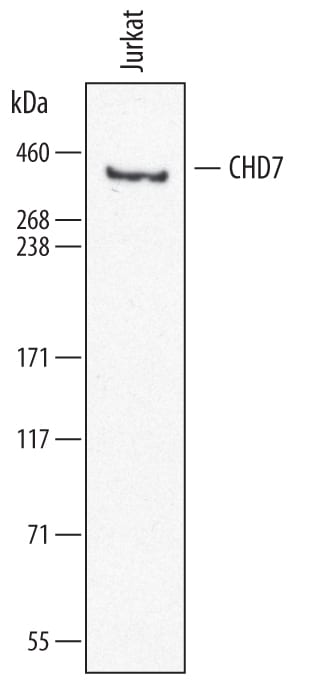
Detection of Human CHD7 by Western Blot.
Western blot shows lysates of Jurkat human acute T cell leukemia cell line. PVDF membrane was probed with 0.5 µg/mL of Sheep Anti-Human CHD7 Antigen Affinity-purified Polyclonal Antibody (Catalog # AF7350) followed by HRP-conjugated Anti-Sheep IgG Secondary Antibody (Catalog # HAF016). A specific band was detected for CHD7 at approximately 350 kDa (as indicated). This experiment was conducted under reducing conditions and using Immunoblot Buffer Group 8.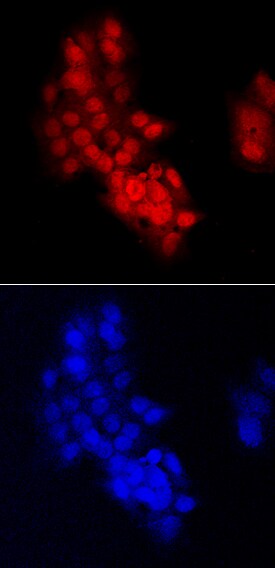
CHD7 in HepG2 Human Cell Line.
CHD7 was detected in immersion fixed HepG2 human hepatocellular carcinoma cell line using Sheep Anti-Human CHD7 Antigen Affinity-purified Polyclonal Antibody (Catalog # AF7350) at 10 µg/mL for 3 hours at room temperature. Cells were stained using the NorthernLights™ 557-conjugated Anti-Sheep IgG Secondary Antibody (red, upper panel; Catalog # NL010) and counterstained with DAPI (blue, lower panel). Specific staining was localized to nuclei. View our protocol for Fluorescent ICC Staining of Cells on Coverslips.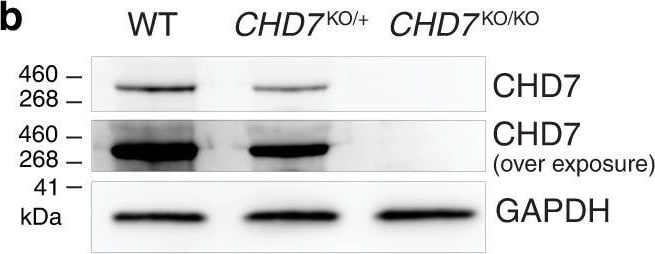
Detection of CHD7 by Western Blot
CHD7 and its ATP-dependent chromatin remodeling activities are required for sensory epithelium derivation. A Sanger sequencing chromatograms of CHD7KO/+ and CHD7KO/KO alleles cloned into TOPO vectors. b Western blotting of WT (PAX2nG), CHD7KO/+, and CHD7KO/KO hESCs using an anti-CHD7 antibody. Source data are provided as a Source Data file. c Sanger sequencing chromatograms of WT (PAX2nG), CHD7S834F/+, and CHD7S834F/S834F hESCs at the CHD7 c.2501 locus. d–w Immunostaining of d20 and d70 WT and CHD7 mutant organoids. Antibodies highlight otic progenitors (PAX2nG, PAX8, and EPCAM), hair cells (MYO7A, POU4F3, PCP4, SOX2, and F-actin for stereocilia of hair cells), and supporting cells (SPARCL1 and SOX2). Scale bars, 25 µm (top two rows of d–w), 10 µm (third row of d–w), and 5 µm (bottom row of d–w). Image collected and cropped by CiteAb from the following open publication (https://pubmed.ncbi.nlm.nih.gov/36396635), licensed under a CC-BY license. Not internally tested by R&D Systems.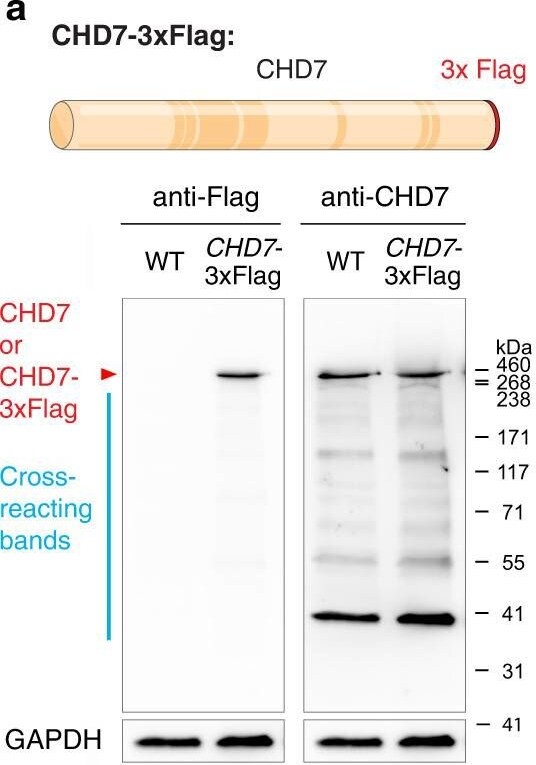
Detection of CHD7 by Western Blot
CHD7 is expressed at key otic development stages.a Western blotting of WT (PAX2−2a-nGFP cell line, hereafter PAX2nG) and CHD7−3×Flag hESCs using anti-Flag and anti-CHD7 antibodies. Calculated molecular weight of CHD7 and CHD7-3×Flag are 336 kDa and 339 kDa, respectively. Source data are provided as a Source Data file. b Schematics of otic lineage differentiation during human inner ear organoid culture. Schematics adapted from Nie J, Hashino E. (2020) Generation of inner ear organoids from human pluripotent stem cells. Methods in Cell Biology, 159: 303–321, with permission from Elsevier. c–g Immunostaining at key otic development stages in CHD7−3×Flag PAX2nG human inner ear organoids using an anti-Flag antibody, as well as antibodies against NNE markers TFAP2A and CDH1, OEPD markers TFAP2A and PAX8, otic placode/pit and otic vesicle markers PAX2nG, PAX8, and EPCAM, and hair cell markers MYO7A and SOX2 and supporting cell marker SOX2. Scale bars, 25 µm. Image collected and cropped by CiteAb from the following open publication (https://pubmed.ncbi.nlm.nih.gov/36396635), licensed under a CC-BY license. Not internally tested by R&D Systems.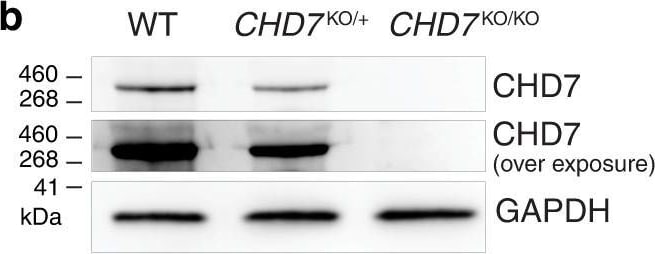
Detection of CHD7 by Western Blot
CHD7 and its ATP-dependent chromatin remodeling activities are required for sensory epithelium derivation. A Sanger sequencing chromatograms of CHD7KO/+ and CHD7KO/KO alleles cloned into TOPO vectors. b Western blotting of WT (PAX2nG), CHD7KO/+, and CHD7KO/KO hESCs using an anti-CHD7 antibody. Source data are provided as a Source Data file. c Sanger sequencing chromatograms of WT (PAX2nG), CHD7S834F/+, and CHD7S834F/S834F hESCs at the CHD7 c.2501 locus. d–w Immunostaining of d20 and d70 WT and CHD7 mutant organoids. Antibodies highlight otic progenitors (PAX2nG, PAX8, and EPCAM), hair cells (MYO7A, POU4F3, PCP4, SOX2, and F-actin for stereocilia of hair cells), and supporting cells (SPARCL1 and SOX2). Scale bars, 25 µm (top two rows of d–w), 10 µm (third row of d–w), and 5 µm (bottom row of d–w). Image collected and cropped by CiteAb from the following open publication (https://pubmed.ncbi.nlm.nih.gov/36396635), licensed under a CC-BY license. Not internally tested by R&D Systems.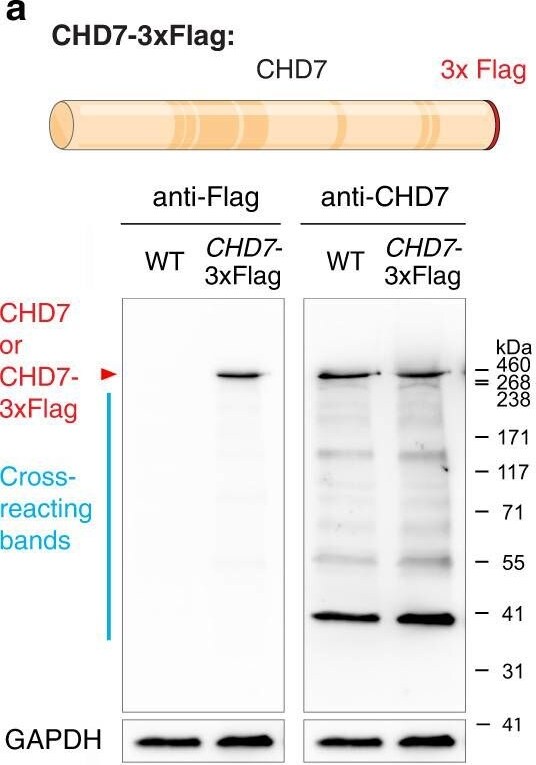
Detection of CHD7 by Western Blot
CHD7 is expressed at key otic development stages.a Western blotting of WT (PAX2−2a-nGFP cell line, hereafter PAX2nG) and CHD7−3×Flag hESCs using anti-Flag and anti-CHD7 antibodies. Calculated molecular weight of CHD7 and CHD7-3×Flag are 336 kDa and 339 kDa, respectively. Source data are provided as a Source Data file. b Schematics of otic lineage differentiation during human inner ear organoid culture. Schematics adapted from Nie J, Hashino E. (2020) Generation of inner ear organoids from human pluripotent stem cells. Methods in Cell Biology, 159: 303–321, with permission from Elsevier. c–g Immunostaining at key otic development stages in CHD7−3×Flag PAX2nG human inner ear organoids using an anti-Flag antibody, as well as antibodies against NNE markers TFAP2A and CDH1, OEPD markers TFAP2A and PAX8, otic placode/pit and otic vesicle markers PAX2nG, PAX8, and EPCAM, and hair cell markers MYO7A and SOX2 and supporting cell marker SOX2. Scale bars, 25 µm. Image collected and cropped by CiteAb from the following open publication (https://pubmed.ncbi.nlm.nih.gov/36396635), licensed under a CC-BY license. Not internally tested by R&D Systems.Applications for Human CHD7 Antibody
Immunocytochemistry
Sample: Immersion fixed HepG2 human hepatocellular carcinoma cell line
Western Blot
Sample: Jurkat human acute T cell leukemia cell line
Formulation, Preparation, and Storage
Purification
Reconstitution
Sterile PBS to a final concentration of 0.2 mg/mL. For liquid material, refer to CoA for concentration.
Formulation
Shipping
Stability & Storage
- 12 months from date of receipt, -20 to -70 °C as supplied.
- 1 month, 2 to 8 °C under sterile conditions after reconstitution.
- 6 months, -20 to -70 °C under sterile conditions after reconstitution.
Calculators
Background: CHD7
Long Name
Alternate Names
Gene Symbol
UniProt
Additional CHD7 Products
Product Documents for Human CHD7 Antibody
Certificate of Analysis
To download a Certificate of Analysis, please enter a lot or batch number in the search box below.
Note: Certificate of Analysis not available for kit components.
Product Specific Notices for Human CHD7 Antibody
For research use only
Citations for Human CHD7 Antibody
 Powered by Bioz
Customer Reviews for Human CHD7 Antibody
There are currently no reviews for this product. Be the first to review Human CHD7 Antibody and earn rewards!
Have you used Human CHD7 Antibody?
Submit a review and receive an Amazon gift card!
$25/€18/£15/$25CAN/¥2500 for a review with an image
$10/€7/£6/$10CAN/¥1110 for a review without an image
Submit a review
Protocols
Find general support by application which include: protocols, troubleshooting, illustrated assays, videos and webinars.
- Appropriate Fixation of IHC/ICC Samples
- Cellular Response to Hypoxia Protocols
- ClariTSA™ Fluorophore Kits
- Detection & Visualization of Antibody Binding
- ICC Cell Smear Protocol for Suspension Cells
- ICC Immunocytochemistry Protocol Videos
- ICC for Adherent Cells
- Immunocytochemistry (ICC) Protocol
- Immunocytochemistry Troubleshooting
- Immunofluorescence of Organoids Embedded in Cultrex Basement Membrane Extract
- Immunohistochemistry (IHC) and Immunocytochemistry (ICC) Protocols
- Preparing Samples for IHC/ICC Experiments
- Preventing Non-Specific Staining (Non-Specific Binding)
- Primary Antibody Selection & Optimization
- Protocol for VisUCyte™ HRP Polymer Detection Reagent
- Protocol for the Fluorescent ICC Staining of Cell Smears - Graphic
- Protocol for the Fluorescent ICC Staining of Cultured Cells on Coverslips - Graphic
- Protocol for the Preparation and Fluorescent ICC Staining of Cells on Coverslips
- Protocol for the Preparation and Fluorescent ICC Staining of Non-adherent Cells
- Protocol for the Preparation and Fluorescent ICC Staining of Stem Cells on Coverslips
- Protocol for the Preparation of a Cell Smear for Non-adherent Cell ICC - Graphic
- R&D Systems Quality Control Western Blot Protocol
- TUNEL and Active Caspase-3 Detection by IHC/ICC Protocol
- The Importance of IHC/ICC Controls
- Troubleshooting Guide: Western Blot Figures
- Western Blot Conditions
- Western Blot Protocol
- Western Blot Protocol for Cell Lysates
- Western Blot Troubleshooting
- Western Blot Troubleshooting Guide
- View all Protocols, Troubleshooting, Illustrated assays and Webinars