
Human KIR3DL2/CD158k Antibody (539304)
R&D Systems | Catalog # MAB2878

Key Product Details
Species Reactivity
Validated:
Cited:
Applications
Validated:
Cited:
Label
Antibody Source
Product Specifications
Immunogen
Accession # P43630
Specificity
Clonality
Host
Isotype
Scientific Data Images for Human KIR3DL2/CD158k Antibody (539304)
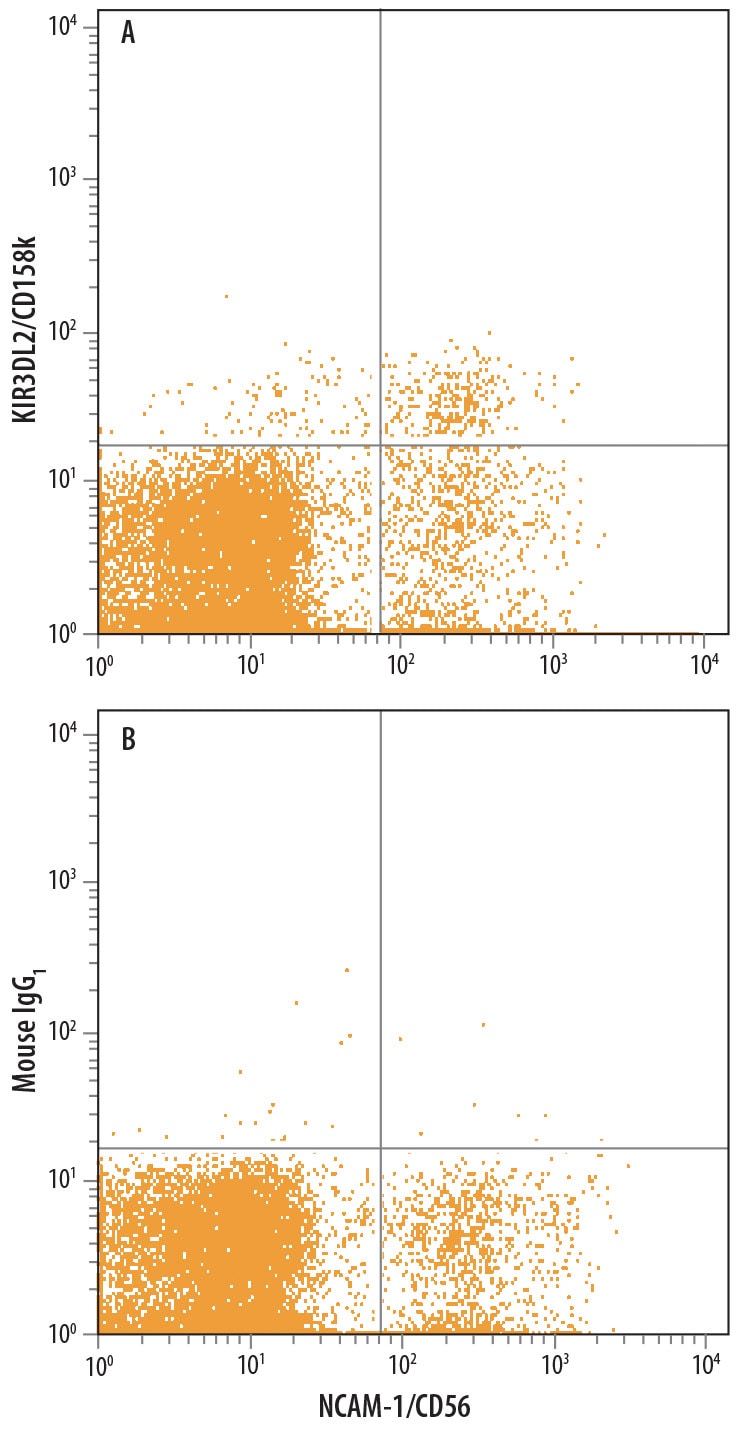
Detection of KIR3DL2/CD158k in Human Blood Lymphocytes by Flow Cytometry.
Human peripheral blood lymphocytes were stained with Mouse Anti-Human NCAM-1/CD56 PE-conjugated Monoclonal Antibody (Catalog # FAB2408P) and either (A) Mouse Anti-Human KIR3DL2/CD158k Monoclonal Antibody (Catalog # MAB2878) or (B) Mouse IgG1Isotype Control (Catalog # MAB002) followed by Allophycocyanin-conjugated Anti-Mouse IgG Secondary Antibody (Catalog # F0101B).Applications for Human KIR3DL2/CD158k Antibody (539304)
CyTOF-ready
Flow Cytometry
Sample: Human peripheral blood lymphocytes
Flow Cytometry Panel Builder
Bio-Techne Knows Flow Cytometry
Save time and reduce costly mistakes by quickly finding compatible reagents using the Panel Builder Tool.
Advanced Features
- Spectra Viewer - Custom analysis of spectra from multiple fluorochromes
- Spillover Popups - Visualize the spectra of individual fluorochromes
- Antigen Density Selector - Match fluorochrome brightness with antigen density

Formulation, Preparation, and Storage
Purification
Reconstitution
Sterile PBS to a final concentration of 0.5 mg/mL. For liquid material, refer to CoA for concentration.
Formulation
Shipping
Stability & Storage
- 12 months from date of receipt, -20 to -70 °C as supplied.
- 1 month, 2 to 8 °C under sterile conditions after reconstitution.
- 6 months, -20 to -70 °C under sterile conditions after reconstitution.
Calculators
Background: KIR3DL2/CD158k
References
- Colonna, M. and J. Samaridis (1995) Science 268:405.
- Pende, D. et al. (1996) J. Exp. Med. 184:505.
- Lanier, L. L. (2005) Annu. Rev. Immunol. 23:225.
- Uhrberg, M. et al. (1997) Immunity 7:753.
- Meenaugh, A. et al. (2004) Tiss. Antigens 64:226.
- Kwon, D. et al. (2000) Mol. Cells 10:54.
- Dohring, C. et al. (1996) J. Immunol. 156:3098.
- Hansasuta, P. et al. (2004) Eur. J. Immunol. 34:1673.
- Kollnberger, S. et al. (2002) Arthritis Rheum. 46:2972.
- Chan, A. T. et al. (2005) Arthritis Rheum. 52:3586.
- Poszepczynska-Guigne, E. et al. (2004) J. Invest. Dermatol. 122:820.
Long Name
Alternate Names
Gene Symbol
UniProt
Additional KIR3DL2/CD158k Products
Product Documents for Human KIR3DL2/CD158k Antibody (539304)
Certificate of Analysis
To download a Certificate of Analysis, please enter a lot or batch number in the search box below.
Note: Certificate of Analysis not available for kit components.
Product Specific Notices for Human KIR3DL2/CD158k Antibody (539304)
For research use only
Citations for Human KIR3DL2/CD158k Antibody (539304)
 Powered by Bioz
Customer Reviews for Human KIR3DL2/CD158k Antibody (539304)
There are currently no reviews for this product. Be the first to review Human KIR3DL2/CD158k Antibody (539304) and earn rewards!
Have you used Human KIR3DL2/CD158k Antibody (539304)?
Submit a review and receive an Amazon gift card!
$25/€18/£15/$25CAN/¥2500 for a review with an image
$10/€7/£6/$10CAN/¥1110 for a review without an image
Submit a review
Protocols
Find general support by application which include: protocols, troubleshooting, illustrated assays, videos and webinars.
- 7-Amino Actinomycin D (7-AAD) Cell Viability Flow Cytometry Protocol
- Extracellular Membrane Flow Cytometry Protocol
- Flow Cytometry Protocol for Cell Surface Markers
- Flow Cytometry Protocol for Staining Membrane Associated Proteins
- Flow Cytometry Staining Protocols
- Flow Cytometry Troubleshooting Guide
- Intracellular Flow Cytometry Protocol Using Alcohol (Methanol)
- Intracellular Flow Cytometry Protocol Using Detergents
- Intracellular Nuclear Staining Flow Cytometry Protocol Using Detergents
- Intracellular Staining Flow Cytometry Protocol Using Alcohol Permeabilization
- Intracellular Staining Flow Cytometry Protocol Using Detergents to Permeabilize Cells
- Propidium Iodide Cell Viability Flow Cytometry Protocol
- Protocol for Liperfluo
- Protocol for the Characterization of Human Th22 Cells
- Protocol for the Characterization of Human Th9 Cells
- Protocol: Annexin V and PI Staining by Flow Cytometry
- Protocol: Annexin V and PI Staining for Apoptosis by Flow Cytometry
- Troubleshooting Guide: Fluorokine Flow Cytometry Kits
- View all Protocols, Troubleshooting, Illustrated assays and Webinars