
Human Microtubule-associated Protein (MAP) Light Chain 3 (LC3) A is a121 amino acid (aa) protein with a predicted molecular weight of 14 kDa. It is a member of the LC3 subfamily of Autophagy-related 8 (Atg8) proteins (1). The LC3 subfamily also includes LC3B andLC3C. LC3 exhibits 100% aa sequence identity with its mouse and rat orthologs, and is orthologous to the yeast autophagy-related protein Atg8. Atg8 family members show structural similarity with Ubiquitin, but lack aa sequence similarity. LC3 was originally described as part is part of a complex that includes heavy and light chains comprising the MAP1 family of microtubule regulatory proteins (3). However, LC3 has gained attention for MAP1-independent functions in autophagy. LC3 utilizes a ubiquitin-like conjugation system that includes E1-, E2-, and E3-like enzymes to covalently attach phosphatidylethanolamine (PE) to its C-terminus, incorporating it into the phagophore membrane during the early stages of autophagasome formation (4). Recruitment of LC3 to the phagophore may promote membrane elongation (4,5). It may also be involved in cargo recruitment to autophagosomes (1). LC3 is often used as a marker of autophagy.

Scientific images may be resized, cropped, or adjusted for brightness or contrast for presentation purposes. These updates are limited to presentation and do not affect the underlying scientific interpretation of the data. Where available, additional source data may be provided upon request.
Key Product Details
Validated by
Species Reactivity
Validated:
Cited:
Applications
Validated:
Cited:
Label
Antibody Source
Product Specifications
Immunogen
Accession # Q9H492
Specificity
Clonality
Host
Isotype
Scientific Data Images for Human LC3A Antibody (877005)
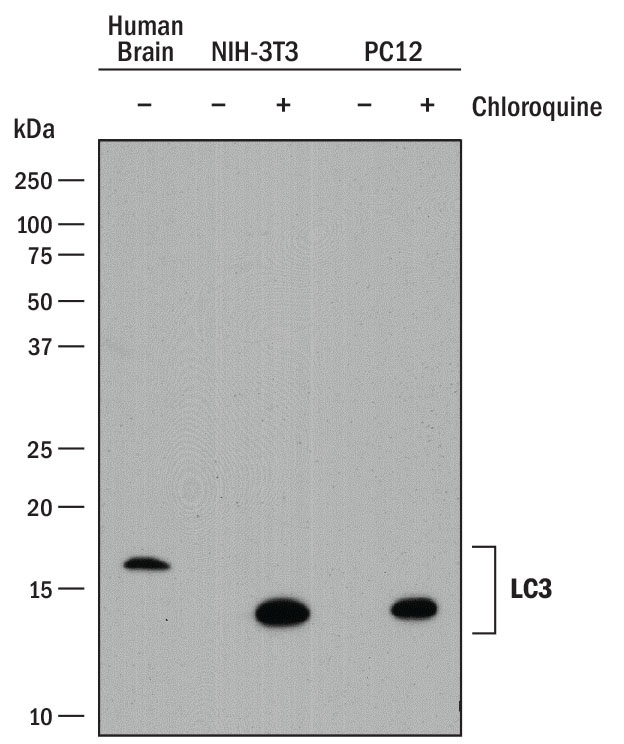
Detection of Human, Mouse, and Rat LC3A by Western Blot.
Western blot shows lysates of human brain tissue, NIH-3T3 mouse embryonic fibroblast cell line, and PC-12 rat adrenal pheochromocytoma cell line untreated (-) or treated (+) with 50 µM Chloroquine for 18 hours. PVDF membrane was probed with 2 µg/mL of Rat Anti-Human LC3A Antibody (Catalog # MAB8558) followed by HRP-conjugated Anti-Rat IgG Secondary Antibody (Catalog # HAF005). Specific bands were detected for LC3A at approximately 14 and 16 kDa (as indicated). This experiment was conducted under reducing conditions and using Immunoblot Buffer Group 1.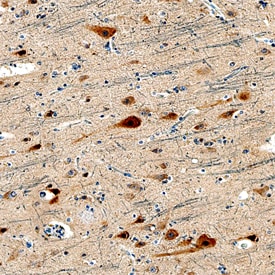
LC3A in Human Brain Cortex Tissue.
LC3A was detected in immersion fixed paraffin-embedded sections of human brain cortex tissue using Rat Anti-Human LC3A Monoclonal Antibody (Catalog # MAB8558) at 15 µg/mL overnight at 4 °C. Tissue was stained using the Anti-Rat HRP-DAB Cell & Tissue Staining Kit (brown; Catalog # CTS017) and counterstained with hematoxylin (blue). Specific staining was localized to neurons. View our protocol for Chromogenic IHC Staining of Paraffin-embedded Tissue Sections.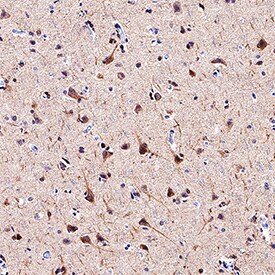
LC3A in Human Brain.
LC3A was detected in immersion fixed paraffin-embedded sections of human brain (cortex) using Rat Anti-Human LC3A Monoclonal Antibody (Catalog # MAB8558) at 1.7 µg/mL overnight at 4 °C. Tissue was stained using the Anti-Rat HRP-DAB Cell & Tissue Staining Kit (brown; Catalog # CTS017) and counterstained with hematoxylin (blue). Specific staining was localized to cytoplasm. View our protocol for Chromogenic IHC Staining of Paraffin-embedded Tissue Sections.Applications for Human LC3A Antibody (877005)
Immunohistochemistry
Sample: Immersion fixed paraffin-embedded sections of human brain cortex tissue
Western Blot
Sample: Human brain tissue (untreated), NIH‑3T3 mouse embryonic fibroblast cell line and PC‑12 rat adrenal pheochromocytoma cell line treated with Chloroquine
Reviewed Applications
Read 2 reviews rated 5 using MAB8558 in the following applications:
Formulation, Preparation, and Storage
Purification
Reconstitution
Reconstitute at 0.5 mg/mL in sterile PBS. For liquid material, refer to CoA for concentration.
Formulation
Shipping
Stability & Storage
- 12 months from date of receipt, -20 to -70 °C as supplied.
- 1 month, 2 to 8 °C under sterile conditions after reconstitution.
- 6 months, -20 to -70 °C under sterile conditions after reconstitution.
Calculators
Background: LC3A
References
- Shpilka, T. et al. (2011) Genome Biol. 12:226.
- He, H. et al. (2003) J. Biol. Chem. 278:29278.
- Kuznetsov, S.A. & V.I. Gelfand (1987) FEBS Let. 212:145.
- Weidberg, H. et al. (2011) Ann Rev. Biochem. 80:125.
- Weidberg, H. et al. (2010) EMBO J. 29:1792.
Long Name
Alternate Names
Gene Symbol
UniProt
Additional LC3A Products
Product Documents for Human LC3A Antibody (877005)
Certificate of Analysis
To download a Certificate of Analysis, please enter a lot or batch number in the search box below.
Note: Certificate of Analysis not available for kit components.
Product Specific Notices for Human LC3A Antibody (877005)
For research use only
Related Research Areas
Citations for Human LC3A Antibody (877005)
 Powered by Bioz
Customer Reviews for Human LC3A Antibody (877005) (2)
Have you used Human LC3A Antibody (877005)?
Submit a review and receive an Amazon gift card!
$25/€18/£15/$25CAN/¥2500 for a review with an image
$10/€7/£6/$10CAN/¥1110 for a review without an image
Submit a review
Customer Images
-
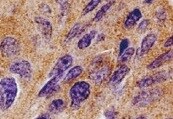
Application: ImmunohistochemistrySample Tested: gastric cancerSpecies: HumanVerified Customer | Posted 10/29/2021

-
Application: ImmunohistochemistrySample Tested: Cancer cell lysatesSpecies: HumanVerified Customer | Posted 08/30/2017
There are no reviews that match your criteria.
Protocols
Find general support by application which include: protocols, troubleshooting, illustrated assays, videos and webinars.
- Antigen Retrieval Protocol (PIER)
- Antigen Retrieval for Frozen Sections Protocol
- Appropriate Fixation of IHC/ICC Samples
- Cellular Response to Hypoxia Protocols
- Chromogenic IHC Staining of Formalin-Fixed Paraffin-Embedded (FFPE) Tissue Protocol
- Chromogenic Immunohistochemistry Staining of Frozen Tissue
- ClariTSA™ Fluorophore Kits
- Detection & Visualization of Antibody Binding
- Fluorescent IHC Staining of Frozen Tissue Protocol
- Graphic Protocol for Heat-induced Epitope Retrieval
- Graphic Protocol for the Preparation and Fluorescent IHC Staining of Frozen Tissue Sections
- Graphic Protocol for the Preparation and Fluorescent IHC Staining of Paraffin-embedded Tissue Sections
- Graphic Protocol for the Preparation of Gelatin-coated Slides for Histological Tissue Sections
- IHC Sample Preparation (Frozen sections vs Paraffin)
- Immunofluorescent IHC Staining of Formalin-Fixed Paraffin-Embedded (FFPE) Tissue Protocol
- Immunohistochemistry (IHC) and Immunocytochemistry (ICC) Protocols
- Immunohistochemistry Frozen Troubleshooting
- Immunohistochemistry Paraffin Troubleshooting
- Preparing Samples for IHC/ICC Experiments
- Preventing Non-Specific Staining (Non-Specific Binding)
- Primary Antibody Selection & Optimization
- Protocol for Heat-Induced Epitope Retrieval (HIER)
- Protocol for Making a 4% Formaldehyde Solution in PBS
- Protocol for VisUCyte™ HRP Polymer Detection Reagent
- Protocol for the Preparation & Fixation of Cells on Coverslips
- Protocol for the Preparation and Chromogenic IHC Staining of Frozen Tissue Sections
- Protocol for the Preparation and Chromogenic IHC Staining of Frozen Tissue Sections - Graphic
- Protocol for the Preparation and Chromogenic IHC Staining of Paraffin-embedded Tissue Sections
- Protocol for the Preparation and Chromogenic IHC Staining of Paraffin-embedded Tissue Sections - Graphic
- Protocol for the Preparation and Fluorescent IHC Staining of Frozen Tissue Sections
- Protocol for the Preparation and Fluorescent IHC Staining of Paraffin-embedded Tissue Sections
- Protocol for the Preparation of Gelatin-coated Slides for Histological Tissue Sections
- R&D Systems Quality Control Western Blot Protocol
- TUNEL and Active Caspase-3 Detection by IHC/ICC Protocol
- The Importance of IHC/ICC Controls
- Troubleshooting Guide: Immunohistochemistry
- Troubleshooting Guide: Western Blot Figures
- Western Blot Conditions
- Western Blot Protocol
- Western Blot Protocol for Cell Lysates
- Western Blot Troubleshooting
- Western Blot Troubleshooting Guide
- View all Protocols, Troubleshooting, Illustrated assays and Webinars