
Midkine is a highly basic, nonglycosylated polypeptide that contains five intrachain disulfide bonds. The predicted molecular weight is approximately 13.3 kDa, based on a mature peptide length of 118 amino acid residues in the mouse and 121 amino acid residues in the human. Across species, MK shows 87% identity between the human and murine proteins. Between family members, human MK is approximately 50% identical to human PTN, with conservation of all 10 cysteines. Initial structure-function studies indicate that the C-terminal half of MK contains the principal heparin-binding site plus the molecule’s antigenicity and neurite-promoting sequences; while both the C- and N-termini are necessary for the molecule’s neurotrophic effects. Cells known to produce MK include endothelial cells, fetal astrocytes, renal proximal tubule epithelial cells and Wilms’ (kidney) tumor cells. MK has also been identified in the senile plaques of patients with Alzheimer’s disease. The pattern of expression of midkine during development strongly suggests a role for this factor both in epithelial-mesenchymal interactions and in development of the nervous system.
Human Midkine Antibody (2284A)
R&D Systems | Catalog # MAB2581

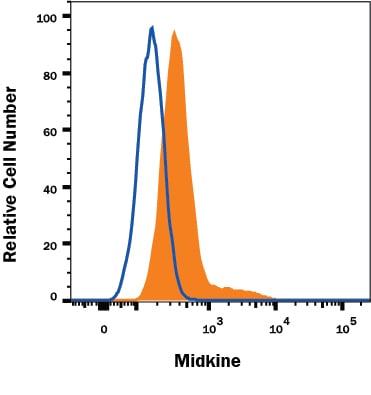
Scientific images may be resized, cropped, or adjusted for brightness or contrast for presentation purposes. These updates are limited to presentation and do not affect the underlying scientific interpretation of the data. Where available, additional source data may be provided upon request.
Key Product Details
Species Reactivity
Applications
Label
Antibody Source
Product Specifications
Immunogen
Lys23-Asp143
Accession # P21741
Specificity
Clonality
Host
Isotype
Scientific Data Images for Human Midkine Antibody (2284A)
Detection of Midkine in HeLa Human Cell Line by Flow Cytometry.
HeLa human cervical epithelial carcinoma cell line was stained with Rabbit Anti-Human Midkine Monoclonal Antibody (Catalog # MAB2581, filled histogram) or isotype control antibody (Catalog # MAB1050, open histogram), followed by Allophycocyanin-conjugated Anti-Rabbit IgG Secondary Antibody (Catalog # F0111). To facilitate intracellular staining, cells were fixed with Flow Cytometry Fixation Buffer (Catalog # FC004) and permeabilized with Flow Cytometry Permeabilization/Wash Buffer I (Catalog # FC005). View our protocol for Staining Intracellular Molecules.Applications for Human Midkine Antibody (2284A)
CyTOF-ready
Intracellular Staining by Flow Cytometry
Sample: HeLa human cervical epithelial carcinoma cell line fixed with Flow Cytometry Fixation Buffer (Catalog # FC004) and permeabilized with Flow Cytometry Permeabilization/Wash Buffer I (Catalog # FC005)
Reviewed Applications
Read 1 review rated 4 using MAB2581 in the following applications:
Flow Cytometry Panel Builder
Bio-Techne Knows Flow Cytometry
Save time and reduce costly mistakes by quickly finding compatible reagents using the Panel Builder Tool.
Advanced Features
- Spectra Viewer - Custom analysis of spectra from multiple fluorochromes
- Spillover Popups - Visualize the spectra of individual fluorochromes
- Antigen Density Selector - Match fluorochrome brightness with antigen density

Formulation, Preparation, and Storage
Purification
Reconstitution
Reconstitute at 0.5 mg/mL in sterile PBS. For liquid material, refer to CoA for concentration.
Formulation
Shipping
Stability & Storage
- 12 months from date of receipt, -20 to -70 °C as supplied.
- 1 month, 2 to 8 °C under sterile conditions after reconstitution.
- 6 months, -20 to -70 °C under sterile conditions after reconstitution.
Calculators
Background: Midkine
References
- Bohlen, P. and I. Kovesdi (1991) Prog. Growth Factor Res. 3:143.
- Muramatsu, T. (1993) Int. J. Dev. Biol. 37:183.
Alternate Names
Gene Symbol
UniProt
Additional Midkine Products
Product Documents for Human Midkine Antibody (2284A)
Certificate of Analysis
To download a Certificate of Analysis, please enter a lot or batch number in the search box below.
Note: Certificate of Analysis not available for kit components.
Product Specific Notices for Human Midkine Antibody (2284A)
For research use only
Customer Reviews for Human Midkine Antibody (2284A) (1)
Have you used Human Midkine Antibody (2284A)?
Submit a review and receive an Amazon gift card!
$25/€18/£15/$25CAN/¥2500 for a review with an image
$10/€7/£6/$10CAN/¥1110 for a review without an image
Submit a review
Customer Images
-
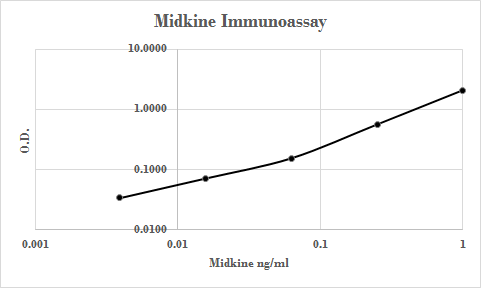
Application: ELISASample Tested: Serum and PlasmaSpecies: HumanVerified Customer | Posted 06/19/2019This monoclonal MAB2581 is used as the capture molecule with the goat polyclonal AF258 as the detect molecule.

There are no reviews that match your criteria.
Protocols
Find general support by application which include: protocols, troubleshooting, illustrated assays, videos and webinars.
- 7-Amino Actinomycin D (7-AAD) Cell Viability Flow Cytometry Protocol
- Extracellular Membrane Flow Cytometry Protocol
- Flow Cytometry Protocol for Cell Surface Markers
- Flow Cytometry Protocol for Staining Membrane Associated Proteins
- Flow Cytometry Staining Protocols
- Flow Cytometry Troubleshooting Guide
- Intracellular Flow Cytometry Protocol Using Alcohol (Methanol)
- Intracellular Flow Cytometry Protocol Using Detergents
- Intracellular Nuclear Staining Flow Cytometry Protocol Using Detergents
- Intracellular Staining Flow Cytometry Protocol Using Alcohol Permeabilization
- Intracellular Staining Flow Cytometry Protocol Using Detergents to Permeabilize Cells
- Propidium Iodide Cell Viability Flow Cytometry Protocol
- Protocol for Liperfluo
- Protocol for the Characterization of Human Th22 Cells
- Protocol for the Characterization of Human Th9 Cells
- Protocol: Annexin V and PI Staining by Flow Cytometry
- Protocol: Annexin V and PI Staining for Apoptosis by Flow Cytometry
- Troubleshooting Guide: Fluorokine Flow Cytometry Kits
- View all Protocols, Troubleshooting, Illustrated assays and Webinars