
Cubilin is a 460 kDa protein that is a component of a multiligand endocytic receptor complex, which also contains amnionless, megalin and LRP2. The receptor complex is expressed in several absorptive epithelia, including kidney proximal tubule, yolk sac, and the small intestine. Human Cubilin is synthesized as a 3623 residue precursor with a signal peptide, an amino-terminal domain, eight EGF-like repeats and 27 Cub domains. Co-expression with amnionless is required for the membrane anchoring, ER export and internalizing action of Cubilin. Within the region used as the immunogen, human, mouse and rat Cubilin share approximately 76% amino acid sequence homology.

Scientific images may be resized, cropped, or adjusted for brightness or contrast for presentation purposes. These updates are limited to presentation and do not affect the underlying scientific interpretation of the data. Where available, additional source data may be provided upon request.
Key Product Details
Species Reactivity
Validated:
Human, Mouse, Rat
Cited:
Human, Mouse
Applications
Validated:
Immunohistochemistry, Western Blot, Simple Western
Cited:
Immunohistochemistry, Immunohistochemistry-Frozen, Western Blot, Immunofluorescence, IF/IHC
Label
Unconjugated
Antibody Source
Polyclonal Sheep IgG
Loading...
Product Specifications
Immunogen
E. coli-derived recombinant human Cubilin
Ser36-Gly126
Accession # O60494
Ser36-Gly126
Accession # O60494
Specificity
Detects human Cubilin in direct ELISAs and Western blots.
Clonality
Polyclonal
Host
Sheep
Isotype
IgG
Scientific Data Images for Cubilin Antibody
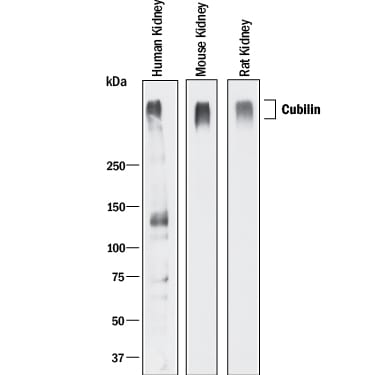
Detection of Human, Mouse, and Rat Cubilin by Western Blot.
Western blot shows lysates of human, mouse, and rat kidney tissue. PVDF membrane was probed with 1 µg/mL of Sheep Anti-Human/Mouse/ Rat Cubilin Antigen Affinity-purified Polyclonal Antibody (Catalog # AF3700) followed by HRP-conjugated Anti-Sheep IgG Secondary Antibody HAF016). A specific band was detected for Cubilin at approximately 500 kDa (as indicated). This experiment was conducted under reducing conditions and using Immunoblot Buffer Group 1.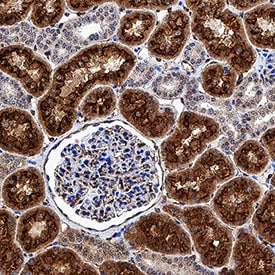
Cubilin in Human Kidney Tissue.
Cubilin was detected in immersion fixed paraffin-embedded sections of human kidney tissue using Sheep Anti-Human/Mouse/Rat Cubilin Antigen Affinity-purified Polyclonal Antibody (Catalog # AF3700) at 1 µg/mL overnight at 4 °C. Before incubation with the primary antibody, tissue was subjected to heat-induced epitope retrieval using Antigen Retrieval Reagent-Basic (CTS013). Tissue was stained using the Anti-Sheep IgG VisUCyte™ HRP Polymer Antibody (brown; (VC006) and counterstained with hematoxylin (blue). Specific staining was localized to convoluted tubules. View our protocol for IHC Staining with VisUCyte HRP Polymer Detection Reagents.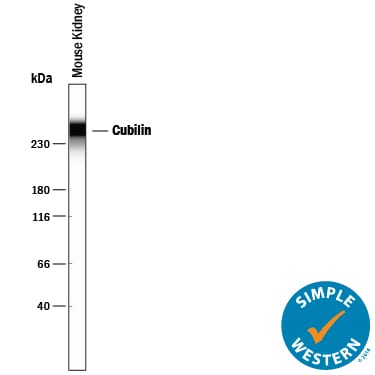
Detection of Mouse Cubilin by Simple WesternTM.
Simple Western lane view shows lysates of mouse kidney tissue, loaded at 0.2 mg/mL. A specific band was detected for Cubilin at approximately 500 kDa (as indicated) using 10 µg/mL of Sheep Anti-Human Cubilin Antigen Affinity-purified Polyclonal Antibody (Catalog # AF3700) followed by 1:50 dilution of HRP-conjugated Anti-Sheep IgG Secondary Antibody (HAF016). This experiment was conducted under reducing conditions and using the 66-440 kDa separation system.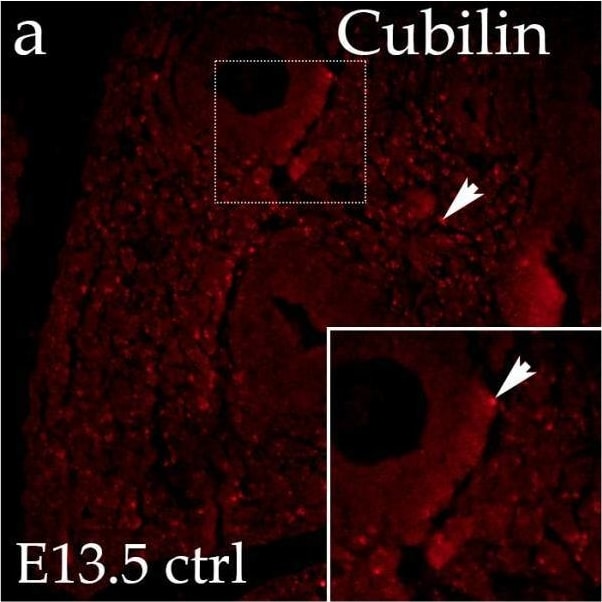
Detection of Cubilin by Immunohistochemistry
Immunofluorescence staining of Cubilin in developing control (ctrl) and yotari (yot) lung tissue (a–d). Comparative expression of Cubilin in the lungs at embryonic day 13.5 (E13.5) and 15.5 (E15.5) is shown in (a–d). Arrows in each substructure of the lungs indicate positive staining of Cubilin. Magnification: ×40; scale bar: 100 µm. The area percentage of Cubilin in control specimens (ctrl) and yotari mice per structure (epithelium and mesenchyme) throughout different stages of developing lungs (e,f). Two substructures were assessed at E13.5 and E15.5. Data are displayed as the mean ± SD (vertical line) and analyzed by a two-way ANOVA test followed by Tukey’s multiple comparison test. The statistical details supporting these findings are provided in Supplementary Tables S1 and S2. Image collected and cropped by CiteAb from the following open publication (https://www.mdpi.com/2075-1729/15/9/1395), licensed under a CC-BY license. Not internally tested by R&D Systems.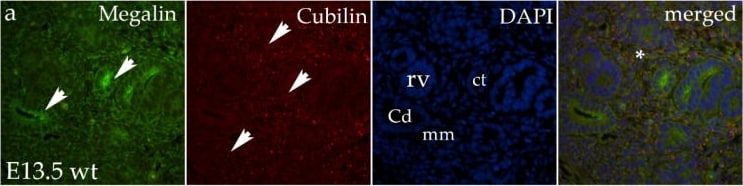
Detection of Cubilin by Immunohistochemistry
Double immunofluorescence staining of embryonic wild-type and yotari mouse kidneys was performed using Megalin (a–d) and Cubilin (a–d) markers. Arrows indicate the immunoexpression patterns of Megalin and Cubilin in the metanephric mesenchyme (mm), glomeruli (g), renal vesicles (rv), ampullae (A), convoluted tubules (Ct) and collecting ducts (Cd), as shown on the 4′,6-diamidino-2-phenylindole (DAPI) nuclei staining image. Immunoexpression of Megalin, Cubilin, DAPI staining and the merged images of Megalin, Cubilin and DAPI was observed at embryonic days E13.5 and E15.5 in wild-type (a,c) and yotari (b,d) kidneys. An asterisk marks the region where co-expression was detected. Images were taken at ×40 magnification, and the scale bar represents 100 μm for all images. The percentages of Megalin (e) and Cubilin (f) positive cells in the metanephric mesenchyme (mm), renal vesicles (rv) or glomeruli (g), convoluted tubules (Ct) and ampullae (A) or collecting ducts (Cd) of wild-type and yotari kidneys at embryonic days 13.5 and 15.5 are shown. Data are presented as the mean ± SD (vertical line) and analyzed using a two-way ANOVA followed by Tukey’s multiple comparison test. Significant differences are indicated by * p < 0.05 and **** p < 0.0001. Ten substructures were assessed at each time point. Image collected and cropped by CiteAb from the following open publication (https://www.mdpi.com/2227-9059/12/7/1542), licensed under a CC-BY license. Not internally tested by R&D Systems.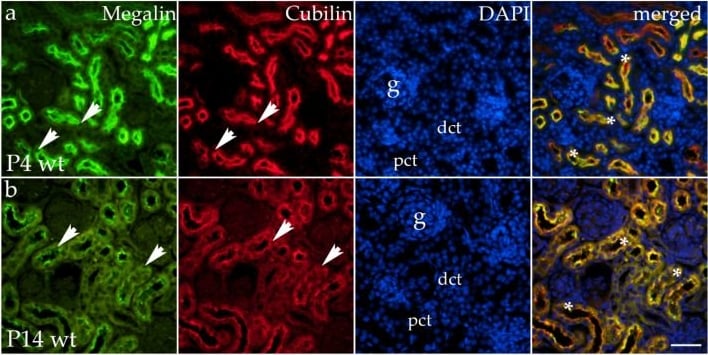
Detection of Cubilin by Immunohistochemistry
Double immunofluorescence staining of postnatal wild-type and yotary mouse kidneys was performed using Megalin (a,b) and Cubilin (a,b) markers. Arrows show the immunoexpression patterns of Megalin and Cubilin in glomeruli (g), distal convoluted tubules (dct) and proximal convoluted tubules (pct), indicated on 4′,6-diamidino-2-phenylindole (DAPI) nuclei staining image. Immunoexpression of Megalin and Cubilin staining and merged Megalin, Cubilin and DAPI at 4 days (P4) and 14 days (P14) in wild type. Wild-type and yotari mice at postnatal days 4 and 14 of kidney development predominantly matched the localization and intensity of Megalin and Cubilin. Therefore, representative images were taken from wild-type mice. An asterisk marks the region where co-expression was detected. Images were taken at ×40 magnification, and the scale bar represents 100 μm for all images. The percentages of Megalin (c) and Cubilin (d) positive cells in the glomeruli (G), distal convoluted tubules (DCT) and proximal convoluted tubules (PCT) of postnatal kidneys of wild type and yotari animals over time (P4 and P14). Data are presented as the mean ± SD (vertical line) and analyzed using a two-way ANOVA followed by Tukey’s multiple comparison test. Significant differences are indicated by **** p < 0.0001. Twenty substructures were assessed at each time point. Image collected and cropped by CiteAb from the following open publication (https://www.mdpi.com/2227-9059/12/7/1542), licensed under a CC-BY license. Not internally tested by R&D Systems.Applications for Cubilin Antibody
Application
Recommended Usage
Immunohistochemistry
1-15 µg/mL
Sample: Immersion fixed paraffin-embedded sections of human kidney tissue
Sample: Immersion fixed paraffin-embedded sections of human kidney tissue
Simple Western
10 µg/mL
Sample: Mouse kidney tissue
Sample: Mouse kidney tissue
Western Blot
1 µg/mL
Sample: Human, mouse, and rat kidney tissue
Sample: Human, mouse, and rat kidney tissue
Reviewed Applications
Read 2 reviews rated 4.5 using AF3700 in the following applications:
Formulation, Preparation, and Storage
Purification
Antigen Affinity-purified
Reconstitution
Reconstitute at 0.2 mg/mL in sterile PBS. For liquid material, refer to CoA for concentration.
Loading...
Formulation
Lyophilized from a 0.2 μm filtered solution in PBS with Trehalose. *Small pack size (SP) is supplied either lyophilized or as a 0.2 µm filtered solution in PBS.
Shipping
Lyophilized product is shipped at ambient temperature. Liquid small pack size (-SP) is shipped with polar packs. Upon receipt, store immediately at the temperature recommended below.
Stability & Storage
Use a manual defrost freezer and avoid repeated freeze-thaw cycles.
- 12 months from date of receipt, -20 to -70 °C as supplied.
- 1 month, 2 to 8 °C under sterile conditions after reconstitution.
- 6 months, -20 to -70 °C under sterile conditions after reconstitution.
Calculators
Background: Cubilin
Alternate Names
CUBN, Cubulin, gp280, IFCR, MGA1
Gene Symbol
CUBN
UniProt
Additional Cubilin Products
Product Documents for Cubilin Antibody
Certificate of Analysis
To download a Certificate of Analysis, please enter a lot or batch number in the search box below.
Note: Certificate of Analysis not available for kit components.
Product Specific Notices for Cubilin Antibody
For research use only
Related Research Areas
Citations for Cubilin Antibody
 Powered by Bioz
Customer Reviews for Cubilin Antibody (2)
4.5 out of 5
2 Customer Ratings
Have you used Cubilin Antibody?
Submit a review and receive an Amazon gift card!
$25/€18/£15/$25CAN/¥2500 for a review with an image
$10/€7/£6/$10CAN/¥1110 for a review without an image
Submit a review
Customer Images
_4e731d9c-0c47-4d45-bc25-93da99cac180.jpg)
Showing
1
-
2 of
2 reviews
Showing All
Filter By:
-
Application: ImmunofluorescenceSample Tested: HK-2Species: HumanVerified Customer | Posted 07/28/2025HK2 cells cultured on glass coverslips stained with Cubilin antibody and DAPI.Antigen retrieval Citrate buffer on pressure cooker. Block 1h RT 5% Donkey serum. Primary ab 1:200 4ºC overnight in humidified chamber. Secondary ab Dk anti Goat 647 2h RT. Antibodies diluted in 1% Dk serum.
 Bio-Techne ResponseThis review reflects a new species or application tested on a primary antibody.
 -
Application: Western BlotSample Tested: Kidney tissue homogenatesSpecies: MouseVerified Customer | Posted 12/19/2014
There are no reviews that match your criteria.
Protocols
Find general support by application which include: protocols, troubleshooting, illustrated assays, videos and webinars.
- Antigen Retrieval Protocol (PIER)
- Antigen Retrieval for Frozen Sections Protocol
- Appropriate Fixation of IHC/ICC Samples
- Cellular Response to Hypoxia Protocols
- Chromogenic IHC Staining of Formalin-Fixed Paraffin-Embedded (FFPE) Tissue Protocol
- Chromogenic Immunohistochemistry Staining of Frozen Tissue
- ClariTSA™ Fluorophore Kits
- Detection & Visualization of Antibody Binding
- Fluorescent IHC Staining of Frozen Tissue Protocol
- Graphic Protocol for Heat-induced Epitope Retrieval
- Graphic Protocol for the Preparation and Fluorescent IHC Staining of Frozen Tissue Sections
- Graphic Protocol for the Preparation and Fluorescent IHC Staining of Paraffin-embedded Tissue Sections
- Graphic Protocol for the Preparation of Gelatin-coated Slides for Histological Tissue Sections
- IHC Sample Preparation (Frozen sections vs Paraffin)
- Immunofluorescent IHC Staining of Formalin-Fixed Paraffin-Embedded (FFPE) Tissue Protocol
- Immunohistochemistry (IHC) and Immunocytochemistry (ICC) Protocols
- Immunohistochemistry Frozen Troubleshooting
- Immunohistochemistry Paraffin Troubleshooting
- Preparing Samples for IHC/ICC Experiments
- Preventing Non-Specific Staining (Non-Specific Binding)
- Primary Antibody Selection & Optimization
- Protocol for Heat-Induced Epitope Retrieval (HIER)
- Protocol for Making a 4% Formaldehyde Solution in PBS
- Protocol for VisUCyte™ HRP Polymer Detection Reagent
- Protocol for the Preparation & Fixation of Cells on Coverslips
- Protocol for the Preparation and Chromogenic IHC Staining of Frozen Tissue Sections
- Protocol for the Preparation and Chromogenic IHC Staining of Frozen Tissue Sections - Graphic
- Protocol for the Preparation and Chromogenic IHC Staining of Paraffin-embedded Tissue Sections
- Protocol for the Preparation and Chromogenic IHC Staining of Paraffin-embedded Tissue Sections - Graphic
- Protocol for the Preparation and Fluorescent IHC Staining of Frozen Tissue Sections
- Protocol for the Preparation and Fluorescent IHC Staining of Paraffin-embedded Tissue Sections
- Protocol for the Preparation of Gelatin-coated Slides for Histological Tissue Sections
- R&D Systems Quality Control Western Blot Protocol
- TUNEL and Active Caspase-3 Detection by IHC/ICC Protocol
- The Importance of IHC/ICC Controls
- Troubleshooting Guide: Immunohistochemistry
- Troubleshooting Guide: Western Blot Figures
- Western Blot Conditions
- Western Blot Protocol
- Western Blot Protocol for Cell Lysates
- Western Blot Troubleshooting
- Western Blot Troubleshooting Guide
- View all Protocols, Troubleshooting, Illustrated assays and Webinars
Loading...