
VSIG3 (V-set and Ig domain-containing protein 3; also BT-IgSF and IGSF11) is a 52 kDa brain and testis-specific protein that belongs to the IGSF11 family of proteins. It is expressed by neurons, astrocytes and oligodendroglia. VSIG3 is an adhesion molecule that forms Ca-independent homophilic interactions in trans. Human VSIG3 is 413 amino acids (aa) in length. It is a type I transmembrane glycoprotein that contains a 219 aa extracellular domain (ECD). The ECD contains one V-type (aa 23‑136) and one C2-type Ig-like domain (aa 144‑234). Over aa 23‑245, human VSIG3 is 94% aa identical to mouse VSIG3. Two potential splice variants exist in human. Both exhibit a 16 aa substitution for the first 17 aa of the signal sequence, and one contains an additional single Ala substitution for aa 211‑235.

Scientific images may be resized, cropped, or adjusted for brightness or contrast for presentation purposes. These updates are limited to presentation and do not affect the underlying scientific interpretation of the data. Where available, additional source data may be provided upon request.
Key Product Details
Species Reactivity
Applications
Label
Antibody Source
Product Specifications
Immunogen
Leu23-Gly245
Accession # NP_001015887
Specificity
Clonality
Host
Isotype
Scientific Data Images for VSIG3 Antibody
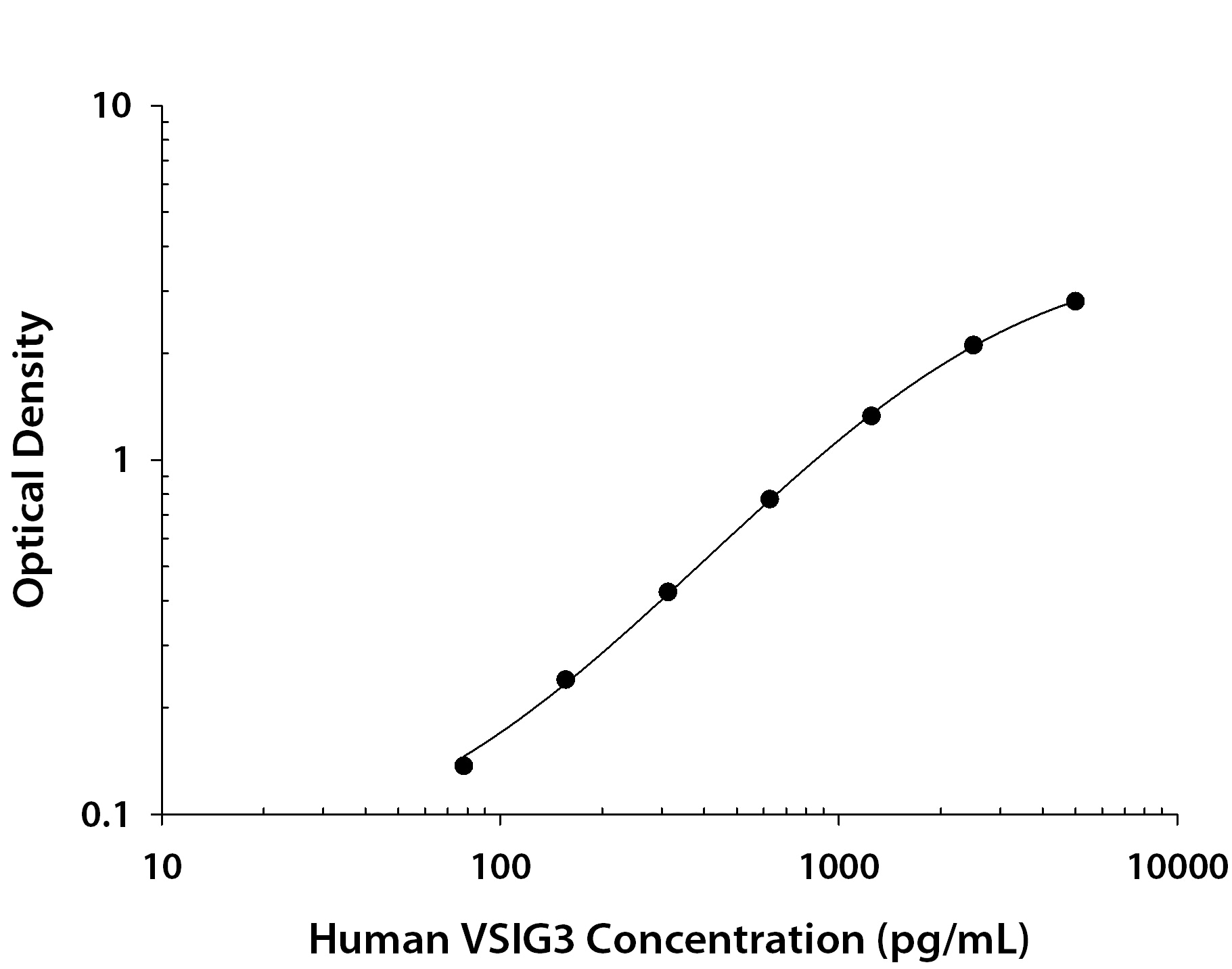
Human VSIG3 ELISA Standard Curve.
Recombinant Human VSIG3 protein was serially diluted 2-fold and captured by Mouse Anti-Human VSIG3 Monoclonal Antibody (Catalog # MAB9229) coated on a Clear Polystyrene Microplate (Catalog # DY990). Sheep Anti-Human/Mouse VSIG3 Antigen Affinity-purified Polyclonal Antibody (Catalog # AF4915) was biotinylated and incubated with the protein captured on the plate. Detection of the standard curve was achieved by incubating Streptavidin-HRP (Catalog # DY998) followed by Substrate Solution (Catalog # DY999) and stopping the enzymatic reaction with Stop Solution (Catalog # DY994).Applications for VSIG3 Antibody
ELISA
This antibody functions as an ELISA detection antibody when paired with Mouse Anti-Human VSIG3 Monoclonal Antibody(Catalog # MAB9229).
This product is intended for assay development on various assay platforms requiring antibody pairs. We recommend the Human VSIG3 DuoSet ELISA Kit (Catalog # DY9229-05) for convenient development of a sandwich ELISA.
Western Blot
Sample: Recombinant Human and mouse VSIG3
Formulation, Preparation, and Storage
Purification
Reconstitution
Reconstitute at 0.2 mg/mL in sterile PBS. For liquid material, refer to CoA for concentration.
Formulation
Shipping
Stability & Storage
- 12 months from date of receipt, -20 to -70 °C as supplied.
- 1 month, 2 to 8 °C under sterile conditions after reconstitution.
- 6 months, -20 to -70 °C under sterile conditions after reconstitution.
Calculators
Background: VSIG3
Long Name
Alternate Names
Gene Symbol
UniProt
Additional VSIG3 Products
Product Documents for VSIG3 Antibody
Certificate of Analysis
To download a Certificate of Analysis, please enter a lot or batch number in the search box below.
Note: Certificate of Analysis not available for kit components.
Product Specific Notices for VSIG3 Antibody
For research use only
Related Research Areas
Citations for VSIG3 Antibody
 Powered by Bioz
Customer Reviews for VSIG3 Antibody
There are currently no reviews for this product. Be the first to review VSIG3 Antibody and earn rewards!
Have you used VSIG3 Antibody?
Submit a review and receive an Amazon gift card!
$25/€18/£15/$25CAN/¥2500 for a review with an image
$10/€7/£6/$10CAN/¥1110 for a review without an image
Submit a review
Protocols
Find general support by application which include: protocols, troubleshooting, illustrated assays, videos and webinars.
- Cellular Response to Hypoxia Protocols
- ELISA Sample Preparation & Collection Guide
- ELISA Troubleshooting Guide
- How to Run an R&D Systems DuoSet ELISA
- How to Run an R&D Systems Quantikine ELISA
- How to Run an R&D Systems Quantikine™ QuicKit™ ELISA
- Quantikine HS ELISA Kit Assay Principle, Alkaline Phosphatase
- Quantikine HS ELISA Kit Principle, Streptavidin-HRP Polymer
- R&D Systems Quality Control Western Blot Protocol
- Sandwich ELISA (Colorimetric) – Biotin/Streptavidin Detection Protocol
- Sandwich ELISA (Colorimetric) – Direct Detection Protocol
- Troubleshooting Guide: ELISA
- Troubleshooting Guide: Western Blot Figures
- Western Blot Conditions
- Western Blot Protocol
- Western Blot Protocol for Cell Lysates
- Western Blot Troubleshooting
- Western Blot Troubleshooting Guide
- View all Protocols, Troubleshooting, Illustrated assays and Webinars