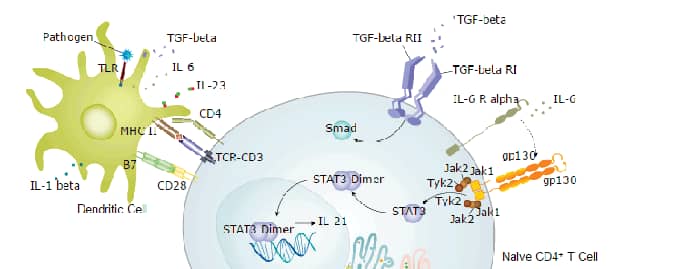
Interleukin 17 (also known as CTLA-8) is a T cell-expressed pleiotropic cytokine that exhibits a high degree of homology to a protein encoded by the ORF13 gene of herpesvirus Saimiri. cDNA clones encoding IL-17 have been isolated from activated rat, mouse and human T cells. Human IL-17 cDNA encodes a 155 amino acid (aa) residue precursor protein with a 19 amino acid residue signal peptide that is cleaved to yield the 136 aa residue mature IL-17 containing one potential N-linked glycosylation site. Both recombinant and natural IL-17 have been shown to exist as disulfide-linked homodimers. At the amino acid level, human IL-17 shows 72% and 63% sequence identity with herpesvirus and rat IL-17, respectively. An IL-17 specific mouse cell surface receptor (IL-17 R) has been cloned. While the expression of IL-17 mRNA is restricted to activated T cells, the expression of mIL-17 R mRNA has been detected in virtually all cells and tissues tested. IL-17 exhibits multiple biological activities on a variety of cells including the induction of IL-6 and IL-8 production in fibroblasts, the enhancement of surface expression of ICAM-1 in fibroblasts, activation of NF-kappa B and costimulation of T cell proliferation. The non-glycosylated, E. coli-expressed rhIL-17 has been shown to be active on human as well as mouse cell lines.


Scientific images may be resized, cropped, or adjusted for brightness or contrast for presentation purposes. These updates are limited to presentation and do not affect the underlying scientific interpretation of the data. Where available, additional source data may be provided upon request.
Key Product Details
Species Reactivity
Validated:
Cited:
Applications
Validated:
Cited:
Label
Antibody Source
Product Specifications
Immunogen
Ile20-Ala155
Accession # Q16552
Specificity
Clonality
Host
Isotype
Scientific Data Images for IL-17/IL-17A Antibody [Biotin]
Human IL-17 / IL-17A ELISA Standard Curve
Recombinant Human IL‑17/IL‑17A (Catalog # 317-ILB) was serially diluted and captured by Mouse Anti-Human/Primate IL‑17/IL‑17A Monoclonal Antibody (Catalog # MAB317) coated on a Clear Polystyrene Microplate (Catalog # DY990). Goat Anti-Human IL‑17/IL‑17A Antigen Affinity-purified Polyclonal Antibody (Catalog # AF-317-NA) was biotinylated and incubated with the protein captured on the plate. Detection of the standard curve was achieved by incubating Streptavidin-HRP (Catalog # DY998)Applications for IL-17/IL-17A Antibody [Biotin]
Human/Primate IL-17 Sandwich Immunoassay
Reviewed Applications
Read 2 reviews rated 4.5 using BAF317 in the following applications:
Formulation, Preparation, and Storage
Purification
Reconstitution
Reconstitute at 0.2 mg/mL in sterile PBS.
Formulation
Shipping
Stability & Storage
- 12 months from date of receipt, -20 to -70 °C as supplied.
- 1 month, 2 to 8 °C under sterile conditions after reconstitution.
- 6 months, -20 to -70 °C under sterile conditions after reconstitution.
Calculators
Background: IL-17/IL-17A
References
- Yao, Z. et al. (1995) J. Immunol. 155:5483.
- Yao, Z. et al. (1995) Immunity 3:811.
- Rouvier, E. et al. (1993) J. Immunol. 150:5445.
Long Name
Alternate Names
Entrez Gene IDs
Gene Symbol
UniProt
Additional IL-17/IL-17A Products
Product Documents for IL-17/IL-17A Antibody [Biotin]
Certificate of Analysis
To download a Certificate of Analysis, please enter a lot or batch number in the search box below.
Note: Certificate of Analysis not available for kit components.
Product Specific Notices for IL-17/IL-17A Antibody [Biotin]
For research use only
Citations for IL-17/IL-17A Antibody [Biotin]
 Powered by Bioz
Customer Reviews for IL-17/IL-17A Antibody [Biotin] (2)
Have you used IL-17/IL-17A Antibody [Biotin]?
Submit a review and receive an Amazon gift card!
$25/€18/£15/$25CAN/¥2500 for a review with an image
$10/€7/£6/$10CAN/¥1110 for a review without an image
Submit a review
Customer Images
![IL-17/IL-17A Antibody [Biotin] BAF317](https://resources.rndsystems.com/images/reviews/review_baf317_29826_0_0.jpg)
-
Application: ELISASample Tested: Cell culture supernatantSpecies: HumanVerified Customer | Posted 08/22/2018The antibody was used as a secondary in an IL17A immunoassay.
![IL-17/IL-17A Antibody [Biotin] BAF317](data:image/png;base64,R0lGODlhAQABAAD/ACwAAAAAAQABAAACADs=)
-
Application: ELISASample Tested: Serum and PlasmaSpecies: HumanVerified Customer | Posted 01/18/2018
There are no reviews that match your criteria.
Associated Pathways