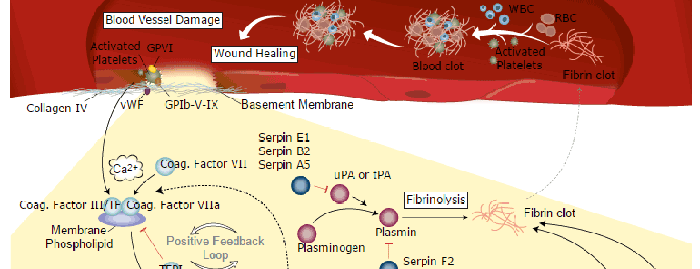
As a member of the Serpin superfamily of serine protease inhibitors, Serpin E1/PAI‑1 is the principal inhibitor of urokinase‑type plasminogen activator (uPA) and tissue‑type PA (1, 2). As important regulators of extracellular matrix remodeling, uPA and PAI‑1 play a major role in many processes such as angiogenesis, tumor invasion and obesity (2‑4). For example, uPA and PAI-1 are the only tumor prognostic factors validated at the highest level of evidence with regard to their clinical utility in breast cancer (5). The human PAI-1 is initially synthesized as 402 amino acid precursor with a N‑terminal signal peptide (6, 7). PAI‑1 may exist in one of two possible conformations, designated as active or latent (8). The purified rhPAI‑1 is active against rhuPA. The heterogeneity at the N‑terminus of the purified recombinant human PAI‑1 has been observed before for both the recombinant and native proteins (9).
Human Serpin E1/PAI-1 Antibody (242816)
R&D Systems | Catalog # MAB1786

Scientific images may be resized, cropped, or adjusted for brightness or contrast for presentation purposes. These updates are limited to presentation and do not affect the underlying scientific interpretation of the data. Where available, additional source data may be provided upon request.
Key Product Details
Species Reactivity
Validated:
Cited:
Applications
Validated:
Cited:
Label
Antibody Source
Product Specifications
Immunogen
Met1-Pro402
Accession # P05121
Specificity
Clonality
Host
Isotype
Scientific Data Images for Human Serpin E1/PAI-1 Antibody (242816)
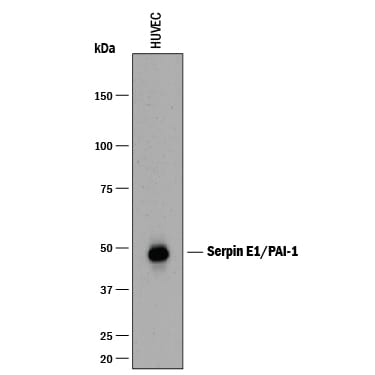
Detection of Human Serpin E1/PAI‑1 by Western Blot.
Western blot shows lysates of HUVEC human umbilical vein endothelial cells. PVDF membrane was probed with 1 µg/mL of Mouse Anti-Human Serpin E1/PAI-1 Monoclonal Antibody (Catalog # MAB1786) followed by HRP-conjugated Anti-Mouse IgG Secondary Antibody (Catalog # HAF018). A specific band was detected for Serpin E1/PAI-1 at approximately 48 kDa (as indicated). This experiment was conducted under reducing conditions and using Immunoblot Buffer Group 1.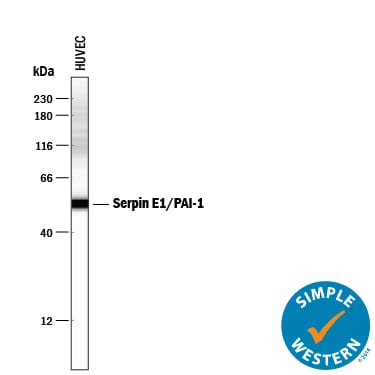
Detection of Human Serpin E1/PAI‑1 by Simple WesternTM.
Simple Western lane view shows lysates of HUVEC human umbilical vein endothelial cells, loaded at 0.2 mg/mL. A specific band was detected for Serpin E1/PAI‑1 at approximately 54 kDa (as indicated) using 2.5 µg/mL of Mouse Anti-Human Serpin E1/PAI‑1 Monoclonal Antibody (Catalog # MAB1786). This experiment was conducted under reducing conditions and using the 12-230 kDa separation system.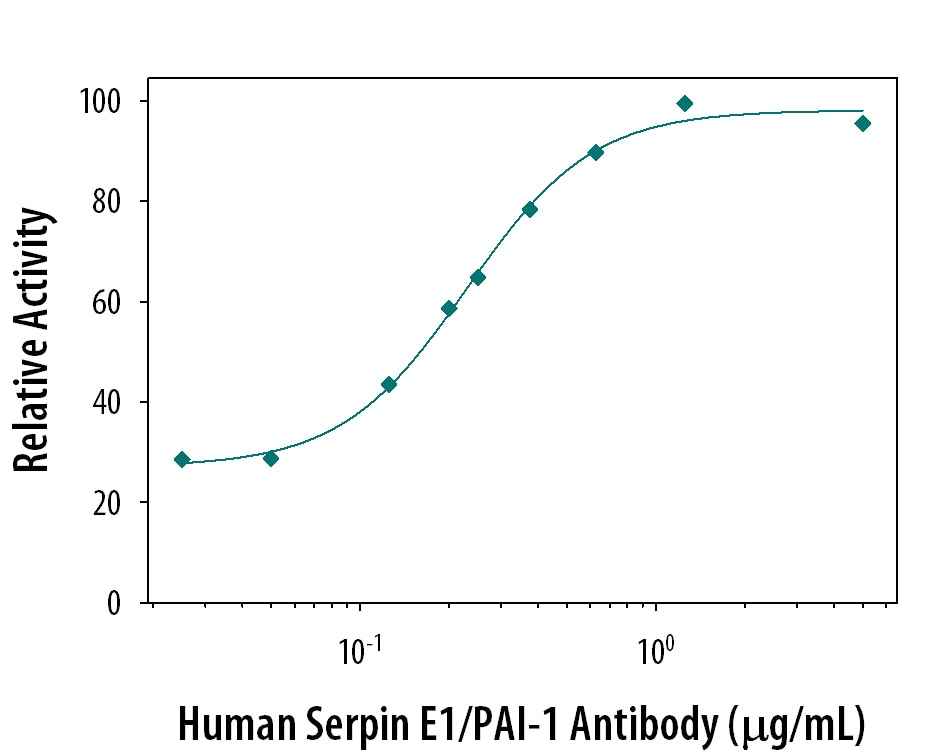
Neutralization of Serpin E1/ PAI‑1 Activity by Human Serpin E1/PAI‑1 Antibody.
Recombinant Human u-Plasminogen Activator (uPA)/Urokinase (0.1 µg/mL, Catalog # 1310-SE) activity is measured in the presence of Recombinant Human Serpin E1/PAI-1 (0.25 µg/mL, Catalog # 1786-PI) that has been preincubated with increasing concentrations of Mouse Anti-Human Serpin E1/PAI-1 Monoclonal Antibody (Catalog # MAB1786). The ND50 is typically 0.3 µg/mL.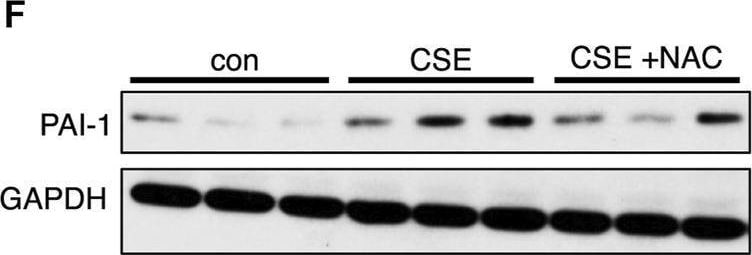
Detection of Serpin E1/PAI-1 by Western Blot
CSE decreases the fibrinolytic activity of LECs in vitro.(A) Immunocytochemical staining of cultured human microvascular lymphatic endothelial cells (LECs) for the human lymphatic markers, PROX1 and podoplanin (red). (B) Fibrin gel zymogram using supernatants from control or CSE-treated LECs. (C) Western blot for PAI-1 using cell lysates from control or CSE-treated LECs. GAPDH was used as a loading control on the same blot. (D,E) Expression of PAI-1 and t-PA by quantitative PCR using lysates from control or CSE-treated LECs and normalized to GAPDH. (F) Western blot using lysates from cells treated with CSE with and without co-incubation with N-acetylcysteine (NAC). GAPDH was used as a loading control on the same blot. Values are expressed as means ± SD. p-value calculated by Student’s t-test, **** p < 0.0001, ns = not significant. Data representative of two independent experiments performed in triplicate. Image collected and cropped by CiteAb from the following open publication (https://pubmed.ncbi.nlm.nih.gov/38440076), licensed under a CC-BY license. Not internally tested by R&D Systems.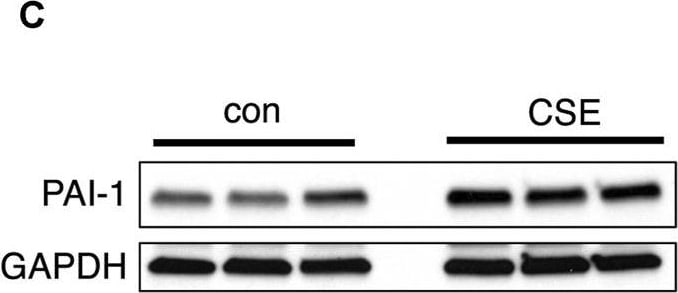
Detection of Serpin E1/PAI-1 by Western Blot
CSE decreases the fibrinolytic activity of LECs in vitro.(A) Immunocytochemical staining of cultured human microvascular lymphatic endothelial cells (LECs) for the human lymphatic markers, PROX1 and podoplanin (red). (B) Fibrin gel zymogram using supernatants from control or CSE-treated LECs. (C) Western blot for PAI-1 using cell lysates from control or CSE-treated LECs. GAPDH was used as a loading control on the same blot. (D,E) Expression of PAI-1 and t-PA by quantitative PCR using lysates from control or CSE-treated LECs and normalized to GAPDH. (F) Western blot using lysates from cells treated with CSE with and without co-incubation with N-acetylcysteine (NAC). GAPDH was used as a loading control on the same blot. Values are expressed as means ± SD. p-value calculated by Student’s t-test, **** p < 0.0001, ns = not significant. Data representative of two independent experiments performed in triplicate. Image collected and cropped by CiteAb from the following open publication (https://pubmed.ncbi.nlm.nih.gov/38440076), licensed under a CC-BY license. Not internally tested by R&D Systems.
Human Serpin E1 / PAI-1 ELISA Standard Curve
Recombinant Human Serpin E1/PAI‑1 (Catalog # 1786-PI) was serially diluted and captured by Mouse Anti-Human Serpin E1/PAI‑1 Monoclonal Antibody (Catalog # MAB1786) coated on a Clear Polystyrene Microplate (Catalog # DY990). Goat Anti-Human Serpin E1/PAI‑1 Antigen Affinity-purified Polyclonal Antibody (Catalog # AF1786) was biotinylated and incubated with the protein captured on the plate. Detection of the standard curve was achieved by incubating Streptavidin-HRP (Catalog # DY998)Applications for Human Serpin E1/PAI-1 Antibody (242816)
Simple Western
Sample: HUVEC human umbilical vein endothelial cells
Western Blot
Sample: HUVEC human umbilical vein endothelial cells
Neutralization
Human Serpin E1/PAI-1 Sandwich Immunoassay
Reviewed Applications
Read 1 review rated 5 using MAB1786 in the following applications:
Formulation, Preparation, and Storage
Purification
Reconstitution
Reconstitute at 0.5 mg/mL in sterile PBS. For liquid material, refer to CoA for concentration.
Formulation
Shipping
Stability & Storage
- 12 months from date of receipt, -20 to -70 °C as supplied.
- 1 month, 2 to 8 °C under sterile conditions after reconstitution.
- 6 months, -20 to -70 °C under sterile conditions after reconstitution.
Calculators
Background: Serpin E1/PAI-1
References
- Silverman, G.A. et al. (2001) J. Biol. Chem. 276:33293.
- Stefansson, S. et al. (2003) Curr. Pharm. Des. 9:1545.
- Duffy, M.J. (2002) Clin. Chem. 48:1194.
- Juhan-Vague, I. et al. (2003) J. Thromb. Haemost. 1:1575.
- Harbeck, N. et al. (2002) Clin. Breast Cancer 3:196.
- Pannekoek, H. et al. (1986) EMBO J. 5:2539.
- Ginsburg, D. et al. (1986) J. Clin. Invest. 78:1673.
- Wang, Z. et al. (1996) Biochemistry 35:16443.
- Stromqvist, M. et al. (1994) Protein Expr. Purif. 5:309.
Long Name
Alternate Names
Gene Symbol
UniProt
Additional Serpin E1/PAI-1 Products
Product Documents for Human Serpin E1/PAI-1 Antibody (242816)
Certificate of Analysis
To download a Certificate of Analysis, please enter a lot or batch number in the search box below.
Note: Certificate of Analysis not available for kit components.
Product Specific Notices for Human Serpin E1/PAI-1 Antibody (242816)
For research use only
Citations for Human Serpin E1/PAI-1 Antibody (242816)
 Powered by Bioz
Customer Reviews for Human Serpin E1/PAI-1 Antibody (242816) (1)
Have you used Human Serpin E1/PAI-1 Antibody (242816)?
Submit a review and receive an Amazon gift card!
$25/€18/£15/$25CAN/¥2500 for a review with an image
$10/€7/£6/$10CAN/¥1110 for a review without an image
Submit a review
-
Application: Block/NeutralizeSample Tested: Breast cancer cellsSpecies: HumanVerified Customer | Posted 05/14/2018We used this Serpin E1 neutralizing antibody (400 ng/mL) as part of an antibody cocktail containing several other antibodies to neutralize/block Serpin E1 present in the Conditioned Medium (CM) from BT549 Cells treated with Angiotensin II. CM (+/- Serpin E1 Neutralizing ab Cocktail) was used to further look at Endothelial (HUVEC) Cell migration using Incucyte Chemotaxis Assay
There are no reviews that match your criteria.
Protocols
Find general support by application which include: protocols, troubleshooting, illustrated assays, videos and webinars.
- Cellular Response to Hypoxia Protocols
- R&D Systems Quality Control Western Blot Protocol
- Troubleshooting Guide: Western Blot Figures
- Western Blot Conditions
- Western Blot Protocol
- Western Blot Protocol for Cell Lysates
- Western Blot Troubleshooting
- Western Blot Troubleshooting Guide
- View all Protocols, Troubleshooting, Illustrated assays and Webinars
Associated Pathways