
Siglecs (sialic acid binding Ig-like lectins) are I-type (Ig-type) lectins belonging to the Ig superfamily. They are characterized by an N-terminal Ig-like V-type domain which mediates sialic acid binding, followed by varying numbers of Ig-like C2-type domains (1, 2). Eleven human Siglecs have been cloned and characterized. They are sialoadhesin/CD169/Siglec-1, CD22/Siglec-2, CD33/Siglec-3, Myelin-Associated Glycoprotein (MAG/Siglec-4a), and the identified Siglecs 5 to 11 (1-3). To date, no Siglec has been shown to recognize any cell surface ligand other than sialic acid, suggesting that interactions with glycans containing this carbohydrate are important in mediating the biological functions of Siglecs. Human Siglec-2, also known as B-cell antigen CD22 or B lymphocyte cell adhesion molecule (BL-CAM), is a B cell restricted glycoprotein that is expressed in the cytoplasm of progenitor B and pre-B cells and on the surface of mature B cells. Two distinct human Siglec-2/CD22 cDNAs that arise from differential RNA processing of the same gene have been isolated. The predominant Siglec-2/CD22 beta encodes an 847 amino acid (aa) polypeptide with a hydrophobic signal peptide, an N-terminal Ig-like V-type domain, six Ig-like C2-type domains, a transmembrane region and a cytoplasmic tail with 4 immunoreceptor tyrosine-based inhibition motifs (ITIMs) (4). The variant Siglec-2/CD22 alpha encodes a 647 aa polypeptide missing two Ig-like C2-type domains and has a truncated (23 aa) cytoplasmic tail (5). Siglec-2/CD22 is an adhesion molecule that preferentially binds alpha 2,6- linked sialic acid on the same (cis) or adjacent (trans) cells. Interaction of CD22 with trans ligands on opposing cells was found to be favored over the binding of ligands in cis (9). Besides its role as an adhesion molecule, Siglec-2/CD22 is a coreceptor that physically interacts with B cell receptor (BCR) and is rapidly phosphorylated upon BCR ligation. It negatively regulates BCR signals by recruiting tyrosine phosphatase SHP-1 to its ITIMs. Phosphorylated Siglec-2/CD22 can also interact with other intracellular effector proteins such as Syk, PLC gamma, PI3 kinase, and Grb-2, suggesting it may play a role in positive signaling (2, 7, 8).
Human Siglec-2/CD22 Antibody (219902)
R&D Systems | Catalog # MAB19681

Scientific images may be resized, cropped, or adjusted for brightness or contrast for presentation purposes. These updates are limited to presentation and do not affect the underlying scientific interpretation of the data. Where available, additional source data may be provided upon request.
Key Product Details
Species Reactivity
Validated:
Cited:
Applications
Validated:
Cited:
Label
Antibody Source
Product Specifications
Immunogen
Asp20-Arg687
Accession # CAA42006
Specificity
Clonality
Host
Isotype
Scientific Data Images for Human Siglec-2/CD22 Antibody (219902)
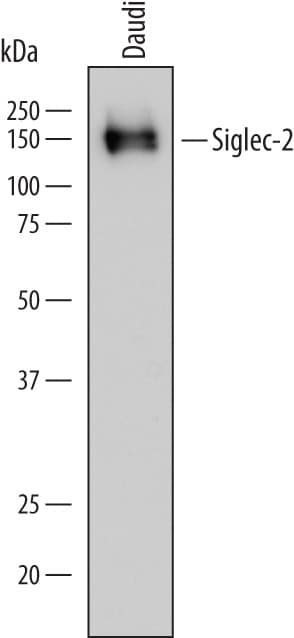
Detection of Human Siglec‑2/CD22 by Western Blot.
Western blot shows lysates of Daudi human Burkitt's lymphoma cell line. PVDF membrane was probed with 0.2 µg/mL of Mouse Anti-Human Siglec-2/CD22 Monoclonal Antibody (Catalog # MAB19681) followed by HRP-conjugated Anti-Mouse IgG Secondary Antibody (Catalog # HAF018). A specific band was detected for Siglec-2/CD22 at approximately 140 kDa (as indicated). This experiment was conducted under reducing conditions and using Immunoblot Buffer Group 1.Applications for Human Siglec-2/CD22 Antibody (219902)
Western Blot
Sample: Daudi human Burkitt's lymphoma cell line
Formulation, Preparation, and Storage
Purification
Reconstitution
Sterile PBS to a final concentration of 0.5 mg/mL. For liquid material, refer to CoA for concentration.
Formulation
Shipping
Stability & Storage
- 12 months from date of receipt, -20 to -70 °C as supplied.
- 1 month, 2 to 8 °C under sterile conditions after reconstitution.
- 6 months, -20 to -70 °C under sterile conditions after reconstitution.
Calculators
Background: Siglec-2/CD22
References
- Crocker, P.R. and A. Varki (2001) Trends Immunol. 22:337.
- Crocker, P.R. and A. Varki (2001) Immunology 103:137.
- Angata, T. et al. (2002) J. Biol. Chem. 277:24466.
- Wilson, G.L et al. (1991) J. Exp. Med. 173:137.
- Stamenkovic, I. and B. Seed (1990) Nature 345:74.
- Kelm, S. et al. (1994) Current Bio. 4:965.
- Ravetch, J.V. and L.L. Lanier (2000) Science 290:84.
- Wienands, Y.J. et al. (1999) J. Biol. Chem. 274:18769.
- Collins, B.E. et al. (2004) Proc. Natl. Acad. Sci. USA 101:6104.
Long Name
Alternate Names
Gene Symbol
UniProt
Additional Siglec-2/CD22 Products
Product Documents for Human Siglec-2/CD22 Antibody (219902)
Certificate of Analysis
To download a Certificate of Analysis, please enter a lot or batch number in the search box below.
Note: Certificate of Analysis not available for kit components.
Product Specific Notices for Human Siglec-2/CD22 Antibody (219902)
For research use only
Citations for Human Siglec-2/CD22 Antibody (219902)
 Powered by Bioz
Customer Reviews for Human Siglec-2/CD22 Antibody (219902)
There are currently no reviews for this product. Be the first to review Human Siglec-2/CD22 Antibody (219902) and earn rewards!
Have you used Human Siglec-2/CD22 Antibody (219902)?
Submit a review and receive an Amazon gift card!
$25/€18/£15/$25CAN/¥2500 for a review with an image
$10/€7/£6/$10CAN/¥1110 for a review without an image
Submit a review
Protocols
Find general support by application which include: protocols, troubleshooting, illustrated assays, videos and webinars.
- Cellular Response to Hypoxia Protocols
- R&D Systems Quality Control Western Blot Protocol
- Troubleshooting Guide: Western Blot Figures
- Western Blot Conditions
- Western Blot Protocol
- Western Blot Protocol for Cell Lysates
- Western Blot Troubleshooting
- Western Blot Troubleshooting Guide
- View all Protocols, Troubleshooting, Illustrated assays and Webinars
Associated Pathways
