

Scientific images may be resized, cropped, or adjusted for brightness or contrast for presentation purposes. These updates are limited to presentation and do not affect the underlying scientific interpretation of the data. Where available, additional source data may be provided upon request.
Key Product Details
Species Reactivity
Validated:
Cited:
Applications
Validated:
Cited:
Label
Antibody Source
Product Specifications
Immunogen
Met1-Glu148
Accession # Q04837
Specificity
Clonality
Host
Isotype
Scientific Data Images for Human SSBP1 Antibody
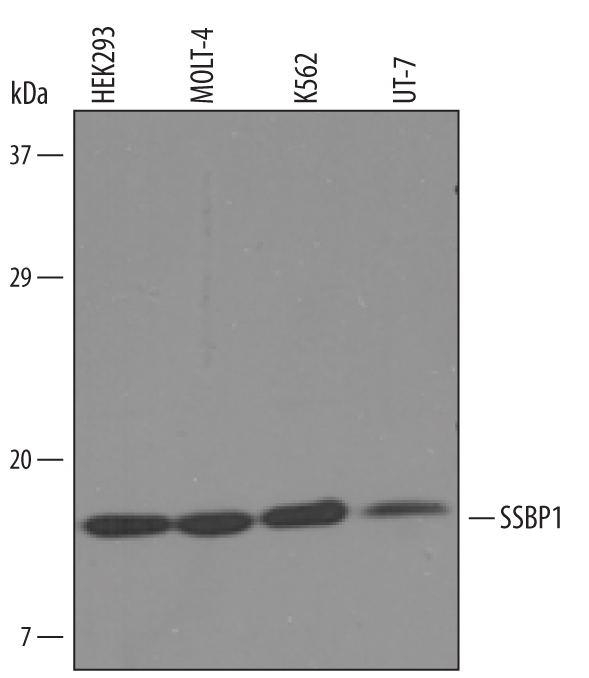
Detection of Human SSBP1 by Western Blot.
Western blot shows lysates of HEK293 human embryonic kidney cell line, MOLT-4 human acute lymphoblastic leukemia cell line, K562 human chronic myelogenous leukemia cell line, and UT-7 human acute myeloid leukemia cell line. PVDF Membrane was probed with 1 µg/mL of Sheep Anti-Human SSBP1 Antigen Affinity-purified Polyclonal Antibody (Catalog # AF6588) followed by HRP-conjugated Anti-Sheep IgG Secondary Antibody (Catalog # HAF016). A specific band was detected for SSBP1 at approximately 18 kDa (as indicated). This experiment was conducted under reducing conditions and using Immunoblot Buffer Group 8.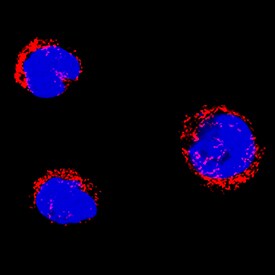
SSBP1 in HL‑60 Human Cell Line.
SSBP1 was detected in immersion fixed HL-60 human acute promyelocytic leukemia cell line using Sheep Anti-Human SSBP1 Antigen Affinity-purified Polyclonal Antibody (Catalog # AF6588) at 5 µg/mL for 3 hours at room temperature. Cells were stained using the NorthernLights™ 557-conjugated Anti-Sheep IgG Secondary Antibody (red; Catalog # NL010) and counterstained with DAPI (blue). Specific staining was localized to cytoplasm. View our protocol for Fluorescent ICC Staining of Non-adherent Cells.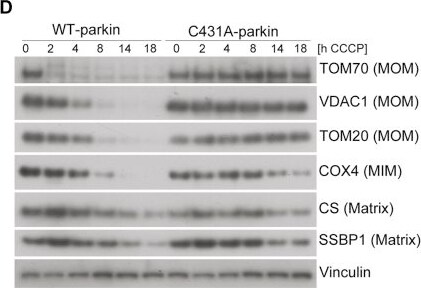
Detection of SSBP1 by Western Blot
Outside–in degradation of mitochondrial proteins.A, mitochondrial proteins were enriched among significantly regulated proteins. B, abundance profiles of significantly regulated proteins from various mitochondrial subcompartments show trends dependent on parkin activity. Indicated are size of total annotated proteins (left; dark profiles) and those after filtering (right; bright profiles); four mitochondrial proteins are of unknown or dual sublocalization (data not shown). C, average profile of each cluster sorted by half maximum in combination with overrepresentation analysis of mitochondrial subcompartments allows for the discrimination of “early” degraded MOM, “intermediate” degraded MOM/IMS/MIM, and “late” degraded MIM/matrix proteins. D, Western blot detection of mitochondrial subcompartment proteins during mitophagy validates stepwise degradation of mitochondrial subcompartments. IMS, inter membrane space; Mito, mitochondrion; MIM, mitochondrial inner membrane; MOM, mitochondrial outer membrane. Image collected and cropped by CiteAb from the following open publication (https://linkinghub.elsevier.com/retrieve/pii/S1535947621001638), licensed under a CC-BY license. Not internally tested by R&D Systems.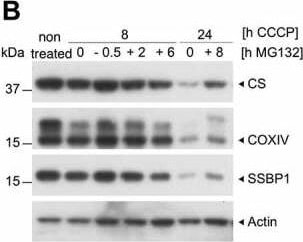
Detection of SSBP1 by Western Blot
Proteasome action is required at late stages of mitophagy. (A) Scheme of treatment time points for proteasome inhibition experiments. Bold text indicates treatment with CCCP while normal text indicates treatment with proteasome inhibitor MG132. (B and C) Western blot analysis of proteasome influence on the indicated inner mitochondrial proteins. (D) Representative images of WT-parkin HeLa cells showing SSBP1 (magenta) and TOM20 (green) after 24 h of CCCP treatment or CCCP treatment combined with MG132 added after 8 h of mitochondria depolarization. Scale bar = 5 µm. (E and F) Single cell analysis of (E) mean number of SSSP1 clumps and (F) relative average SSBP1 clump area per cell. Bars: Mean ± SEM. ns: non-significant; *: p≤0.05, ***: p≤0.001. Image collected and cropped by CiteAb from the following open publication (https://pubmed.ncbi.nlm.nih.gov/40396016), licensed under a CC-BY license. Not internally tested by R&D Systems.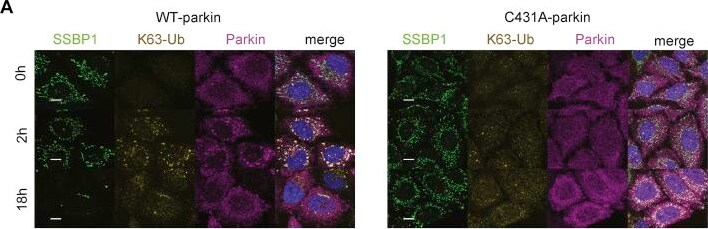
Detection of SSBP1 by Immunohistochemistry
Parkin activity is essential for the removal of depolarized mitochondria.A, immunofluorescence staining of WT-parkin and C431A-parkin cells after early (2 h) and late (18 h) depolarization times. Scale bars represent 5 μm. B, experimental setup combining subcellular protein fractionation with peptide dimethyl labeling and high pH reversed-phase fractionation during “early” and “late” mitophagy stages in WT-parkin and C431A-parkin cells. Basic workflow applied for proteome and phosphoproteome analysis. C, correlation plot between replicates after log2 transformation of protein ratios. Common light dimethyl labeling channel (0 h postdepolarization) allows comparison between “early” and “late” triple dimethyl-labeling sets per cell line. Parkin-dependent degradation of mitochondrial proteins reflected by shifting data points (density colored points) from “unregulated” toward “downregulated” in WT-parkin expressing cells in comparison to total proteome (gray points). Number of valid pairs per condition and Spearman rank correlation (in brackets) indicated for total (T) and mitochondrial annotated proteins (M). Image collected and cropped by CiteAb from the following open publication (https://linkinghub.elsevier.com/retrieve/pii/S1535947621001638), licensed under a CC-BY license. Not internally tested by R&D Systems.
Detection of SSBP1 by Immunohistochemistry
Autophagy activation and delivery to lysosomes of inner- mitochondrial material. (A and B) Influence of BafA inhibition on TOM20-negative mitochondrial-aggresomes. (A) Representative immunofluorescence images showing TOM20 (green) and SSBP1 (magenta) structures at the indicated CCCP-treatment time points in combination with autophagy inhibition (BafA). (B) Single-cell analysis of mean number of mitochondrial SSBP1 and TOM20 puncta in (A). (C) COX IV-positive puncta (magenta) are positive for EGFP-LC3B (yellow). Arrows indicate COX IV puncta partially engaged with EGFP-LC3B structures. Closed arrowheads indicate complete overlap of COX IV puncta and EGFP-LC3B. Open arrowheads indicate non co-localizing COX IV puncta with EGFP-LC3B. (D) Representative immunofluorescence images showing COX IV-positive puncta (green) co-localizing with LysoTracker (magenta) at the indicated time points. Arrows indicate mitochondrial puncta while arrowheads indicate inner mitochondrial aggregates. (E and F) Representative immunofluorescence images showing (E) COX IV-positive (magenta) or (F) SSBP1-positive mitochondrial aggregates (magenta) close to LAMP1 patches (green) at the indicated time points. Arrows indicate mitochondrial puncta while arrowheads indicate inner mitochondrial aggregates. ****: p ≤0.0001. All scale bars = 5 µm. Image collected and cropped by CiteAb from the following open publication (https://pubmed.ncbi.nlm.nih.gov/40396016), licensed under a CC-BY license. Not internally tested by R&D Systems.Applications for Human SSBP1 Antibody
Immunocytochemistry
Sample: Immersion fixed HL-60 human acute promyelocytic leukemia cell line
Western Blot
Sample: HEK293 human embryonic kidney cell line, MOLT‑4 human acute lymphoblastic leukemia cell line, K562 human chronic myelogenous leukemia cell line, and UT‑7 human acute myeloid leukemia cell line
Reviewed Applications
Read 1 review rated 4 using AF6588 in the following applications:
Formulation, Preparation, and Storage
Purification
Reconstitution
Sterile PBS to a final concentration of 0.2 mg/mL. For liquid material, refer to CoA for concentration.
Formulation
Shipping
Stability & Storage
- 12 months from date of receipt, -20 to -70 °C as supplied.
- 1 month, 2 to 8 °C under sterile conditions after reconstitution.
- 6 months, -20 to -70 °C under sterile conditions after reconstitution.
Calculators
Background: SSBP1
Long Name
Alternate Names
Gene Symbol
UniProt
Additional SSBP1 Products
Product Documents for Human SSBP1 Antibody
Certificate of Analysis
To download a Certificate of Analysis, please enter a lot or batch number in the search box below.
Note: Certificate of Analysis not available for kit components.
Product Specific Notices for Human SSBP1 Antibody
For research use only
Citations for Human SSBP1 Antibody
 Powered by Bioz
Customer Reviews for Human SSBP1 Antibody (1)
Have you used Human SSBP1 Antibody?
Submit a review and receive an Amazon gift card!
$25/€18/£15/$25CAN/¥2500 for a review with an image
$10/€7/£6/$10CAN/¥1110 for a review without an image
Submit a review
Customer Images
-
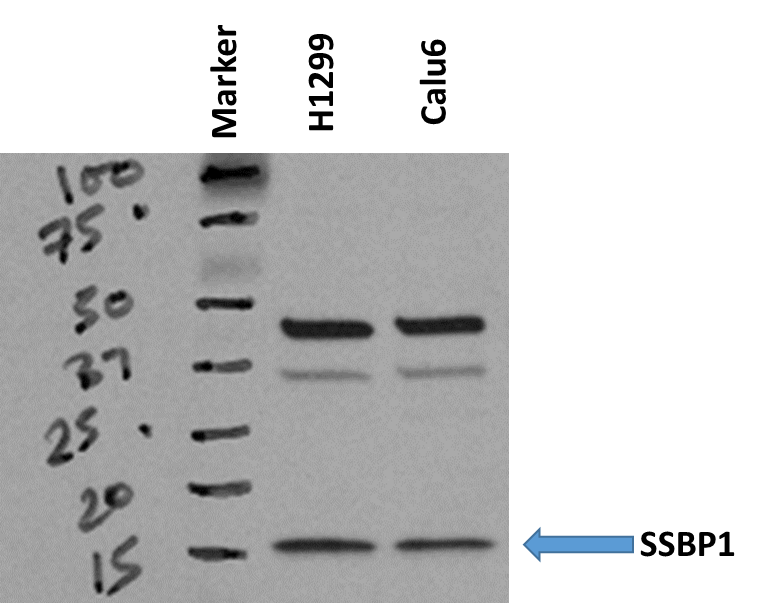
Application: Western BlotSample Tested: H1299 human lung carcinoma cell line, H1944 human lung carcinoma cell line and Calu-6 human lung carcinoma cell lineSpecies: HumanVerified Customer | Posted 11/14/2017

There are no reviews that match your criteria.
Protocols
Find general support by application which include: protocols, troubleshooting, illustrated assays, videos and webinars.
- Appropriate Fixation of IHC/ICC Samples
- Cellular Response to Hypoxia Protocols
- ClariTSA™ Fluorophore Kits
- Detection & Visualization of Antibody Binding
- ICC Cell Smear Protocol for Suspension Cells
- ICC Immunocytochemistry Protocol Videos
- ICC for Adherent Cells
- Immunocytochemistry (ICC) Protocol
- Immunocytochemistry Troubleshooting
- Immunofluorescence of Organoids Embedded in Cultrex Basement Membrane Extract
- Immunohistochemistry (IHC) and Immunocytochemistry (ICC) Protocols
- Preparing Samples for IHC/ICC Experiments
- Preventing Non-Specific Staining (Non-Specific Binding)
- Primary Antibody Selection & Optimization
- Protocol for VisUCyte™ HRP Polymer Detection Reagent
- Protocol for the Fluorescent ICC Staining of Cell Smears - Graphic
- Protocol for the Fluorescent ICC Staining of Cultured Cells on Coverslips - Graphic
- Protocol for the Preparation and Fluorescent ICC Staining of Cells on Coverslips
- Protocol for the Preparation and Fluorescent ICC Staining of Non-adherent Cells
- Protocol for the Preparation and Fluorescent ICC Staining of Stem Cells on Coverslips
- Protocol for the Preparation of a Cell Smear for Non-adherent Cell ICC - Graphic
- R&D Systems Quality Control Western Blot Protocol
- TUNEL and Active Caspase-3 Detection by IHC/ICC Protocol
- The Importance of IHC/ICC Controls
- Troubleshooting Guide: Western Blot Figures
- Western Blot Conditions
- Western Blot Protocol
- Western Blot Protocol for Cell Lysates
- Western Blot Troubleshooting
- Western Blot Troubleshooting Guide
- View all Protocols, Troubleshooting, Illustrated assays and Webinars