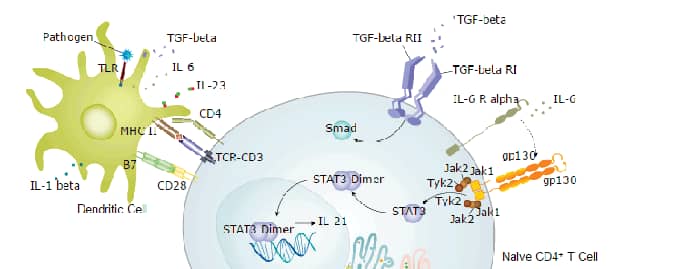
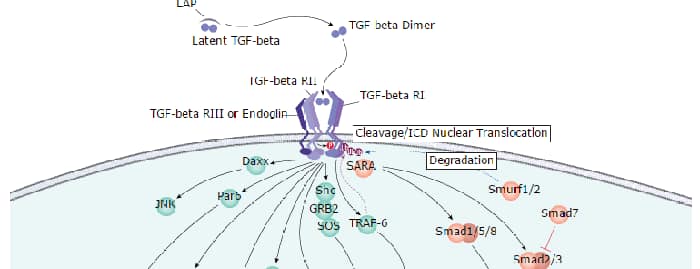
TGF-beta 1 (transforming growth factor beta 1) is one of three closely related mammalian members of the large TGF-beta superfamily that share a characteristic cysteine knot structure (1-7). TGF-beta 1, -2 and -3 are highly pleiotropic cytokines that are proposed to act as cellular switches that regulate processes such as immune function, proliferation and epithelial-mesenchymal transition (1-4). Each TGF-beta isoform has some non-redundant functions; for TGF-beta 1, mice with targeted deletion show defects in hematopoiesis and endothelial differentiation, and die of overwhelming inflammation (2). Human TGF-beta 1 cDNA encodes a 390 amino acid (aa) precursor that contains a 29 aa signal peptide and a 361 aa proprotein (8). A furin-like convertase processes the proprotein to generate an N-terminal 249 aa latency-associated peptide (LAP) and a C-terminal 112 aa mature TGF- beta 1 (8, 9). Disulfide-linked homodimers of LAP and TGF-beta 1 remain non-covalently associated after secretion, forming the small latent TGF-beta 1 complex (8-10). Covalent linkage of LAP to one of three latent TGF-beta binding proteins (LTBPs) creates a large latent complex that may interact with the extracellular matrix (9, 10). TGF-beta is activated from latency by pathways that include actions of the protease plasmin, matrix metalloproteases, thrombospondin 1 and a subset of integrins (10). Mature human TGF-beta 1 shares 100% aa identity with pig, dog and cow TGF-beta 1, and 99% aa identity with mouse, rat and horse TGF-beta 1. It demonstrates cross-species activity (1). TGF-beta 1 signaling begins with high-affinity binding to a type II ser/thr kinase receptor termed TGF-beta RII. This receptor then phosphorylates and activates a second ser/thr kinase receptor, TGF-beta RI (also called activin receptor-like kinase (ALK) -5), or alternatively,
ALK‑1.This complex phosphorylates and activates Smad proteins that regulate transcription (3, 11, 12). Contributions of the accessory receptors betaglycan (also known as TGF-beta RIII) and endoglin, or use of Smad-independent signaling pathways, allow for disparate actions observed in response to TGF-beta in different contexts (11).

Discontinued Product
100-B has been discontinued.
An alternative/replacement product is available:
7754-BH, 240-B. View all TGF-beta 1 products.
Key Product Details
Source
Human Platelets
Structure / Form
Disulfide-linked homodimer
Applications
Bioactivity
Loading...
Product Specifications
Source
Human platelet-derived TGF-beta 1 protein
The human platelets used for the isolation of this product were certified by the supplier to be HIV-1 and HBsAg negative at the time of shipment. Human blood products should always be treated in accordance with universal handling precautions.
The human platelets used for the isolation of this product were certified by the supplier to be HIV-1 and HBsAg negative at the time of shipment. Human blood products should always be treated in accordance with universal handling precautions.
Purity
>97%, by SDS-PAGE under reducing conditions and visualized by silver stain.
Endotoxin Level
<0.10 EU per 1 μg of the protein by the LAL method.
SDS-PAGE
12 kDa, reducing conditions
Activity
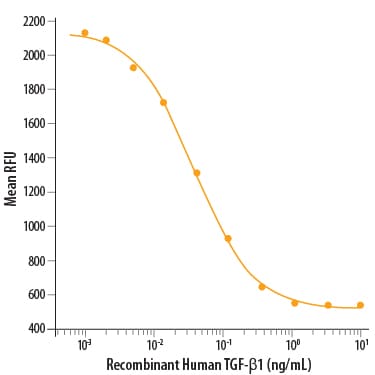
Measured by its ability to inhibit the IL-4-dependent proliferation of HT‑2 mouse T cells. Tsang, M. et al. (1995) Cytokine 7:389.
The ED50 for this effect is 0.04-0.2 ng/mL.
The ED50 for this effect is 0.04-0.2 ng/mL.
Reviewed Applications
Read 4 reviews rated 5 using 100-B in the following applications:
Scientific Data Images for Human TGF-beta 1 Protein
Human TGF-beta 1 Protein Bioactivity
Human TGF-beta 1 (Catalog # 100-B) inhibits Recombinant Mouse IL-4 (Catalog # 404-ML) induced cell proliferation in the HT-2 mouse T cell line. The ED50 for this effect is 0.04-0.2 ng/mL.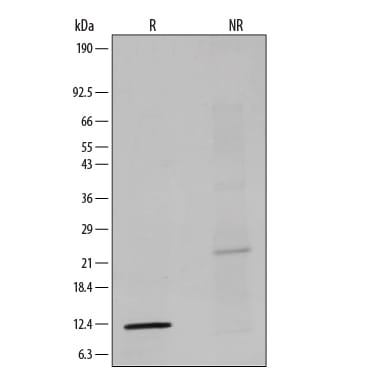
Human TGF-beta 1 Protein SDS-PAGE
1 μg/lane of Recombinant Human TGF-beta 1 was resolved with SDS-PAGE under reducing (R) and non-reducing (NR) conditions and visualized by silver staining, showing single bands at 12 kDa and 24 kDa, respectively.Formulation, Preparation, and Storage
100-B
| Formulation | Lyophilized from a 0.2 μm filtered solution in Acetonitrile and TFA with BSA as a carrier protein. |
| Reconstitution | Reconstitute at 10 μg/mL in sterile 4 mM HCl containing at least 0.1% human or bovine serum albumin. |
| Shipping | The product is shipped at ambient temperature. Upon receipt, store it immediately at the temperature recommended below. |
| Stability & Storage | Use a manual defrost freezer and avoid repeated freeze-thaw cycles.
|
Calculators
Background: TGF-beta 1
References
- Derynck, R. and K. Miyazono (2008) “TGF-beta and the TGF-beta Family” in The TGF-beta Family, Derynck, R. and K. Miyazono eds., Cold Spring Harbor Laboratory Press, p. 29.
- Dunker, N. & K. Krieglstein, 2000, Eur. J. Biochem. 267:6982.
- Wahl, S.M. (2006) Immunol. Rev. 213:213.
- Chang, H. et al. (2002) Endocr. Rev. 23:787.
- Lin, J.S. et al. (2006) Reproduction 132:179.
- Hinck, A.P. et al. (1996) Biochemistry 35:8517.
- Mittl, P.R.E. et al. (1996) Protein Sci. 5:1261.
- Derynck, R. et al. (1985) Nature 316:701.
- Miyazono, K. et al. (1988) J. Biol. Chem. 263:6407.
- Oklu, R. and R. Hesketh (2000) Biochem. J. 352:601.
- de Caestecker, M. et al. (2004) Cytokine Growth Factor Rev. 15:1.
- Zuniga, J.E. et al. (2005) J. Mol. Biol. 354:1052.
Long Name
Transforming Growth Factor beta 1
Alternate Names
TGF beta1, TGFB, TGFB1, TGFbeta 1
Gene Symbol
TGFB1
Additional TGF-beta 1 Products
Product Documents for Human TGF-beta 1 Protein
Certificate of Analysis
To download a Certificate of Analysis, please enter a lot or batch number in the search box below.
Note: Certificate of Analysis not available for kit components.
Product Specific Notices for Human TGF-beta 1 Protein
For research use only
Related Research Areas
Citations for Human TGF-beta 1 Protein
 Powered by Bioz
Customer Reviews for Human TGF-beta 1 Protein (4)
5 out of 5
4 Customer Ratings
Have you used Human TGF-beta 1 Protein?
Submit a review and receive an Amazon gift card!
$25/€18/£15/$25CAN/¥2500 for a review with an image
$10/€7/£6/$10CAN/¥1110 for a review without an image
Submit a review
Customer Images
Showing
1
-
4 of
4 reviews
Showing All
Filter By:
-
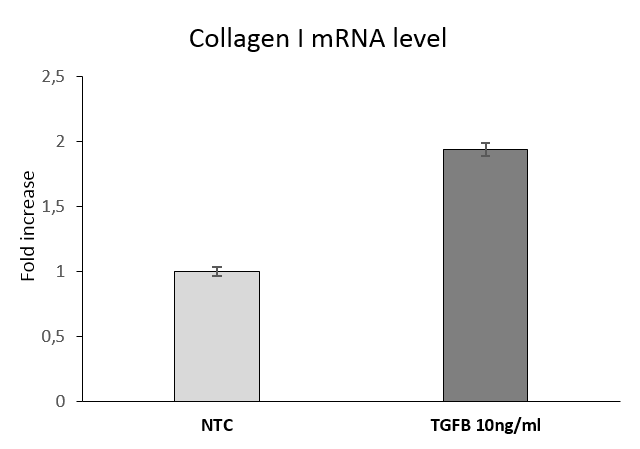
Application: Evaluation of fibrosis induction after TGFb treatment.Verified Customer | Posted 08/17/2020

-
Application: In vitro bioactivity in cell cultureVerified Customer | Posted 11/03/2017
-
Application: Immunoassay StandardVerified Customer | Posted 07/31/2017
-
Application: In vitro bioactivity in cell cultureVerified Customer | Posted 07/21/2017
There are no reviews that match your criteria.
Loading...
Associated Pathways


IL-21 Signaling Pathways and their Primary Biological Effects in Different Immune Cell Types
 Mesenchymal Stem Cell Differentiation Pathways & Lineage-specific Markers
 TGF-beta Signaling Pathways
 Th17 Differentiation Pathway