
The mouse asialoglycoprotein receptor (ASGP-R) is an endocytic recycling receptor that belongs to the long-form subfamily of the C-type/Ca++-dependent lectin family (1-3). It is a complex of two noncovalently-linked subunits, a major 42 kDa glycoprotein (ASGPR1) and a minor 51 kDa glycoprotein (ASGR2). The major mouse ASGP-R subunit, ASGPR1, is synthesized as a 284 amino acid (aa) type II transmembrane (TM) protein that contains a 39 aa cytoplasmic region, a 21 aa TM segment, and a 224 aa extracellular domain (ECD) (4‑6). The ECD contains two important structural regions. The first is a stalk region of 56 aa (aa’s # 59-117) that contributes to noncovalent oligomerization. The second is a 118 aa, carbohydrate-binding, Ca++-dependent C-type lectin domain (aa’s 160-277) that is unusually stabilized by three Ca++ ions (3, 5). There are two potential alternate splice forms for ASGPR1. Both are TM and show a deletion of the C-type lectin domain. One is 113 aa in length and shows a deletion of aa’s # 114-284 (7). The second is 132 aa in length and shows a deletion of aa’s 118-146 and aa’s 162 - 284 (8). Mouse ASGPR1 ECD is 89% and 79% aa identical to the ASGPR1 ECD in rat and human, respectively. The minor mouse ASGP-R subunit, ASGR2, is also a C-type lectin that shares the same structural organization as ASGR-1. It is 301 aa in length and has two 45 kDa and 51 kDa differentially-glycosylated isoforms (4, 6, 9). The ECD of ASGR2 is 50% aa identical to the ECD of ASGPR1. Although ASGPR1 and 2 can be expressed individually, a fully functional and stable ASGP-R requires simultaneous expression of both subunits (10-12). The stoichiometry of a functional ASGP-R is suggested to be either a 2:2, 3:1 or 3:2 ratio of ASGPR1:ASGR2 (13, 14). ASGPR1 is reported to bind Gal (non-reducing), GalNAc, and sialic acid alpha 2,6GalNAc (3, 15, 16). This is generally in the context of triantennary or tetraantennary configurations (2).
Mouse ASGR1/ASGPR1 Antibody
R&D Systems | Catalog # AF2755

Scientific images may be resized, cropped, or adjusted for brightness or contrast for presentation purposes. These updates are limited to presentation and do not affect the underlying scientific interpretation of the data. Where available, additional source data may be provided upon request.
Key Product Details
Species Reactivity
Applications
Label
Antibody Source
Product Specifications
Immunogen
Ser60-Asn284
Accession # Q91Y84
Specificity
Clonality
Host
Isotype
Endotoxin Level
Scientific Data Images for Mouse ASGR1/ASGPR1 Antibody
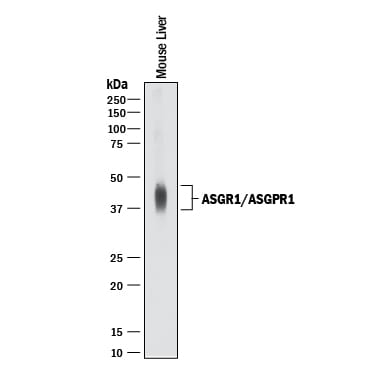
Detection of Mouse ASGR1/ASGPR1 by Western Blot.
Western blot shows lysate of mouse liver tissue. PVDF membrane was probed with 0.25 µg/mL of Goat Anti-Mouse ASGR1/ASGPR1 Antigen Affinity-purified Polyclonal Antibody (Catalog # AF2755) followed by HRP-conjugated Anti-Goat IgG Secondary Antibody (Catalog # HAF017). A specific band was detected for ASGR1/ASGPR1 at approximately 40-46 kDa (as indicated). This experiment was conducted under reducing conditions and using Immunoblot Buffer Group 1.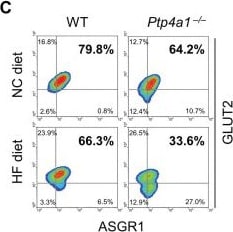
Detection of ASGR1/ASGPR1 by Flow Cytometry
The deficiency of PTP4A1 in mice fed a high-fat (HF) diet reduces glucose uptake by a decrease in GLUT2 on the plasma membrane in hepatocytes. (A) The assay of 2-deoxyglucose (2-DG) uptake in the livers, epididymal white adipose tissues (eWAT), and gastrocnemius muscles of wild-type (WT) and Ptp4a1-/- mice fed an HF diet for 12 weeks (n = 5). (B) FACS analysis after staining BODIPY on primary hepatocytes (PH) of WT and Ptp4a1-/- mice fed an HF diet. Data represent three independent experiments. (C) FACS analysis after staining glucose transporter 2 (GLUT2)-APC and asialoglycoprotein receptor 1 (ASGR1)-Alexa 488 on PH of WT and Ptp4a1-/- mice fed a normal chow (NC) or an HF diet. ASGR1 was used as a marker for hepatocytes. Data represent three independent experiments. (D) FACS analysis of the 2-NBDG glucose uptake assay on the PH of WT and Ptp4a1-/- mice fed an HF diet. Data represent three independent experiments. (E) FACS analysis after staining BODIPY on Hep3B expressing mock or PTP4A1 treated with bovine serum albumin-oleic acid (BSA-OA). Data represent three independent experiments. (F) The 2-NBDG uptake assay after incubation of BSA-OA on Hep3B transfected by PTP4A1-expressing vector or control vector. Representative images (left) and quantification for relative fluorescence intensity (RFI, right) (n = 4). Scale bar, 500 μm. Data are presented as the mean ± standard error of the mean. **P < 0.01, n.s., not significant (Mann-Whitney U test for A; two‐tailed Student's t‐test for F). Image collected and cropped by CiteAb from the following open publication (https://pubmed.ncbi.nlm.nih.gov/36793871), licensed under a CC-BY license. Not internally tested by R&D Systems.Applications for Mouse ASGR1/ASGPR1 Antibody
Blockade of Receptor-ligand Interaction
Western Blot
Sample: Mouse liver tissue
Formulation, Preparation, and Storage
Purification
Reconstitution
Reconstitute at 0.2 mg/mL in sterile PBS. For liquid material, refer to CoA for concentration.
Formulation
Shipping
Stability & Storage
- 12 months from date of receipt, -20 to -70 °C as supplied.
- 1 month, 2 to 8 °C under sterile conditions after reconstitution.
- 6 months, -20 to -70 °C under sterile conditions after reconstitution.
Calculators
Background: ASGR1/ASGPR1
References
- Stockert, R. J. (1995) Physiol. Rev. 75:591.
- Weigel, P.H. and J.H.N. Yik (2002) Biochim. Biophys. Acta 1572:341.
- Meier, M. et al. (2000) J. Mol. Biol. 300:857.
- Takezawa, R. et al. (1993) Biochim. Biophys. Acta 1172 :220.
- Monroe, R.S. and B.E. Huber (1994) Gene 148:237.
- Sanford, J.P. et al. (1988) DNA 7:721.
- Heath, P. (2005) GenBank Accession # Q5NCV2.
- Heath, P. (2005) GenBank Accession # Q5NCV1.
- Sanford, J.P. and D. Doyle (1990) Biochim. Biophys. Acta 1087:259.
- Braun, J.R. et al. (1996) J. Biol. Chem. 271:21160.
- Ishibashi, S. et al. (1994) J. Biol. Chem. 269:27803.
- Tozawa, R. et al. (2001) J. Biol. Chem. 276:12624.
- Bider, M.D. et al. (1996) J. Biol. Chem. 271:31996.
- Lodish, H. (1991) Trends Biochem. Sci. 16:374.
- Westerlind, U. et al. (2004) Glyconj. J. 21:227.
- Park, E.I. et al. (2005) Proc. Natl. Acad. Sci. USA 102:17125.
Long Name
Alternate Names
Gene Symbol
UniProt
Additional ASGR1/ASGPR1 Products
Product Documents for Mouse ASGR1/ASGPR1 Antibody
Certificate of Analysis
To download a Certificate of Analysis, please enter a lot or batch number in the search box below.
Note: Certificate of Analysis not available for kit components.
Product Specific Notices for Mouse ASGR1/ASGPR1 Antibody
For research use only
Related Research Areas
Citations for Mouse ASGR1/ASGPR1 Antibody
 Powered by Bioz
Customer Reviews for Mouse ASGR1/ASGPR1 Antibody
There are currently no reviews for this product. Be the first to review Mouse ASGR1/ASGPR1 Antibody and earn rewards!
Have you used Mouse ASGR1/ASGPR1 Antibody?
Submit a review and receive an Amazon gift card!
$25/€18/£15/$25CAN/¥2500 for a review with an image
$10/€7/£6/$10CAN/¥1110 for a review without an image
Submit a review
Protocols
Find general support by application which include: protocols, troubleshooting, illustrated assays, videos and webinars.
- Cellular Response to Hypoxia Protocols
- R&D Systems Quality Control Western Blot Protocol
- Troubleshooting Guide: Western Blot Figures
- Western Blot Conditions
- Western Blot Protocol
- Western Blot Protocol for Cell Lysates
- Western Blot Troubleshooting
- Western Blot Troubleshooting Guide
- View all Protocols, Troubleshooting, Illustrated assays and Webinars