
PDGF R alpha (platelet-derived growth factor receptor alpha) is a type I transmembrane glycoprotein in the class III subfamily of receptor tyrosine kinases (RTK) (1-3). PDGF R alpha and PDGF R beta can form homo- or hetero-dimeric receptors when engaged by dimers of the PDGF family of growth factors, which include disulfide-linked homodimers of PDGF-A, B, C or D, or the heterodimer PDGF-AB that is mainly found in human platelets. While multiple in vitro ligand-receptor combinations have been identified, in vivo evidence indicates that PDGF R alpha primarily binds PDGF-AA and PDGF-CC, while PDGF R beta primarily binds PDGF-BB and probably PDGF-DD. Like all class III RTKs, the extracellular domain (ECD) of mouse PDGF R alpha (amino acids 25-525) contains five immunoglobulin-like domains, while the intracellular region contains a split tyrosine kinase domain (aa 593‑954). Within the ECD, mouse PDGF R alpha shares 85%, 93%, 84%, 84%, and 81% amino acid sequence identity with human, rat, equine, canine and bovine PDGF R alpha respectively. PDGF R alpha autophosphorylates upon dimerization, activating signaling cascades in PI 3-kinase Ras-MAP kinase, and PLC-gamma pathways (1, 2). Signaling is down‑regulated by SHP-2 phosphatase activity and by receptor endocytosis and lysosomal degradation. PDGF R alpha is expressed at low levels in most mesenchymal cells, but is strongly expressed in oligodendrocyte, lung, skin and intestinal progenitor cells and induced by inflammation or growth in culture (1-3). During development, mesenchymal cells expressing PDGF R alpha respond to local gradients of epithelially produced PDGF-AA or PDGF-CC during formation of the cranial and cardiac neural crest, retina, gonads, lung alveoli, intestinal villi, skin, hair follicles, skeleton, teeth, palate, and interstitial kidney mesenchyme (1, 4). Deletion of PDGF R alpha in mice severely impairs mesenchymal derivatives in both embryo and extraembryonic tissues, and high or low PDGF R alpha signaling in humans may result in spina bifida or cleft palate‑type malformations. Postnatally, PDGF R alpha is implicated in gliomas and fibrotic disorders of lung, heart and skin (scleroderma) (5- 7).
Mouse PDGF R alpha Antibody (1039504)
R&D Systems | Catalog # MAB3221

Scientific images may be resized, cropped, or adjusted for brightness or contrast for presentation purposes. These updates are limited to presentation and do not affect the underlying scientific interpretation of the data. Where available, additional source data may be provided upon request.
Key Product Details
Species Reactivity
Applications
Label
Antibody Source
Product Specifications
Immunogen
Leu25-Glu524
Accession # P26618.3
Specificity
Clonality
Host
Isotype
Scientific Data Images for Mouse PDGF R alpha Antibody (1039504)
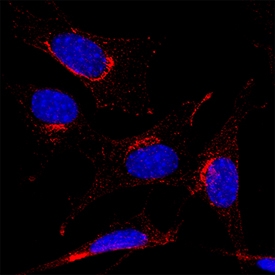
PDGF R alpha in NIH‑3T3 Mouse Cell Line.
PDGF R alpha was detected in immersion fixed NIH‑3T3 mouse embryonic fibroblast cell line using Rat Anti-Mouse PDGF R alpha Monoclonal Antibody (Catalog # MAB3221) at 8 µg/mL for 3 hours at room temperature. Cells were stained using the NorthernLights™ 557-conjugated Anti-Rat IgG Secondary Antibody (red; NL013) and counterstained with DAPI (blue). Specific staining was localized to cell surface. Staining was performed using our protocol for Fluorescent ICC Staining of Non-adherent Cells.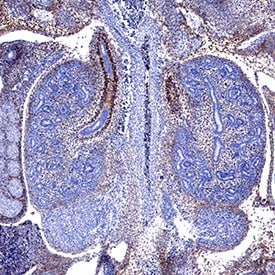
PDGF R alpha in 13 d.p.c. mouse embryos.
PDGF R alpha was detected in immersion fixed paraffin-embedded sections of 13 d.p.c. mouse embryos using Rat Anti-MousePDGF R alpha Monoclonal Antibody (Catalog # MAB3221) at 5 µg/mL for 1 hour at room temperature followed by incubation with the Anti-Rat IgG VisUCyte™ HRP Polymer Antibody (VC005). Before incubation with the primary antibody, tissue was subjected to heat-induced epitope retrieval using Antigen Retrieval Reagent-Basic (CTS013). Tissue was stained using DAB (brown) and counterstained with hematoxylin (blue). Specific staining was localized to embryonic kidney. Staining was performed using our protocol for IHC Staining with VisUCyte HRP Polymer Detection Reagents.Applications for Mouse PDGF R alpha Antibody (1039504)
Immunocytochemistry
Sample: Immersion fixed NIH‑3T3 mouse embryonic fibroblast cell line
Immunohistochemistry
Sample: Immersion fixed paraffin-embedded sections of 13 d.p.c. mouse embryos
Formulation, Preparation, and Storage
Purification
Reconstitution
Reconstitute at 0.5 mg/mL in sterile PBS.
Formulation
Shipping
Stability & Storage
- 12 months from date of receipt, -20 to -70 °C as supplied.
- 1 month, 2 to 8 °C under sterile conditions after reconstitution.
- 6 months, -20 to -70 °C under sterile conditions after reconstitution.
Calculators
Background: PDGF R alpha
References
- Andrae, J. et al. (2008) Genes Dev. 22:1276.
- Heldin, C-H. and B. Westermark (1999) Physiol. Rev. 79:1283.
- Do, M.S. et al. (1992) Oncogene 7:1567.
- Klinghoffer, R.A. et al. (2002) Dev. Cell 2:103.
- Martinho, O. (2009) Br. J. Cancer 101:973.
- Olson, L.E. and P. Soriano (2009) Dev. Cell 16:303.
- Baroni, S.S. et al. (2006) N. Engl. J. Med. 354:2667.
Long Name
Alternate Names
Gene Symbol
UniProt
Additional PDGF R alpha Products
Product Documents for Mouse PDGF R alpha Antibody (1039504)
Certificate of Analysis
To download a Certificate of Analysis, please enter a lot or batch number in the search box below.
Note: Certificate of Analysis not available for kit components.
Product Specific Notices for Mouse PDGF R alpha Antibody (1039504)
For research use only
Customer Reviews for Mouse PDGF R alpha Antibody (1039504)
There are currently no reviews for this product. Be the first to review Mouse PDGF R alpha Antibody (1039504) and earn rewards!
Have you used Mouse PDGF R alpha Antibody (1039504)?
Submit a review and receive an Amazon gift card!
$25/€18/£15/$25CAN/¥2500 for a review with an image
$10/€7/£6/$10CAN/¥1110 for a review without an image
Submit a review
Protocols
Find general support by application which include: protocols, troubleshooting, illustrated assays, videos and webinars.
- Antigen Retrieval Protocol (PIER)
- Antigen Retrieval for Frozen Sections Protocol
- Appropriate Fixation of IHC/ICC Samples
- Cellular Response to Hypoxia Protocols
- Chromogenic IHC Staining of Formalin-Fixed Paraffin-Embedded (FFPE) Tissue Protocol
- Chromogenic Immunohistochemistry Staining of Frozen Tissue
- ClariTSA™ Fluorophore Kits
- Detection & Visualization of Antibody Binding
- Fluorescent IHC Staining of Frozen Tissue Protocol
- Graphic Protocol for Heat-induced Epitope Retrieval
- Graphic Protocol for the Preparation and Fluorescent IHC Staining of Frozen Tissue Sections
- Graphic Protocol for the Preparation and Fluorescent IHC Staining of Paraffin-embedded Tissue Sections
- Graphic Protocol for the Preparation of Gelatin-coated Slides for Histological Tissue Sections
- ICC Cell Smear Protocol for Suspension Cells
- ICC Immunocytochemistry Protocol Videos
- ICC for Adherent Cells
- IHC Sample Preparation (Frozen sections vs Paraffin)
- Immunocytochemistry (ICC) Protocol
- Immunocytochemistry Troubleshooting
- Immunofluorescence of Organoids Embedded in Cultrex Basement Membrane Extract
- Immunofluorescent IHC Staining of Formalin-Fixed Paraffin-Embedded (FFPE) Tissue Protocol
- Immunohistochemistry (IHC) and Immunocytochemistry (ICC) Protocols
- Immunohistochemistry Frozen Troubleshooting
- Immunohistochemistry Paraffin Troubleshooting
- Preparing Samples for IHC/ICC Experiments
- Preventing Non-Specific Staining (Non-Specific Binding)
- Primary Antibody Selection & Optimization
- Protocol for Heat-Induced Epitope Retrieval (HIER)
- Protocol for Making a 4% Formaldehyde Solution in PBS
- Protocol for VisUCyte™ HRP Polymer Detection Reagent
- Protocol for the Fluorescent ICC Staining of Cell Smears - Graphic
- Protocol for the Fluorescent ICC Staining of Cultured Cells on Coverslips - Graphic
- Protocol for the Preparation & Fixation of Cells on Coverslips
- Protocol for the Preparation and Chromogenic IHC Staining of Frozen Tissue Sections
- Protocol for the Preparation and Chromogenic IHC Staining of Frozen Tissue Sections - Graphic
- Protocol for the Preparation and Chromogenic IHC Staining of Paraffin-embedded Tissue Sections
- Protocol for the Preparation and Chromogenic IHC Staining of Paraffin-embedded Tissue Sections - Graphic
- Protocol for the Preparation and Fluorescent ICC Staining of Cells on Coverslips
- Protocol for the Preparation and Fluorescent ICC Staining of Non-adherent Cells
- Protocol for the Preparation and Fluorescent ICC Staining of Stem Cells on Coverslips
- Protocol for the Preparation and Fluorescent IHC Staining of Frozen Tissue Sections
- Protocol for the Preparation and Fluorescent IHC Staining of Paraffin-embedded Tissue Sections
- Protocol for the Preparation of Gelatin-coated Slides for Histological Tissue Sections
- Protocol for the Preparation of a Cell Smear for Non-adherent Cell ICC - Graphic
- TUNEL and Active Caspase-3 Detection by IHC/ICC Protocol
- The Importance of IHC/ICC Controls
- Troubleshooting Guide: Immunohistochemistry
- View all Protocols, Troubleshooting, Illustrated assays and Webinars


