Simple Plex Control for Mouse IL-6

Control for use with Mouse IL-6 Simple Plex Cartridge Kit
Catalog # Availability Size / Price Qty
898307
Simple Plex Assay Controls
1 Image
Product Details
FAQs
Supplemental Products
Reviews

Simple Plex Control for Mouse IL-6 Summary

INTENDED USE AND DESCRIPTION: For use a quantitative control for the determination of mouse IL-6 concentrations in biological fluids. Controls are supplied lyophilized. Please refer to the lot specific certificate of analysis and Simple Plex Lyophilized Quality Control product insert for additional information.

Specifications

Source
N/A
Shipping Conditions
The product is shipped with polar packs. Upon receipt, store it immediately at the temperature recommended below.
Storage
• Store lyophilized controls at 2-8 °C. Lyophilized controls are stable for up to 12 months from date of receipt.
• Reconstituted controls are stable for up to 6 months from date of preparation when stored at ≤ -70 °C. Storage at -20° C is not recommended.
• Individual frozen aliquots of low and high controls are designed as single-use entities. Thaw directly before use and discard any remaining volume.
Applications
Control Simple Plex Automated Immunoassay
Species
Mouse

Product Datasheets

You must select a language.

x

Background: IL-6

Interleukin 6 (IL-6) is a pleiotropic, a-helical, 22-28 kDa phosphorylated and variably glycosylated cytokine that plays important roles in the acute phase reaction, inflammation, hematopoiesis, bone metabolism, and cancer progression. Mature human IL-6 is 183 amino acids (aa) in length and shares 39% aa sequence identity with mouse and rat IL-6. Alternative splicing generates several isoforms with internal deletions, some of which exhibit antagonistic properties. Cells known to express IL-6 include CD8+ T cells, fibroblasts, synoviocytes, adipocytes, osteoblasts, megakaryocytes, endothelial cells (under the influence of endothelins), sympathetic neurons, cerebral cortex neurons, adrenal medulla chromaffin cells, retinal pigment cells, mast cells, keratinocytes, Langerhans cells, fetal and adult astrocytes, neutrophils, monocytes, eosinophils, colonic epithelial cells, B1 B cells and pancreatic islet beta cells. IL-6 production is generally correlated with cell activation and is normally kept in control by glucocorticoids, catecholamines, and secondary sex steroids. Normal human circulating IL-6 is in the 1 pg/mL range, with slight elevations during the menstrual cycle, modest elevations in certain cancers, and large elevations after surgery.

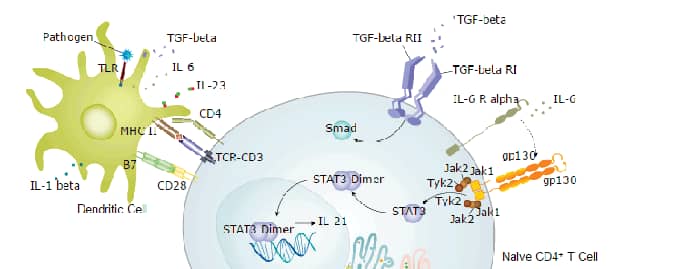
IL-6 induces signaling through a cell surface heterodimeric receptor complex composed of a ligand binding subunit (IL-6 R alpha) and a signal transducing subunit (gp130). IL-6 binds to IL-6 Ra, triggering IL-6 Ra association with gp130 and gp130 dimerization. gp130 is also a component of the receptors for CLC, CNTF, CT-1, IL-11, IL-27, LIF, and OSM. Soluble forms of IL-6 Ra are generated by both alternative splicing and proteolytic cleavage. In a mechanism known as trans-signaling, complexes of soluble IL-6 and IL-6 Ra elicit responses from gp130-expressing cells that lack cell surface IL-6 Ra. Trans-signaling enables a wider range of cell types to respond to IL-6, as the expression of gp130 is ubiquitous, while that of IL-6 Ra is predominantly restricted to hepatocytes, monocytes, and resting lymphocytes. Soluble splice forms of gp130 block trans-signaling from IL-6/IL-6 Ra but not from other cytokines that use gp130 as a co-receptor.

IL-6, along with TNF-a and IL-1, drives the acute inflammatory response. IL-6 is almost solely responsible for fever and the acute phase response in the liver, and it is important in the transition from acute inflammation to either acquired immunity or chronic inflammatory disease. When dysregulated, it contributes to chronic inflammation in conditions such as obesity, insulin resistance, inflammatory bowel disease, arthritis, and sepsis. IL-6 modulates bone resorption and is a major effector of inflammatory joint destruction in rheumatoid arthritis through its promotion of Th17 cell development and activity. It contributes to atherosclerotic plaque development and destabilization as well as the development of inflammation-associated carcinogenesis.

Long Name
Interleukin 6
Entrez Gene IDs
3569 (Human); 16193 (Mouse); 24498 (Rat); 399500 (Porcine); 280826 (Bovine); 403985 (Canine); 102138971 (Cynomolgus Monkey); 100034196 (Equine); 493687 (Feline); 463288 (Primate); 100008733 (Rabbit)
Alternate Names
B-cell differentiation factor; B-cell stimulatory factor 2; BSF2; BSF-2; CDF; CTL differentiation factor ; HSF; hybridoma growth factor; IFNB2; IFN-beta-2; IL6; IL-6; Interferon beta-2; interleukin 6 (interferon, beta 2); interleukin BSF-2; interleukin-6; MGI-2A

FAQs

No product specific FAQs exist for this product, however you may

View all Simple Plex Assays FAQs
Loading...

Reviews for Simple Plex Control for Mouse IL-6

There are currently no reviews for this product. Be the first to review Simple Plex Control for Mouse IL-6 and earn rewards!

Have you used Simple Plex Control for Mouse IL-6?

Submit a review and receive an Amazon gift card.

$25/€18/£15/$25CAN/¥75 Yuan/¥2500 Yen for a review with an image

$10/€7/£6/$10 CAD/¥70 Yuan/¥1110 Yen for a review without an image

Submit a Review