
The term 'mesenchymal stem cells' (MSCs) is most commonly used to describe multipotent self-renewing cells that can be differentiated in vitro to generate adipocytes, chondrocytes, and osteoblasts. However, because these biological properties and hierarchical relationships remain to be clearly demonstrated in vivo, the term 'multipotent mesenchymal stromal cells' is often used to distinguish cultured cells from their in vivo precursors. Originally discovered in mouse bone marrow, multipotent mesenchymal stromal cells cultured from a variety of species and tissue types, have been shown to differentiate into progeny of additional lineages including, cardiomyocytes, endothelial cells, hepatocytes, and neural cells. Again, the physiological relevance of these findings remains to be determined.
StemXVivo Osteogenic/Adipogenic Base Media
R&D Systems | Catalog # CCM007

Key Product Details
Species
Product Summary for StemXVivo Osteogenic/Adipogenic Base Media
Kit Summary
Base media for the differentiation of MSCs into osteocytes or adipocytes. For use with StemXVivo® Osteogenic or Adipogenic Supplements.
Key Benefits
- Supports human, mouse, and rat MSC differentiation
- Developed and optimized using MSCs to reduce experimental variation
- Tested for consistent MSC differentiation
Why Induce Osteogenic or Adipogenic Differentiation in MSCs with Defined Media?
Despite the well-characterized factors and protocols used to differentiate mesenchymal stem/stromal cells (MSCs) into osteocytes or adipocytes, differentiation efficiencies can vary depending on the quality of the MSC starting population and the reagents used to expand and differentiate MSCs.
Osteogenic/Adipogenic Base Media:
- Supports reproducible human, mouse, and rat MSC differentiation.
- Offers flexibility to evaluate novel cytokine and growth factor combinations to induce osteogenesis or adipogenesis.
- Has been developed and optimized using MSCs.
- Can be used with StemXVivo® Osteogenic Supplement (Catalog # CCM008 or CCM009) or StemXVivo® Adipogenic Supplement (Catalog # CCM011) to reduce variation in differentiation.
The term ‘mesenchymal stromal cells’ is commonly used to describe a heterogeneous population of cultured cells that are adherent to plastic, have a distinct morphology, and express a specific set of marker proteins. Within this heterogeneous population are cells referred to as ‘mesenchymal stem cells.’
Mesenchymal stem cells are multipotent, self-renewing cells that have the ability to differentiate into adipocytes, chondrocytes, and osteoblasts when cultured in vitro. Read More about MSC Nomenclature
Human/Mouse/Rat StemXVivo® Osteogenic/Adipogenic Base Media Components
Supplied in a 250 mL volume, this defined media contains high quality factors to drive MSC differentiation into osteocytes or adipocytes when used with additional differentiation factors.
- Supplemented with sodium bicarbonate but does not contain antibiotics.
*This kit requires supplements (not included), such as StemXVivo® Osteogenic Supplement (Catalog # CCM008 or CCM009), StemXVivo® Adipogenic Supplement (Catalog # CCM011), or user-selected cytokines and growth factors.
2006 Proposed Change to MSC Nomenclature
Although mesenchymal stromal cells were once referred to as ‘mesenchymal stem cells’, a change to ‘mesenchymal stromal cells’ was proposed by the International Society for Cellular Therapy in 2006.1
The change in nomenclature originates from two important factors:
- Methods used to isolate mesenchymal stem cells yield a heterogeneous population of cells with only a fraction of these cells demonstrating multipotency.
- The absence of direct evidence that mesenchymal stem cells can self-renew and differentiate in vivo.
Use of Mesenchymal Stem and Stromal Cell Terminology
Data supporting MSC self-renewal and multipotency have been obtained using in vitro conditions, which does not adequately reflect the in vivo environment. The lack of in vivo data has led some researchers to question the validity of the term ‘mesenchymal stem cell’ providing further support for the use of ‘mesenchymal stromal cells’ to describe MSCs.2 While ‘mesenchymal stromal cells’ may be the more scientifically accurate term for MSCs, the two terms are often used interchangeably in the literature. R&D Systems recognizes the use of both mesenchymal stem cells and mesenchymal stromal cells and uses ‘MSC’ to indicate mesenchymal stem/stromal cells to account for both designations.
Definitions of Mesenchymal Stromal Cells and Mesenchymal Stem Cells
- Mesenchymal Stromal Cells – A heterogeneous population of cultured cells with similar characteristics such as the ability to adhere to plastic and the expression of specific marker proteins.
- Mesenchymal Stem Cells – A subpopulation of mesenchymal stromal cells that have the capacity to self-renew and differentiate into mesodermal lineages when cultured in vitro. The capacity to self-renew and differentiate in vivo has yet to be clearly demonstrated for mesenchymal stem cells.
References
- Dominici, M. et al. (2006) Cytotherapy 8:315.
- Keating, A. (2012) Cell Stem Cell 10:709.
Scientific Data Images for StemXVivo Osteogenic/Adipogenic Base Media
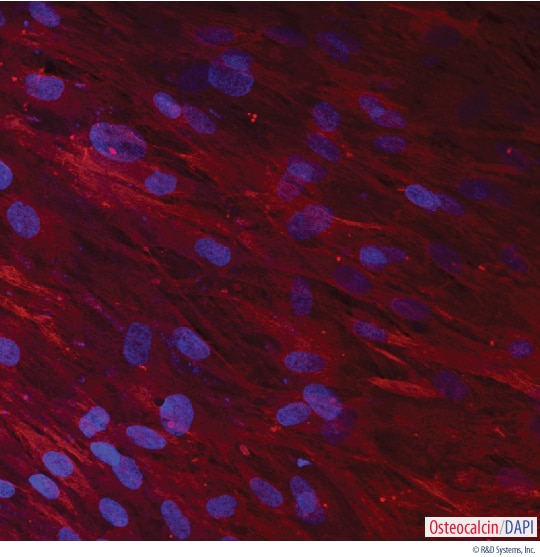
Detection of Osteocalcin in Human MSCs-differentiated Osteocytes.
Human MSCs were differentiatedin vitrofor 14 days using Human/Mouse/Rat StemXVivo®Osteogenic/Adipogenic Base Media (Catalog #CCM007) and Human StemXVivo®Osteogenic Supplement (Catalog # CCM008). Osteocyte differentiation was verified using a Mouse Anti-Human Osteocalcin Monoclonal Antibody (Catalog # MAB1419). The cells were stained with a NorthernLights™(NL)557-conjugated Donkey Anti-Mouse Secondary Antibody (Catalog # NL007; red), and the nuclei were counterstained with DAPI (blue).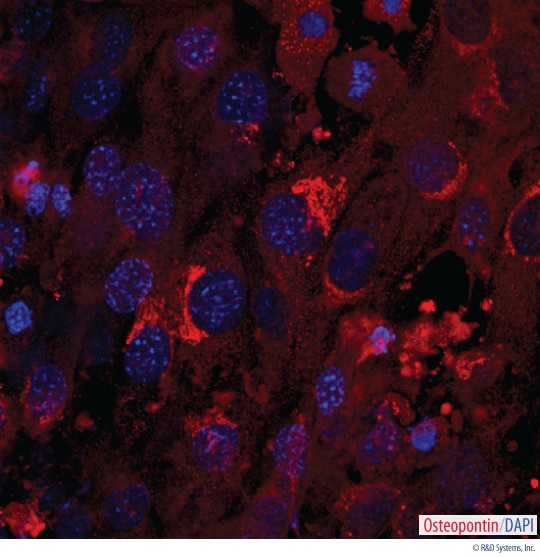
Detection of Osteopontin in Mouse MSC-differentiated Osteocytes.
Mouse MSCs were cultured for 14 days using the Human/Mouse/Rat StemXVivo®Osteogenic/Adipogenic Base Media (Catalog # CCM007) and Mouse/Rat StemXVivo®Osteogenic Supplement (Catalog # CCM009). Osteocyte differentiation was verified using a Goat Anti-Mouse Osteopontin Antigen Affinity-purified Polyclonal Antibody (Catalog # AF808). The cells were stained using a NorthernLights™557-conjugated Donkey Anti-Goat Secondary Antibody (Catalog # NL001; red) and the nuclei were counterstained with DAPI (blue).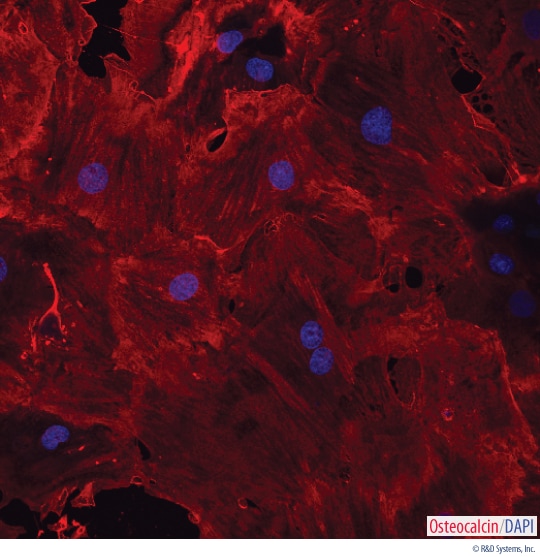
Detection of Osteocalcin in Rat MSC-differentiated Osteocytes.
Rat MSCs were cultured for 14 days using the Human/Mouse/Rat StemXVivo®Osteogenic/Adipogenic Base Media (Catalog # CCM007) and Mouse/Rat StemXVivo®Osteogenic Supplement (Catalog # CCM009). Osteocyte differentiation was verified using a Mouse Anti-Human Osteocalcin Monoclonal Antibody (Catalog # MAB1419). The cells were stained using a NorthernLights™557-conjugated Donkey Anti-Mouse Secondary Antibody (Catalog # NL007; red) and the nuclei were counterstained with DAPI (blue).
Detection of FABP4 in Human MSC-differentiated Adipocytes.
Human MSCs were differentiated for 14 days using the Human/Mouse/Rat StemXVivo®Osteogenic/Adipogenic Base Media (Catalog # CCM007) and Human/Mouse/Rat StemXVivo®Adipogenic Supplement (Catalog # CCM011). Mature differentiated adipocytes were detected with a Goat Anti-Mouse FABP4 Antigen Affinity-purified Polyclonal Antibody (Catalog # AF1443). The cells were stained with a NorthernLights™557-conjugated Donkey Anti-Mouse Secondary Antibody (Catalog # NL001; red) and the nuclei were counterstained with DAPI (blue).
Detection of FABP4 in Mouse MSC-differentiated Adipocytes
Mouse MSCs were differentiated for 14 days using the Human/Mouse/Rat StemXVivo®Osteogenic/Adipogenic Base Media (Catalog # CCM007) and Human/Mouse/Rat StemXVivo®Adipogenic Supplement (Catalog # CCM011). Mature differentiated adipocytes were detected with a Goat Anti-Mouse FABP4 Antigen Affinity-purified Polyclonal Antibody (Catalog # AF1443). The cells were stained with a NorthernLights™557-conjugated Donkey Anti-Mouse Secondary Antibody (Catalog # NL007; red) and the nuclei were counterstained with DAPI (blue).
Detection of FABP4 in Rat MSC-differentiated Adipocytes.
Rat MSCs were differentiated for 14 days using the Human/Mouse/Rat StemXVivo®Osteogenic/Adipogenic Base Media (Catalog # CCM007) and Human/Mouse/Rat StemXVivo®Adipogenic Supplement (Catalog # CCM011). Mature differentiated adipocytes were detected with a Goat Anti-Mouse FABP4 Antigen Affinity-purified Polyclonal Antibody (Catalog # AF1443). The cells were stained with a NorthernLights™557-conjugated Donkey Anti-Mouse Secondary Antibody (Catalog # NL007; red) and the nuclei were counterstained with DAPI (blue).Formulation, Preparation, and Storage
Shipping
Storage
Background: Mesenchymal Stem Cells
Alternate Names
Additional Mesenchymal Stem Cells Products
Product Documents for StemXVivo Osteogenic/Adipogenic Base Media
Certificate of Analysis
To download a Certificate of Analysis, please enter a lot or batch number in the search box below.
Note: Certificate of Analysis not available for kit components.
Product Specific Notices for StemXVivo Osteogenic/Adipogenic Base Media
For research use only
Citations for StemXVivo Osteogenic/Adipogenic Base Media
 Powered by Bioz
Customer Reviews for StemXVivo Osteogenic/Adipogenic Base Media (2)
Have you used StemXVivo Osteogenic/Adipogenic Base Media?
Submit a review and receive an Amazon gift card!
$25/€18/£15/$25CAN/¥2500 for a review with an image
$10/€7/£6/$10CAN/¥1110 for a review without an image
Submit a review
-
Verified Customer | Posted 01/18/2019
-
Verified Customer | Posted 04/04/2018
There are no reviews that match your criteria.
Protocols
View specific protocols for StemXVivo Osteogenic/Adipogenic Base Media (CCM007):
Refer to the product datasheet for complete product details.
Briefly, human, mouse, or rat MSCs are differentiated into adipocytes or osteocytes using the following in vitro differentiation procedure:
- Culture multipotent cells of interest
- Induce adipogenic or osteogenic differentiation using media supplements
- Evaluate differentiation using a mature phenotype marker antibody and fluorescent ICC
For use with Human StemXVivo® Osteogenic Supplement (Catalog # CCM008), Mouse/Rat Osteogenic Supplement (Catalog # CCM009), or Human/Mouse/Rat StemXVivo® Adipogenic Supplement (Catalog # CCM011).
View Graphic Procedure
Reagents Provided
Reagents supplied in the Human/Mouse/Rat StemXVivo® Osteogenic/Adipogenic Base Media (Catalog # CCM007):
- 250 mL of StemXVivo® Osteogenic/Adipogenic Base Media
Other Supplies Required
Reagents
- Human StemXVivo® Osteogenic Supplement (Catalog # CCM008) or Mouse/Rat Osteogenic Supplement (Catalog # CCM009)
- Human/Mouse/Rat StemXVivo® Adipogenic Supplement (Catalog # CCM011)
- Penicillin-Streptomycin-Glutamate (100X)
Materials
- MSCs
- 10 cm tissue culture plates
- 15 mL centrifuge tubes
- Pipettes and pipette tips
- Serological pipettes
Equipment
- 37 °C and 5% CO2 incubator
- Centrifuge
- Hemocytometer
- Inverted microscope
- 2 °C to 8 °C refrigerator
- 37 °C water bath
Procedure Overview
This protocol has been tested using bone marrow- and/or adipose tissue-derived MSCs. If using a different tissue source or cell line, the protocol below may need to be optimized.
Osteogenic Differentiation
- Plate 4.2 x 10³ MSCs/cm2 in StemXVivo® Osteogenic/Adipogenic Base Media.
- Culture cells to 50-70% confluency.
- Replace the medium with StemXVivo® Osteogenic Differentiation Medium to induce osteogenesis.
- Every 3-4 days, replace with fresh Osteogenic Differentiation Medium.
- After 14-21 days, osteocytes can be harvested and analyzed.
Adipogenic Differentiation
- Plate 2.1 x 10⁴ MSCs/cm2 in StemXVivo® Osteogenic/Adipogenic Base Media.
- Culture cells to 100% confluency.
- Replace the medium in with Adipogenic Differentiation Medium to induce adipogenesis.
- Every 3-4 days, replace with fresh Adipogenic Differentiation Medium.
- After 14-21 days, adipocytes can be harvested and analyzed.