
What is an ELISA and What Are The Different Types of ELISAs?
What is an ELISA
An ELISA (enzyme-linked immunosorbent assay) is a laboratory immunoassay used to detect and quantify specific proteins, peptides, antibodies, hormones, and other biomolecules in biological samples. ELISAs combine highly specific antibody-antigen interactions with enzyme-based signal detection to provide accurate, sensitive, and reproducible quantitative results.
Common sample types include:
- Serum
- Plasma
- Cell culture supernatants
- Cell lysates
- Tissue lysates
- Saliva
- Urine
What is an ELISA Used For?
ELISAs are widely used in basic research, drug discovery, biomarker validation, diagnostics, vaccine development, and clinical research. Because they provide sensitive and quantitative protein measurement, ELISAs are commonly used to measure cytokines, chemokines, growth factors, antibodies, hormones, and other biomarkers in biological samples.
How Does an ELISA Work?
An ELISA measures the amount of a specific target protein, antibody, or other analyte in a biological sample using highly specific antibody-antigen interactions and enzyme-based signal detection. While different ELISA formats vary slightly, most sandwich ELISAs—the most commonly used format—follow the same five basic steps:
- Capture the Target
A capture antibody is immobilized on the surface of a microplate well. This antibody specifically binds the analyte of interest while allowing other sample components to be washed away. - Add the Sample
Samples, standards, and controls are added to the plate. If the target analyte is present, it binds to the immobilized capture antibody during the incubation step. - Detect the Bound Analyte
A detection antibody that recognizes a different epitope on the target protein is added, creating a highly specific antibody-analyte-antibody "sandwich." - Generate the Signal
An enzyme conjugated to the detection antibody (or to a secondary reagent) reacts with a substrate solution to produce a measurable colorimetric, fluorescent, or chemiluminescent signal. - Quantify the Results
The intensity of the signal is measured using a microplate reader and compared with a standard curve generated from known concentrations. This allows the concentration of the target analyte in each sample to be accurately determined.
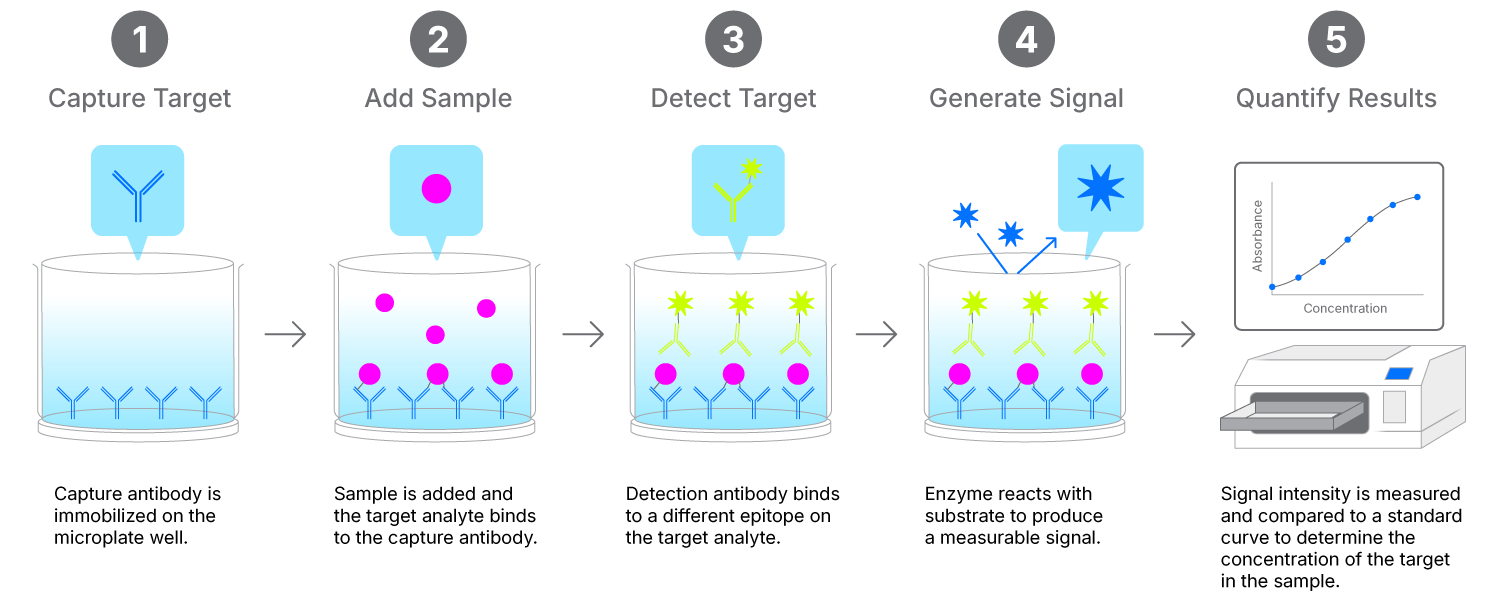
This five-step workflow represents a typical sandwich ELISA. Other ELISA formats follow the same general principles with variations in the detection method.
What Are the Types of ELISA?
There are four primary types of ELISA: Direct, Indirect, Sandwich, and Competitive. Each format uses a different detection strategy and is designed for specific research applications. The best choice depends on your target analyte, sample type, sensitivity requirements, and whether you are measuring proteins, antibodies, or small molecules.
| ELISA Type | Best Used For | Key Advantage |
|---|---|---|
| Direct ELISA | Detecting immobilized antigens | Fast and simple workflow |
| Indirect ELISA | Measuring antibodies | Signal amplification and improved sensitivity |
| Sandwich ELISA | Quantifying proteins and biomarkers | Highest specificity and sensitivity |
| Competitive ELISA | Measuring small molecules, peptides, and hormones | Ideal for analytes that cannot be measured with two antibodies |
Direct ELISA
What is a Direct ELISA?
A direct ELISA uses a single enzyme-conjugated primary antibody to detect an antigen that has been immobilized directly onto the surface of an ELISA plate. Because only one antibody is required, it is the simplest and fastest ELISA format, although it generally provides lower specificity and sensitivity than sandwich ELISAs.
How Does a Direct ELISA Work?
In a direct ELISA, the sample containing the target antigen is first immobilized on the microplate surface. An enzyme-labeled primary antibody then binds directly to the antigen. After unbound antibody is washed away, a substrate is added that reacts with the enzyme to produce a measurable signal proportional to the amount of antigen present.
When Should You Use a Direct ELISA?
Direct ELISAs are commonly used when speed and simplicity are important. They are well suited for evaluating antibody affinity and specificity, screening purified antigens, and investigating blocking or inhibitory interactions.
Advantages of Direct ELISA
- Fast and simple workflow
- Fewer incubation and wash steps
- Reduced assay time
- Eliminates the need for a secondary antibody
Disadvantages of Direct ELISA
- Lower specificity than sandwich ELISAs
- Lower sensitivity due to lack of signal amplification
- Higher background when analyzing complex biological samples
- Requires labeling each primary antibody individually
Indirect ELISA
What is an Indirect ELISA?
An indirect ELISA uses an unlabeled primary antibody to bind the target antigen, followed by an enzyme-conjugated secondary antibody that recognizes the primary antibody. This additional detection step amplifies the signal, making indirect ELISAs more sensitive than direct ELISAs and well suited for detecting antibodies.
How Does an Indirect ELISA Work?
The target antigen is first immobilized on the microplate surface. An unconjugated primary antibody binds specifically to the antigen, followed by an enzyme-labeled secondary antibody directed against the host species of the primary antibody. After washing, a substrate is added to produce a measurable signal that is proportional to the amount of antigen present.
When Should You Use an Indirect ELISA?
Indirect ELISAs are commonly used to measure endogenous antibodies in serum or plasma and are frequently employed in serological studies, vaccine research, and immune response analysis. They are ideal when increased sensitivity is needed through signal amplification.
Advantages of Indirect ELISA
- Greater sensitivity through signal amplification
- Flexible detection using a single labeled secondary antibody
- Economical when multiple primary antibodies are used
- Does not require conjugation of every primary antibody
Disadvantages of Indirect ELISA
- Additional incubation and wash steps increase assay time
- Potential for cross-reactivity from the secondary antibody
- Higher background if secondary antibodies bind non-specifically
- More optimization may be required than direct ELISA
Sandwich ELISA
What is a Sandwich ELISA?
A sandwich ELISA uses two matched antibodies that bind different epitopes on the same target protein, providing exceptional specificity and sensitivity. Because the analyte is captured and detected by separate antibodies, sandwich ELISAs are the preferred format for accurately quantifying proteins in complex biological samples.
How Does a Sandwich ELISA Work?
A capture antibody is first immobilized on the microplate surface. After the sample is added, the target analyte binds to the capture antibody. A second enzyme-conjugated detection antibody then binds to a different epitope on the analyte, forming an antibody-analyte-antibody "sandwich." Addition of a substrate produces a measurable signal that is proportional to the amount of target protein present.
When Should You Use a Sandwich ELISA?
Sandwich ELISAs are the preferred choice for quantitative measurement of cytokines, chemokines, growth factors, hormones, and other protein biomarkers in serum, plasma, cell culture supernatants, tissue lysates, and other complex biological samples.
Advantages of Sandwich ELISA
- Highest specificity through dual-antibody recognition
- Excellent sensitivity for low-abundance proteins
- Compatible with complex biological samples
- Highly accurate and reproducible quantitative results
Disadvantages of Sandwich ELISA
- Requires carefully validated matched antibody pairs
- More complex assay development
- Longer workflow than direct ELISAs
- Not suitable for very small analytes with only one antibody binding site
Competitive ELISA
What is a Competitive ELISA?
A competitive ELISA measures target concentration by allowing labeled and unlabeled antigen to compete for binding to a limited number of antibody binding sites. Unlike other ELISA formats, the signal decreases as the concentration of the target analyte increases, making this approach ideal for measuring small molecules that cannot be detected using sandwich ELISAs.
How Does a Competitive ELISA Work?
A capture antibody is immobilized on the microplate surface and incubated with both the sample antigen and a known amount of enzyme-labeled antigen. The labeled and unlabeled antigens compete for binding to the capture antibody. After washing, substrate is added, and the resulting signal is inversely proportional to the concentration of the target analyte in the sample.
When Should You Use a Competitive ELISA?
Competitive ELISAs are commonly used to quantify small molecules, peptides, hormones, steroids, and other analytes that are too small to accommodate two antibody binding sites required for sandwich ELISAs.
Advantages of Competitive ELISA
- Ideal for detecting small molecules and low-molecular-weight analytes
- Can measure analytes with a single antibody binding site
- Suitable for complex sample matrices
- Broad dynamic range for many applications
Disadvantages of Competitive ELISA
- Signal is inversely proportional to analyte concentration, making interpretation less intuitive
- Typically less specific than sandwich ELISAs
- Requires a labeled antigen for assay development
- More complex assay optimization than direct or indirect ELISAs
Why Use an ELISA?
ELISAs remain one of the most widely used immunoassays because they combine excellent sensitivity, specificity, reproducibility, and quantitative performance. Compared with techniques such as Western blotting, ELISAs provide fully quantitative results with greater throughput and reduced subjectivity. Compared with multiplex immunoassays, ELISAs offer highly optimized single-analyte detection with minimal risk of antibody cross-reactivity.
Why Are ELISAs So Sensitive?
ELISAs are among the most sensitive and widely used immunoassays because they combine highly specific antibody-antigen interactions with enzyme-based signal amplification and carefully optimized assay design. Together, these features enable accurate detection of proteins present at very low concentrations while maintaining excellent specificity and reproducibility across a wide range of biological sample types.
High-Affinity Antibodies
The sensitivity of an ELISA begins with high-quality antibodies. Carefully selected capture and detection antibodies bind specifically to the target analyte with high affinity, allowing even low-abundance proteins to be detected while minimizing non-specific binding and background signal.
Enzyme-Based Signal Amplification
ELISAs use enzyme-conjugated detection systems that convert a substrate into a measurable signal. Because a single enzyme molecule can catalyze many substrate molecules, this natural amplification process enables highly sensitive detection of target analytes.
Optimized Assay Chemistry
Assay buffers, diluents, blocking reagents, and wash conditions are carefully optimized to reduce background noise, minimize matrix effects, and improve signal-to-noise ratios. These optimized assay conditions help ensure accurate, reproducible measurements across a variety of sample types.
Matched Antibody Pairs
In sandwich ELISAs, carefully validated matched antibody pairs recognize different epitopes on the same target protein. This dual-recognition strategy significantly improves assay specificity while increasing sensitivity by reducing interference from unrelated proteins.
Enhanced Detection for Low-Abundance Targets
When extremely low concentrations of an analyte must be measured, specialized amplification systems can further increase assay sensitivity. High-sensitivity ELISA formats, such as Quantikine® HS ELISAs, use optimized detection chemistries capable of measuring proteins at femtogram-level concentrations while maintaining excellent precision and reproducibility.
At R&D Systems™, high-affinity antibodies, optimized assay chemistry, and rigorous assay validation are combined to deliver ELISAs that provide exceptional sensitivity, reproducibility, and confidence in every result.
What does ELISA stand for?
ELISA stands for Enzyme-Linked Immunosorbent Assay. It is a laboratory technique that uses highly specific antibodies and enzyme-based detection to identify and quantify proteins, antibodies, hormones, cytokines, and other biomolecules in biological samples.
What is an ELISA test?
An ELISA test is an immunoassay used to measure the presence or concentration of a specific target molecule in a sample. Depending on the assay design, ELISAs can provide qualitative, semi-quantitative, or fully quantitative results and are widely used in research, diagnostics, drug development, and clinical studies.
What can an ELISA detect?
ELISAs can detect a wide variety of biological molecules, including cytokines, chemokines, growth factors, hormones, antibodies, enzymes, viral and bacterial antigens, and other protein biomarkers. They are commonly used to study immune responses, disease biomarkers, therapeutic proteins, and cell signaling pathways.
What sample types can be used in an ELISA?
ELISAs are compatible with many biological sample types, including serum, plasma, cell culture supernatants, cell lysates, tissue lysates, urine, saliva, and other biological fluids. The appropriate sample type depends on the assay and should always be validated for the specific ELISA being used.
Which type of ELISA is the most sensitive?
Sandwich ELISAs are generally considered the most sensitive and specific ELISA format because they use two antibodies that recognize different regions of the target protein. For detecting extremely low-abundance biomarkers, specialized high-sensitivity ELISAs with enhanced detection chemistries can measure proteins at femtogram-level concentrations.
What is the difference between a Direct ELISA and a Sandwich ELISA?
A Direct ELISA uses a single enzyme-labeled antibody to detect an antigen immobilized on the plate, making it simple and fast. A Sandwich ELISA uses both capture and detection antibodies that bind different epitopes on the target protein, providing greater specificity, sensitivity, and quantitative performance for complex biological samples.
How long does an ELISA take?
The total assay time depends on the ELISA format and protocol. Traditional ELISAs typically require 2 to 5 hours, while rapid formats such as Quantikine QuicKit ELISAs can generate results in approximately 90 minutes.
What is the difference between ELISA and Western blot?
Both techniques use antibodies to detect proteins, but they serve different purposes. ELISAs provide highly sensitive, quantitative measurement of specific analytes, while Western blots separate proteins by size before detection and are generally considered semi-quantitative. ELISAs are often preferred for biomarker quantification, whereas Western blots are commonly used to confirm protein identity and molecular weight.
What is the difference between ELISA and multiplex immunoassays?
ELISAs measure one analyte at a time and are often considered the gold standard for quantitative protein measurement because of their high specificity and sensitivity. Multiplex immunoassays can measure multiple analytes simultaneously from a single sample, making them ideal when sample volume is limited or when profiling multiple biomarkers in a single experiment.
Can ELISAs measure cytokines?
Yes. ELISAs are one of the most widely used methods for measuring cytokines and other soluble biomarkers in biological samples. They provide highly sensitive and reproducible quantification of cytokines in serum, plasma, cell culture supernatants, tissue lysates, and other sample types.
What is the difference between an ELISA and an immunoassay?
An ELISA is a type of immunoassay that uses antibodies and enzyme-based detection to measure a specific target molecule. While all ELISAs are immunoassays, not all immunoassays are ELISAs. Other immunoassay formats include chemiluminescent immunoassays (CLIA), multiplex bead-based assays, lateral flow assays, and automated microfluidic immunoassays.