
Cardiotrophin-1 (CT-1) is a member of the cytokine family which also includes IL-6, IL-11, leukemia inhibitory factor (LIF), oncostatin M (OSM), and ciliary neurotrophic factor (CNTF). It was originally isolated based on its ability to induce cardiac myocyte hypertrophy in vitro. CT-1 has since been shown to be a pleiotrophic cytokine with overlapping actions with other IL-6 family members on a variety of cell types. Human CT-1 encodes a 201 amino acid (aa) residue protein that lacks a hydrophobic signal peptide. The mechanism of CT-1 release from cells is currently not understood. Human and mouse CT-1 share 80% aa sequence identity and exhibit cross-species activity. CT-1 is highly expressed in heart, skeletal muscle, liver, lung and kidney. Lower levels of CT-1 expression is also seen in testis and brain. CT-1 initiates downstream signaling pathways through the heterodimerization of gp130 and the LIF receptor beta subunit. A third alpha receptor subunit has been implicated in the receptor complex.
Human Cardiotrophin-1/CT-1 Antibody (89215)
R&D Systems | Catalog # MAB2601

Scientific images may be resized, cropped, or adjusted for brightness or contrast for presentation purposes. These updates are limited to presentation and do not affect the underlying scientific interpretation of the data. Where available, additional source data may be provided upon request.
Key Product Details
Species Reactivity
Validated:
Cited:
Applications
Validated:
Cited:
Label
Antibody Source
Product Specifications
Immunogen
Ser2-Ala201
Accession # Q16619
Specificity
Clonality
Host
Isotype
Endotoxin Level
Scientific Data Images for Human Cardiotrophin-1/CT-1 Antibody (89215)
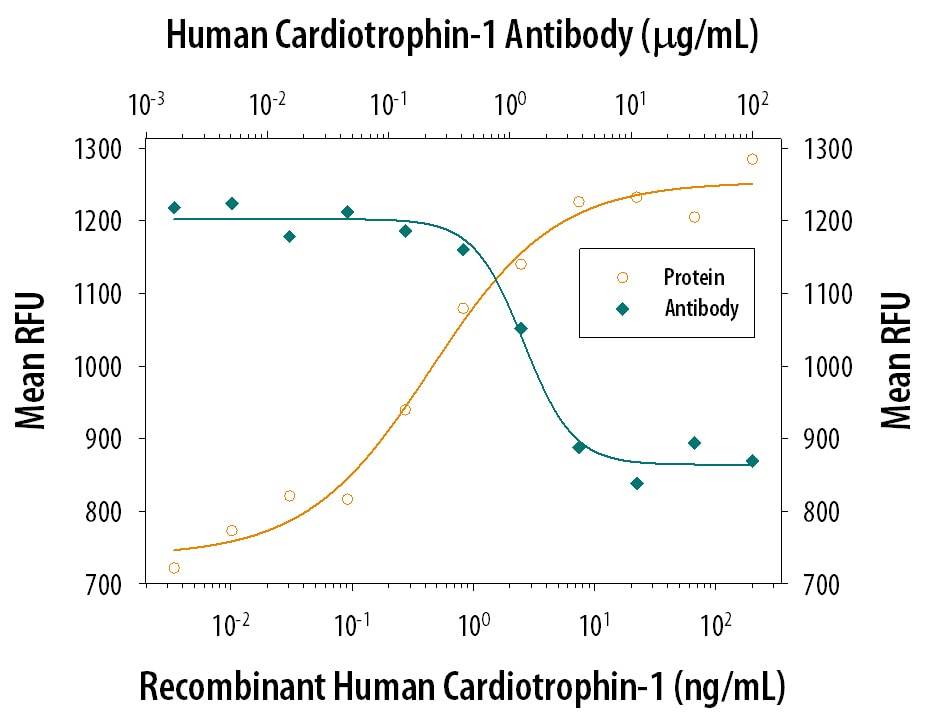
Cell Proliferation Induced by Cardiotrophin‑1/CT‑1 and Neutralization by Human Cardiotrophin‑1/CT‑1 Antibody.
Recombinant Human Cardiotrophin-1/CT-1 (Catalog # 612-CD) stimulates proliferation in the TF-1 human erythroleukemic cell line in a dose-dependent manner (orange line). Proliferation elicited by Recombinant Human Cardiotrophin-1/CT-1 (20 ng/mL) is neutralized (green line) by increasing concentrations of Mouse Anti-Human Cardiotrophin-1/CT-1 Mono- clonal Antibody (Catalog # MAB2601). The ND50 is typically 1-3 µg/mL.Applications for Human Cardiotrophin-1/CT-1 Antibody (89215)
Western Blot
Sample: Recombinant Human Cardiotrophin‑1/CT‑1 (Catalog # 612-CD)
Neutralization
Formulation, Preparation, and Storage
Purification
Reconstitution
Reconstitute at 0.5 mg/mL in sterile PBS. For liquid material, refer to CoA for concentration.
Formulation
Shipping
Stability & Storage
- 12 months from date of receipt, -20 to -70 °C as supplied.
- 1 month, 2 to 8 °C under sterile conditions after reconstitution.
- 6 months, -20 to -70 °C under sterile conditions after reconstitution.
Calculators
Background: Cardiotrophin-1/CT-1
References
- Pennica, D. et al. (1996) Cytokine and Growth Factor Reviews 7:81.
- Robledo, O. et al. (1997) J. Biol. Chem. 272:4855.
Alternate Names
Gene Symbol
UniProt
Additional Cardiotrophin-1/CT-1 Products
Product Documents for Human Cardiotrophin-1/CT-1 Antibody (89215)
Certificate of Analysis
To download a Certificate of Analysis, please enter a lot or batch number in the search box below.
Note: Certificate of Analysis not available for kit components.
Product Specific Notices for Human Cardiotrophin-1/CT-1 Antibody (89215)
For research use only
Related Research Areas
Citations for Human Cardiotrophin-1/CT-1 Antibody (89215)
 Powered by Bioz
Customer Reviews for Human Cardiotrophin-1/CT-1 Antibody (89215)
There are currently no reviews for this product. Be the first to review Human Cardiotrophin-1/CT-1 Antibody (89215) and earn rewards!
Have you used Human Cardiotrophin-1/CT-1 Antibody (89215)?
Submit a review and receive an Amazon gift card!
$25/€18/£15/$25CAN/¥2500 for a review with an image
$10/€7/£6/$10CAN/¥1110 for a review without an image
Submit a review
Protocols
Find general support by application which include: protocols, troubleshooting, illustrated assays, videos and webinars.
- Cellular Response to Hypoxia Protocols
- R&D Systems Quality Control Western Blot Protocol
- Troubleshooting Guide: Western Blot Figures
- Western Blot Conditions
- Western Blot Protocol
- Western Blot Protocol for Cell Lysates
- Western Blot Troubleshooting
- Western Blot Troubleshooting Guide
- View all Protocols, Troubleshooting, Illustrated assays and Webinars