
CD31/PECAM-1 is a heavily glycosylated transmembrane homophilic adhesion protein that is highly expressed on endothelial cells and at a lower level on platelets, granulocytes, macrophages, dendritic cells, T and B cells, and NK cells. It is required for the transepithelial migration of leukocytes. CD31 signaling increases the activation threshold of T cells and inhibits dendritic cell development. The extracellular domain of CD31 is released during endothelial cell apoptosis. This fragment circulates in the serum of patients suffering from myocardial infarction, acute ischaemic stroke, and multiple sclerosis, conditions that involve tissue damage and endothelial cell apoptosis.
Human CD31/PECAM-1 DuoSet ELISA
R&D Systems | Catalog # DY806-05

Loading...
Key Product Details
Assay Type
Solid Phase Sandwich ELISA
Assay Range
156-10000 pg/mL
Sample Type
Cell culture supernates, serum, and plasma
Note: Diluents for complex matrices, such as serum and plasma, should be evaluated prior to use in this DuoSet
Note: Diluents for complex matrices, such as serum and plasma, should be evaluated prior to use in this DuoSet
Reactivity
Human
Human CD31/PECAM-1 DuoSet ELISA Features
- Optimized capture and detection antibody pairings with recommended concentrations save lengthy development time
- Development protocols are provided to guide further assay optimization
- Assay can be customized to your specific needs
- Economical alternative to complete kits
Loading...
Product Summary for Human CD31/PECAM-1 DuoSet ELISA
This DuoSet ELISA Development kit contains the basic components required for the development of sandwich ELISAs to measure natural and recombinant human CD31 / PECAM-1. The suggested diluent is suitable for the analysis of most cell culture supernate samples. Diluents for complex matrices, such as serum and plasma, should be evaluated prior to use in this DuoSet ELISA.
Product Specifications
Assay Format
96-well strip plate (sold separately)
Sample Volume Required
100 µL
Detection Method
Colorimetric ELISA - 450nm (TMB)
Conjugate
Biotin
Specificity
Label
HRP
Scientific Data Images for Human CD31/PECAM-1 DuoSet ELISA
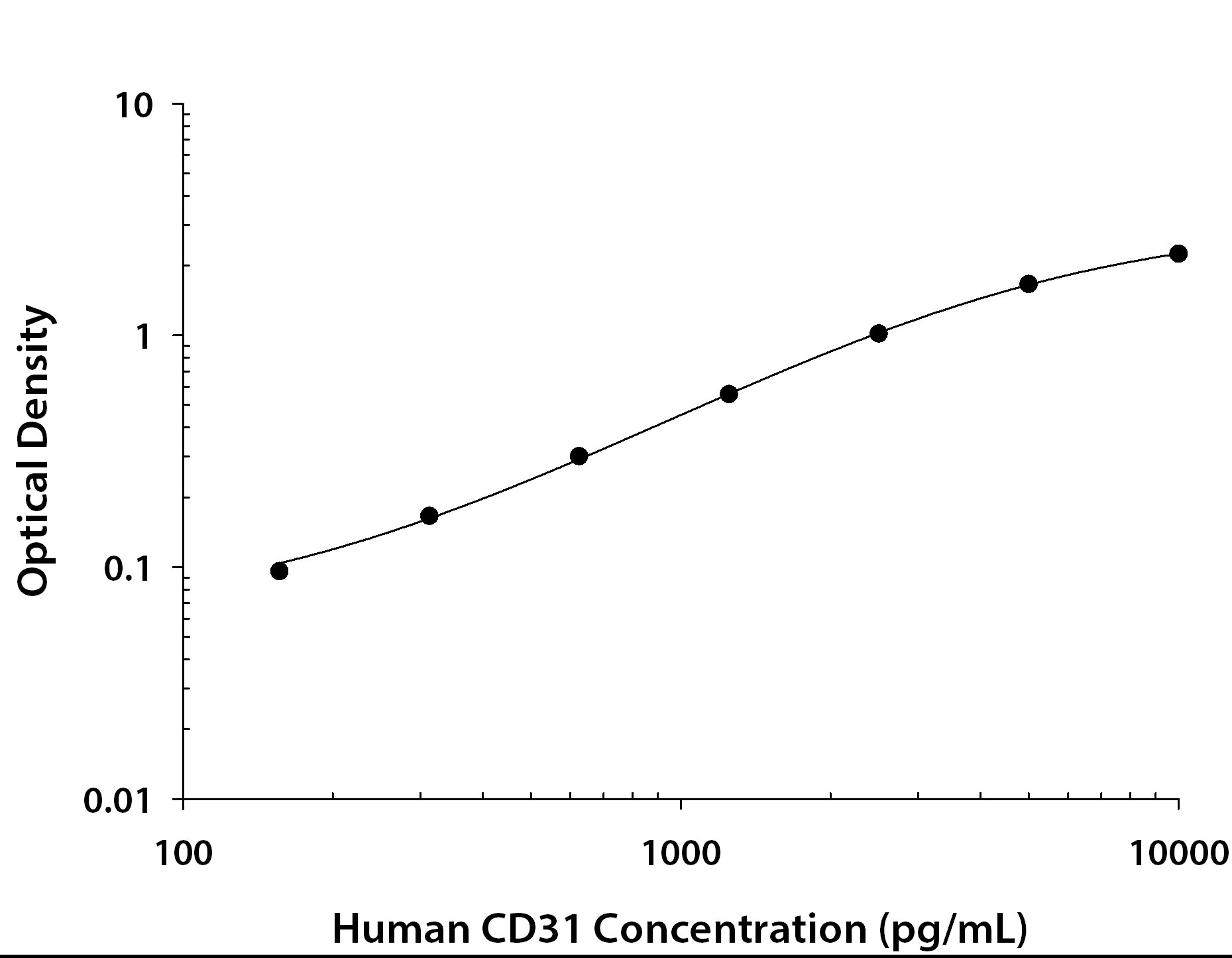
Human CD31 / PECAM-1 ELISA Standard Curve
Kit Contents for Human CD31/PECAM-1 DuoSet ELISA
- Capture Antibody
- Detection Antibody
- Recombinant Standard
- Streptavidin conjugated to horseradish-peroxidase (Streptavidin-HRP)
Other Reagents Required
DuoSet Ancillary Reagent Kit 2 (5 plates): (Catalog # DY008C) containing 96 well microplates, plate sealers, substrate solution, stop solution, plate coating buffer (PBS), wash buffer, and Reagent Diluent Concentrate 2.
PBS: (Catalog # DY006), or 137 mM NaCl, 2.7 mM KCl, 8.1 mM Na2HPO4, 1.5 mM KH2PO4, pH 7.2 - 7.4, 0.2 µm filtered
Wash Buffer: (Catalog # WA126), or equivalent
Reagent Diluent*
Blocking Buffer*
Substrate Solution: ELISA TMB Substrate (Catalog # DY999B or DY999B-250)
Stop Solution: Methanesulfonic acid (Catalog # DY994B or DY994B-250)
Microplates: (Catalog # DY990), or equivalent
Plate Sealers: (Catalog # DY992), or equivalent
*For the recommended Reagent Diluent and Blocking Buffer for a specific DuoSet ELISA Development Kit, refer to the product datasheet.
Preparation and Storage
Shipping
The product is shipped at ambient temperature. Upon receipt, store it immediately at the temperature recommended below.
Stability & Storage
Store the unopened product at 2 - 8 °C. Do not use past expiration date.
Background: CD31/PECAM-1
Long Name
Platelet Endothelial Cell Adhesion Molecule 1
Alternate Names
CD31, EndoCAM, PECA1, PECAM-1, PECAM1
Gene Symbol
PECAM1
Additional CD31/PECAM-1 Products
Product Documents for Human CD31/PECAM-1 DuoSet ELISA
Certificate of Analysis
To download a Certificate of Analysis, please enter a lot or batch number in the search box below.
Note: Certificate of Analysis not available for kit components.
Product Specific Notices for Human CD31/PECAM-1 DuoSet ELISA
For research use only
Related Research Areas
Citations for Human CD31/PECAM-1 DuoSet ELISA
 Powered by Bioz
Customer Reviews for Human CD31/PECAM-1 DuoSet ELISA
There are currently no reviews for this product. Be the first to review Human CD31/PECAM-1 DuoSet ELISA and earn rewards!
Have you used Human CD31/PECAM-1 DuoSet ELISA?
Submit a review and receive an Amazon gift card!
$25/€18/£15/$25CAN/¥2500 for a review with an image
$10/€7/£6/$10CAN/¥1110 for a review without an image
Submit a review
Protocols
Find general support by application which include: protocols, troubleshooting, illustrated assays, videos and webinars.
- ELISA Sample Preparation & Collection Guide
- ELISA Troubleshooting Guide
- How to Run an R&D Systems DuoSet ELISA
- How to Run an R&D Systems Quantikine ELISA
- How to Run an R&D Systems Quantikine™ QuicKit™ ELISA
- Quantikine HS ELISA Kit Assay Principle, Alkaline Phosphatase
- Quantikine HS ELISA Kit Principle, Streptavidin-HRP Polymer
- Sandwich ELISA (Colorimetric) – Biotin/Streptavidin Detection Protocol
- Sandwich ELISA (Colorimetric) – Direct Detection Protocol
- Troubleshooting Guide: ELISA
- View all Protocols, Troubleshooting, Illustrated assays and Webinars
Loading...