Key Product Details
Assay Type
Solid Phase Sandwich ELISA
Assay Range
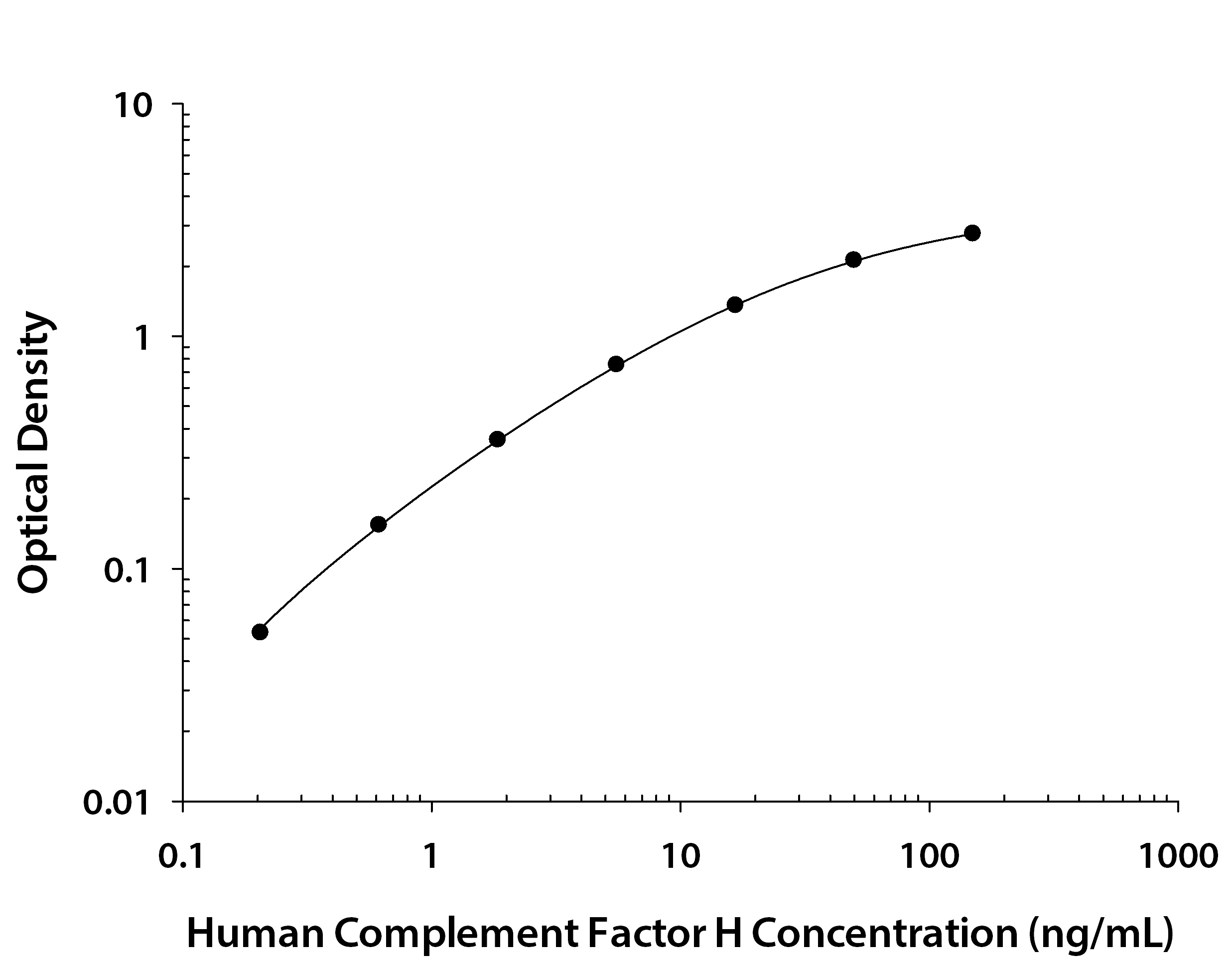
0.206-150 ng/mL
Sample Type
Cell culture supernates, serum, and plasma
Note: Diluents for complex matrices, such as serum and plasma, should be evaluated prior to use in this DuoSet
Human Complement Factor H DuoSet ELISA Features
- Optimized capture and detection antibody pairings with recommended concentrations save lengthy development time
- Development protocols are provided to guide further assay optimization
- Assay can be customized to your specific needs
- Economical alternative to complete kits
Product Summary for Human Complement Factor H DuoSet ELISA
This DuoSet ELISA Development kit contains the basic components required for the development of sandwich ELISAs to measure natural and recombinant human Complement Factor H. The suggested diluent is suitable for the analysis of most cell culture supernate samples. Diluents for complex matrices, such as serum and plasma, should be evaluated prior to use in this DuoSet ELISA.
Other Reagents Required
DuoSet Ancillary Reagent Kit 2 (5 plates): (Catalog # DY008C) containing 96 well microplates, plate sealers, substrate solution, stop solution, plate coating buffer (PBS), wash buffer, and Reagent Diluent Concentrate 2.
PBS: (Catalog # DY006), or 137 mM NaCl, 2.7 mM KCl, 8.1 mM Na2HPO4, 1.5 mM KH2PO4, pH 7.2 - 7.4, 0.2 µm filtered
Wash Buffer: (Catalog # WA126), or equivalent
Reagent Diluent*
Blocking Buffer*
Substrate Solution: ELISA TMB Substrate (Catalog # DY999B or DY999B-250)
Stop Solution: Methanesulfonic acid (Catalog # DY994B or DY994B-250)
Microplates: (Catalog # DY990), or equivalent
Plate Sealers: (Catalog # DY992), or equivalent
*For the recommended Reagent Diluent and Blocking Buffer for a specific DuoSet ELISA Development Kit, refer to the product datasheet.
Background: Complement Factor H
Complement Factor H is a 155 kDa glycoprotein that provides critical negative regulation to the alternative pathway of complement cascade. It is secreted by Kupffer cells, hepatocytes, vascular endothelial cells, and platelets, and circulates in the serum at high concentration. Complement Factor H is composed of 20 SCRs (short consensus repeats), each of which consists of approximately 60 amino acids with four invariant Cys residues. Alternate splicing generates a Complement Factor H isoform that is truncated following SCR7.
Complement Factor H interacts with cell surface polyanions including heparin and sialoglycoproteins, and immobilized Complement Factor H supports the CD11b/CD18 integrin-dependent adhesion of neutrophils. It prevents local complement activation by sequestering complement component C3b, accelerating the decay of C3 and C5 convertases, and functions as a cofactor for the C3b inactivator, Factor I.
Short consensus repeats 15-20 (SCR15-20) encompass the primary binding sites for heparin and C3b, as well as for the peptide hormone adrenomedullin. Within SCR15-20, human Complement Factor H shares 60% and 63% amino acid sequence identity with mouse and rat Complement Factor H, respectively. Dozens of mutations clustered in SCR15-20 are associated with atypical hemolytic uremic syndrome, a disorder characterized by anemia, thrombocytopenia, and renal failure. Binding of Complement Factor H to tumor cell-associated dentin matrix protein 1, bone sialoprotein, or osteopontin results in the protection of that cell from complement-mediated lysis. A variety of pathogenic microbes also express Complement Factor H binding molecules that interfere with immune clearance of the infection.
Alternate Names
ARMD4, ARMS1, beta-1-H-globulin, CFH, CFHL3, FH, FHL1, HF1, HF2, HUS
Additional Complement Factor H Products


 Powered by Bioz