
Cryptic, also known at CFC-1, was originally identified as a secreted protein that is specifically expressed during mesoderm differentiation (1). Cryptic, along with Cripto, Xenopus FRL-1 and zebrafish OEP (one-eyed pinhead) define the epidermal growth factor-CriptoFRL1Cryptic (EGF-CFC) family of signaling proteins that function in cancer and various developmental processes (2, 3). Overall sequence identity between members of the family is low, but they do share distinct domains: a variant EGF-like motif, a novel conserved cysteine-rich domain (called CFC domain), and a C-terminal hydrophobic region (2). Most EGF-CFC members have a glycosyl-phosphatidylinositol (GPI) anchoring site at the C-terminus and exist as extracellular membrane-anchored proteins. However, naturally-occurring soluble isoforms also exist. Human Cryptic shares 55% and 25% amino acid idenitity with mouse Cryptic and human Cripto, respectively. Despite weak conservation in amino acid identity, EGF-CFC family members appear to function similarly in assays for phenotypic rescue of zebrafish oep mutants (2). Cryptic is expressed during gastrulation in the mesoderm and later in the neuroectoderm, marking the prospective floor plate of the neural tube (1). Genetic evidence from mice and humans points to a role for Cryptic in determining left-right asymmetry. Mutations in the cryptic gene result in a spectrum of heart, lung and spleen defects, all representing left-right laterality defects (4, 5). These phenotypes resemble some Nodal mutant alleles suggesting that Cryptic, like Cripto, acts as an essential cofactor for Nodal signaling (1, 3). Studies have shown that other TGF-beta superfamily members involved in mesoderm induction and left-right patterning, Vg1 and GDF-1, also require EGF-CFC cofactors. Cryptic binds to GDF-1 leading to an Act RIIB-ALK4-Cryptic-GDF-1 complex for signaling (6).
Human Cryptic Antibody (219708)
R&D Systems | Catalog # MAB1410

Scientific images may be resized, cropped, or adjusted for brightness or contrast for presentation purposes. These updates are limited to presentation and do not affect the underlying scientific interpretation of the data. Where available, additional source data may be provided upon request.
Key Product Details
Species Reactivity
Applications
Label
Antibody Source
Product Specifications
Immunogen
Tyr26-Gly169
Accession # P0CG36
Specificity
Clonality
Host
Isotype
Scientific Data Images for Human Cryptic Antibody (219708)
Detection of Cryptic by Western Blot
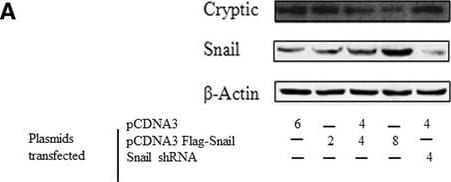
Endogenous Cryptic levels are attenuated by Snail expression and are restored upon Snail depletion in PANC1 cells. a Cryptic and Snail levels are measured by western blotting after transfecting different amounts of Snail/control/shRNA plasmids (2/4/6 μg of Snail plasmid and 4 μg of shRNA plasmid and total amount of plasmid made up to 8 μg with pCDNA3 empty vector). Equal loading is confirmed by beta-actin. The blot is representative of 3 experiments (n = 3). qPCR is performed on reverse transcribed samples to estimate the mRNA levels of (b) Snail and (c) Cryptic and is normalized to beta-actin expression (n = 4) Image collected and cropped by CiteAb from the following open publication (https://pubmed.ncbi.nlm.nih.gov/27793090), licensed under a CC-BY license. Not internally tested by R&D Systems.Applications for Human Cryptic Antibody (219708)
Western Blot
Sample: Recombinant Human Cryptic (Catalog # 1410-CR) under non-reducing conditions only
Formulation, Preparation, and Storage
Purification
Reconstitution
Reconstitute at 0.5 mg/mL in sterile PBS. For liquid material, refer to CoA for concentration.
Formulation
Shipping
Stability & Storage
- 12 months from date of receipt, -20 to -70 °C as supplied.
- 1 month, 2 to 8 °C under sterile conditions after reconstitution.
- 6 months, -20 to -70 °C under sterile conditions after reconstitution.
Calculators
Background: Cryptic
References
- Shen, M. et al. (1997) Development 124:429.
- Shen, M. and A. Schier (2000) Trends Genet. 16:303.
- Rosa, F.M. (2002) Science's STKE http://stke.sciencemag.org/.
- Gaio, U. et al. (1999) Curr. Biol. 9:1339.
- Bamford, R. et al. (2000) Nature Genet. 26:365.
- Cheng, S. et al. (2003) Genes & Dev. 17:31.
Alternate Names
Gene Symbol
UniProt
Additional Cryptic Products
Product Documents for Human Cryptic Antibody (219708)
Certificate of Analysis
To download a Certificate of Analysis, please enter a lot or batch number in the search box below.
Note: Certificate of Analysis not available for kit components.
Product Specific Notices for Human Cryptic Antibody (219708)
For research use only
Related Research Areas
Citations for Human Cryptic Antibody (219708)
 Powered by Bioz
Customer Reviews for Human Cryptic Antibody (219708)
There are currently no reviews for this product. Be the first to review Human Cryptic Antibody (219708) and earn rewards!
Have you used Human Cryptic Antibody (219708)?
Submit a review and receive an Amazon gift card!
$25/€18/£15/$25CAN/¥2500 for a review with an image
$10/€7/£6/$10CAN/¥1110 for a review without an image
Submit a review
Protocols
Find general support by application which include: protocols, troubleshooting, illustrated assays, videos and webinars.
- Cellular Response to Hypoxia Protocols
- R&D Systems Quality Control Western Blot Protocol
- Troubleshooting Guide: Western Blot Figures
- Western Blot Conditions
- Western Blot Protocol
- Western Blot Protocol for Cell Lysates
- Western Blot Troubleshooting
- Western Blot Troubleshooting Guide
- View all Protocols, Troubleshooting, Illustrated assays and Webinars