
Integrin alpha 2b beta 3 (also alpha IIb beta 3 or GPIIbIIIa) is the only alpha 2b integrin and shares the beta 3 subunit only with alpha V beta 3 (1‑3). It is the non‑covalent heterodimer of type I transmembrane subunits, alpha 2b/CD41 (present as a disulfide‑linked complex of 114 kDa heavy and 22 kDa light chains) and 93 kDa beta 3/CD61 (1‑3). It is the most abundant integrin expressed by megakaryocytes and platelets, both on the surface and within alpha granules (1, 2). Deficiencies of alpha 2b beta 3 produce Glanzmann thrombasthenia, a potentially serious bleeding disorder (4). In its constitutively inactive state, alpha 2b beta 3 is flexed within the extracellular domains. Activation, either by intracellular signaling or by Mg2+ or Mn2+ binding, extends the integrin to expose the ligand binding site created by interaction of the beta 3 vWFA domain with the alpha 2b beta ‑propeller structure (1). The 962 aa human alpha 2b ECD shares 78‑83% aa sequence identity with mouse, rat, canine, equine and porcine alpha 2b while the 685 aa human beta 3 ECD shares 95% aa identity with horse and dog, and 89‑92% aa identity with mouse, rat and porcine beta 3. It is unclear whether splice variants of beta 3 that differ in the cytoplasmic domain are expressed significantly in platelets (5‑7). However, platelet expression of a beta 3 splice variant that produces a soluble 60 kDa beta 3 isoform, and an alpha 2b isoform lacking aa 948‑982, have been reported (7, 8). Active cell surface alpha 2b beta 3 adheres to fibrinogen, mediating platelet/platelet interactions that initiate a cascade of platelet activation and aggregation, extracellular matrix adhesion, formation of thrombi and clot retraction (1). It also binds matrix proteins that have an RGD motif, including fibronectin, plasminogen, prothrombin, thrombospondin and vitronectin (1, 2). Targeting of alpha 2b beta 3 by therapeutic antibodies or small molecules can inhibit formation of thrombi in patients with acute coronary syndrome, and potentially inhibits tumor angiogenesis and metastasis by blocking interaction of platelet alpha 2b beta 3 with tumor cells (1, 9).
Human Integrin alpha 2b beta 3 Antibody (2530A)
R&D Systems | Catalog # MAB76161

Key Product Details
Species Reactivity
Applications
Label
Antibody Source
Product Specifications
Immunogen
Specificity
Clonality
Host
Isotype
Scientific Data Images for Human Integrin alpha 2b beta 3 Antibody (2530A)
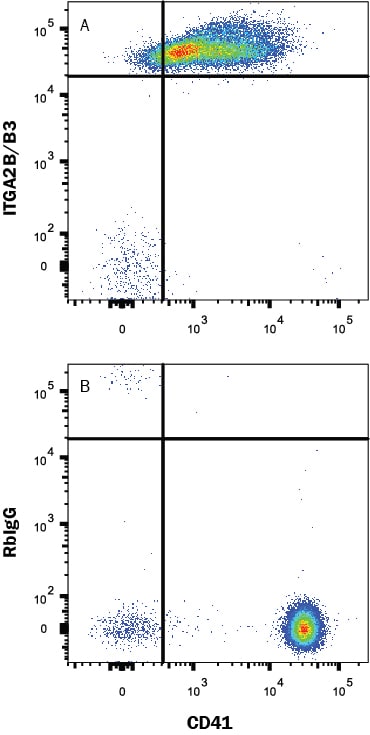
Detection of Integrin alpha 2b beta 3 in Human peripheral blood platelets by Flow Cytometry.
Human peripheral blood platelets were stained with (A) Rabbit Anti-Human Integrin a2b beta 3 Monoclonal Antibody (Catalog # MAB76161) or (B) Rabbit IgG isotype control antibody (Catalog # MAB1050) followed by Anti-Rabbit IgG APC-conjugated Secondary Antibody (Catalog # F0111) and Mouse anti-Human CD41 PE-conjugated Monoclonal Antibody (Catalog # FAB7616P). View our protocol for Staining Membrane-associated Proteins.Applications for Human Integrin alpha 2b beta 3 Antibody (2530A)
CyTOF-ready
Flow Cytometry
Sample: Human peripheral blood platelets
Flow Cytometry Panel Builder
Bio-Techne Knows Flow Cytometry
Save time and reduce costly mistakes by quickly finding compatible reagents using the Panel Builder Tool.
Advanced Features
- Spectra Viewer - Custom analysis of spectra from multiple fluorochromes
- Spillover Popups - Visualize the spectra of individual fluorochromes
- Antigen Density Selector - Match fluorochrome brightness with antigen density

Formulation, Preparation, and Storage
Purification
Reconstitution
Reconstitute at 0.5 mg/mL in sterile PBS. For liquid material, refer to CoA for concentration.
Formulation
Shipping
Stability & Storage
- 12 months from date of receipt, -20 to -70 °C as supplied.
- 1 month, 2 to 8 °C under sterile conditions after reconstitution.
- 6 months, -20 to -70 °C under sterile conditions after reconstitution.
Calculators
Background: Integrin alpha 2b beta 3
References
- Kasirer-Friede, A. et al. (2007) Immunol. Rev. 218:247.
- Poncz, M. et al. (1987) J. Biol. Chem. 262:8476.
- Fitzgerald, L.A. et al. (1987) J. Biol. Chem. 262:3936.
- Franchini, M. et al. (2010) Clin. Chim. Acta 411:1.
- Kumar, C. S. et al. (1987) J. Biol. Chem. 272:16390.
- van Kuppevelt, H. et al. (1989) Proc. Natl. Acad. Sci. USA 86:5415.
- Djaffar, I. et al. (1994) Biochem. J. 300:67.
- Bray, P.F. et al. (1990) J. Biol. Chem. 265:9587.
- Erpenbeck, L. and M.P. Schon (2010) Blood 115:3427.
Alternate Names
Gene Symbol
Additional Integrin alpha 2b beta 3 Products
Product Documents for Human Integrin alpha 2b beta 3 Antibody (2530A)
Certificate of Analysis
To download a Certificate of Analysis, please enter a lot or batch number in the search box below.
Note: Certificate of Analysis not available for kit components.
Product Specific Notices for Human Integrin alpha 2b beta 3 Antibody (2530A)
For research use only
Customer Reviews for Human Integrin alpha 2b beta 3 Antibody (2530A)
There are currently no reviews for this product. Be the first to review Human Integrin alpha 2b beta 3 Antibody (2530A) and earn rewards!
Have you used Human Integrin alpha 2b beta 3 Antibody (2530A)?
Submit a review and receive an Amazon gift card!
$25/€18/£15/$25CAN/¥2500 for a review with an image
$10/€7/£6/$10CAN/¥1110 for a review without an image
Submit a review
Protocols
Find general support by application which include: protocols, troubleshooting, illustrated assays, videos and webinars.
- 7-Amino Actinomycin D (7-AAD) Cell Viability Flow Cytometry Protocol
- Extracellular Membrane Flow Cytometry Protocol
- Flow Cytometry Protocol for Cell Surface Markers
- Flow Cytometry Protocol for Staining Membrane Associated Proteins
- Flow Cytometry Staining Protocols
- Flow Cytometry Troubleshooting Guide
- Intracellular Flow Cytometry Protocol Using Alcohol (Methanol)
- Intracellular Flow Cytometry Protocol Using Detergents
- Intracellular Nuclear Staining Flow Cytometry Protocol Using Detergents
- Intracellular Staining Flow Cytometry Protocol Using Alcohol Permeabilization
- Intracellular Staining Flow Cytometry Protocol Using Detergents to Permeabilize Cells
- Propidium Iodide Cell Viability Flow Cytometry Protocol
- Protocol for Liperfluo
- Protocol for the Characterization of Human Th22 Cells
- Protocol for the Characterization of Human Th9 Cells
- Protocol: Annexin V and PI Staining by Flow Cytometry
- Protocol: Annexin V and PI Staining for Apoptosis by Flow Cytometry
- Troubleshooting Guide: Fluorokine Flow Cytometry Kits
- View all Protocols, Troubleshooting, Illustrated assays and Webinars