Human LRH-1/NR5A2 Antibody

Catalog # Availability Size / Price Qty
PP-H2325-00

Save 15% on Select RUO Reagents. See Details

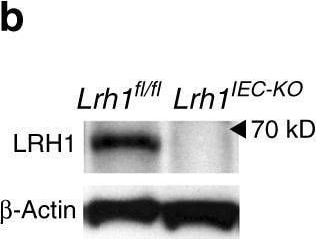
Detection of LRH-1/NR5A2 by Western Blot
1 Image
Product Details
Citations (16)
FAQs
Supplemental Products
Reviews

Human LRH-1/NR5A2 Antibody Summary

Species Reactivity
Human
Specificity
This antibody specifically recognizes human LRH-1 alpha and LRH-1 beta and cross-reacts with mouse and rat LRH-1. Not yet tested in other species.
Source
Monoclonal Mouse IgG3 Clone # H2325
Purification
Protein A or G purified from hybridoma culture supernatant
Immunogen
Recombinant human LRH-1/NR5A2
aa 161-280
Formulation
A liquid formulation in physiologic saline with 0.1% NaN3.
Label
Unconjugated

Applications

Recommended Concentration
Sample
Western Blot
This antibody can be used at 1 μg/mL with the appropriatesecondary reagents to detect human LRH-1.
 
Immunoprecipitation
Optimal dilutions should be determined by eachlaboratory.
 
Direct ELISA
This antibody can be used at 2 ng/mL with the appropriatesecondary reagents to detect human LRH-1.
 

Please Note: Optimal dilutions should be determined by each laboratory for each application. General Protocols are available in the Technical Information section on our website.

Scientific Data

Western Blot Detection of LRH-1/NR5A2 by Western Blot View Larger

Detection of LRH-1/NR5A2 by Western Blot Effects of loss of LRH-1 on murine organoids. a Expression of mLRH-1 transcripts in intestinal organoids is widespread and higher in crypt regions (dashed black line). Scale bar = 100 μm. b Loss of mLRH-1 after Cre-recombination induced by 4-hydroxytamoxifen (4OHT) added to Lrh-1fl/fl;Vil-CreERT2 organoids for 48 h (Lrh1IEC-KO) compared to similarly treated wild-type (Lrh1fl/fl) organoids, as detected by anti-LRH-1 antibody. c Cell death in Lrh1fl/fl and Lrh1IEC-KO organoids following acute loss of Lrh-1. Values normalized to five independent wells of untreated Lrh1fl/fl organoids taken to be 0%. d Most significant gene changes up (blue) or down (ochre) after loss of mLRH-1 by RNA expression (q = < 0.05 and p = < 0.005). Gene names in bold refer to markers of differentiation while red refer to known EEC markers. e Top five altered gene networks as identified by IPA Ingenuity analysis. fLrh1fl/fl and Lrh1IEC-KO organoids exposed to TNF alpha (10 ng/ml) for 40 h stained for active Casp3 (red) and CD44 (green). Cells expressing active Casp3 undergoing cell death in crypt regions are indicated (white arrowheads and dashed white line). Scale bar = 50 μm. g Expression of active Casp3 in Lrh1fl/fl and Lrh1IEC-KO organoids as described in panel f, detected by western blotting (17 and19 kDa, black arrowheads). Shorter (top panel) and longer exposures (middle panel). h Uptake of fluorescent dextran after 30 min in Lrh1fl/fl and Lrh1IEC-KO organoids. Scale bar = 100 μm. Bar graph of percentage dye-positive enteroids (≥30 total organoids counted per condition). Data represent average of minimum three biological triplicates. For c and g, error bars are SEM using Student’s t test (unpaired, two tailed) with p values of ****p = < 0.0001 Image collected and cropped by CiteAb from the following open publication (https://pubmed.ncbi.nlm.nih.gov/30305617), licensed under a CC-BY license. Not internally tested by R&D Systems.

Reconstitution Calculator

Reconstitution Calculator

The reconstitution calculator allows you to quickly calculate the volume of a reagent to reconstitute your vial. Simply enter the mass of reagent and the target concentration and the calculator will determine the rest.

=
÷

Preparation and Storage

Shipping
The product is shipped with dry ice or equivalent. Upon receipt, store it immediately at the temperature recommended below.
Stability & Storage
This antibody is stable for greater than six months when held at -20 °C in a manual defrost freezer or at -70 °C. Upon thawing, the antibody can be stored at 2-8 °C for at least 1 month without detectable loss of activity. Avoid repeated freeze-thaw cycles.

Background: LRH-1/NR5A2

Liver Receptor Homologous Protein (LRH-1, FTF, CPF, hB1F, FTZ-F1b; NR5A2) is a member of the Orphan Nuclear Receptor family. LRH-1 is a mammalian homolog of the Drosophila Fushi Tarazu F1 Gene product. LRH-1 is expressed in the liver and intestine. LRH-1 is involved in the regulation of genes which participate in steroid, bile acid and cholesterol homeostasis.

Long Name
Liver Receptor Homolog 1/Nuclear Receptor Subfamily 5, Group A, Member 2
Entrez Gene IDs
2494 (Human)
Alternate Names
Alpha-1-fetoprotein transcription factor; B1-binding factor; b1-binding factor, hepatocyte transcription factor which activates enhancer IIof hepatitis B virus; B1F; B1F2; fetoprotein-alpha 1 (AFP) transcription factor; FTFLRH1; FTZ-F1 beta; FTZ-F1; FTZ-F1beta; HB1F; hB1F-2; hB1FCYP7A promoter-binding factor; Hepatocytic transcription factor; Liver receptor homolog 1; liver receptor homolog-1; LRH1; LRH-1; LRH-1CPF; NR5A2; nuclear receptor NR5A2; nuclear receptor subfamily 5 group A member 2; nuclear receptor subfamily 5, group A, member 2

Product Datasheets

You must select a language.

x

Citations for Human LRH-1/NR5A2 Antibody

R&D Systems personnel manually curate a database that contains references using R&D Systems products. The data collected includes not only links to publications in PubMed, but also provides information about sample types, species, and experimental conditions.

16 Citations: Showing 1 - 10
Filter your results:

Filter by:

  1. AMH protects the ovary from doxorubicin by regulating cell fate and the response to DNA damage
    Authors: Nguyen, NMP;Chang, EM;Chauvin, M;Sicher, N;Kashiwagi, A;Nagykery, N;Chow, C;May, P;Mermin-Bunnel, A;Cleverdon, J;Duong, T;Meinsohn, MC;Gao, D;Donahoe, PK;Pepin, D;
    bioRxiv : the preprint server for biology
    Species: Mouse
    Sample Types: Whole Cells
    Applications: Immunocytochemistry
  2. Ovarian ER? cistrome and transcriptome reveal chromatin interaction with LRH-1
    Authors: Birgersson, M;Indukuri, R;Lindquist, L;Stepanauskaite, L;Luo, Q;Deng, Q;Archer, A;Williams, C;
    BMC biology
    Species: Mouse
    Sample Types: Tissue Homogenates
    Applications: ChIP
  3. Asparagine protects pericentral hepatocytes during acute liver injury
    Authors: Yu Sun, Hadrien Demagny, Adrien Faure, Francesca Pontanari, Antoine Jalil, Nadia Bresciani et al.
    Journal of Clinical Investigation
  4. Genetic and pharmacologic inhibition of ALDH1A3 as a treatment of beta-cell failure
    Authors: J Son, W Du, M Esposito, K Shariati, H Ding, Y Kang, D Accili
    Nature Communications, 2023-02-02;14(1):558.
    Species: Mouse
    Sample Types: Whole Tissue
    Applications: IHC
  5. Reprogramming competence of OCT factors is determined by transactivation domains
    Authors: KP Kim, Y Wu, J Yoon, K Adachi, G Wu, S Velychko, CM MacCarthy, B Shin, A Röpke, MJ Arauzo-Bra, M Stehling, DW Han, Y Gao, J Kim, S Gao, HR Schöler
    Science Advances, 2020-09-02;6(36):.
    Species: Mouse
    Sample Types: Cell Lysates
    Applications: Western Blot
  6. Integrated Structural Modeling of Full-Length LRH-1 Reveals Inter-domain Interactions Contribute to Receptor Structure and Function
    Authors: Corey D. Seacrist, Georg Kuenze, Reece M. Hoffmann, Brandon E. Moeller, John E. Burke, Jens Meiler et al.
    Structure
  7. Integrated Structural Modeling of Full-Length LRH-1 Reveals Inter-domain Interactions Contribute to Receptor Structure and Function
    Authors: Corey D. Seacrist, Georg Kuenze, Reece M. Hoffmann, Brandon E. Moeller, John E. Burke, Jens Meiler et al.
    Structure
    Species: Human
    Sample Types: Cell Lysates
    Applications: Western Blot
  8. Steroidogenic control of liver metabolism through a nuclear receptor-network
    Authors: A Milona, V Massafra, H Vos, J Naik, N Artigas, HAB Paterson, ITGW Bijsmans, ECL Willemsen, JM Ramos Pitt, I Miguel-Ali, P Bosma, BMT Burgering, C Williamson, S Vernia, WS Dhillo, SWC van Mil, BM Owen
    Mol Metab, 2019-09-30;30(0):221-229.
    Species: Mouse
    Sample Types: Tissue Homogenates
    Applications: ChIP
  9. LRH-1 mitigates intestinal inflammatory disease by maintaining epithelial homeostasis and cell survival
    Authors: JR Bayrer, H Wang, R Nattiv, M Suzawa, HS Escusa, RJ Fletterick, OD Klein, DD Moore, HA Ingraham
    Nat Commun, 2018-10-10;9(1):4055.
    Species: Human
    Sample Types: Organoids
    Applications: Western Blot
  10. Hepatocyte nuclear receptor SHP suppresses inflammation and fibrosis in a mouse model of nonalcoholic steatohepatitis
    Authors: A Zou, N Magee, F Deng, S Lehn, C Zhong, Y Zhang
    J. Biol. Chem., 2018-04-17;0(0):.
    Species: Human
    Sample Types: Cell Lysates
    Applications: Immunoprecipitation
  11. LRH-1 regulates hepatic lipid homeostasis and maintains arachidonoyl phospholipid pools critical for phospholipid diversity
    Authors: DA Miranda, WC Krause, A Cazenave-G, M Suzawa, H Escusa, JC Foo, DS Shihadih, A Stahl, M Fitch, E Nyangau, M Hellerstei, MR Wenk, DL Silver, HA Ingraham
    JCI Insight, 2018-03-08;3(5):.
    Species: Mouse
    Sample Types: Tissue Homogenates
    Applications: Western Blot
  12. Liver receptor homolog‐1 is a critical determinant of methyl‐pool metabolism
    Authors: Martin Wagner, Sungwoo Choi, Katrin Panzitt, Jennifer L. Mamrosh, Jae Man Lee, Alex Zaufel et al.
    Hepatology
  13. Silencing LRH-1 in colon cancer cell lines impairs proliferation and alters gene expression programs.
    Authors: Bayrer J, Mukkamala S, Sablin E, Webb P, Fletterick R
    Proc Natl Acad Sci U S A, 2015-02-09;112(8):2467-72.
    Species: Human
    Sample Types: Cell Lysates
    Applications: Western Blot
  14. Genome-wide analysis of hepatic LRH-1 reveals a promoter binding preference and suggests a role in regulating genes of lipid metabolism in concert with FXR
    Authors: Hansook Kim Chong, Jacob Biesinger, Young-Kyo Seo, Xiaohui Xie, Timothy F Osborne
    BMC Genomics
  15. LRH-1 and PTF1-L coregulate an exocrine pancreas-specific transcriptional network for digestive function.
    Authors: Holmstrom SR, Deering T, Swift GH
    Genes Dev., 2011-08-15;25(16):1674-9.
    Species: Mouse
    Sample Types: Tissue Homogenates
    Applications: ChIP
  16. A genome-wide screen in EpiSCs identifies Nr5a nuclear receptors as potent inducers of ground state pluripotency.
    Authors: Guo G, Smith A
    Development, 2010-10-01;137(19):3185-92.
    Species: Mouse
    Sample Types: Cell Lysates
    Applications: Western Blot

FAQs

No product specific FAQs exist for this product, however you may

View all Antibody FAQs
Loading...

Reviews for Human LRH-1/NR5A2 Antibody

There are currently no reviews for this product. Be the first to review Human LRH-1/NR5A2 Antibody and earn rewards!

Have you used Human LRH-1/NR5A2 Antibody?

Submit a review and receive an Amazon gift card.

$25/€18/£15/$25CAN/¥75 Yuan/¥2500 Yen for a review with an image

$10/€7/£6/$10 CAD/¥70 Yuan/¥1110 Yen for a review without an image

Submit a Review