
LRIG3 (leucine-rich repeats and Ig-like domains-3) is a 140 kDa type I transmembrane glycoprotein member of the mammalian LRIG glycoprotein family. This family contains three members who share 45 - 50% amino acid (aa) identity (1). All members contain at least fifteen LRRs, accompanied by two flanking cysteine-rich regions, and three C2-type Ig-like domains in their extracellular domains (ECD) (1). LRIG3 mRNA is widely expressed, with highest levels in stomach, skin, thyroid and small intestine (1). Human LRIG3 is synthesized as a 1120 amino acid (aa) precursor. It contains a 24 aa signal sequence, a 786 aa ECD, a 21 aa transmembrane sequence, and a 289 aa intracellular region. One splice variant exists that has a 19 aa substitution for the first 79 aa of the standard (or long) form. This substitution appears to encode an alternate signal sequence, resulting in a mature protein that lacks the first and part of the second LRR. LRIG1, a related family member, is known to bind the EGF family receptors ErbB1-4, via either its LRR or Ig-like domains. It also binds the ubiquitin ligase, c-Cbl, and promotes ubiquitination, internalization and destruction of these receptors (2, 3). It is not known whether LRIG3 performs similar functions. Within the cell, LRIG3 is expressed in the perinuclear region as well as on the cell surface. Perinuclear location of LRIG3 in grade III and IV astrocytic tumors has been associated with better patient survival (4). Human LRIG3 ECD shows 91%, 92%, 95% and 98% aa identity with mouse, rat, bovine and canine LRIG3 ECD, respectively.

Scientific images may be resized, cropped, or adjusted for brightness or contrast for presentation purposes. These updates are limited to presentation and do not affect the underlying scientific interpretation of the data. Where available, additional source data may be provided upon request.
Key Product Details
Species Reactivity
Validated:
Cited:
Applications
Validated:
Cited:
Label
Antibody Source
Product Specifications
Immunogen
Asp28-Thr807
Accession # Q6UXM1
Specificity
Clonality
Host
Isotype
Scientific Data Images for Human LRIG3 Antibody
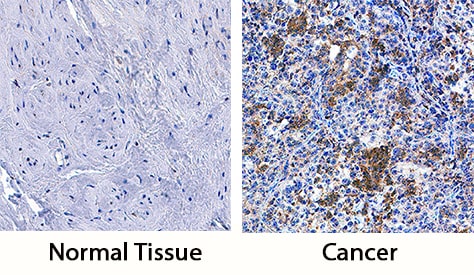
LRIG3 in Human Cervical Cancer Tissue.
LRIG3 was detected in immersion fixed paraffin-embedded sections of human cervical cancer tissue using Goat Anti-Human LRIG3 Antigen Affinity-purified Polyclonal Antibody (Catalog # AF3495) at 3 µg/mL overnight at 4 °C. Tissue was stained using the Anti-Goat HRP-DAB Cell & Tissue Staining Kit (brown; Catalog # CTS008) and counterstained with hematoxylin (blue). Specific staining was localized to cytoplasm of cancer cells. View our protocol for Chromogenic IHC Staining of Paraffin-embedded Tissue Sections.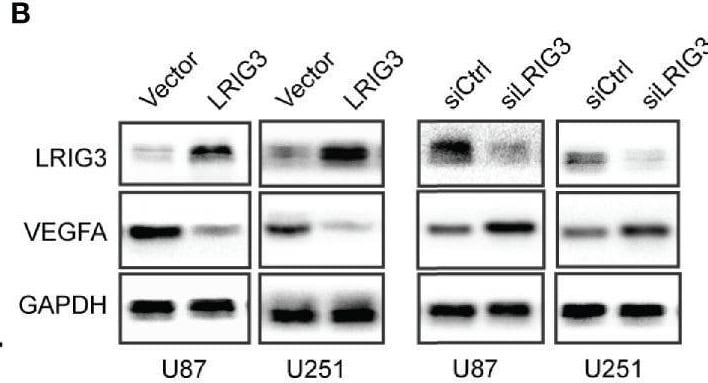
Detection of LRIG3 by Western Blot
LRIG3 inhibited glioma angiogenesis by regulating VEGFA expression. (A) qRT-PCR analysis targeting angiogenic factors in glioma cells transduced with LRIG3 and control siRNAs. (B) Western blot analysis of VEGFA, LRIG3, and GAPDH. (C) Integrated density of the bands was normalized to GAPDH in LRIG3 knockdown or overexpression glioma cells. (D) Levels of VEGFA protein in the CM from glioma cells with LRIG3 knockdown or overexpression were detected by ELISA. Data are means ± SD of 3 independent replicates. *p < 0.05; **p < 0.01; ***p < 0.001. CM, conditioned medium. Image collected and cropped by CiteAb from the following open publication (https://pubmed.ncbi.nlm.nih.gov/33718179), licensed under a CC-BY license. Not internally tested by R&D Systems.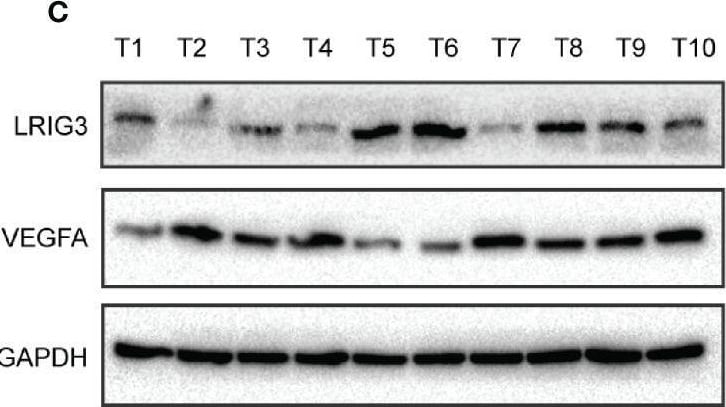
Detection of LRIG3 by Western Blot
Clinical relevance of LRIG3, p-AKT, and VEGFA expression in gliomas. (A) IHC staining targeting LRIG3, p-AKT, and VEGFA in two representative GBM specimens. Brown staining, positive immunoreactivity. (B) Relative levels of LRIG3, p-AKT, and VEGFA proteins in GBM specimens (with low and high LRIG3 expression levels in 28 GBM patients). (C) Expression analysis (left) and correlation (right) between LRIG3 and VEGFA expression in 10 freshly collected human glioma samples. Data are means ± SD of 3 independent replicates. ***p < 0.001. Image collected and cropped by CiteAb from the following open publication (https://pubmed.ncbi.nlm.nih.gov/33718179), licensed under a CC-BY license. Not internally tested by R&D Systems.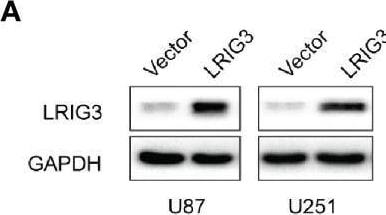
Detection of LRIG3 by Western Blot
Ectopic expression of LRIG3 reduces the pro-angiogenic activity of glioma cells in vitro.(A) Western blots showing levels of LRIG3 expression in the vector control and LRIG3-transduced glioma cells. GAPDH was used as an internal control. (B) Representative images (left) and quantification (right) of wound healing assays in HUVECs treated with CM derived from the vector control or LRIG3-transduced glioma cells. (C) Representative images (left) and quantification (right) of transwell migration assays of HUVECs treated with the indicated CM. (D) Representative images (left) and quantification (right) of HUVECs formed tube-like structures on Matrigel-coated plates with CM derived from the vector control or LRIG3-transduced glioma cells. (E) HUVEC viability was determined using the MTT assay. HUVECs were treated with CM derived from the indicated cells for the specific number of days. Data are means ± SD of 3 replicates. *p < 0.05; **p < 0.01; ***p < 0.001. CM, conditioned medium. Image collected and cropped by CiteAb from the following open publication (https://pubmed.ncbi.nlm.nih.gov/33718179), licensed under a CC-BY license. Not internally tested by R&D Systems.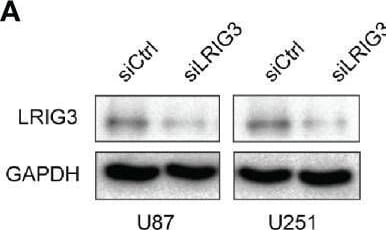
Detection of LRIG3 by Western Blot
Downregulation of LRIG3 enhances the pro-angiogenic activity of glioma cells in vitro. (A) Western blot analysis of LRIG3 expression in the siRNA control and LRIG3-silenced glioma cells. GAPDH was used as an internal control. (B) Representative images (left) and quantification (right) of wound healing assays of HUVECs treated with CM derived from the siRNA control or LRIG3-silenced glioma cells. (C) Representative images (left) and quantification (right) of transwell migration assays in HUVECs treated with the indicated CM. (D) Representative images (left) and quantification (right) of HUVECs formed tube-like structures on Matrigel-coated plates with CM derived from the siRNA control cells or LRIG3-silenced glioma cells. (E) HUVEC viability was determined using the MTT assay. HUVECs were treated with CM derived from the indicated cells for the specific number of days. Data are presented as means ± SD of 3 independent replicates. *p < 0.05; **p < 0.01. CM, conditioned medium. Image collected and cropped by CiteAb from the following open publication (https://pubmed.ncbi.nlm.nih.gov/33718179), licensed under a CC-BY license. Not internally tested by R&D Systems.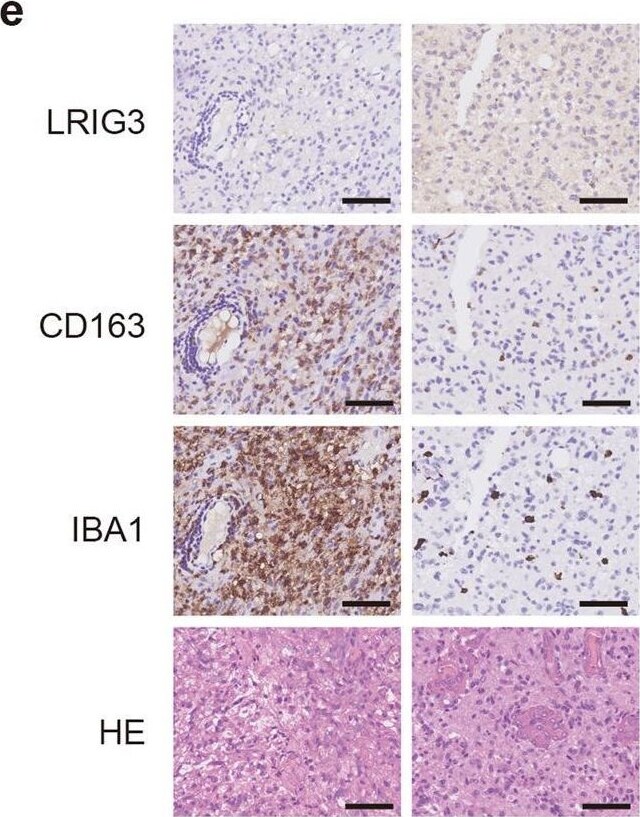
Detection of LRIG3 by Immunohistochemistry
LRIG3 expression is negatively correlated with tumor-supportive TAMs in human GBM and informs good prognosis of GBM patients. A, b The stroma score (a) and immune score (b) of LRIG3-High-expression and LRIG3-low-expression patients in the TCGA GBM database. The stroma and immune scores were determined based on expression data (Yoshihara et al., 2013). Unpaired student’s t test. c GSEA analysis based on KEGG gene sets and TCGA GBM database. d GSEA analysis for various types of immune cells in LRIG3-High-expression and LRIG3-low-expression patients in TCGA GBM database. e Representative images of HE staining and the low- and high-expression levels of LRIG3, CD163, and IBA1 in human GBM tissue microarrays. Scale bar, 50 mm. f, g Correlation analysis between LRIG3 and CD163 expression in TMA of low grade (grade 2 and 3) glioma (n = 31) (f) and GBM (n = 40) (g). Pearson’s correlation test. h Kaplan–Meier survival curves of LRIG3-High-expression and LRIG3-Low-expression patients in TCGA GBM database. Image collected and cropped by CiteAb from the following open publication (https://pubmed.ncbi.nlm.nih.gov/36639372), licensed under a CC-BY license. Not internally tested by R&D Systems.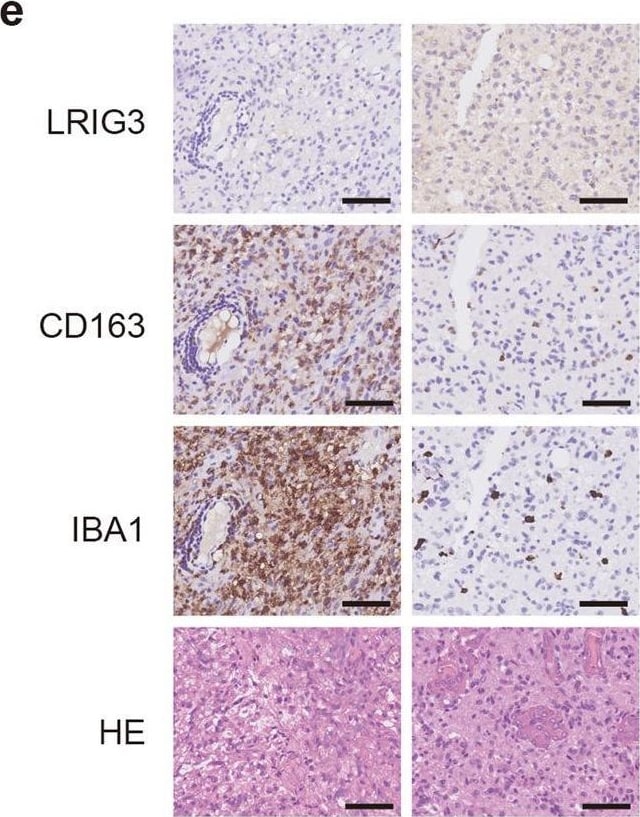
Detection of LRIG3 by Immunohistochemistry
LRIG3 expression is negatively correlated with tumor-supportive TAMs in human GBM and informs good prognosis of GBM patients. A, b The stroma score (a) and immune score (b) of LRIG3-High-expression and LRIG3-low-expression patients in the TCGA GBM database. The stroma and immune scores were determined based on expression data (Yoshihara et al., 2013). Unpaired student’s t test. c GSEA analysis based on KEGG gene sets and TCGA GBM database. d GSEA analysis for various types of immune cells in LRIG3-High-expression and LRIG3-low-expression patients in TCGA GBM database. e Representative images of HE staining and the low- and high-expression levels of LRIG3, CD163, and IBA1 in human GBM tissue microarrays. Scale bar, 50 mm. f, g Correlation analysis between LRIG3 and CD163 expression in TMA of low grade (grade 2 and 3) glioma (n = 31) (f) and GBM (n = 40) (g). Pearson’s correlation test. h Kaplan–Meier survival curves of LRIG3-High-expression and LRIG3-Low-expression patients in TCGA GBM database. Image collected and cropped by CiteAb from the following open publication (https://pubmed.ncbi.nlm.nih.gov/36639372), licensed under a CC-BY license. Not internally tested by R&D Systems.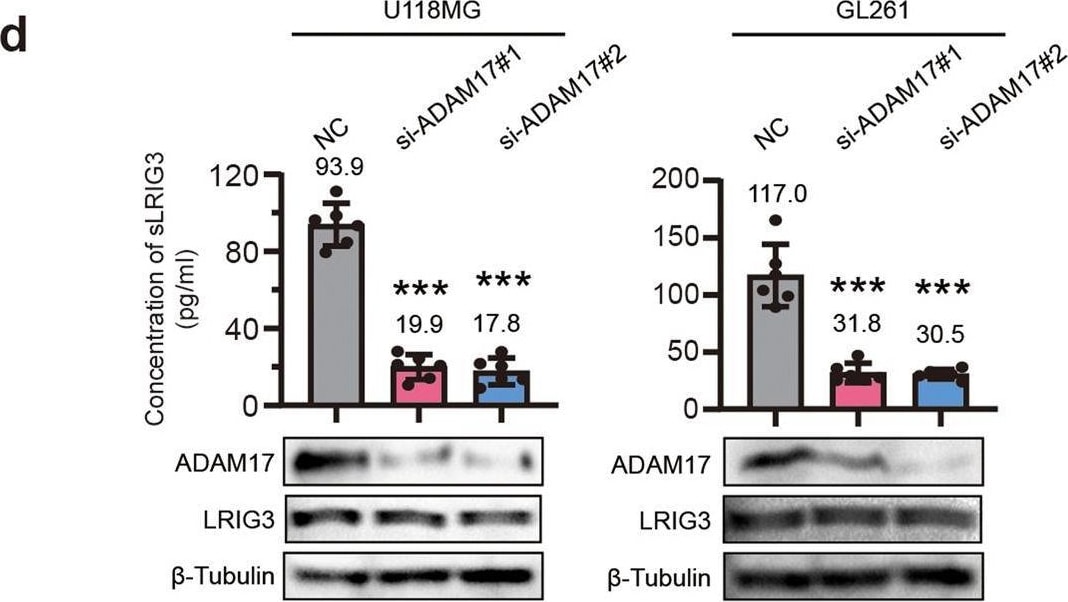
Detection of LRIG3 by Western Blot
ADAM17 promotes the secretion of soluble LRIG3 by glioma cells. A Immunoblots for LRIG3 in the cell lysates of human glioma cell lines (U118MG, U87MG, FU) and macrophage-like cell line (THP-1). b Immunoblots for LRIG3 in the cell lysates of mouse glioma cell line (GL261) and macrophage-like cell line (RAW264.7 and BMDM). c ELISA standard curve showing the correlation relationship of LRIG3 concentrations and the log of the optical density 490. d ELISA and immunoblots for the expression of soluble LRIG3 protein of supernatant medium (up panel), ADAM17, and LRIG3 in the cell lysates (down panel) in negative control and si-ADAM17 U118MG and GL261 cells. n = 6 biological replicates for ELISA assay. One-way ANOVA with bonferroni correction. e, f ELISA for the expression of soluble LRIG3 protein of supernatant medium in U118MG (e) and GL261 (f) cells with stimulation of ADAM17 agonist PMA, ADAM17 inhibitor TAPI and ADAM17 siRNAs. n = 6 biological replicates. One-way ANOVA with bonferroni correction. g, h ELISA for the expression of soluble LRIG3 protein of supernatant medium in U118MG (g) and GL261 (h) cells in the absence or presence of increasing doses of ADAM17 agonist PMA. n = 3 biological replicates. One-way ANOVA. i, j ELISA for the expression of soluble LRIG3 protein of supernatant medium in U118MG (i) and GL261 (j) cells in the absence or presence of increasing doses of ADAM17 inhibitor TAPI. n = 3 biological replicates. One-way ANOVA. Image collected and cropped by CiteAb from the following open publication (https://pubmed.ncbi.nlm.nih.gov/36639372), licensed under a CC-BY license. Not internally tested by R&D Systems.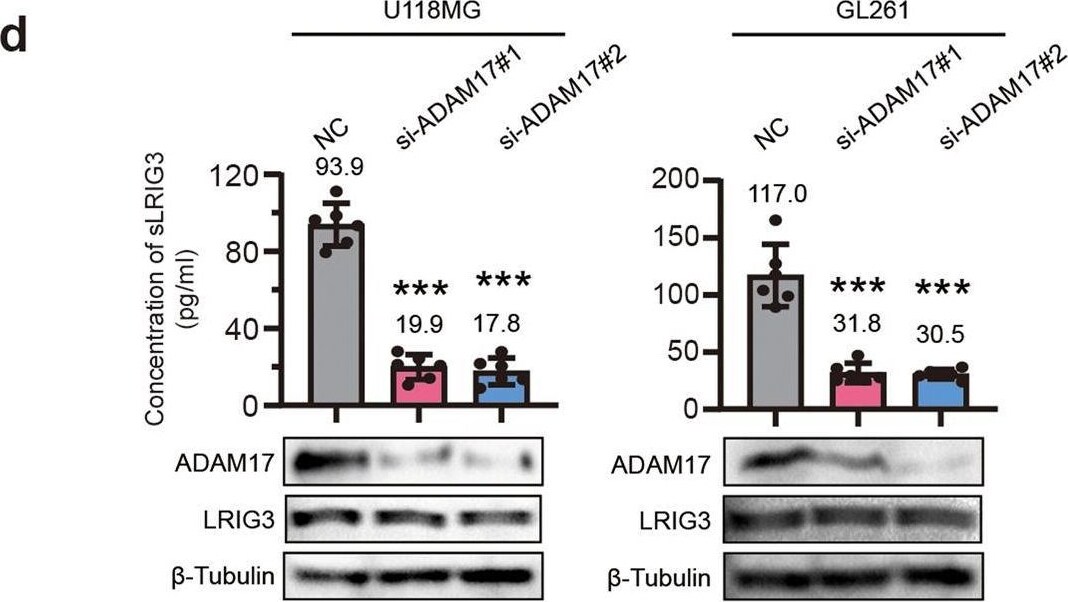
Detection of LRIG3 by Western Blot
ADAM17 promotes the secretion of soluble LRIG3 by glioma cells. A Immunoblots for LRIG3 in the cell lysates of human glioma cell lines (U118MG, U87MG, FU) and macrophage-like cell line (THP-1). b Immunoblots for LRIG3 in the cell lysates of mouse glioma cell line (GL261) and macrophage-like cell line (RAW264.7 and BMDM). c ELISA standard curve showing the correlation relationship of LRIG3 concentrations and the log of the optical density 490. d ELISA and immunoblots for the expression of soluble LRIG3 protein of supernatant medium (up panel), ADAM17, and LRIG3 in the cell lysates (down panel) in negative control and si-ADAM17 U118MG and GL261 cells. n = 6 biological replicates for ELISA assay. One-way ANOVA with bonferroni correction. e, f ELISA for the expression of soluble LRIG3 protein of supernatant medium in U118MG (e) and GL261 (f) cells with stimulation of ADAM17 agonist PMA, ADAM17 inhibitor TAPI and ADAM17 siRNAs. n = 6 biological replicates. One-way ANOVA with bonferroni correction. g, h ELISA for the expression of soluble LRIG3 protein of supernatant medium in U118MG (g) and GL261 (h) cells in the absence or presence of increasing doses of ADAM17 agonist PMA. n = 3 biological replicates. One-way ANOVA. i, j ELISA for the expression of soluble LRIG3 protein of supernatant medium in U118MG (i) and GL261 (j) cells in the absence or presence of increasing doses of ADAM17 inhibitor TAPI. n = 3 biological replicates. One-way ANOVA. Image collected and cropped by CiteAb from the following open publication (https://pubmed.ncbi.nlm.nih.gov/36639372), licensed under a CC-BY license. Not internally tested by R&D Systems.Applications for Human LRIG3 Antibody
Immunohistochemistry
Sample: Immersion fixed paraffin-embedded sections of human cervical cancer tissue
Western Blot
Sample: Recombinant Human LRIG3 (Catalog # 3495-LR)
Formulation, Preparation, and Storage
Purification
Reconstitution
Reconstitute at 0.2 mg/mL in sterile PBS. For liquid material, refer to CoA for concentration.
Formulation
Shipping
Stability & Storage
- 12 months from date of receipt, -20 to -70 °C as supplied.
- 1 month, 2 to 8 °C under sterile conditions after reconstitution.
- 6 months, -20 to -70 °C under sterile conditions after reconstitution.
Calculators
Background: LRIG3
References
- Guo, D. et al. (2004) Genomics 84:157.
- Gur, G. et al. (2004) EMBO J. 23:3270.
- Laederich, M.B. (2004) J. Biol. Chem. 279:47050.
- Guo, D. et al. (2006) Acta Neuropathol. (Berl.) 111:238.
Long Name
Alternate Names
Gene Symbol
UniProt
Additional LRIG3 Products
Product Documents for Human LRIG3 Antibody
Certificate of Analysis
To download a Certificate of Analysis, please enter a lot or batch number in the search box below.
Note: Certificate of Analysis not available for kit components.
Product Specific Notices for Human LRIG3 Antibody
For research use only
Related Research Areas
Citations for Human LRIG3 Antibody
 Powered by Bioz
Customer Reviews for Human LRIG3 Antibody
There are currently no reviews for this product. Be the first to review Human LRIG3 Antibody and earn rewards!
Have you used Human LRIG3 Antibody?
Submit a review and receive an Amazon gift card!
$25/€18/£15/$25CAN/¥2500 for a review with an image
$10/€7/£6/$10CAN/¥1110 for a review without an image
Submit a review
Protocols
Find general support by application which include: protocols, troubleshooting, illustrated assays, videos and webinars.
- Antigen Retrieval Protocol (PIER)
- Antigen Retrieval for Frozen Sections Protocol
- Appropriate Fixation of IHC/ICC Samples
- Cellular Response to Hypoxia Protocols
- Chromogenic IHC Staining of Formalin-Fixed Paraffin-Embedded (FFPE) Tissue Protocol
- Chromogenic Immunohistochemistry Staining of Frozen Tissue
- ClariTSA™ Fluorophore Kits
- Detection & Visualization of Antibody Binding
- Fluorescent IHC Staining of Frozen Tissue Protocol
- Graphic Protocol for Heat-induced Epitope Retrieval
- Graphic Protocol for the Preparation and Fluorescent IHC Staining of Frozen Tissue Sections
- Graphic Protocol for the Preparation and Fluorescent IHC Staining of Paraffin-embedded Tissue Sections
- Graphic Protocol for the Preparation of Gelatin-coated Slides for Histological Tissue Sections
- IHC Sample Preparation (Frozen sections vs Paraffin)
- Immunofluorescent IHC Staining of Formalin-Fixed Paraffin-Embedded (FFPE) Tissue Protocol
- Immunohistochemistry (IHC) and Immunocytochemistry (ICC) Protocols
- Immunohistochemistry Frozen Troubleshooting
- Immunohistochemistry Paraffin Troubleshooting
- Preparing Samples for IHC/ICC Experiments
- Preventing Non-Specific Staining (Non-Specific Binding)
- Primary Antibody Selection & Optimization
- Protocol for Heat-Induced Epitope Retrieval (HIER)
- Protocol for Making a 4% Formaldehyde Solution in PBS
- Protocol for VisUCyte™ HRP Polymer Detection Reagent
- Protocol for the Preparation & Fixation of Cells on Coverslips
- Protocol for the Preparation and Chromogenic IHC Staining of Frozen Tissue Sections
- Protocol for the Preparation and Chromogenic IHC Staining of Frozen Tissue Sections - Graphic
- Protocol for the Preparation and Chromogenic IHC Staining of Paraffin-embedded Tissue Sections
- Protocol for the Preparation and Chromogenic IHC Staining of Paraffin-embedded Tissue Sections - Graphic
- Protocol for the Preparation and Fluorescent IHC Staining of Frozen Tissue Sections
- Protocol for the Preparation and Fluorescent IHC Staining of Paraffin-embedded Tissue Sections
- Protocol for the Preparation of Gelatin-coated Slides for Histological Tissue Sections
- R&D Systems Quality Control Western Blot Protocol
- TUNEL and Active Caspase-3 Detection by IHC/ICC Protocol
- The Importance of IHC/ICC Controls
- Troubleshooting Guide: Immunohistochemistry
- Troubleshooting Guide: Western Blot Figures
- Western Blot Conditions
- Western Blot Protocol
- Western Blot Protocol for Cell Lysates
- Western Blot Troubleshooting
- Western Blot Troubleshooting Guide
- View all Protocols, Troubleshooting, Illustrated assays and Webinars