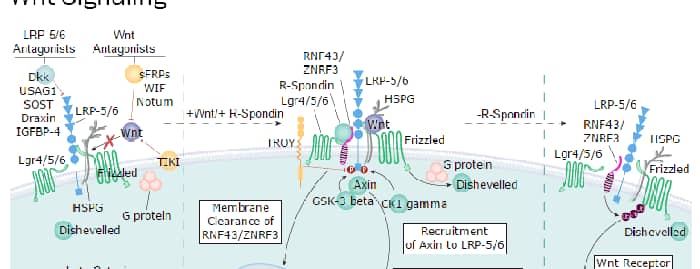
Casein Kinase 1 (CK1) represents a group of serine/threonine protein kinases that are present in all eukaryotic organisms. Human CK1 isoforms ( alpha, gamma 1, gamma 2, gamma 3, delta, and epsilon ) act as monomeric constitutively active enzymes that phosphorylate key regulatory proteins involved in the control of cell differentiation, proliferation, chromosome segregation, and circadian rhythms. CK1 family members share a highly conserved kinase domain but differ in their variable N- and C-terminal domains. CK1 alpha is speculated to play a role in mammalian cell cycle progression, spindle dynamics, and chromosome segregation.
Casein Kinase 1 alpha Antibody
R&D Systems | Catalog # AF4569


Scientific images may be resized, cropped, or adjusted for brightness or contrast for presentation purposes. These updates are limited to presentation and do not affect the underlying scientific interpretation of the data. Where available, additional source data may be provided upon request.
Key Product Details
Validated by
Knockout/Knockdown
Species Reactivity
Validated:
Human, Mouse, Rat
Cited:
Human
Applications
Validated:
Western Blot, Immunocytochemistry, Immunoprecipitation
Cited:
Western Blot
Label
Unconjugated
Antibody Source
Polyclonal Sheep IgG
Loading...
Product Specifications
Immunogen
E. coli-derived recombinant human CK1 alpha
Ala255-Phe365
Accession # NP_001020276
Ala255-Phe365
Accession # NP_001020276
Specificity
Detects endogenous human, mouse, and rat CK1 alpha in Western blots. In Western blots, this antibody does not cross-react with recombinant human CK1 delta or CK1 gamma ; reactivity with CK1 epsilon is unknown.
Clonality
Polyclonal
Host
Sheep
Isotype
IgG
Scientific Data Images for Casein Kinase 1 alpha Antibody
Detection of Human and Rat Casein Kinase 1 alpha by Western Blot.
Western blot shows lysates of HeLa human cervical epithelial carcinoma cell line, K562 human chronic myelogenous leukemia cell line, NRK rat normal kidney cell line, and Y3-Ag rat myeloid cell line. PVDF membrane was probed with 1 µg/mL of Human/Mouse/Rat Casein Kinase 1a Antigen Affinity-purified Polyclonal Antibody (Catalog # AF4569) followed by HRP-conjugated Anti-Sheep IgG Secondary Antibody (HAF016). A specific band was detected for Casein Kinase 1a at approximately 38 kDa (as indicated). This experiment was conducted under reducing conditions and using Immunoblot Buffer Group 1.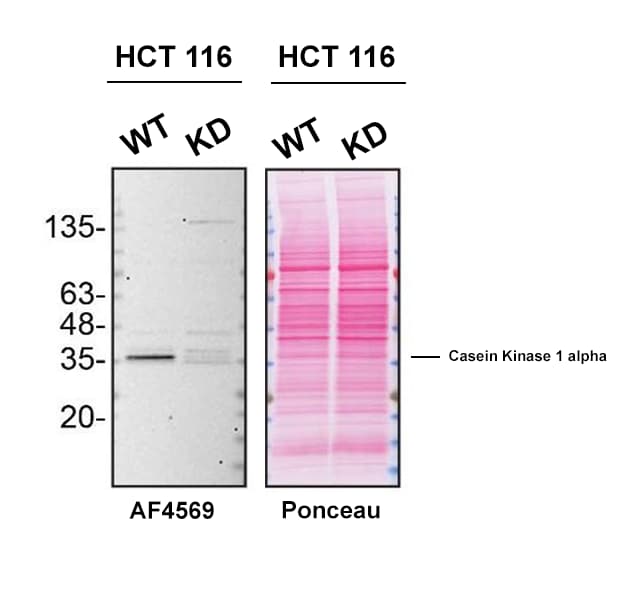
Western Blot Shows Human Casein Kinase 1 alpha Specificity Using Knockdown Cell Line.
Western blot shows lysates of HCT 116 human colorectal carcinoma cell line and Casein Kinase 1 alpha knockdown HCT 116 cell line (KD). Nitrocellulose membrane was probed with 2 µg/mL of Human/Mouse/Rat Casein Kinase 1 alpha Antigen Affinity-purified Polyclonal Antibody (Catalog # AF4569) followed by HRP-conjugated donkey anti-sheep IgG Secondary Antibody. A specific band was detected for Casein Kinase 1 alpha at approximately 36 kDa (as indicated) in the parental HCT 116 cell line, but is significantly reduced in knockdown HCT 116 cell line. The Ponceau stained transfer of the blot is shown. This experiment was conducted under reducing conditions. Image, protocol, and testing courtesy of YCharOS Inc. See ycharos.com for additional details.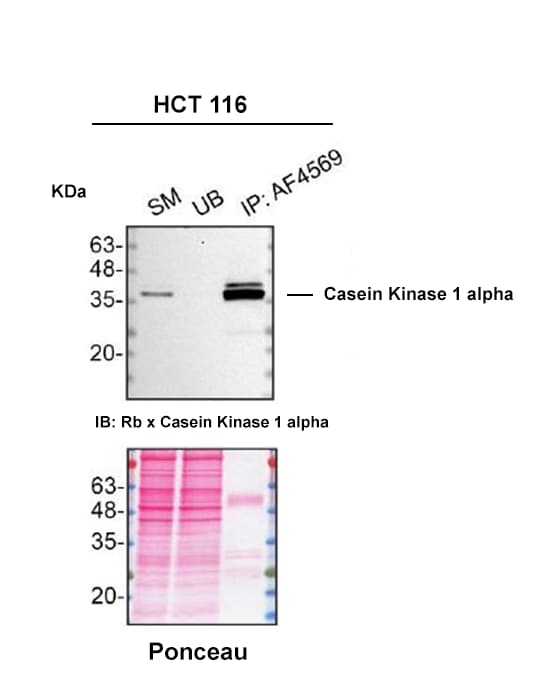
Detection of Casein Kinase 1 alpha by Immunoprecipitation.
HCT 116 lysates were prepared and immunoprecipitation was performed using 2.0 µg of Human/Mouse/Rat Casein Kinase 1 alpha Antigen Affinity-purified Polyclonal Antibody (Catalog # AF4569) pre-coupled to Dynabeads protein G. Immunoprecipitated Casein Kinase 1 alpha was detected with a Rabbit Anti-Casein Kinase 1 alpha antibody. The Ponceau stained transfer of the blot is shown. SM=4% starting material; UB=4% unbound fraction; IP=immunoprecipitate; HC=antibody heavy chain. Image, protocol and testing courtesy of YCharOS Inc. (ycharos.com).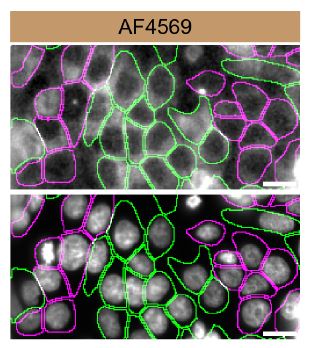
Casein Kinase 1 alpha Specificity is Shown by Immunocytochemistry in Knockdown Cell Line.
HCT 116 WT and Casein Kinase 1 alpha KD cells were labelled with a green or a far-red fluorescent dye, respectively. Cells were stained with Human/Mouse/Rat Casein Kinase 1 alpha Antigen Affinity-purified Polyclonal Antibody (Catalog # AF4569) followed by incubation with a donkey anti-sheep Alexa-fluor 555 coupled secondary antibody (upper panel). DAPI-only counterstained cells shown on a lower panel. Acquisition of the blue (nucleus-DAPI), green (identification of WT cells), red (antibody staining) and far-red (identification of KD cells) channels was performed. Representative images of the blue and red (grayscale) channels are shown. WT and KD cells are outlined with green and magenta dashed line, respectively. Primary antibody concentration used: 2 µg/mL. Image, protocol and testing courtesy of YCharOS Inc. (ycharos.com).Applications for Casein Kinase 1 alpha Antibody
Application
Recommended Usage
Immunocytochemistry
2 µg/mL
Sample: HCT 116 human colorectal carcinoma cell line
Sample: HCT 116 human colorectal carcinoma cell line
Immunoprecipitation
2 µg/1 mg cell lysate
Sample: Lysates of HCT 116 human colorectal carcinoma cell line
Sample: Lysates of HCT 116 human colorectal carcinoma cell line
Western Blot
1 µg/mL
Sample: NRK rat normal kidney cell, HeLa human cervical epithelial carcinoma cell line,K562 human chronic myelogenous leukemia cell line, Y3-Ag rat myeloid cell line, and HCT 116 human colorectal carcinoma cell line
Sample: NRK rat normal kidney cell, HeLa human cervical epithelial carcinoma cell line,K562 human chronic myelogenous leukemia cell line, Y3-Ag rat myeloid cell line, and HCT 116 human colorectal carcinoma cell line
Formulation, Preparation, and Storage
Purification
Antigen Affinity-purified
Reconstitution
Reconstitute at 0.2 mg/mL in sterile PBS. For liquid material, refer to CoA for concentration.
Loading...
Formulation
Lyophilized from a 0.2 μm filtered solution in PBS with Trehalose. See Certificate of Analysis for details.<br/>*Small pack size (-SP) is supplied either lyophilized or as a 0.2 µm filtered solution in PBS.
Shipping
Lyophilized product is shipped at ambient temperature. Liquid small pack size (-SP) is shipped with polar packs. Upon receipt, store immediately at the temperature recommended below.
Stability & Storage
Use a manual defrost freezer and avoid repeated freeze-thaw cycles.
- 12 months from date of receipt, -20 to -70 °C as supplied.
- 1 month, 2 to 8 °C under sterile conditions after reconstitution.
- 6 months, -20 to -70 °C under sterile conditions after reconstitution.
Calculators
Background: Casein Kinase 1 alpha
Alternate Names
CSNK1A1, HLCDGP1
Gene Symbol
CSNK1A1
UniProt
Additional Casein Kinase 1 alpha Products
Product Documents for Casein Kinase 1 alpha Antibody
Certificate of Analysis
To download a Certificate of Analysis, please enter a lot or batch number in the search box below.
Note: Certificate of Analysis not available for kit components.
Product Specific Notices for Casein Kinase 1 alpha Antibody
For research use only
Related Research Areas
Citations for Casein Kinase 1 alpha Antibody
 Powered by Bioz
Customer Reviews for Casein Kinase 1 alpha Antibody
There are currently no reviews for this product. Be the first to review Casein Kinase 1 alpha Antibody and earn rewards!
Have you used Casein Kinase 1 alpha Antibody?
Submit a review and receive an Amazon gift card!
$25/€18/£15/$25CAN/¥2500 for a review with an image
$10/€7/£6/$10CAN/¥1110 for a review without an image
Submit a review
Protocols
Find general support by application which include: protocols, troubleshooting, illustrated assays, videos and webinars.
- Appropriate Fixation of IHC/ICC Samples
- Cellular Response to Hypoxia Protocols
- ClariTSA™ Fluorophore Kits
- Detection & Visualization of Antibody Binding
- ICC Cell Smear Protocol for Suspension Cells
- ICC Immunocytochemistry Protocol Videos
- ICC for Adherent Cells
- Immunocytochemistry (ICC) Protocol
- Immunocytochemistry Troubleshooting
- Immunofluorescence of Organoids Embedded in Cultrex Basement Membrane Extract
- Immunohistochemistry (IHC) and Immunocytochemistry (ICC) Protocols
- Immunoprecipitation Protocol
- Preparing Samples for IHC/ICC Experiments
- Preventing Non-Specific Staining (Non-Specific Binding)
- Primary Antibody Selection & Optimization
- Protocol for VisUCyte™ HRP Polymer Detection Reagent
- Protocol for the Fluorescent ICC Staining of Cell Smears - Graphic
- Protocol for the Fluorescent ICC Staining of Cultured Cells on Coverslips - Graphic
- Protocol for the Preparation and Fluorescent ICC Staining of Cells on Coverslips
- Protocol for the Preparation and Fluorescent ICC Staining of Non-adherent Cells
- Protocol for the Preparation and Fluorescent ICC Staining of Stem Cells on Coverslips
- Protocol for the Preparation of a Cell Smear for Non-adherent Cell ICC - Graphic
- R&D Systems Quality Control Western Blot Protocol
- TUNEL and Active Caspase-3 Detection by IHC/ICC Protocol
- The Importance of IHC/ICC Controls
- Troubleshooting Guide: Western Blot Figures
- Western Blot Conditions
- Western Blot Protocol
- Western Blot Protocol for Cell Lysates
- Western Blot Troubleshooting
- Western Blot Troubleshooting Guide
- View all Protocols, Troubleshooting, Illustrated assays and Webinars
Loading...
Associated Pathways