
Heat shock proteins (HSPs) are a family of highly conserved stress response proteins. Heat shock proteins function primarily as molecular chaperones by facilitating the folding of other cellular proteins, preventing protein aggregation or targeting improperly folded proteins to specific degradative pathways. HSPs are typically expressed at low levels under normal physiological conditions but are dramatically up‑regulated in response to cellular stress. HSP70 is a 72 kDa member of the heat shock protein 70 family of proteins. HSP70, also known as HSPA1A, HSP70-1, and HSP72 is a 641 amino acid (aa) heat shock protein. Over aa 1-641, human HSP70 shares 95% and 97% aa identity to mouse and rat HSP70.
HSP70/HSPA1A Antibody
R&D Systems | Catalog # AF1663

Scientific images may be resized, cropped, or adjusted for brightness or contrast for presentation purposes. These updates are limited to presentation and do not affect the underlying scientific interpretation of the data. Where available, additional source data may be provided upon request.
Loading...
Key Product Details
Validated by
Biological Validation
Species Reactivity
Validated:
Human, Mouse, Rat
Cited:
Human, Mouse, Rat
Applications
Validated:
Western Blot, Simple Western
Cited:
Immunohistochemistry, Immunohistochemistry-Paraffin, Western Blot, Immunocytochemistry, Simple Western
Label
Unconjugated
Antibody Source
Polyclonal Rabbit IgG
Loading...
Product Specifications
Immunogen
E. coli-derived recombinant human HSP70
Met1-Asp641
Accession # P08107
Met1-Asp641
Accession # P08107
Specificity
Detects the induced form of recombinant endogenous human, mouse and rat HSP70/HSPA1A (HSP72) in Western blots. In Western blots, no cross‑reactivity with the constitutively expressed HSC70 (HSP73) is detected.
Clonality
Polyclonal
Host
Rabbit
Isotype
IgG
Scientific Data Images for HSP70/HSPA1A Antibody
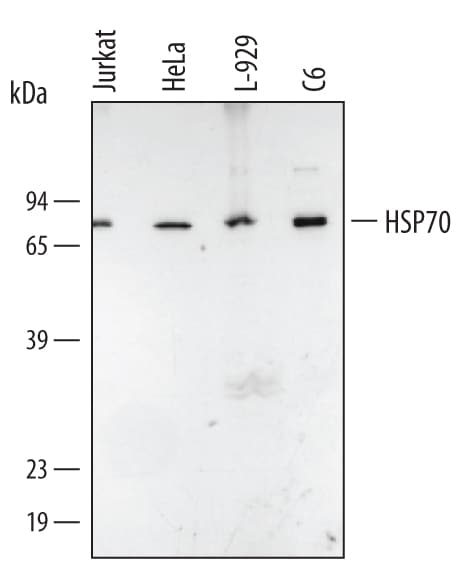
Detection of Human, Mouse, and Rat HSP70/HSPA1A by Western Blot.
Western blot shows lysates of Jurkat human acute T cell leukemia cell line, HeLa human cervical epithelial carcinoma cell line, L-929 mouse fibroblast cell line, and C6 rat glioma cell line. PVDF membrane was probed with 0.1 µg/mL of Rabbit Anti-Human/Mouse/Rat HSP70/HSPA1A Antigen Affinity-purified Polyclonal Antibody (Catalog # AF1663) followed by HRP-conjugated Anti-Rabbit IgG Secondary Antibody (Catalog # HAF008). A specific band was detected for HSP70/HSPA1A at approximately 72 kDa (as indicated). This experiment was conducted under reducing conditions and using Immunoblot Buffer Group 2.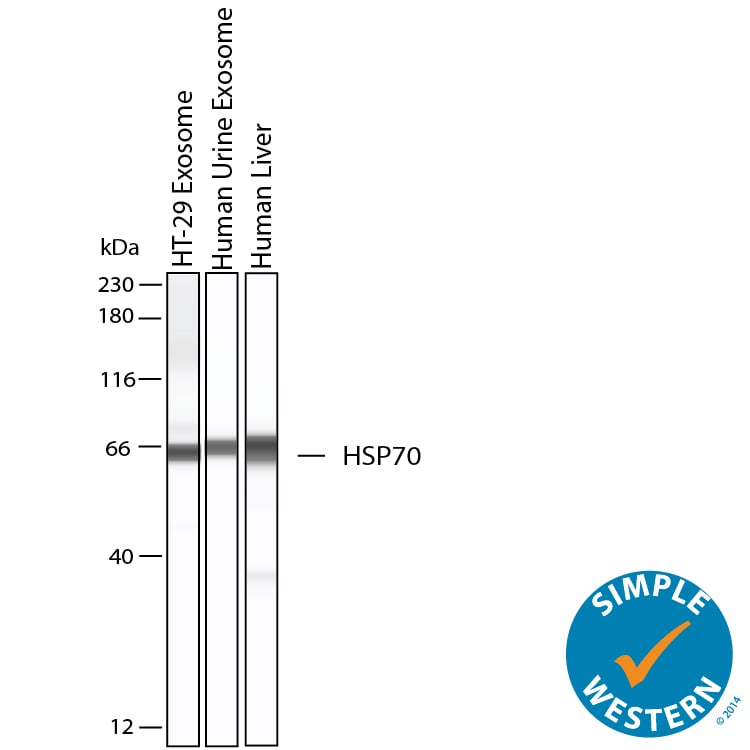
Detection of Human HSP70/HSPA1A by Simple WesternTM.
Simple Western shows lysates of Exosome Standards (HT‑29) (NBP3-11685), Exosome Standards (Human Urine) (NBP2-49840) and human liver tissue, loaded at 0.5 mg/ml. A specific band was detected for HSP70/HSPA1A at approximately 67 kDa (as indicated) using 20 µg/mL of Rabbit Anti-Human/Mouse/Rat HSP70/HSPA1A Antigen Affinity-purified Polyclonal Antibody (Catalog # AF1663). This experiment was conducted under reducing conditions and using the 12-230kDa separation system.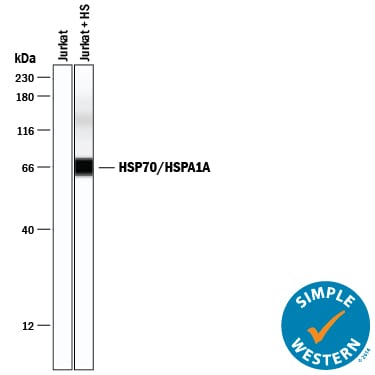
Detection of Human HSP70/HSPA1A by Simple WesternTM.
Simple Western lane view shows lysates of Jurkat human acute T cell leukemia cell line untreated (-) or treated (+) with heat shocked (HS), loaded at 0.2 mg/mL. A specific band was detected for HSP70/HSPA1A at approximately 66 kDa (as indicated) using 0.5 µg/mL of Rabbit Anti-Human/Mouse/Rat HSP70/HSPA1A Antigen Affinity-purified Polyclonal Antibody (Catalog # AF1663). This experiment was conducted under reducing conditions and using the 12-230 kDa separation system.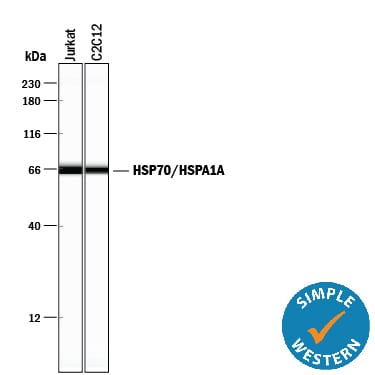
Detection of Human and Mouse HSP70/HSPA1A by Simple WesternTM.
Simple Western lane view shows lysates of Jurkat human acute T cell leukemia cell line and C2C12 mouse myoblast cell line, loaded at 0.2 mg/mL. A specific band was detected for HSP70/HSPA1A at approximately 66 kDa (as indicated) using 0.5 µg/mL of Rabbit Anti-Human/Mouse/Rat HSP70/HSPA1A Antigen Affinity-purified Polyclonal Antibody (Catalog # AF1663). This experiment was conducted under reducing conditions and using the 12-230 kDa separation system.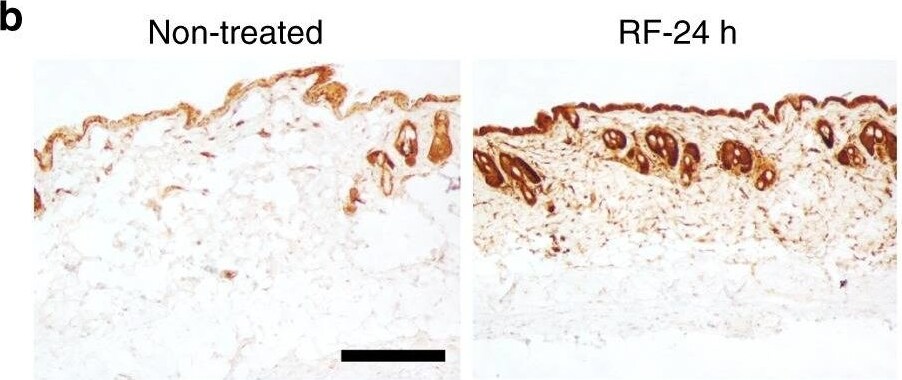
Detection of Mouse HSP70/HSPA1A by Immunohistochemistry
RFA increases HSP70 levels and activates MyD88. a C57BL/6 mice were exposed to RF and skin HSP70, HSc70, and HSP90 levels were then analyzed by western blotting at 6 and 24 h (hr) using GAPDH as internal control. b Representative IHC images of HSP70 expression in RF-treated and non-treated skin at 24 h. Scale: 250 µm. c WT and MyD88 KO mice were exposed to RF or sham treatment followed by ID injection of 10 µg OVA into RF or sham-treated skin. Serum anti-OVA antibody titer was measured 2 weeks later. n = 4–5. d WT mice were intradermally injected with 100 µg Pepinh-Control or Pepinh-MyD, or the same volume of PBS 3 and 1 h before RF treatment and ID OVA immunization at 10 µg dose. OVA immunization alone served as control (No adjuvant). Serum anti-OVA antibody titer was measured 2 weeks later. n = 4–5. One-way ANOVA with Tukey’s multiple comparison test was used to compare differences between groups in c and d. *p < 0.05; **p < 0.01. NS not significant. Representative of two independent experiments in c and d Image collected and cropped by CiteAb from the following publication (https://pubmed.ncbi.nlm.nih.gov/30209303), licensed under a CC-BY license. Not internally tested by R&D Systems.
Detection of Mouse HSP70/HSPA1A by Western Blot
RFA increases HSP70 levels and activates MyD88. a C57BL/6 mice were exposed to RF and skin HSP70, HSc70, and HSP90 levels were then analyzed by western blotting at 6 and 24 h (hr) using GAPDH as internal control. b Representative IHC images of HSP70 expression in RF-treated and non-treated skin at 24 h. Scale: 250 µm. c WT and MyD88 KO mice were exposed to RF or sham treatment followed by ID injection of 10 µg OVA into RF or sham-treated skin. Serum anti-OVA antibody titer was measured 2 weeks later. n = 4–5. d WT mice were intradermally injected with 100 µg Pepinh-Control or Pepinh-MyD, or the same volume of PBS 3 and 1 h before RF treatment and ID OVA immunization at 10 µg dose. OVA immunization alone served as control (No adjuvant). Serum anti-OVA antibody titer was measured 2 weeks later. n = 4–5. One-way ANOVA with Tukey’s multiple comparison test was used to compare differences between groups in c and d. *p < 0.05; **p < 0.01. NS not significant. Representative of two independent experiments in c and d Image collected and cropped by CiteAb from the following publication (https://pubmed.ncbi.nlm.nih.gov/30209303), licensed under a CC-BY license. Not internally tested by R&D Systems.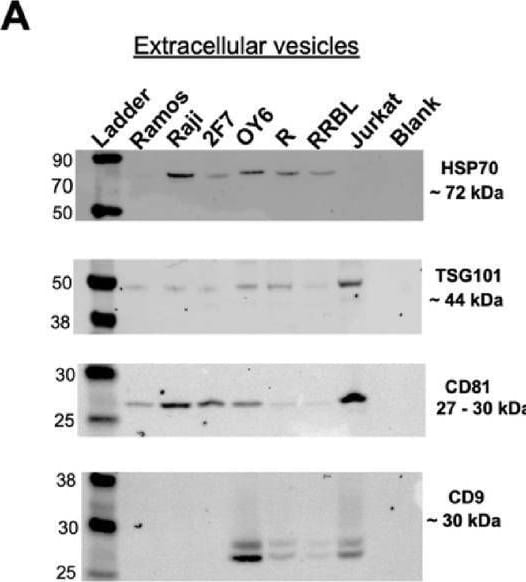
Detection of Human HSP70/HSPA1A by Western Blot
EVs isolated from NHL and AIDS-NHL cell lines sequester rituximab and inhibit apoptosis in Ramos cells. (A) Characterization of extracellular vesicles isolated from NHL and AIDS-NHL cell lines. Western blots of EVs demonstrate the presence of classic exosome markers: HSP70, TSG101, CD81, CD9, and (B) CD63. 20 µg of EV protein lysate was loaded into each well. Imaging/exposure times of each blot: CD81, 60 s; HSP70, 75 s; CD9, 60 s; TSG101, 40 s; and CD63, 60 s. (C) CD20 concentrations measured in EVs by ELISA. Data is for one Luminex assay run. (D) Ramos cells were treated with rituximab (3 µg/ml) in the presence or absence of EVs isolated from NHL (Raji, Ramos) or AIDS-NHL cell lines (2F7, RRBL, R) cell lines, including OY6, a lymphoblastoid cell line of AIDS-NHL. 30 µg of total EV protein was used for each treatment. Shown are representative flow cytometry plots of Ramos cells double stained with Propidium iodide (PI) and Annexin V-FITC after treatment with rituximab in the presence of 2F7 EVs or Raji EVs to evaluate subpopulations of cells undergoing apoptosis. Percentage values are shown in each quadrant of each plot. (E) Quantitative data presented as bar graphs showing the fold increase of apoptosis: Ratio of % double positive cells (PI + and Annexin V+) after treatment with rituximab/untreated Ramos cells. Results are from two to four independent experiments. Image collected and cropped by CiteAb from the following open publication (https://pubmed.ncbi.nlm.nih.gov/40646161), licensed under a CC-BY license. Not internally tested by R&D Systems.Applications for HSP70/HSPA1A Antibody
Application
Recommended Usage
Simple Western
0.5-20 µg/mL
Sample: Exosome Standards (HT-29) (Catalog # NBP3-11685), Exosome Standards (Human Urine) (Catalog # NBP2-49840), human liver tissue, Heat shock treated Jurkat human acute T cell leukemia cell line and C2C12 mouse myoblast cell line
Sample: Exosome Standards (HT-29) (Catalog # NBP3-11685), Exosome Standards (Human Urine) (Catalog # NBP2-49840), human liver tissue, Heat shock treated Jurkat human acute T cell leukemia cell line and C2C12 mouse myoblast cell line
Western Blot
0.1 µg/mL
Sample: Jurkat human acute T cell leukemia cell line, HeLa human cervical epithelial carcinoma cell line, L-929 mouse fibroblast cell line, and C6 rat glioma cell line
Sample: Jurkat human acute T cell leukemia cell line, HeLa human cervical epithelial carcinoma cell line, L-929 mouse fibroblast cell line, and C6 rat glioma cell line
Formulation, Preparation, and Storage
Purification
Antigen and protein A Affinity-purified
Reconstitution
Reconstitute at 0.2 mg/mL in sterile PBS. For liquid material, refer to CoA for concentration.
Loading...
Formulation
Lyophilized from a 0.2 μm filtered solution in PBS with Trehalose. See Certificate of Analysis for details.<br/>*Small pack size (-SP) is supplied either lyophilized or as a 0.2 µm filtered solution in PBS.
Shipping
Lyophilized product is shipped at ambient temperature. Liquid small pack size (-SP) is shipped with polar packs. Upon receipt, store immediately at the temperature recommended below.
Stability & Storage
Use a manual defrost freezer and avoid repeated freeze-thaw cycles.
- 12 months from date of receipt, -20 to -70 °C as supplied.
- 1 month, 2 to 8 °C under sterile conditions after reconstitution.
- 6 months, -20 to -70 °C under sterile conditions after reconstitution.
Calculators
Background: HSP70/HSPA1A
Long Name
Heat Shock Protein 70
Alternate Names
HSP70-1A, HSP72, HSPA1A
Gene Symbol
HSPA1A
UniProt
Additional HSP70/HSPA1A Products
Product Documents for HSP70/HSPA1A Antibody
Certificate of Analysis
To download a Certificate of Analysis, please enter a lot or batch number in the search box below.
Note: Certificate of Analysis not available for kit components.
Product Specific Notices for HSP70/HSPA1A Antibody
For research use only
Related Research Areas
Citations for HSP70/HSPA1A Antibody
 Powered by Bioz
Customer Reviews for HSP70/HSPA1A Antibody
There are currently no reviews for this product. Be the first to review HSP70/HSPA1A Antibody and earn rewards!
Have you used HSP70/HSPA1A Antibody?
Submit a review and receive an Amazon gift card!
$25/€18/£15/$25CAN/¥2500 for a review with an image
$10/€7/£6/$10CAN/¥1110 for a review without an image
Submit a review
Protocols
Find general support by application which include: protocols, troubleshooting, illustrated assays, videos and webinars.
- Cellular Response to Hypoxia Protocols
- R&D Systems Quality Control Western Blot Protocol
- Troubleshooting Guide: Western Blot Figures
- Western Blot Conditions
- Western Blot Protocol
- Western Blot Protocol for Cell Lysates
- Western Blot Troubleshooting
- Western Blot Troubleshooting Guide
- View all Protocols, Troubleshooting, Illustrated assays and Webinars
Loading...
Associated Pathways
