
The Chk1 checkpoint kinase is an integral member of a signaling cascade that controls cell cycle progression. In response to genotoxic or replicative stress, Chk1 is phosphorylated by ATM or ATM-related kinases (ATR) at S317. In turn, Chk1 phosphorylates downstream effectors, such as p53 or the Cdc25 phosphatases to halt cell cycle progression and allow time for repair of incurred damage.
phospho-Chk1 (S317) Antibody
R&D Systems | Catalog # AF2054


Scientific images may be resized, cropped, or adjusted for brightness or contrast for presentation purposes. These updates are limited to presentation and do not affect the underlying scientific interpretation of the data. Where available, additional source data may be provided upon request.
Key Product Details
Validated by
Biological Validation
Species Reactivity
Validated:
Human, Mouse, Rat
Cited:
Human
Applications
Validated:
Western Blot, Simple Western
Cited:
Western Blot
Label
Unconjugated
Antibody Source
Polyclonal Rabbit IgG
Loading...
Product Specifications
Immunogen
Phosphopeptide containing human Chk1 S317 site
Specificity
Detects human, mouse, and rat Chk1 when phosphorylated at S317 in Western blots. Does not recognize Chk1 when unphosphorylated at S317.
Clonality
Polyclonal
Host
Rabbit
Isotype
IgG
Scientific Data Images for phospho-Chk1 (S317) Antibody
Detection of Human Phospho-Chk1 (S317) by Western Blot.
Western blot shows lysates of HeLa human cervical epithelial carcinoma cell line untreated (-) or exposed (+) to 50 J/m2UV-C for the indicated time. PVDF membrane was probed with 1 µg/mL Rabbit Anti-Human/Mouse/Rat Phospho-Chk1 (S317) Antigen Affinity-purified Polyclonal Antibody (Catalog # AF2054) followed by HRP-conjugated Anti-Rabbit IgG Secondary Antibody (Catalog # HAF008). A specific band for Phospho-Chk1 (S317) was detected at approximately 56 kDa (as indicated). The phospho-specificity of this antibody was supported by decreased labeling following treatment with 600 U lambda-phosphatase (lambda-PPase) for 1 hour. This experiment was conducted under reducing conditions and using Immunoblot Buffer Group 1.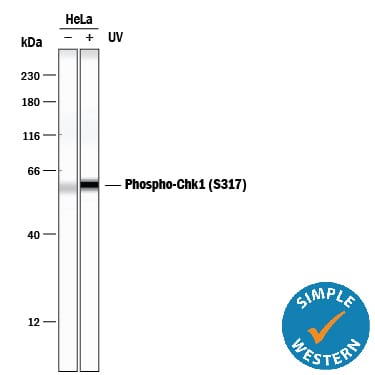
Detection of Human Phospho-Chk1 (S317) by Simple WesternTM.
Simple Western lane view shows lysates of HeLa human cervical epithelial carcinoma cell line untreated (-) or treated (+) with 50 J/m2ultraviolet light (UV) for 2 hours, loaded at 0.2 mg/mL. A specific band was detected for Phospho-Chk1 (S317) at approximately 60 kDa (as indicated) using 10 µg/mL of Rabbit Anti-Human/Mouse/Rat Phospho-Chk1 (S317) Antigen Affinity-purified Polyclonal Antibody (Catalog # AF2054). This experiment was conducted under reducing conditions and using the 12-230 kDa separation system.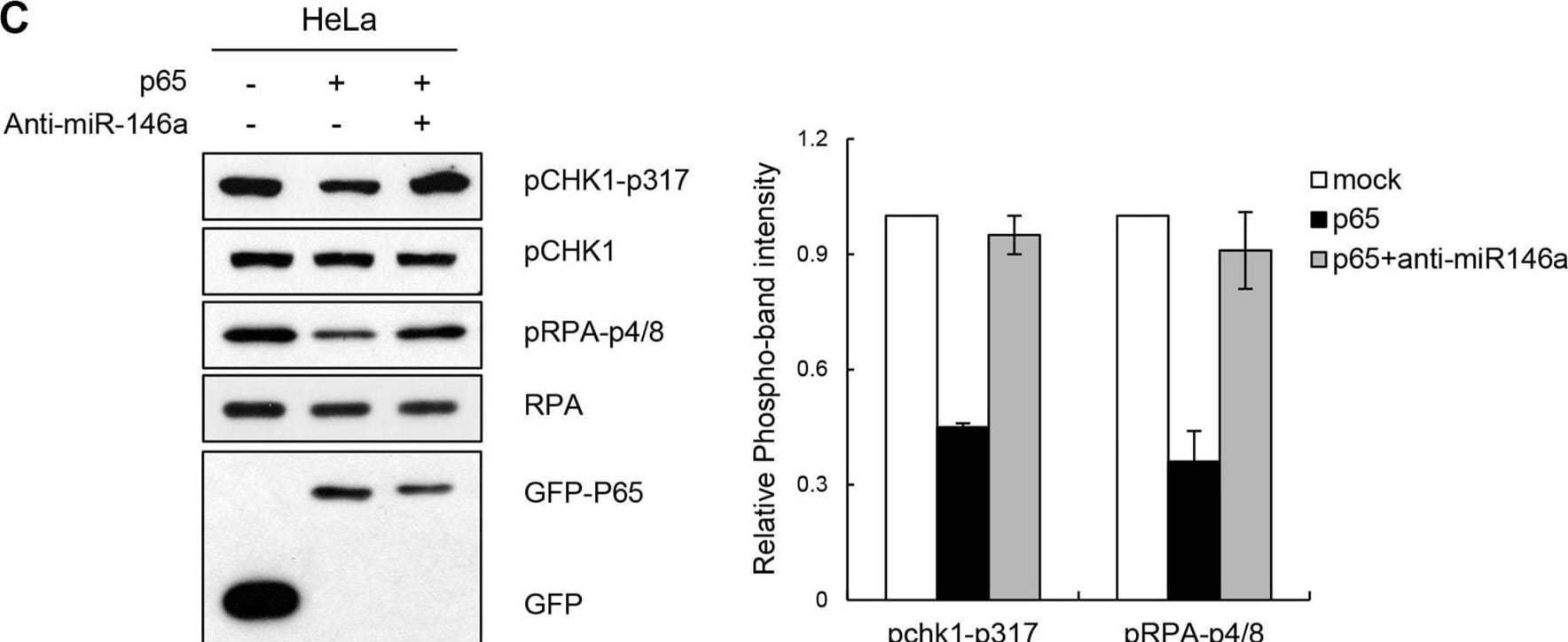
Detection of Phospho-Chk1 (S317) by Western Blot
NF-kappa B reiterating miR146a function in the FA pathway and replication fork restart(A) Two days after transfection of cells with p65 cDNA and anti-miR146a in combination as indicated, cells were treated with 5 mM HU for 5 h. The levels of FANCM and p63 proteins, and FANCD2 ubiquitination were measured by western blotting. (B) After undergoing the same treatment as (A) HeLa cells were analyzed for FANCD2 foci formation. Results are shown as the mean ± SD (n = 3); **P < 0.01. (C) Under the same conditions described in (A) cell lysates were analyzed by western blotting with antibodies against pCHK1-S317, CHK1, pRPA-S4/8, RPA, and GFP. Right, quantitation of pCHK1-S317 and pRPA-S4/8 expression. Results are shown as the mean ± SD (n = 3). (D) GES-1 cells transfected with p65 construct were applied to DNA fiber analysis. Resulting images of DNA fibers of p65-overexpressing cells compared with control cells (top). CldU tract length distribution was determined (bottom). (E) HeLa or GES-1 cells with the same treatment as A were subjected to gamma -H2AX detection. Results are shown as the mean ± SD (n = 3); **P < 0.01. (F) HeLa and GES-1 cells were transfected with p65 construct and Anti-miR146a in combinations as indicated and were treated with different doses of HU for 5 hr. Cell survival thereafter was measured using clonogenic survival assay. Results are shown as the mean ± SD (n = 3); **P < 0.01. Image collected and cropped by CiteAb from the following open publication (https://pubmed.ncbi.nlm.nih.gov/27351285), licensed under a CC-BY license. Not internally tested by R&D Systems.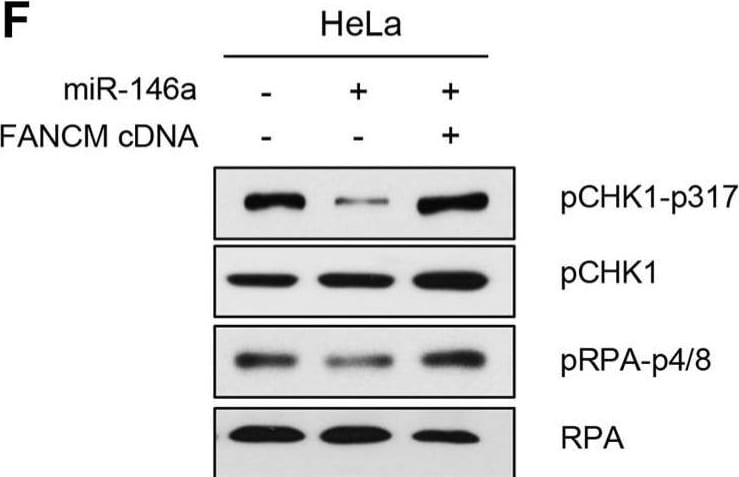
Detection of Phospho-Chk1 (S317) by Western Blot
Effect of miR146a on FANCD2 monoubiquitination and the FA pathway(A and B) HeLa cells were transfected with miR146a in the absence or presence of anti-miR146a (A) or miR146a-insensitive FANCM cDNA (B). After a 48 h transfection, the cells were treated with 5 mM HU for 5 h. The protein levels of FANCM and FANCD2 were measured by western blotting. Monoubiquitinated FANCD2 is indicated as the upper band of doublet protein bands corresponding to FANCD2. (C and D) After HeLa cells underwent the same treatment as (A and B) cells were analyzed for FANCD2 foci formation. DAPI was used for nuclear staining. Results are shown as the mean ± SD (n = 3); **P < 0.01. (E and F) Indicated cells were treated with 5 mM HU for 5 hr. Cell lysates were analyzed by Western blotting with antibodies against pCHK1-S317, CHK1, pRPA-S4/8, and RPA. Image collected and cropped by CiteAb from the following open publication (https://pubmed.ncbi.nlm.nih.gov/27351285), licensed under a CC-BY license. Not internally tested by R&D Systems.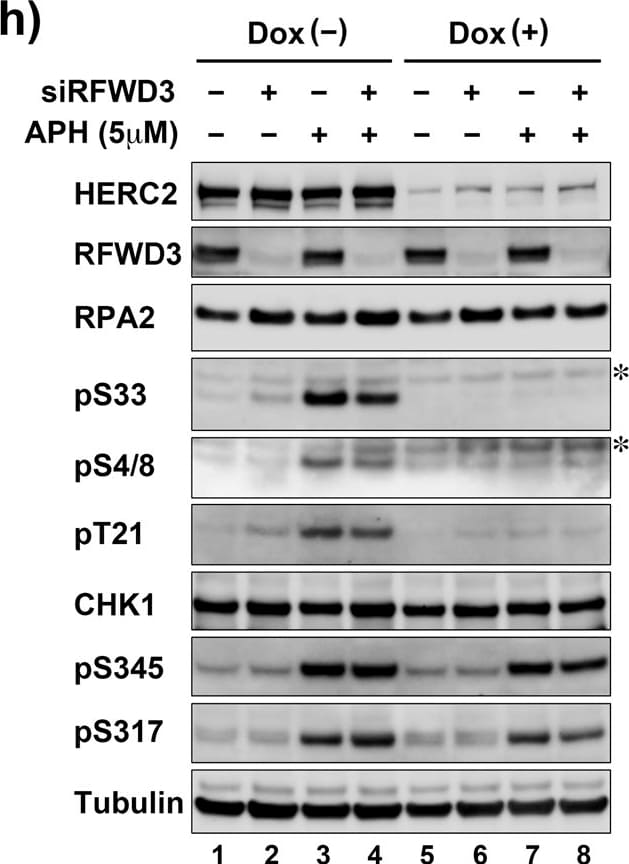
Detection of Phospho-Chk1 (S317) by Western Blot
Depletion of HERC2 inhibit ATR-mediated phosphorylation of RPA2 induced by low-level replication stress. (a–d) HeLa-shHERC2 cells were induced or not with Dox, treated or not with the indicated genotoxic agents, and subjected to immunoblotting with the indicated antibodies. (e–h) HeLa-shHERC2 cells were transfected with siRNA specific to ATR (e,f) or RFWD3 (g,h) induced or not with Dox, treated or not with indicated concentration of HU (e,g) or APH (f,h), and subjected to immunoblotting with the indicated antibodies. The asterisks indicates non-specific bands. Image collected and cropped by CiteAb from the following open publication (https://pubmed.ncbi.nlm.nih.gov/31582797), licensed under a CC-BY license. Not internally tested by R&D Systems.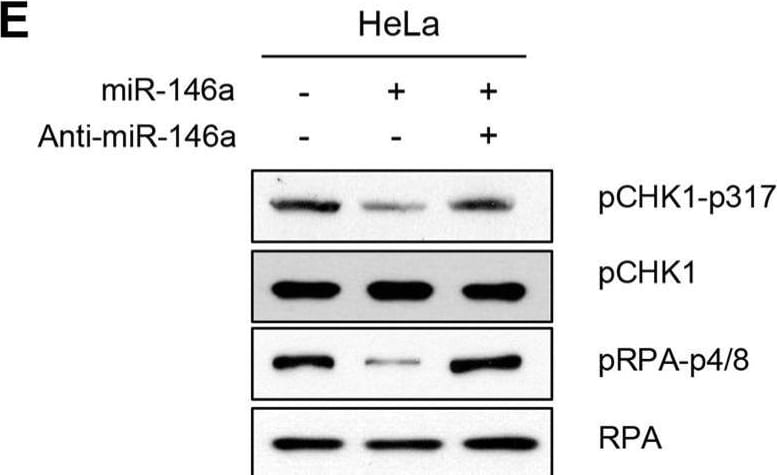
Detection of Phospho-Chk1 (S317) by Western Blot
Effect of miR146a on FANCD2 monoubiquitination and the FA pathway(A and B) HeLa cells were transfected with miR146a in the absence or presence of anti-miR146a (A) or miR146a-insensitive FANCM cDNA (B). After a 48 h transfection, the cells were treated with 5 mM HU for 5 h. The protein levels of FANCM and FANCD2 were measured by western blotting. Monoubiquitinated FANCD2 is indicated as the upper band of doublet protein bands corresponding to FANCD2. (C and D) After HeLa cells underwent the same treatment as (A and B) cells were analyzed for FANCD2 foci formation. DAPI was used for nuclear staining. Results are shown as the mean ± SD (n = 3); **P < 0.01. (E and F) Indicated cells were treated with 5 mM HU for 5 hr. Cell lysates were analyzed by Western blotting with antibodies against pCHK1-S317, CHK1, pRPA-S4/8, and RPA. Image collected and cropped by CiteAb from the following open publication (https://pubmed.ncbi.nlm.nih.gov/27351285), licensed under a CC-BY license. Not internally tested by R&D Systems.Applications for phospho-Chk1 (S317) Antibody
Application
Recommended Usage
Simple Western
10 µg/mL
Sample: HeLa human cervical epithelial carcinoma cell line treated with ultraviolet light (UV)
Sample: HeLa human cervical epithelial carcinoma cell line treated with ultraviolet light (UV)
Western Blot
1 µg/mL
Sample: HeLa human cervical epithelial carcinoma cell line exposed to UV-C
Sample: HeLa human cervical epithelial carcinoma cell line exposed to UV-C
Formulation, Preparation, and Storage
Purification
Antigen Affinity-purified
Reconstitution
Reconstitute at 0.2 mg/mL in sterile PBS. For liquid material, refer to CoA for concentration.
Loading...
Formulation
Lyophilized from a 0.2 μm filtered solution in PBS with Trehalose. *Small pack size (SP) is supplied either lyophilized or as a 0.2 µm filtered solution in PBS.
Shipping
Lyophilized product is shipped at ambient temperature. Liquid small pack size (-SP) is shipped with polar packs. Upon receipt, store immediately at the temperature recommended below.
Stability & Storage
Use a manual defrost freezer and avoid repeated freeze-thaw cycles.
- 12 months from date of receipt, -20 to -70 °C as supplied.
- 1 month, 2 to 8 °C under sterile conditions after reconstitution.
- 6 months, -20 to -70 °C under sterile conditions after reconstitution.
Calculators
Background: Chk1
Long Name
Checkpoint Kinase 1
Alternate Names
CHEK1
Gene Symbol
CHEK1
Additional Chk1 Products
Product Documents for phospho-Chk1 (S317) Antibody
Certificate of Analysis
To download a Certificate of Analysis, please enter a lot or batch number in the search box below.
Note: Certificate of Analysis not available for kit components.
Product Specific Notices for phospho-Chk1 (S317) Antibody
For research use only
Citations for phospho-Chk1 (S317) Antibody
 Powered by Bioz
Customer Reviews for phospho-Chk1 (S317) Antibody
There are currently no reviews for this product. Be the first to review phospho-Chk1 (S317) Antibody and earn rewards!
Have you used phospho-Chk1 (S317) Antibody?
Submit a review and receive an Amazon gift card!
$25/€18/£15/$25CAN/¥2500 for a review with an image
$10/€7/£6/$10CAN/¥1110 for a review without an image
Submit a review
Protocols
Find general support by application which include: protocols, troubleshooting, illustrated assays, videos and webinars.
- Cellular Response to Hypoxia Protocols
- R&D Systems Quality Control Western Blot Protocol
- Troubleshooting Guide: Western Blot Figures
- Western Blot Conditions
- Western Blot Protocol
- Western Blot Protocol for Cell Lysates
- Western Blot Troubleshooting
- Western Blot Troubleshooting Guide
- View all Protocols, Troubleshooting, Illustrated assays and Webinars
Loading...