
Netrins/UNC-6 (netr: Sanskrit for “one who guides”) are a family of laminin-related small proteins that are involved in neurite outgrowth and axon guidance. Netrins bind to the DCC and UNC5 family of receptors to attract or repel axons. Human Netrin-4 is synthesized as a 628 amino acid (aa) precursor that contains a 19 aa signal sequence, a 443 aa laminin-related region containing an N-terminal laminin globular domain (domain VI) followed by 3 laminin EGF-like repeats, and a 166 aa C‑terminal domain rich in basic aa residues that serves as a heparin binding site. Unlike human Netrin-1 which is reminiscent of the laminin gamma -chain, human Netrin-4 resembles the laminin beta -chain. Netrin-4 has been reported to exist as both a monomer and a dimer. The dimeric form was reported to be the less active of the two. Human Netrin-4 shares 31%, 29% and 25% aa sequence identity with human Netrin-1, 2 and G2, respectively; it shares 89% aa identity with mouse Netrin-4. Netrin-4 has widespread expression, occurring in nervous tissues such as embryonic floor plate and postnatal neurons such as cerebellar granule cells and hippocampal pyramidal cells. It also is found in non-neural tissues, such as adult Bowman’s capsule and medullary tubular epithelium in kidney, and embryonic pancreatic and intestinal epithelium, plus cells of the ureteric bud. Netrin-4 expression is often associated with basement membrane. Netrin-4 has been shown to initiate axon outgrowth from olfactory bulb explants (1‑7).
Human Netrin-4 Antibody
R&D Systems | Catalog # AF1254

Scientific images may be resized, cropped, or adjusted for brightness or contrast for presentation purposes. These updates are limited to presentation and do not affect the underlying scientific interpretation of the data. Where available, additional source data may be provided upon request.
Key Product Details
Species Reactivity
Validated:
Cited:
Applications
Validated:
Cited:
Label
Antibody Source
Product Specifications
Immunogen
Val26-Lys628
Accession # Q9HB63
Specificity
Clonality
Host
Isotype
Scientific Data Images for Human Netrin-4 Antibody
Detection of Human Netrin-4 by Immunohistochemistry
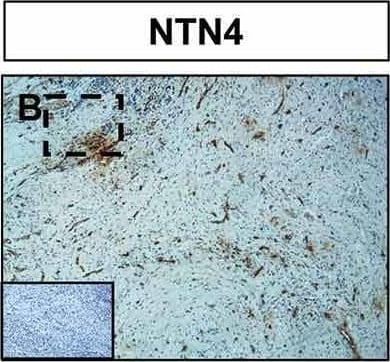
Immunohistochemistry of NTN4 expression within NB. Representative light microscopy images of a neuroblastoma sample from a female patient (age > 18M); tumor with retroperotineal location and in disseminated stage. (a) Hematoxylin and eosin staining reveals presence of ganglionar-differentiated cells (yellow arrowhead) and primitive neuroblasts (yellow asterisk). (b) Immunohistochemistry of NTN4 with its corresponding negative control (inset). (c) PCNA staining. (d) NTN4 is expressed preferentially in the endothelium (yellow arrows), as confirmed by CD31 staining (inset). (e) Detail of ganglionar-differentiated cells with strong NTN4 cytoplasmic expression in a characteristic punctuated pattern (yellow arrowhead). (f) Close up image of (b) as indicated, highlighting NTN4 expression within the stroma (yellow asterisk). A, B, C; Scale bar = 40 μm. D, E, F; Scale bar = 10 μm; inset = 10 μm. Image collected and cropped by CiteAb from the following open publication (https://pubmed.ncbi.nlm.nih.gov/30160193), licensed under a CC-BY license. Not internally tested by R&D Systems.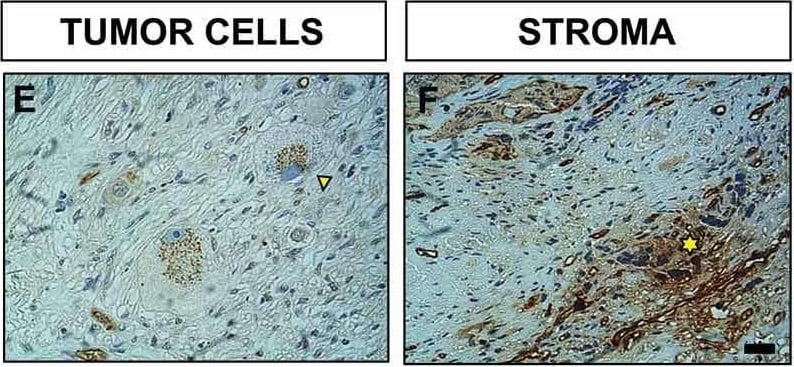
Detection of Human Netrin-4 by Immunohistochemistry
Immunohistochemistry of NTN4 expression within NB. Representative light microscopy images of a neuroblastoma sample from a female patient (age > 18M); tumor with retroperotineal location and in disseminated stage. (a) Hematoxylin and eosin staining reveals presence of ganglionar-differentiated cells (yellow arrowhead) and primitive neuroblasts (yellow asterisk). (b) Immunohistochemistry of NTN4 with its corresponding negative control (inset). (c) PCNA staining. (d) NTN4 is expressed preferentially in the endothelium (yellow arrows), as confirmed by CD31 staining (inset). (e) Detail of ganglionar-differentiated cells with strong NTN4 cytoplasmic expression in a characteristic punctuated pattern (yellow arrowhead). (f) Close up image of (b) as indicated, highlighting NTN4 expression within the stroma (yellow asterisk). A, B, C; Scale bar = 40 μm. D, E, F; Scale bar = 10 μm; inset = 10 μm. Image collected and cropped by CiteAb from the following open publication (https://pubmed.ncbi.nlm.nih.gov/30160193), licensed under a CC-BY license. Not internally tested by R&D Systems.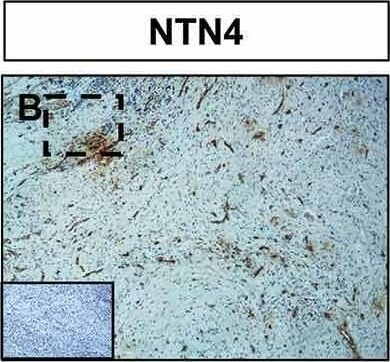
Detection of Human Netrin-4 by Immunohistochemistry
Immunohistochemistry of NTN4 expression within NB. Representative light microscopy images of a neuroblastoma sample from a female patient (age > 18M); tumor with retroperotineal location and in disseminated stage. (a) Hematoxylin and eosin staining reveals presence of ganglionar-differentiated cells (yellow arrowhead) and primitive neuroblasts (yellow asterisk). (b) Immunohistochemistry of NTN4 with its corresponding negative control (inset). (c) PCNA staining. (d) NTN4 is expressed preferentially in the endothelium (yellow arrows), as confirmed by CD31 staining (inset). (e) Detail of ganglionar-differentiated cells with strong NTN4 cytoplasmic expression in a characteristic punctuated pattern (yellow arrowhead). (f) Close up image of (b) as indicated, highlighting NTN4 expression within the stroma (yellow asterisk). A, B, C; Scale bar = 40 μm. D, E, F; Scale bar = 10 μm; inset = 10 μm. Image collected and cropped by CiteAb from the following open publication (https://pubmed.ncbi.nlm.nih.gov/30160193), licensed under a CC-BY license. Not internally tested by R&D Systems.Applications for Human Netrin-4 Antibody
Immunohistochemistry
Sample: Immersion fixed paraffin-embedded sections of human kidney
Western Blot
Sample: Recombinant Human Netrin‑4 (Catalog # 1254-N4)
Formulation, Preparation, and Storage
Purification
Reconstitution
Reconstitute at 0.2 mg/mL in sterile PBS. For liquid material, refer to CoA for concentration.
Formulation
Shipping
Stability & Storage
- 12 months from date of receipt, -20 to -70 °C as supplied.
- 1 month, 2 to 8 °C under sterile conditions after reconstitution.
- 6 months, -20 to -70 °C under sterile conditions after reconstitution.
Calculators
Background: Netrin-4
References
- McFarlane, S. (2000) Biochem. Cell. Biol. 78:563.
- Kennedy, T.E. (2000) Biochem. Cell Biol. 78:569.
- Yu, T.W. and C.I. Bargmann (2001) Nature Neurosci. 4(Suppl):1169.
- Stein, E. et al. (2001) Science 291:1976.
- Koch, M. et al. (2000) J. Cell Biol. 151:221.
- Yin, Y. et al. (2000) Mech. Dev. 96:115.
- Livesey, F.J. (1999) Cell. Mol. Life Sci. 56:62.
Alternate Names
Gene Symbol
UniProt
Additional Netrin-4 Products
Product Documents for Human Netrin-4 Antibody
Certificate of Analysis
To download a Certificate of Analysis, please enter a lot or batch number in the search box below.
Note: Certificate of Analysis not available for kit components.
Product Specific Notices for Human Netrin-4 Antibody
This product or the use of this product is covered by U.S. Patents owned by The Regents of the University of California. This product is for research use only and is not to be used for commercial purposes. Use of this product to produce products for sale or for diagnostic, therapeutic or drug discovery purposes is prohibited. In order to obtain a license to use this product for such purposes, contact The Regents of the University of California.
U.S. Patent # 5,824,775, 6,218,526, and other U.S. and international patents pending.
For research use only
Citations for Human Netrin-4 Antibody
 Powered by Bioz
Customer Reviews for Human Netrin-4 Antibody
There are currently no reviews for this product. Be the first to review Human Netrin-4 Antibody and earn rewards!
Have you used Human Netrin-4 Antibody?
Submit a review and receive an Amazon gift card!
$25/€18/£15/$25CAN/¥2500 for a review with an image
$10/€7/£6/$10CAN/¥1110 for a review without an image
Submit a review
Protocols
Find general support by application which include: protocols, troubleshooting, illustrated assays, videos and webinars.
- Antigen Retrieval Protocol (PIER)
- Antigen Retrieval for Frozen Sections Protocol
- Appropriate Fixation of IHC/ICC Samples
- Cellular Response to Hypoxia Protocols
- Chromogenic IHC Staining of Formalin-Fixed Paraffin-Embedded (FFPE) Tissue Protocol
- Chromogenic Immunohistochemistry Staining of Frozen Tissue
- ClariTSA™ Fluorophore Kits
- Detection & Visualization of Antibody Binding
- Fluorescent IHC Staining of Frozen Tissue Protocol
- Graphic Protocol for Heat-induced Epitope Retrieval
- Graphic Protocol for the Preparation and Fluorescent IHC Staining of Frozen Tissue Sections
- Graphic Protocol for the Preparation and Fluorescent IHC Staining of Paraffin-embedded Tissue Sections
- Graphic Protocol for the Preparation of Gelatin-coated Slides for Histological Tissue Sections
- IHC Sample Preparation (Frozen sections vs Paraffin)
- Immunofluorescent IHC Staining of Formalin-Fixed Paraffin-Embedded (FFPE) Tissue Protocol
- Immunohistochemistry (IHC) and Immunocytochemistry (ICC) Protocols
- Immunohistochemistry Frozen Troubleshooting
- Immunohistochemistry Paraffin Troubleshooting
- Preparing Samples for IHC/ICC Experiments
- Preventing Non-Specific Staining (Non-Specific Binding)
- Primary Antibody Selection & Optimization
- Protocol for Heat-Induced Epitope Retrieval (HIER)
- Protocol for Making a 4% Formaldehyde Solution in PBS
- Protocol for VisUCyte™ HRP Polymer Detection Reagent
- Protocol for the Preparation & Fixation of Cells on Coverslips
- Protocol for the Preparation and Chromogenic IHC Staining of Frozen Tissue Sections
- Protocol for the Preparation and Chromogenic IHC Staining of Frozen Tissue Sections - Graphic
- Protocol for the Preparation and Chromogenic IHC Staining of Paraffin-embedded Tissue Sections
- Protocol for the Preparation and Chromogenic IHC Staining of Paraffin-embedded Tissue Sections - Graphic
- Protocol for the Preparation and Fluorescent IHC Staining of Frozen Tissue Sections
- Protocol for the Preparation and Fluorescent IHC Staining of Paraffin-embedded Tissue Sections
- Protocol for the Preparation of Gelatin-coated Slides for Histological Tissue Sections
- R&D Systems Quality Control Western Blot Protocol
- TUNEL and Active Caspase-3 Detection by IHC/ICC Protocol
- The Importance of IHC/ICC Controls
- Troubleshooting Guide: Immunohistochemistry
- Troubleshooting Guide: Western Blot Figures
- Western Blot Conditions
- Western Blot Protocol
- Western Blot Protocol for Cell Lysates
- Western Blot Troubleshooting
- Western Blot Troubleshooting Guide
- View all Protocols, Troubleshooting, Illustrated assays and Webinars