
PSP94 (prostate secretory protein of 94 amino acids; also named beta -MSP) is a secreted, non-glycosylated member of the beta -microseminoprotein family (1). The 94 amino acid (aa) mature PSP94 contains no classic motifs or domains, but does have ten Cys that are conserved across species (1, 2). It is expressed in mucoid secretions, but its function is unknown (2, 3). PSP94 is abundant in prostatic fluid, which is the exclusive source in rodents (4). Gastric and respiratory secretory epithelia are also significant sources in humans (2, 3). Human PSP94 circulates bound to a 71 kDa PSP binding protein, possibly disulfide-linked (5). The seminal fluid protein CRISP-3 can also bind PSP94 (6). PSP94 has been proposed as an alternative to PSA as a serum marker for prostate cancer. When total (bound plus free) PSP94 is considered, its secretion is found to be down-regulated in cancer cells, creating below normal circulating levels (7, 8). Its size is predicted at 11 kDa, but may appear to be 16 kDa due to anomalous migration (3). A 61 aa variant, formed by C-terminal proteolysis, is increased in prostate secretions from patients with benign prostatic hyperplasia (9). A prostate-specific alternate splice form shows a substitution of 41 aa for the C-terminal 78 aa (10). Mature human PSP94 shares 53%, 46%, 43%, and 42% aa identity with porcine, rat, mouse, and chicken PSP94, respectively. Most of the ten primate sequences available show less than 80% aa identity. PSP94 has been proposed as a species barrier protein due to its low evolutionary conservation and abundance in seminal fluid (11).

Scientific images may be resized, cropped, or adjusted for brightness or contrast for presentation purposes. These updates are limited to presentation and do not affect the underlying scientific interpretation of the data. Where available, additional source data may be provided upon request.
Key Product Details
Species Reactivity
Applications
Label
Antibody Source
Product Specifications
Immunogen
Ser21-Ile114
Accession # P08118
Specificity
Clonality
Host
Isotype
Scientific Data Images for Human PSP94/MSMB Antibody
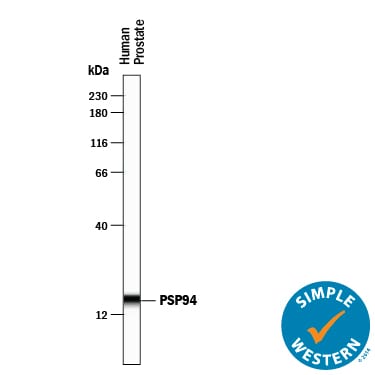
Detection of Human PSP94/MSMB by Simple WesternTM.
Simple Western lane view shows lysates of human prostate tissue, loaded at 0.2 mg/mL. A specific band was detected for PSP94/MSMB at approximately 17 kDa (as indicated) using 10 µg/mL of Goat Anti-Human PSP94/MSMB Antigen Affinity-purified Polyclonal Antibody (Catalog # AF3780) followed by 1:50 dilution of HRP-conjugated Anti-Goat IgG Secondary Antibody (Catalog # HAF109). This experiment was conducted under reducing conditions and using the 12-230 kDa separation system.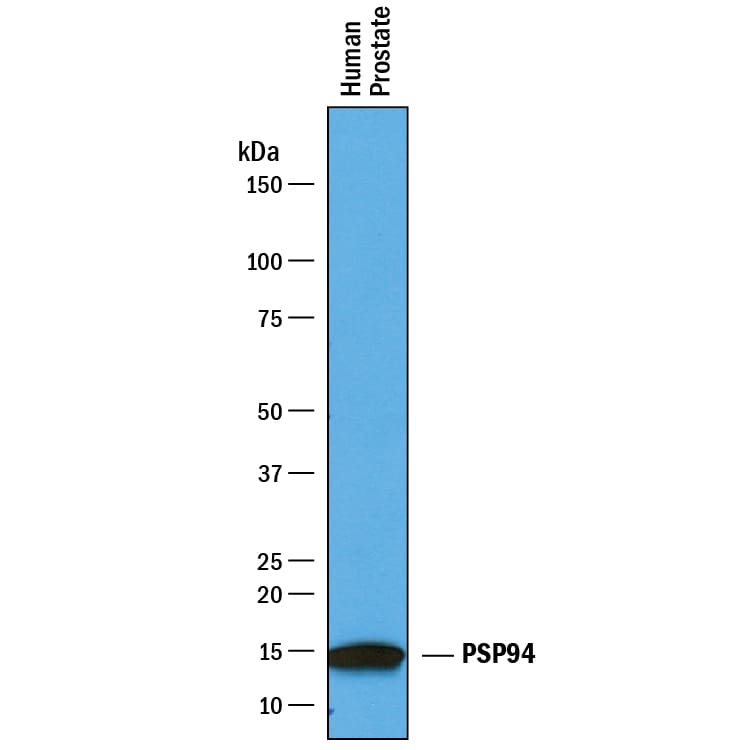
Detection of Human PSP94/MSMB by Western Blot.
Western blot shows lysates of human prostate tissue. PVDF membrane was probed with 1 µg/mL of Goat Anti-Human PSP94/MSMB Antigen Affinity-purified Polyclonal Antibody (Catalog # AF3780) followed by HRP-conjugated Anti-Goat IgG Secondary Antibody (Catalog # HAF019). A specific band was detected for PSP94/MSMB at approximately 13 kDa (as indicated). This experiment was conducted under reducing conditions and using Immunoblot Buffer Group 1.Applications for Human PSP94/MSMB Antibody
Simple Western
Sample: Human prostate tissue
Western Blot
Sample: Human prostate tissue
Formulation, Preparation, and Storage
Purification
Reconstitution
Reconstitute at 0.2 mg/mL in sterile PBS. For liquid material, refer to CoA for concentration.
Formulation
Shipping
Stability & Storage
- 12 months from date of receipt, -20 to -70 °C as supplied.
- 1 month, 2 to 8 °C under sterile conditions after reconstitution.
- 6 months, -20 to -70 °C under sterile conditions after reconstitution.
Calculators
Background: PSP94/MSMB
References
- Seidah, N.G. et al. (1984) FEBS Lett. 175:349.
- Ulvsback, M. et al. (1989) Biochem. Biophys. Res. Comm. 164:1310.
- Weiber, H. et al. (1990) Am. J. Pathol. 137:593.
- Thota, A. et al. (2003) J. Cell. Biochem. 88:999.
- Wu, D. et al. (1999) J. Cell. Biochem. 76:71.
- Udby, L. et al. (2005) Biochem. Biophys. Res. Comm. 333:555.
- Reeves, J.R. et al. (2005) Biochem. J. 385:105.
- Nam, R.K. et al. (2006) J. Urol. 175:1291.
- Xu, K. et al. (2003) Electrophoresis 24:1311.
- Xuan, J.W. et al. (1995) Oncogene 11:1041.
- Xuan, J.W. et al. (1999) DNA Cell Biol. 18:11.
Long Name
Alternate Names
Gene Symbol
UniProt
Additional PSP94/MSMB Products
Product Documents for Human PSP94/MSMB Antibody
Certificate of Analysis
To download a Certificate of Analysis, please enter a lot or batch number in the search box below.
Note: Certificate of Analysis not available for kit components.
Product Specific Notices for Human PSP94/MSMB Antibody
For research use only
Related Research Areas
Customer Reviews for Human PSP94/MSMB Antibody
There are currently no reviews for this product. Be the first to review Human PSP94/MSMB Antibody and earn rewards!
Have you used Human PSP94/MSMB Antibody?
Submit a review and receive an Amazon gift card!
$25/€18/£15/$25CAN/¥2500 for a review with an image
$10/€7/£6/$10CAN/¥1110 for a review without an image
Submit a review
Protocols
Find general support by application which include: protocols, troubleshooting, illustrated assays, videos and webinars.
- Cellular Response to Hypoxia Protocols
- R&D Systems Quality Control Western Blot Protocol
- Troubleshooting Guide: Western Blot Figures
- Western Blot Conditions
- Western Blot Protocol
- Western Blot Protocol for Cell Lysates
- Western Blot Troubleshooting
- Western Blot Troubleshooting Guide
- View all Protocols, Troubleshooting, Illustrated assays and Webinars