
SREBP2 (Sterol Regulatory Element-Binding Protein 2; also bHLHD2 and SREBF2) is a 120-125 kDa member of the SREBP family of proteins. It is ubiquitously expressed and found in the intracellular membrane fraction of cells. SREBP2 is a transcriptional factor initially embedded in the ER as an inactive precursor associated with SCAP. When necessary, SCAP mediates SREBP2 transfer to the Golgi, where two resident proteases remove the N-terminus from SREBP2, and the N-terminus is transported into the nucleus. Here, SREBP2 acts as a transcription factor, activating the LDLR and cholesterol synthesis genes. The human SREBP2 precursor is an 1141 amino acid (aa) two transmembrane protein whose N- and C-termini are cytoplasmic. The two cytoplasmic domains span aa 1-479 and 555-1141, respectively. Proteolytic cleavage between Leu484-Cys485 generates the 64-66 kDa SREBP2 transcription factor. This fragment contains a bHLH DNA binding domain (aa 330-380) and one Leu zipper region (aa 381-401). Homodimerization of SREBP2 is necessary for nuclear translocation. There is one potential isoform that shows a deletion of aa 274-276 coupled to a 96 aa substitution for aa 580-1141. A second isoform (known in rodent) shows a premature truncation after Val463 and runs at 55 kDa in SDS-PAGE. Over aa 242-450, human SREBP2 shares 97% aa identity with mouse SREBP2.
Human SREBP2 Antibody
R&D Systems | Catalog # AF7119

Scientific images may be resized, cropped, or adjusted for brightness or contrast for presentation purposes. These updates are limited to presentation and do not affect the underlying scientific interpretation of the data. Where available, additional source data may be provided upon request.
Key Product Details
Validated by
Species Reactivity
Validated:
Cited:
Applications
Validated:
Cited:
Label
Antibody Source
Product Specifications
Immunogen
Leu242-Asp450
Accession # Q12772
Specificity
Clonality
Host
Isotype
Scientific Data Images for Human SREBP2 Antibody
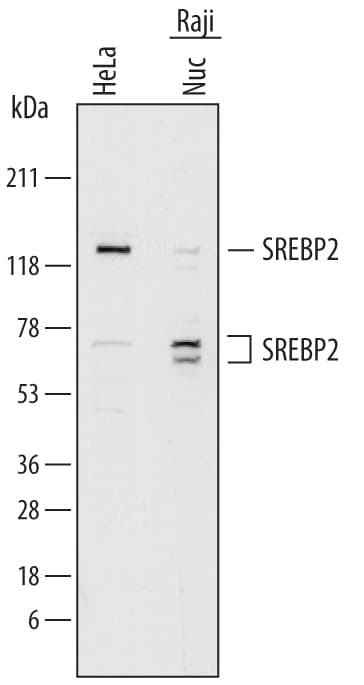
Detection of Human SREBP2 by Western Blot.
Western blot shows lysates of HeLa human cervical epithelial carcinoma cell line and Raji human Burkitt's lymphoma cell line. Gels were loaded with 15 µg of nuclear extracts (Nuc). PVDF membrane was probed with 2 µg/mL of Goat Anti-Human SREBP2 Antigen Affinity-purified Polyclonal Antibody (Catalog # AF7119) followed by HRP-conjugated Anti-Goat IgG Secondary Antibody (Catalog # HAF017). Specific bands were detected for SREBP2 at approximately 125 kDa and 60-70 kDa (as indicated). This experiment was conducted under reducing conditions and using Immunoblot Buffer Group 1.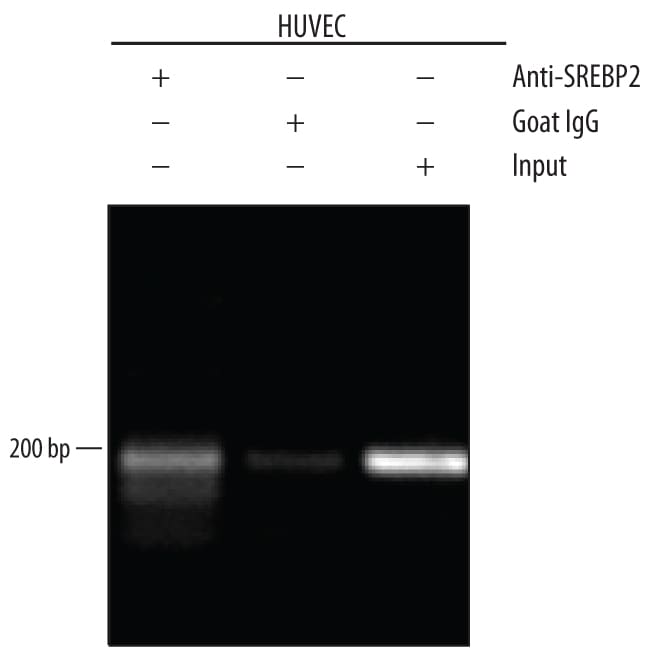
Detection of SREBP2-regulated Genes by Chromatin Immunoprecipitation.
HUVEC human umbilical vein endothelial cells were serum-starved for 5 hours, fixed using formaldehyde, resuspended in lysis buffer, and sonicated to shear chromatin. SREBP2/DNA complexes were immuno-precipitated using 5 µg Goat Anti-Human SREBP2 Antigen Affinity-purified Polyclonal Antibody (Catalog # AF7119) or control antibody (Catalog # AB-108-C) for 15 minutes in an ultrasonic bath, followed by Biotinylated Anti-Goat IgG Secondary Antibody (Catalog # BAF109). Immuno-complexes were captured using 50 µL of MagCellect Streptavidin Ferrofluid (Catalog # MAG999) and DNA was purified using chelating resin solution. TheABCA1promoter was detected by standard PCR. In the figure, "Input" represents total cell lysate DNA.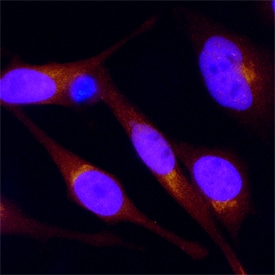
SREBP2 in HeLa Human Cell Line.
SREBP2 was detected in immersion fixed HeLa human cervical epithelial carcinoma cell line using Goat Anti-Human SREBP2 Antigen Affinity-purified Polyclonal Antibody (Catalog # AF7119) at 15 µg/mL for 3 hours at room temperature. Cells were stained using the NorthernLights™ 557-conjugated Anti-Goat IgG Secondary Antibody (red; Catalog # NL001) and counterstained with DAPI (blue). Specific staining was localized to cytoplasm. View our protocol for Fluorescent ICC Staining of Cells on Coverslips.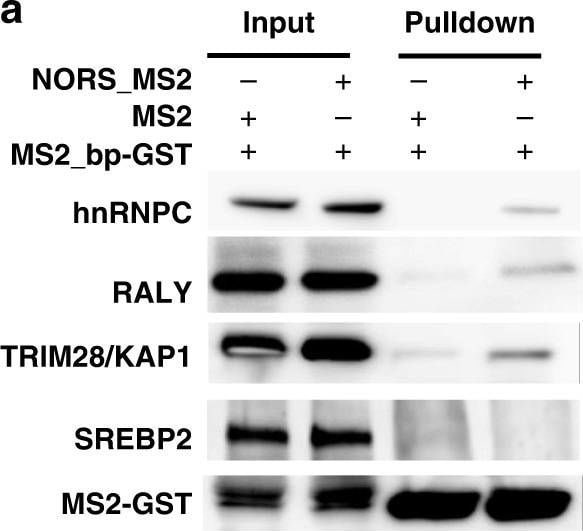
Detection of Human SREBP2 by Western Blot
lincNORS regulates cholesterol synthesis via interaction with RALY.a The level of hnRNPC, RALY, TRIM28, SREBP2, and MS2-GST in the MS2 pulldown material and input lysate was detected by western blot. The data presented are a representative image from two to three independent experiments. b Subcellular location of RALY was detected by western blot. Tubulin, Lamin-B1, and acetyl-histone H3 were included as controls for cytoplasmic, nuclear, and chromatin-associated fractions. A representative image from three independent experiments is shown. c RNA immunoprecipitation (RIP) analysis of RALY. The presence of lincNORS and 18s rRNA in the precipitated complex was detected by qPCR. Data represent mean ± SD from three biological replicates (two-sided Student’s t-test). d qPCR analysis of NORS, MSMO1, and SQLE expression in MCF-7 cells transfected with control, lincNORS siRNA, and/or RALY siRNA. Data represent mean ± SD from four biological replicates (two-sided Student’s t-test). RALY knockdown was confirmed by western blot in each experiment and a representative image is shown on the right. e Enrichment of RNA of cholesterol synthesis genes in RALY-containing immunoprecipitated complex. The barplot displays the mean fold enrichment ± S.E.M. from three independent RALY RIP-Seq vs control experiments in MCF7 cells. The statistical significance of the enrichment was determined with CuffDiff v2.2.1 (*FDR < 0.05, **FDR < 0.01, ***FDR < 0.001). Source data are provided as a Source Data file. f Enrichment of MSMO1, SQLE, H1FX, and GAPDH in RALY-containing immunoprecipitated complex after lincNORS or hnRNPC knockdown was detected by qPCR. Data represent mean ± SD from four biological replicates (two-sided Student’s t-test). Image collected and cropped by CiteAb from the following publication (https://pubmed.ncbi.nlm.nih.gov/32958772), licensed under a CC-BY license. Not internally tested by R&D Systems.Applications for Human SREBP2 Antibody
Chromatin Immunoprecipitation (ChIP)
Immunocytochemistry
Sample: Immersion fixed HeLa human cervical epithelial carcinoma cell line
Western Blot
Sample: HeLa human cervical epithelial carcinoma cell line and Raji human Burkitt's lymphoma cell line
Formulation, Preparation, and Storage
Purification
Reconstitution
Sterile PBS to a final concentration of 0.2 mg/mL. For liquid material, refer to CoA for concentration.
Formulation
Shipping
Stability & Storage
- 12 months from date of receipt, -20 to -70 °C as supplied.
- 1 month, 2 to 8 °C under sterile conditions after reconstitution.
- 6 months, -20 to -70 °C under sterile conditions after reconstitution.
Calculators
Background: SREBP2
Long Name
Alternate Names
Gene Symbol
UniProt
Additional SREBP2 Products
Product Documents for Human SREBP2 Antibody
Certificate of Analysis
To download a Certificate of Analysis, please enter a lot or batch number in the search box below.
Note: Certificate of Analysis not available for kit components.
Product Specific Notices for Human SREBP2 Antibody
For research use only
Citations for Human SREBP2 Antibody
 Powered by Bioz
Customer Reviews for Human SREBP2 Antibody
There are currently no reviews for this product. Be the first to review Human SREBP2 Antibody and earn rewards!
Have you used Human SREBP2 Antibody?
Submit a review and receive an Amazon gift card!
$25/€18/£15/$25CAN/¥2500 for a review with an image
$10/€7/£6/$10CAN/¥1110 for a review without an image
Submit a review
Protocols
Find general support by application which include: protocols, troubleshooting, illustrated assays, videos and webinars.
- Appropriate Fixation of IHC/ICC Samples
- Cellular Response to Hypoxia Protocols
- ChIP Protocol Video
- Chromatin Immunoprecipitation (ChIP) Protocol
- Chromatin Immunoprecipitation Protocol
- ClariTSA™ Fluorophore Kits
- Detection & Visualization of Antibody Binding
- ICC Cell Smear Protocol for Suspension Cells
- ICC Immunocytochemistry Protocol Videos
- ICC for Adherent Cells
- Immunocytochemistry (ICC) Protocol
- Immunocytochemistry Troubleshooting
- Immunofluorescence of Organoids Embedded in Cultrex Basement Membrane Extract
- Immunohistochemistry (IHC) and Immunocytochemistry (ICC) Protocols
- Preparing Samples for IHC/ICC Experiments
- Preventing Non-Specific Staining (Non-Specific Binding)
- Primary Antibody Selection & Optimization
- Protocol for VisUCyte™ HRP Polymer Detection Reagent
- Protocol for the Fluorescent ICC Staining of Cell Smears - Graphic
- Protocol for the Fluorescent ICC Staining of Cultured Cells on Coverslips - Graphic
- Protocol for the Preparation and Fluorescent ICC Staining of Cells on Coverslips
- Protocol for the Preparation and Fluorescent ICC Staining of Non-adherent Cells
- Protocol for the Preparation and Fluorescent ICC Staining of Stem Cells on Coverslips
- Protocol for the Preparation of a Cell Smear for Non-adherent Cell ICC - Graphic
- R&D Systems Quality Control Western Blot Protocol
- TUNEL and Active Caspase-3 Detection by IHC/ICC Protocol
- The Importance of IHC/ICC Controls
- Troubleshooting Guide: Western Blot Figures
- Western Blot Conditions
- Western Blot Protocol
- Western Blot Protocol for Cell Lysates
- Western Blot Troubleshooting
- Western Blot Troubleshooting Guide
- View all Protocols, Troubleshooting, Illustrated assays and Webinars
Associated Pathways
