
Human TRAIL R2, also called DR5 and TRICK 2 is a type 1, TNF R family, membrane protein which is a receptor for TRAIL (APO2 ligand). In the new TNF superfamily nomenclature, TRAIL R2 is referred to as TNFRSF10B. TRAIL R2 cDNA encodes a 440 amino acid residue precursor protein containing extracellular cysteine-rich domains, a transmembrane domain and a cytoplasmic death domain. Among TNF receptor family proteins, TRAIL R2 is most closely related to TRAIL R1/DR4, sharing 55% amino acid sequence identity. Binding of trimeric TRAIL to TRAIL R2 induces apoptosis. The induction of apoptosis likely requires oligomerization of the receptor. The human TRAIL R2/Fc chimera neutralizes the ability of TRAIL to induce apoptosis. Besides TRAIL R2, an additional TRAIL R1/DR4, which tranduces apoptosis signaling, and two TRAIL decoy receptors, which antagonize TRAIL-induced apoptosis, have been reported.
Human TRAIL R2/TNFRSF10B Antibody (71903)
R&D Systems | Catalog # MAB631

Scientific images may be resized, cropped, or adjusted for brightness or contrast for presentation purposes. These updates are limited to presentation and do not affect the underlying scientific interpretation of the data. Where available, additional source data may be provided upon request.
Key Product Details
Validated by
Species Reactivity
Validated:
Cited:
Applications
Validated:
Cited:
Label
Antibody Source
Product Specifications
Immunogen
Met1-Glu182
Accession # CAG46696
Specificity
Clonality
Host
Isotype
Endotoxin Level
Scientific Data Images for Human TRAIL R2/TNFRSF10B Antibody (71903)
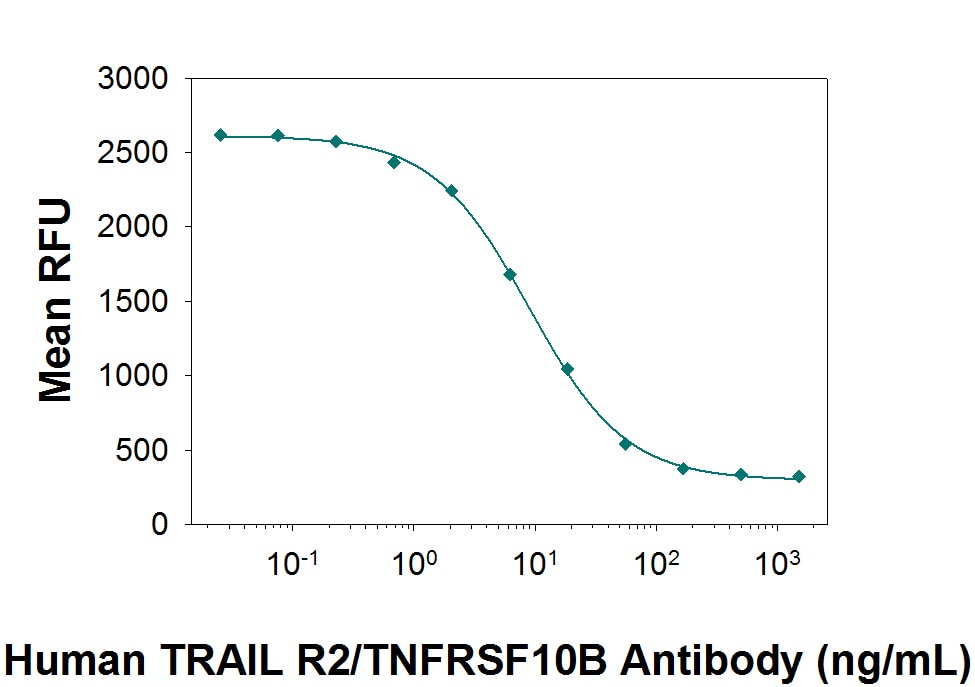
Human TRAIL R2/TNFRSF10B Antibody Induces Apoptosis of Jurkat Cells.
Human TRAIL R2/TNFRSF10B Monoclonal Antibody induces apoptosis of the Jurkat human acute T cell leukemia cell line in a dose-dependent manner, as measured by Resazurin (Catalog # AR002). The ED50 for this effect is typically 2-12 ng/mL.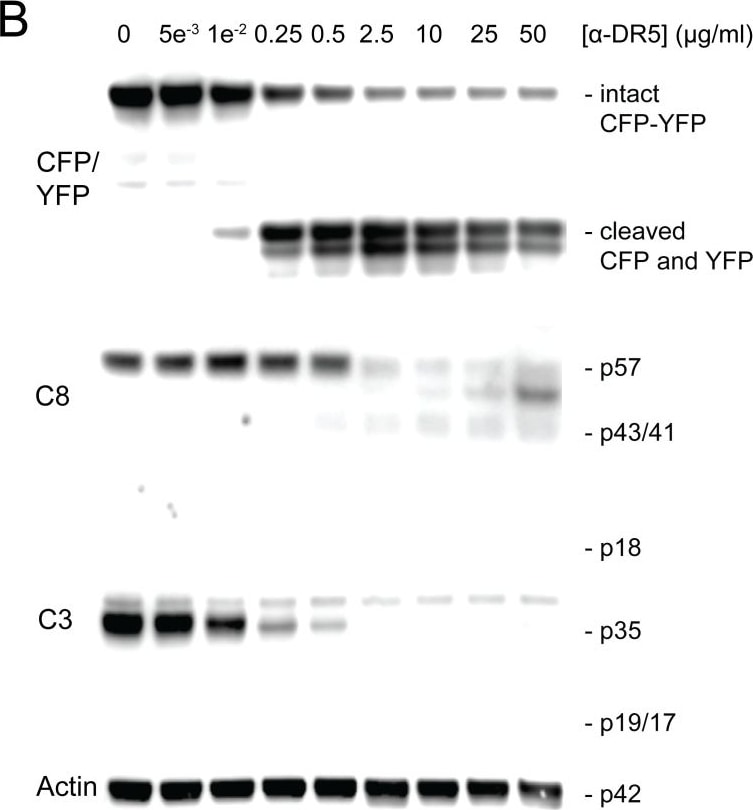
Detection of Human TRAILR2/TNFRSF10B by Western Blot
Cleavage of FRET probe is indicative of caspase activation.Cells were treated with (A) 0–300 ng/ml TRAIL for 2.5 hours or (B) 0–50 µg/ml anti-DR5 antibody for 20 h. The resultant cells were analyzed by western blotting using antibodies specific to caspase 3 (C3), caspase 8 (C8), and CFP/YFP. Image collected and cropped by CiteAb from the following publication (https://dx.plos.org/10.1371/journal.pone.0107010), licensed under a CC-BY license. Not internally tested by R&D Systems.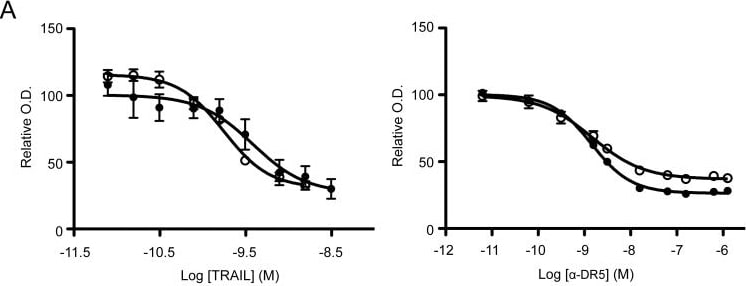
Detection of Human TRAILR2/TNFRSF10B by Functional
MB231_CFP-YFP cells retain sensitivity to TRAIL and anti-DR5 antibody.(A) Parental MB231 (filled black) and MB231_CFP-YFP (open clear) cells were treated with TRAIL (0–100 ng/ml) for 2.5 h or anti-DR5 antibody (0–200 µg/ml) for 20 h, at the indicated concentrations. Cell viability was determined by MTT assay. (B) Cells were treated as in A and analyzed for apoptosis by flow cytometry after staining with Annexin-V-APC and propidium iodide (PI). p-values were determined using a Student’s t-test. EC50 values were determined using nonlinear curve fitting as described in the Materials and Methods section. For each EC50 value, 95% confidence intervals reflecting the statistical accuracy are reported in Table 1. Image collected and cropped by CiteAb from the following publication (https://dx.plos.org/10.1371/journal.pone.0107010), licensed under a CC-BY license. Not internally tested by R&D Systems.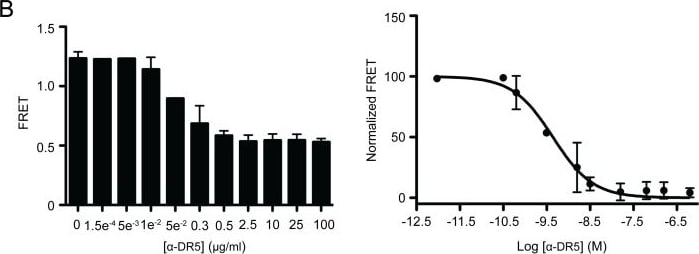
Detection of Human TRAILR2/TNFRSF10B by Functional
Cell-based FRET biosensor provides a quantifiable response to treatments of death receptor targeted cancer therapies.MB231_CFP-YFP cells were treated with (A) 0–300 ng/ml TRAIL for 2.5 h and (B) 0–100 µg/ml anti-DR5 antibody for 20 h. FRET was calculated and is represented using bar graphs on the left side of the panel. EC50 values were determined by nonlinear curve fitting to normalized FRET values plotted against the log values of TRAIL and anti-DR5 antibody concentration in molar (right side of the panel). (C) Confocal microscopy images showing changes in FRET in MB231_CFP-YFP cells treated with 0–25 ng/ml TRAIL for 2.5 h. A pronounced shift from YFP acceptor emission (yellow) to CFP donor emission (cyan) can be observed for cells treated with increasing concentration of TRAIL, with an excitation setting = 458 nm. Statistical analysis was performed as in Fig. 1 and 2. Image collected and cropped by CiteAb from the following publication (https://dx.plos.org/10.1371/journal.pone.0107010), licensed under a CC-BY license. Not internally tested by R&D Systems.Applications for Human TRAIL R2/TNFRSF10B Antibody (71903)
Agonist Activity
Sample: Jurkat human acute T cell leukemia cell line
Formulation, Preparation, and Storage
Purification
Reconstitution
Reconstitute at 0.5 mg/mL in sterile PBS. For liquid material, refer to CoA for concentration.
Formulation
Shipping
Stability & Storage
- 12 months from date of receipt, -20 to -70 °C as supplied.
- 1 month, 2 to 8 °C under sterile conditions after reconstitution.
- 6 months, -20 to -70 °C under sterile conditions after reconstitution.
Calculators
Background: TRAIL R2/TNFRSF10B
References
- Chaudhary, P.M. et al. (1997) Immunity 7:821.
- Walczak, H. et al. (1997) EMBO J. 16:5386.
- Golstein, P. (1997) Curr. Biol. 7:R750.
Long Name
Alternate Names
Gene Symbol
UniProt
Additional TRAIL R2/TNFRSF10B Products
Product Documents for Human TRAIL R2/TNFRSF10B Antibody (71903)
Certificate of Analysis
To download a Certificate of Analysis, please enter a lot or batch number in the search box below.
Note: Certificate of Analysis not available for kit components.
Product Specific Notices for Human TRAIL R2/TNFRSF10B Antibody (71903)
For research use only
Citations for Human TRAIL R2/TNFRSF10B Antibody (71903)
 Powered by Bioz
Customer Reviews for Human TRAIL R2/TNFRSF10B Antibody (71903)
There are currently no reviews for this product. Be the first to review Human TRAIL R2/TNFRSF10B Antibody (71903) and earn rewards!
Have you used Human TRAIL R2/TNFRSF10B Antibody (71903)?
Submit a review and receive an Amazon gift card!
$25/€18/£15/$25CAN/¥2500 for a review with an image
$10/€7/£6/$10CAN/¥1110 for a review without an image
Submit a review
Associated Pathways

