
Human TRAIL R4, also called decoy receptor 2 (DcR2) and TRUNND (TRAIL receptor with a truncated death domain), is a type I, TNF R family transmembrane protein, which is a receptor for TRAIL (APO2 ligand). In the TNF superfamily nomenclature, TRAIL R4 is designated as TNFRSF10D. TRAIL R4 is unique among the TRAIL receptors in that its cytoplasmic domain contains a truncated consensus death domain motif. Binding of TRAIL R4 does not result in an apoptotic signal. Overexpression of TRAIL R4 can protect cells bearing TRAIL R1 and/or TRAIL R2 from TRAIL-mediated apoptosis. The human soluble TRAIL R4/Fc chimera neutralizes the ability of TRAIL to induce apoptosis.
Human TRAILR4/TNFRSF10D Antibody (104918)
R&D Systems | Catalog # MAB633

Scientific images may be resized, cropped, or adjusted for brightness or contrast for presentation purposes. These updates are limited to presentation and do not affect the underlying scientific interpretation of the data. Where available, additional source data may be provided upon request.
Key Product Details
Species Reactivity
Validated:
Human
Cited:
Human, Rat
Applications
Validated:
ELISA Capture (Matched Antibody Pair), Neutralization, Flow Cytometry, CyTOF-ready
Cited:
Flow Cytometry
Label
Unconjugated
Antibody Source
Monoclonal Mouse IgG1 Clone # 104918
Loading...
Product Specifications
Immunogen
Mouse myeloma cell line NS0-derived recombinant human TRAIL R4/TNFRSF10D
Ala56-His211
Accession # Q9UBN6
Ala56-His211
Accession # Q9UBN6
Specificity
Detects human TRAIL R4/TNFRSF10D in ELISAs and Western blots. In sandwich immunoassays, less than 5% cross-reactivity with recombinant human (rh) TRAIL R1, rhTRAIL R2, TRAIL R3, rhTRAIL, rhTNF‑ alpha, and rhTNF-beta is observed.
Clonality
Monoclonal
Host
Mouse
Isotype
IgG1
Endotoxin Level
<0.10 EU per 1 μg of the antibody by the LAL method.
Scientific Data Images for Human TRAILR4/TNFRSF10D Antibody (104918)
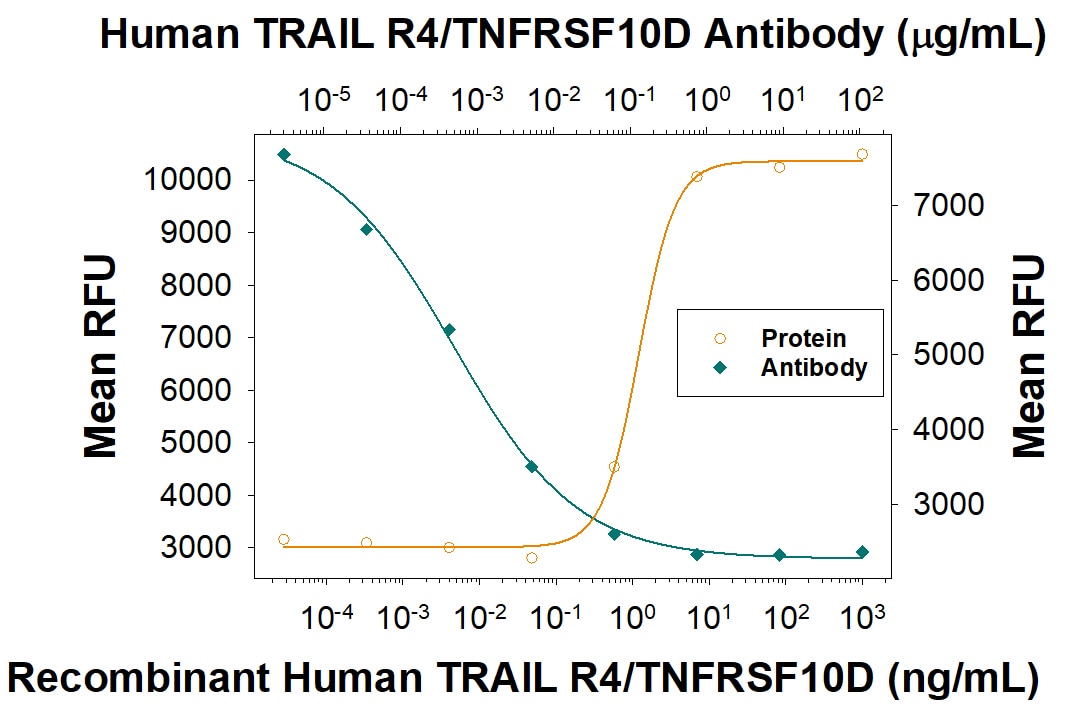
TRAIL R4/TNFRSF10D Inhibition of TRAIL/TNFSF10-induced Cytotoxicity and Neutralization by Human TRAIL R4/TNFRSF10D Antibody.
In the presence of the metabolic inhibitor actinomycin D, Recombinant Human TRAIL R4/TNFRSF10D Fc Chimera (Catalog # 633-TR) inhibits Recombinant Human TRAIL/TNFSF10 (Catalog # 375-TEC) induced cytotoxicity in the L-929 mouse fibroblast cell line in a dose-dependent manner (orange line). Under these conditions, inhibition of Recombinant Human TRAIL/TNFSF10 (20 ng/mL) activity elicited by Recombinant Human TRAIL R4/TNFRSF10D Fc Chimera (90 ng/mL) is neutralized (green line) by increasing concentrations of Human TRAIL R4/TNFRSF10D Monoclonal Antibody (Catalog # MAB633). The ND50 is typically 0.3-1.8 µg/mL.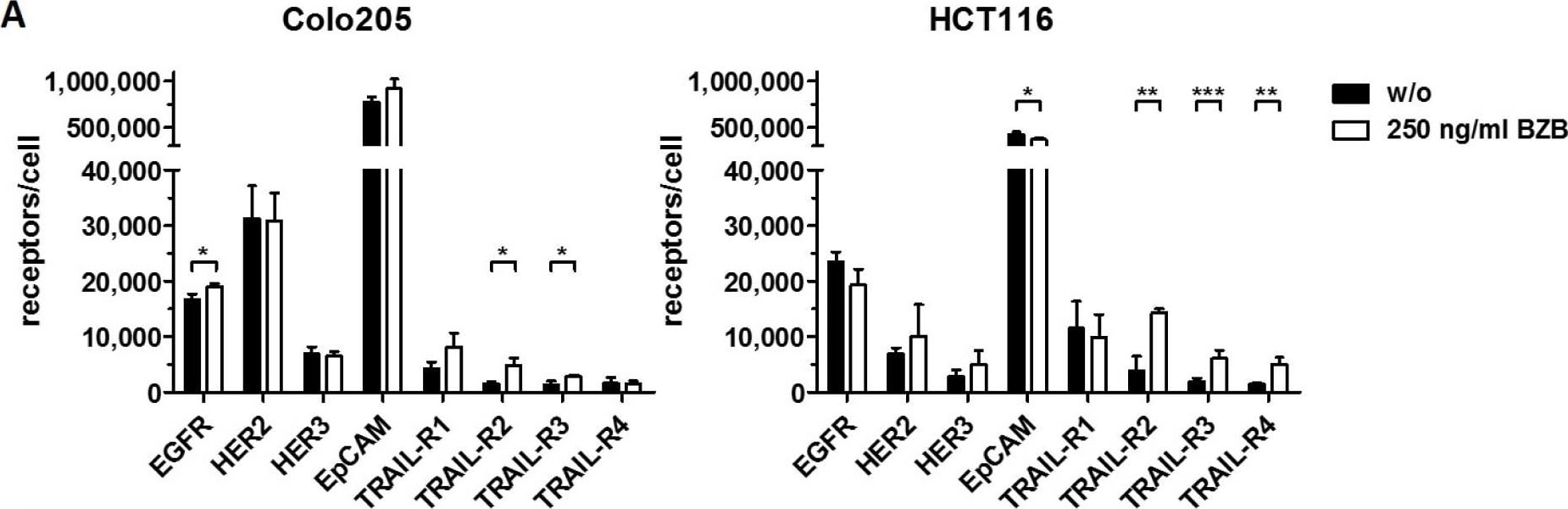
Detection of Human TRAILR4/TNFRSF10D/DcR2 by Flow Cytometry
Flow cytometry studies of scFv-Fc-scTRAIL molecules and Fc-scTRAIL on Colo205 and HCT116 cells(A) Expression levels of EGFR, HER2, HER3, EpCAM, and TRAIL-receptors were investigated after treatment of the cells with medium or 250 ng/ml BZB for 16 h. (B) Serial dilutions of the molecules were analyzed. (C) 20 nM scTRAIL units were analyzed after preincubation of the cells with PBA or a 200-fold molar excess of the respective blocking antibody. Binding of Fc-scTRAIL was measured in the presence of all blocking antibodies separately and is here represented as the mean of blocking with all different antibodies. Bound molecules were detected via anti-FLAG-PE. relative MFI, relative median fluorescence intensity. Pairwise comparisons were performed by unpaired t test (two-tailed; *P < 0.05; **P < 0.01; ***P < 0.001; ns, P > 0.05). Image collected and cropped by CiteAb from the following publication (https://www.oncotarget.com/lookup/doi/10.18632/oncotarget.24379), licensed under a CC-BY license. Not internally tested by R&D Systems.Applications for Human TRAILR4/TNFRSF10D Antibody (104918)
Application
Recommended Usage
CyTOF-ready
Ready to be labeled using established conjugation methods. No BSA or other carrier proteins that could interfere with conjugation.
Flow Cytometry
2.5 µg/106 cells
Sample: Human whole blood granulocytes
Sample: Human whole blood granulocytes
Neutralization
Measured by its ability to neutralize TRAIL R4/TNFRSF10D-mediated inhibition of cytotoxicity in the L‑929 mouse fibroblast cell line. The Neutralization Dose (ND50) is typically 0.3-1.8 µg/mL in the presence of 90 ng/mL Recombinant Human TRAIL R4/TNFRSF10D Fc Chimera, 20 ng/mL of Recombinant Human TRAIL/TNFSF10, and actinomycin D.
Human TRAIL R4/TNFRSF10D Sandwich Immunoassay
Please Note: Optimal dilutions of this antibody should be experimentally determined.
Reviewed Applications
Read 1 review rated 4 using MAB633 in the following applications:
Flow Cytometry Panel Builder
Bio-Techne Knows Flow Cytometry
Save time and reduce costly mistakes by quickly finding compatible reagents using the Panel Builder Tool.
Advanced Features
- Spectra Viewer - Custom analysis of spectra from multiple fluorochromes
- Spillover Popups - Visualize the spectra of individual fluorochromes
- Antigen Density Selector - Match fluorochrome brightness with antigen density

Formulation, Preparation, and Storage
Purification
Protein A or G purified from ascites
Reconstitution
Reconstitute at 0.5 mg/mL in sterile PBS. For liquid material, refer to CoA for concentration.
Loading...
Formulation
Lyophilized from a 0.2 μm filtered solution in PBS with Trehalose. *Small pack size (SP) is supplied either lyophilized or as a 0.2 µm filtered solution in PBS.
Shipping
Lyophilized product is shipped at ambient temperature. Liquid small pack size (-SP) is shipped with polar packs. Upon receipt, store immediately at the temperature recommended below.
Stability & Storage
Use a manual defrost freezer and avoid repeated freeze-thaw cycles.
- 12 months from date of receipt, -20 to -70 °C as supplied.
- 1 month, 2 to 8 °C under sterile conditions after reconstitution.
- 6 months, -20 to -70 °C under sterile conditions after reconstitution.
Calculators
Background: TRAILR4/TNFRSF10D
References
- Griffith, T.S. et al. (1998) Curr. Opin. Immunol. 10:559.
- Pan, G. et al. (1998) FEBS lett 424:41.
- Marsters, S.A. et al. (1997) Cur. Biol. 7:1003.
- Degli-Esposti, M.A. et al. (1997) Immunity 7:813.
Long Name
TRAIL Receptor 4
Alternate Names
CD264, DcR2, TNFRSF10D, TRAIL R4
Entrez Gene IDs
8793 (Human)
Gene Symbol
TNFRSF10D
UniProt
Additional TRAILR4/TNFRSF10D Products
Product Documents for Human TRAILR4/TNFRSF10D Antibody (104918)
Certificate of Analysis
To download a Certificate of Analysis, please enter a lot or batch number in the search box below.
Note: Certificate of Analysis not available for kit components.
Product Specific Notices for Human TRAILR4/TNFRSF10D Antibody (104918)
For research use only
Citations for Human TRAILR4/TNFRSF10D Antibody (104918)
 Powered by Bioz
Customer Reviews for Human TRAILR4/TNFRSF10D Antibody (104918) (1)
4 out of 5
1 Customer Rating
Have you used Human TRAILR4/TNFRSF10D Antibody (104918)?
Submit a review and receive an Amazon gift card!
$25/€18/£15/$25CAN/¥2500 for a review with an image
$10/€7/£6/$10CAN/¥1110 for a review without an image
Submit a review
Customer Images
Showing
1
-
1 of
1 review
Showing All
Filter By:
-
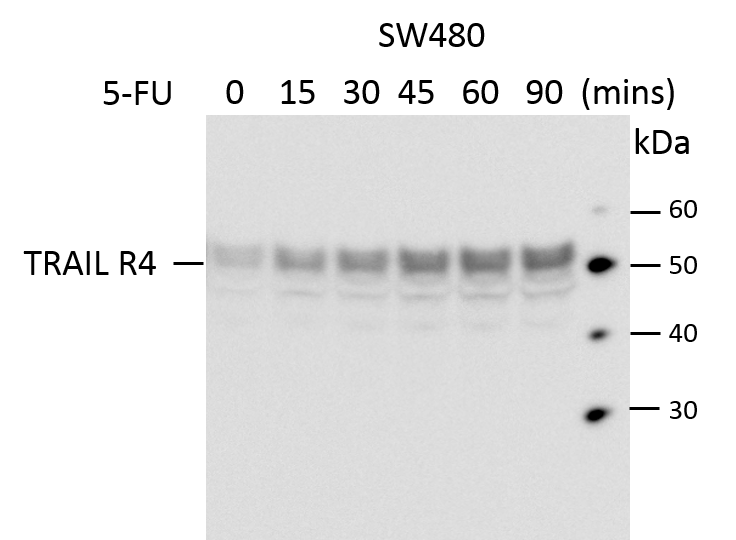
Application: Western BlotSample Tested: SW480 human colorectal adenocarcinoma cell lineSpecies: HumanVerified Customer | Posted 07/17/2018SW480 cells were treated with 5-FU (1 mg/ml) for indicated time points. Total cell lysates were subjected to western blot. PVDF membrane were probed with 1mm/ml Human TRAIL R4 Antibody (MAB633). A specific band was detected for TRAIL R4 at approximately 45-55 kDa. This experiment was conducted under reducing conditions.

There are no reviews that match your criteria.
Protocols
Find general support by application which include: protocols, troubleshooting, illustrated assays, videos and webinars.
- 7-Amino Actinomycin D (7-AAD) Cell Viability Flow Cytometry Protocol
- Extracellular Membrane Flow Cytometry Protocol
- Flow Cytometry Protocol for Cell Surface Markers
- Flow Cytometry Protocol for Staining Membrane Associated Proteins
- Flow Cytometry Staining Protocols
- Flow Cytometry Troubleshooting Guide
- Intracellular Flow Cytometry Protocol Using Alcohol (Methanol)
- Intracellular Flow Cytometry Protocol Using Detergents
- Intracellular Nuclear Staining Flow Cytometry Protocol Using Detergents
- Intracellular Staining Flow Cytometry Protocol Using Alcohol Permeabilization
- Intracellular Staining Flow Cytometry Protocol Using Detergents to Permeabilize Cells
- Propidium Iodide Cell Viability Flow Cytometry Protocol
- Protocol for Liperfluo
- Protocol for the Characterization of Human Th22 Cells
- Protocol for the Characterization of Human Th9 Cells
- Protocol: Annexin V and PI Staining by Flow Cytometry
- Protocol: Annexin V and PI Staining for Apoptosis by Flow Cytometry
- Troubleshooting Guide: Fluorokine Flow Cytometry Kits
- View all Protocols, Troubleshooting, Illustrated assays and Webinars
Loading...
Associated Pathways
