
TREM-1 (Triggering Receptor Expressed on Myeloid cells) is a type I transmembrane protein having a single Ig-like domain. It associates with the adapter protein, DAP12, to deliver an activating signal. Several other TREM family members have been reported that are structurally similar but share less than 30% amino acid identity. TREM-1 is expressed on blood neutrophils and a subset of monocytes, and expression is up-regulated by bacterial LPS. The natural ligand for TREM-1 has not been identified. However, engagement of TREM-1 with an agonist monoclonal antibody leads to expression of IL-8, MCP-1, and TNF-alpha, suggesting that this receptor plays an important role in inflammatory responses. TREM-1 is expressed at high levels on neutrophils of patients with microbial sepsis and in mice with
LPS-induced shock. Blockade of TREM-1 with a TREM-1/Fc fusion protein protected mice against LPS-induced shock. Human and mouse TREM-1 share approximately 42% amino acid sequence homology (1-3).
Human TREM-1 Antibody (193015)
R&D Systems | Catalog # MAB1278

Scientific images may be resized, cropped, or adjusted for brightness or contrast for presentation purposes. These updates are limited to presentation and do not affect the underlying scientific interpretation of the data. Where available, additional source data may be provided upon request.
Key Product Details
Species Reactivity
Validated:
Cited:
Applications
Validated:
Cited:
Label
Antibody Source
Product Specifications
Immunogen
Ala21-Asn205
Accession # Q9NP99
Specificity
Clonality
Host
Isotype
Endotoxin Level
Scientific Data Images for Human TREM-1 Antibody (193015)
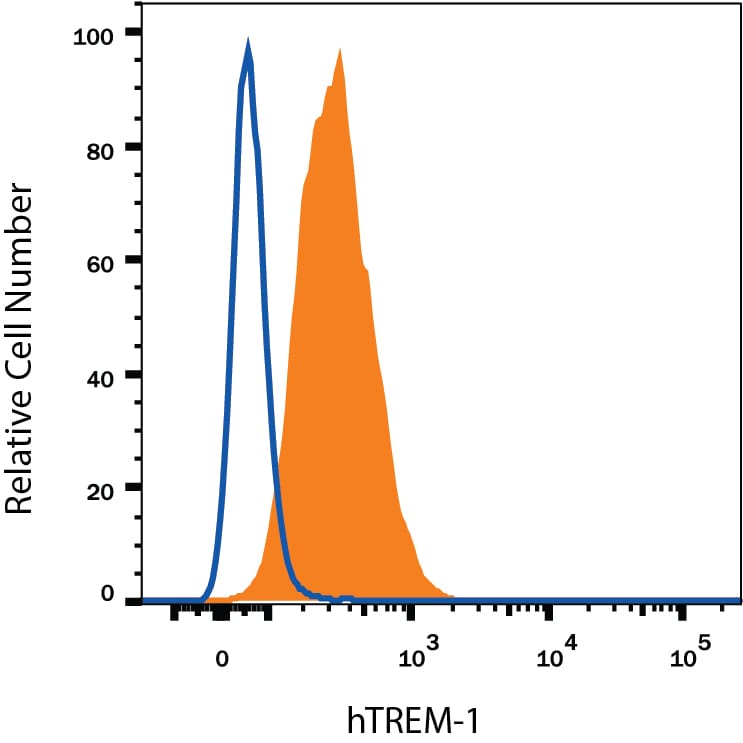
Detection of TREM‑1 in Human Blood Granulocytes by Flow Cytometry.
Human peripheral blood granulocytes were stained with Mouse Anti-Human TREM-1 Monoclonal Antibody (Catalog # MAB1278, filled histogram) or isotype control antibody (Catalog # MAB002, open histogram), followed by Phycoerythrin-conjugated Anti-Mouse IgG Secondary Antibody (Catalog # F0102B). View our protocol for Staining Membrane-associated Proteins.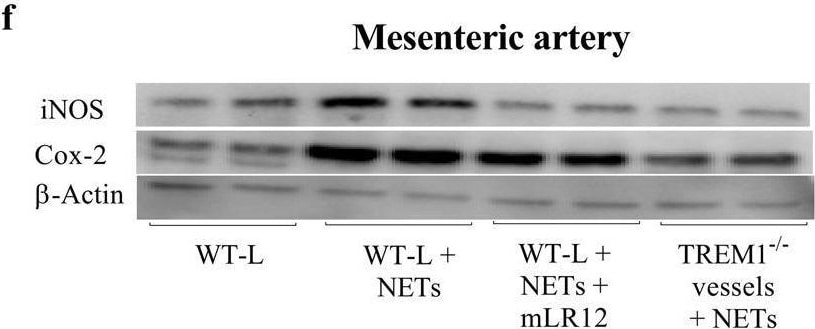
Detection of TREM-1 by Western Blot
TREM-1 inhibition dampens NET-induced vascular dysfunction. Concentration–response curves to phenylephrine (Phe) and acetylcholine (Ach) in murine aortas and mesenteric arteries incubated or without NETs (10 µg/ml) and hLR12 (25 µg/ml) for 3 h (a, b). Vessels from Trem1-knockout mice were incubated or without NETs (10 µg/l) (c, d). n.s. Not significant, *p < 0.05, **p < 0.01, ***p < 0.005, n = 4–5 per group (two-way ANOVA). Western blots showing iNOS and COX-2 expression in the aorta and mesenteric arteries (e, f) Image collected and cropped by CiteAb from the following open publication (https://pubmed.ncbi.nlm.nih.gov/33420354), licensed under a CC-BY license. Not internally tested by R&D Systems.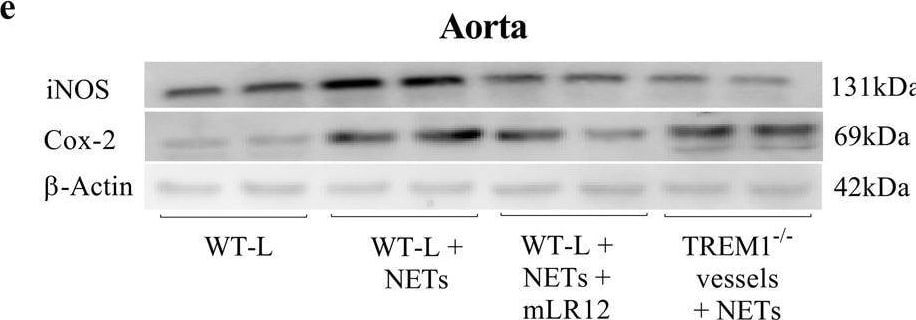
Detection of TREM-1 by Western Blot
TREM-1 inhibition dampens NET-induced vascular dysfunction. Concentration–response curves to phenylephrine (Phe) and acetylcholine (Ach) in murine aortas and mesenteric arteries incubated or without NETs (10 µg/ml) and hLR12 (25 µg/ml) for 3 h (a, b). Vessels from Trem1-knockout mice were incubated or without NETs (10 µg/l) (c, d). n.s. Not significant, *p < 0.05, **p < 0.01, ***p < 0.005, n = 4–5 per group (two-way ANOVA). Western blots showing iNOS and COX-2 expression in the aorta and mesenteric arteries (e, f) Image collected and cropped by CiteAb from the following open publication (https://pubmed.ncbi.nlm.nih.gov/33420354), licensed under a CC-BY license. Not internally tested by R&D Systems.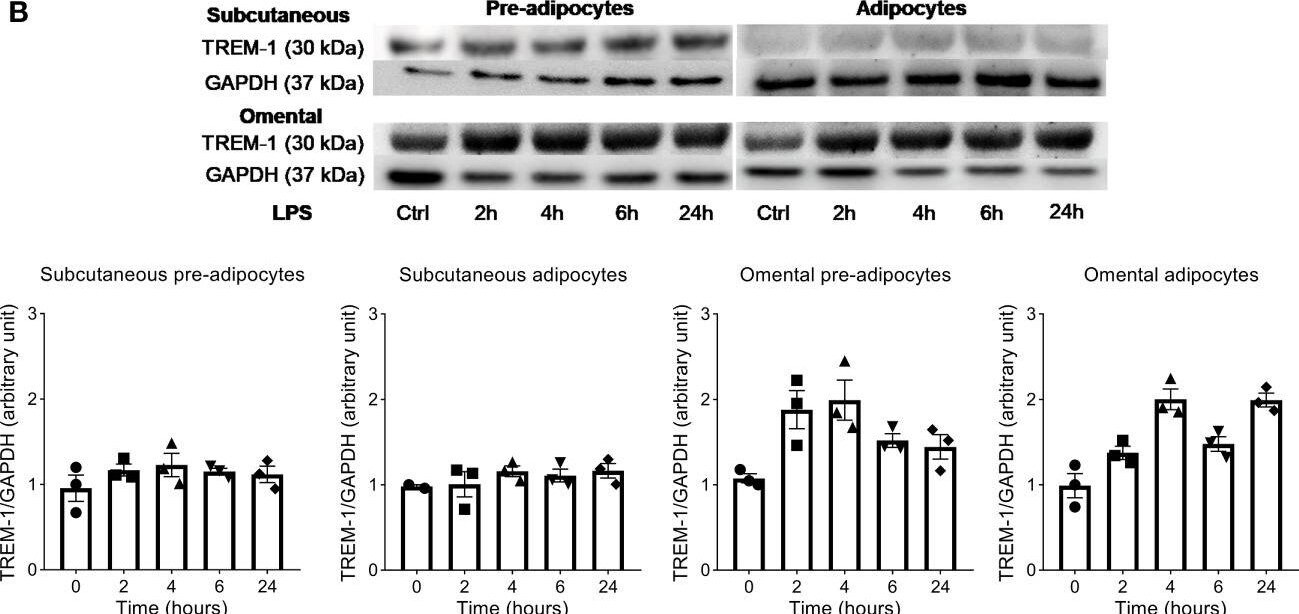
Detection of TREM-1 by Western Blot
Triggering Receptor Expressed on Myeloid cells-1 (TREM-1) is expressed by human subcutaneous and omental pre-adipocyte and adipocytes. (A) Confocal fluorescent images of human subcutaneous (top panels) and omental (bottom panels) pre-adipocytes and adipocytes. Cells were stained with anti-human TREM-1 (red), DAP-12 (green), and TO-PRO3 (blue) mAbs, Scale bars: 100 µm. (B) Western blot of lysates of human subcutaneous and omental pre-adipocytes and adipocytes treated for 2, 4, 6, and 24 hours with LPS (100 ng/ml). Images are representatives from 3 different experiments each performed on three different donors. Image collected and cropped by CiteAb from the following open publication (https://pubmed.ncbi.nlm.nih.gov/36699032), licensed under a CC-BY license. Not internally tested by R&D Systems.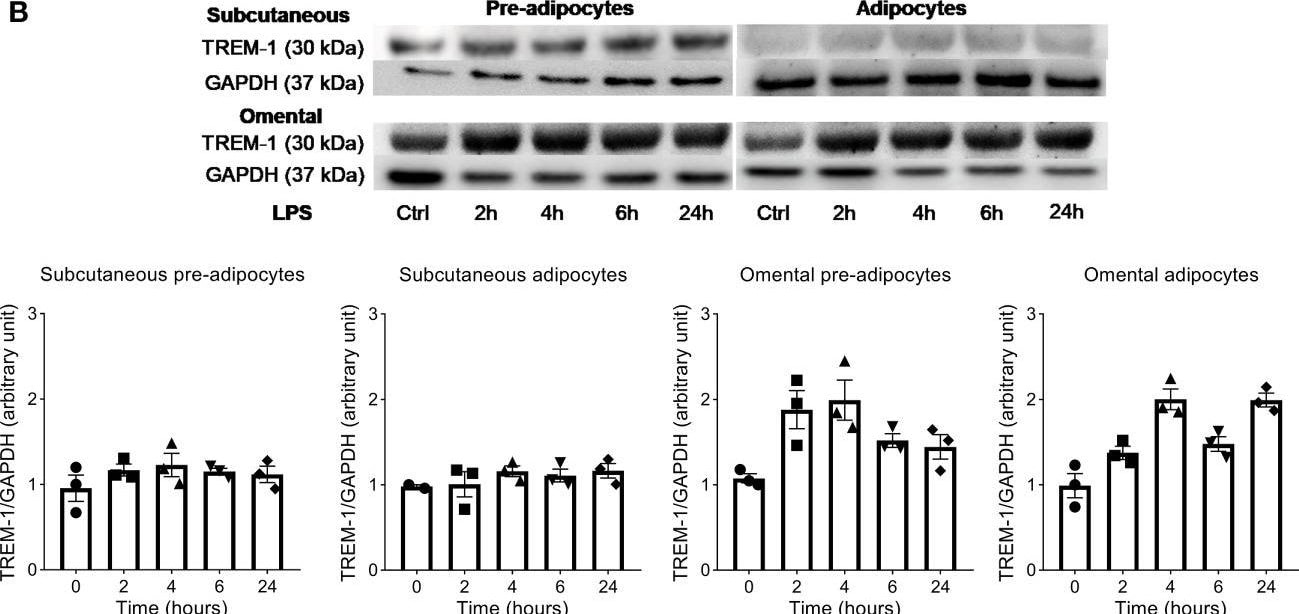
Detection of TREM-1 by Western Blot
Triggering Receptor Expressed on Myeloid cells-1 (TREM-1) is expressed by human subcutaneous and omental pre-adipocyte and adipocytes. (A) Confocal fluorescent images of human subcutaneous (top panels) and omental (bottom panels) pre-adipocytes and adipocytes. Cells were stained with anti-human TREM-1 (red), DAP-12 (green), and TO-PRO3 (blue) mAbs, Scale bars: 100 µm. (B) Western blot of lysates of human subcutaneous and omental pre-adipocytes and adipocytes treated for 2, 4, 6, and 24 hours with LPS (100 ng/ml). Images are representatives from 3 different experiments each performed on three different donors. Image collected and cropped by CiteAb from the following open publication (https://pubmed.ncbi.nlm.nih.gov/36699032), licensed under a CC-BY license. Not internally tested by R&D Systems.Applications for Human TREM-1 Antibody (193015)
Agonist Activity
The ED50 for this effect is typically 1-4 μg/mL.
CyTOF-ready
Flow Cytometry
Sample: Human peripheral blood granulocytes
Flow Cytometry Panel Builder
Bio-Techne Knows Flow Cytometry
Save time and reduce costly mistakes by quickly finding compatible reagents using the Panel Builder Tool.
Advanced Features
- Spectra Viewer - Custom analysis of spectra from multiple fluorochromes
- Spillover Popups - Visualize the spectra of individual fluorochromes
- Antigen Density Selector - Match fluorochrome brightness with antigen density

Formulation, Preparation, and Storage
Purification
Reconstitution
Reconstitute at 0.5 mg/mL in sterile PBS. For liquid material, refer to CoA for concentration.
Formulation
Shipping
Stability & Storage
- 12 months from date of receipt, -20 to -70 °C as supplied.
- 1 month, 2 to 8 °C under sterile conditions after reconstitution.
- 6 months, -20 to -70 °C under sterile conditions after reconstitution.
Calculators
Background: TREM-1
References
- Bouchon, A. (2000) J. Immunol. 164:4991.
- Bouchon, A. (2001) Nature 410:1103.
- Nathan, C. and A. Ding (2001) Nature Med. 7:530.
Long Name
Alternate Names
Gene Symbol
UniProt
Additional TREM-1 Products
Product Documents for Human TREM-1 Antibody (193015)
Certificate of Analysis
To download a Certificate of Analysis, please enter a lot or batch number in the search box below.
Note: Certificate of Analysis not available for kit components.
Product Specific Notices for Human TREM-1 Antibody (193015)
For research use only
Related Research Areas
Citations for Human TREM-1 Antibody (193015)
 Powered by Bioz
Customer Reviews for Human TREM-1 Antibody (193015)
There are currently no reviews for this product. Be the first to review Human TREM-1 Antibody (193015) and earn rewards!
Have you used Human TREM-1 Antibody (193015)?
Submit a review and receive an Amazon gift card!
$25/€18/£15/$25CAN/¥2500 for a review with an image
$10/€7/£6/$10CAN/¥1110 for a review without an image
Submit a review
Protocols
Find general support by application which include: protocols, troubleshooting, illustrated assays, videos and webinars.
- 7-Amino Actinomycin D (7-AAD) Cell Viability Flow Cytometry Protocol
- Extracellular Membrane Flow Cytometry Protocol
- Flow Cytometry Protocol for Cell Surface Markers
- Flow Cytometry Protocol for Staining Membrane Associated Proteins
- Flow Cytometry Staining Protocols
- Flow Cytometry Troubleshooting Guide
- Intracellular Flow Cytometry Protocol Using Alcohol (Methanol)
- Intracellular Flow Cytometry Protocol Using Detergents
- Intracellular Nuclear Staining Flow Cytometry Protocol Using Detergents
- Intracellular Staining Flow Cytometry Protocol Using Alcohol Permeabilization
- Intracellular Staining Flow Cytometry Protocol Using Detergents to Permeabilize Cells
- Propidium Iodide Cell Viability Flow Cytometry Protocol
- Protocol for Liperfluo
- Protocol for the Characterization of Human Th22 Cells
- Protocol for the Characterization of Human Th9 Cells
- Protocol: Annexin V and PI Staining by Flow Cytometry
- Protocol: Annexin V and PI Staining for Apoptosis by Flow Cytometry
- Troubleshooting Guide: Fluorokine Flow Cytometry Kits
- View all Protocols, Troubleshooting, Illustrated assays and Webinars