
URB (upregulated in BRS-3 deficient mice) is a 150 kDa, secreted glycoprotein that belongs to the sushi-repeat-containing protein superfamily (1, 2). Sushi repeats, otherwise known as short consensus repeats (SCRs), are 60 amino acid (aa) sequences usually involved in protein-protein interaction. They are characterized by the presence of four Cys, two Pro, one Gly and one Trp (3). Human URB is synthesized as a 950 aa precursor that contains a 21 aa signal sequence and a 929 aa mature region. The mature molecule contains three extended sushi/SCR domains of approximately 140 aa each. They bear resemblance to the fifth sushi-repeat in human SPRX (4). The three lie between aa 141‑281, 615‑760, and 771‑913, respectively. Between the first and second SCR lie two amino acid-rich regions, a Thr-rich domain (aa 347‑404), and a Lys-rich domain (aa 487‑588). Three potential N-linked glycosylation sites exist in the last two SCR’s, while six potential bipartite nuclear localization signals (NLS) occur between aa 420‑780. There are two potential alternate splice forms for human URB. One is 594 aa in length, and shows a simple truncation at Ser594. This effectively removes the second and third SCRs and two bipartite NLS (5). The second is 553 aa in length and shows a simple truncation after Lys553. This eliminates four bipartite NLSs, the second and third SCRs, and part of the Lys-rich domain (6). Full-length human URB is 83%, 84% and 87% aa identical to rat, mouse and bovine URB, respectively. URB is found in chondrocytes and appears to be downregulated upon CFU-Fibroblast differentiation (1). Thus, it may play a role in skeletogenesis.

Scientific images may be resized, cropped, or adjusted for brightness or contrast for presentation purposes. These updates are limited to presentation and do not affect the underlying scientific interpretation of the data. Where available, additional source data may be provided upon request.
Key Product Details
Species Reactivity
Validated:
Cited:
Applications
Validated:
Cited:
Label
Antibody Source
Product Specifications
Immunogen
Met129-Tyr950
Accession # Q76M96
Specificity
Clonality
Host
Isotype
Scientific Data Images for Human URB Antibody
Detection of URB by Western Blot
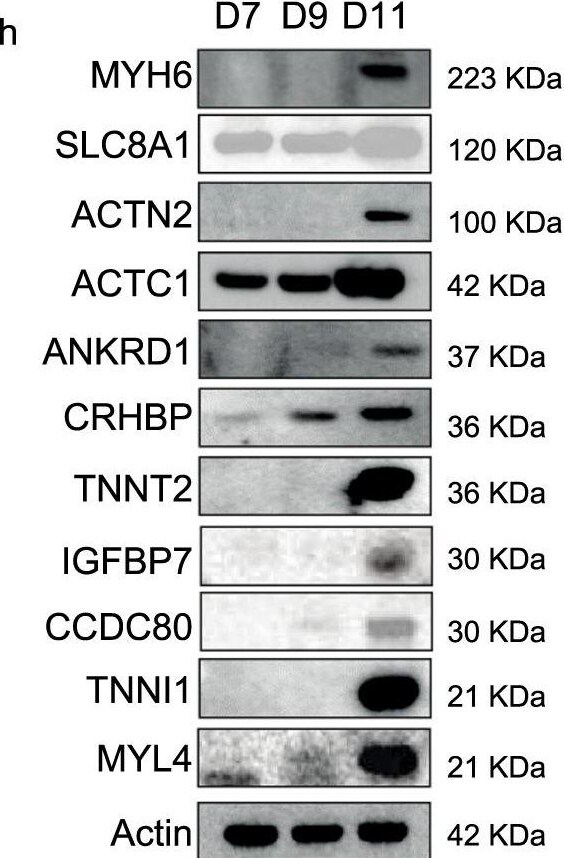
Committed Cardiac Progenitors and their Signature Genes.a Schematic showing the laminin (LN) protocol that uses LN-521 + 221 as a defined extracellular matrix together with small molecule inhibitors for the differentiation of pluripotent stem cells to day 11 committed cardiac progenitors (CCPs). b Heat map of three biological replicates from bulk RNA-seq data demonstrating the canonical progenitor gene expression on days 9 and 11. Supplementary Table 1 shows the actual transcripts per million (TPM) for each gene. c Time course analysis of scRNAseq data from days 0 to 11 for known canonical gene expression: PDGFRA, GATA4, KDR, NKX2–5, ISL1, and MESP1. d Immunoblotting of canonical progenitor genes from differentiation days 7, 9, and 11. Supplementary Fig. 1 shows the quantification of each blot from five biological replicates. e Heat map of the bulk RNA-seq data using CCP signature genes at differentiation days 9 and 11. Supplementary Table 1 shows the actual TPM for each gene. f Single-cell RNA-seq data (two biological replicates) of the CCP signature gene expression in tSNE plots from days 0, 4, 7, 9, and 11. The tSNE plot at the top left shows the overall distribution of each day using different colors. g Time course analysis of scRNAseq data from days 0 to 11 for day 11 CCP gene signature markers. h Immunoblotting of CCP signature genes from differentiation days 7, 9, and 11 (5 biological replicates). Supplementary Fig. 1 shows the quantification of each blot. Comparisons between groups were performed using two-way ANOVA with Tukey post hoc analysis. Image collected and cropped by CiteAb from the following open publication (https://pubmed.ncbi.nlm.nih.gov/37236990), licensed under a CC-BY license. Not internally tested by R&D Systems.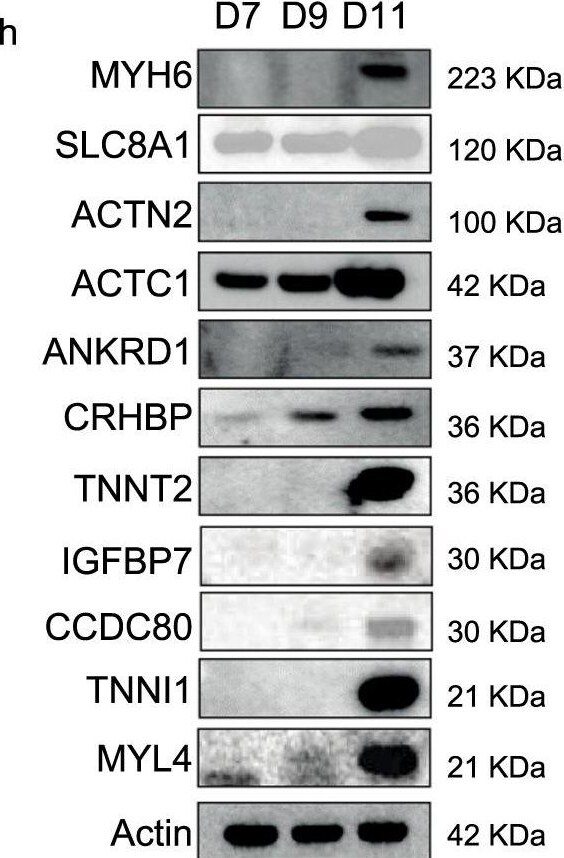
Detection of URB by Western Blot
Committed Cardiac Progenitors and their Signature Genes.a Schematic showing the laminin (LN) protocol that uses LN-521 + 221 as a defined extracellular matrix together with small molecule inhibitors for the differentiation of pluripotent stem cells to day 11 committed cardiac progenitors (CCPs). b Heat map of three biological replicates from bulk RNA-seq data demonstrating the canonical progenitor gene expression on days 9 and 11. Supplementary Table 1 shows the actual transcripts per million (TPM) for each gene. c Time course analysis of scRNAseq data from days 0 to 11 for known canonical gene expression: PDGFRA, GATA4, KDR, NKX2–5, ISL1, and MESP1. d Immunoblotting of canonical progenitor genes from differentiation days 7, 9, and 11. Supplementary Fig. 1 shows the quantification of each blot from five biological replicates. e Heat map of the bulk RNA-seq data using CCP signature genes at differentiation days 9 and 11. Supplementary Table 1 shows the actual TPM for each gene. f Single-cell RNA-seq data (two biological replicates) of the CCP signature gene expression in tSNE plots from days 0, 4, 7, 9, and 11. The tSNE plot at the top left shows the overall distribution of each day using different colors. g Time course analysis of scRNAseq data from days 0 to 11 for day 11 CCP gene signature markers. h Immunoblotting of CCP signature genes from differentiation days 7, 9, and 11 (5 biological replicates). Supplementary Fig. 1 shows the quantification of each blot. Comparisons between groups were performed using two-way ANOVA with Tukey post hoc analysis. Image collected and cropped by CiteAb from the following open publication (https://pubmed.ncbi.nlm.nih.gov/37236990), licensed under a CC-BY license. Not internally tested by R&D Systems.Applications for Human URB Antibody
Western Blot
Sample: Recombinant Human URB (Catalog # 3410-UR)
Formulation, Preparation, and Storage
Purification
Reconstitution
Reconstitute at 0.2 mg/mL in sterile PBS. For liquid material, refer to CoA for concentration.
Formulation
Shipping
Stability & Storage
- 12 months from date of receipt, -20 to -70 °C as supplied.
- 1 month, 2 to 8 °C under sterile conditions after reconstitution.
- 6 months, -20 to -70 °C under sterile conditions after reconstitution.
Calculators
Background: URB
References
- Liu, Y. et al. (2004) Biochem. Biophys. Res. Commun. 322:497.
- Aoki, K. et al. (2002) Biochem. Biophys. Res. Commun. 290:1282.
- Anatova, J. et al. (1989) Biochemistry 28:4754.
- Meindl, A. et al. (1995) Hum. Mol. Genet. 4:2339.
- Isogai, T. et al. (2002) GenBank Accession # BAC11475.
- Strausberg, R.L. et al. (2002) GenBank Accession # AAH86876.
Long Name
Alternate Names
Gene Symbol
UniProt
Additional URB Products
Product Documents for Human URB Antibody
Certificate of Analysis
To download a Certificate of Analysis, please enter a lot or batch number in the search box below.
Note: Certificate of Analysis not available for kit components.
Product Specific Notices for Human URB Antibody
For research use only
Related Research Areas
Citations for Human URB Antibody
 Powered by Bioz
Customer Reviews for Human URB Antibody
There are currently no reviews for this product. Be the first to review Human URB Antibody and earn rewards!
Have you used Human URB Antibody?
Submit a review and receive an Amazon gift card!
$25/€18/£15/$25CAN/¥2500 for a review with an image
$10/€7/£6/$10CAN/¥1110 for a review without an image
Submit a review
Protocols
Find general support by application which include: protocols, troubleshooting, illustrated assays, videos and webinars.
- Cellular Response to Hypoxia Protocols
- R&D Systems Quality Control Western Blot Protocol
- Troubleshooting Guide: Western Blot Figures
- Western Blot Conditions
- Western Blot Protocol
- Western Blot Protocol for Cell Lysates
- Western Blot Troubleshooting
- Western Blot Troubleshooting Guide
- View all Protocols, Troubleshooting, Illustrated assays and Webinars