
CXCL9, also known as MIG, is a member of the alpha subfamily of chemokines that lacks the ELR domain, and was initially identified as a lymphokine-activated gene in mouse macrophages. Human CXCL9 was subsequently cloned using mouse CXCL9 cDNA as a probe. The CXCL9 gene is induced in macrophages and in primary glial cells of the central nervous system specifically in response to IFN-gamma. CXCL9 has been shown to be a chemoattractant for activated T-lymphocytes and TIL but not for neutrophils or monocytes. The mouse CXCL9 cDNA encodes a 126 amino acid residue precursor protein with a 21 amino acid residue signal peptide that is cleaved to yield a 105 amino acid residue mature protein. CXCL9 has an extended carboxy-terminus containing greater than 50% basic amino acid residues and is larger than most other chemokines. The carboxy-terminal residues of CXCL9 are prone to proteolytic cleavage resulting in size heterogeneity of natural and recombinant CXCL9. CXCL9 with large carboxy-terminal deletions have been shown to have diminished activity in the calcium flux assay. A chemokine receptor (CXCR3) specific for CXCL9 and IP-10 has been cloned and shown to be highly expressed in IL-2-activated T-lymphocytes.
Mouse CXCL9/MIG Antibody
R&D Systems | Catalog # AF-492-NA


Scientific images may be resized, cropped, or adjusted for brightness or contrast for presentation purposes. These updates are limited to presentation and do not affect the underlying scientific interpretation of the data. Where available, additional source data may be provided upon request.
Key Product Details
Species Reactivity
Validated:
Cited:
Applications
Validated:
Cited:
Label
Antibody Source
Product Specifications
Immunogen
Accession # P18340
Specificity
Clonality
Host
Isotype
Endotoxin Level
Scientific Data Images for Mouse CXCL9/MIG Antibody
Chemotaxis Induced by CXCL9/MIG and Neutralization by Mouse CXCL9/MIG Antibody.
Recombinant Mouse CXCL9/MIG (Catalog # 492-MM) chemoattracts the BaF3 mouse pro-B cell line transfected with mouse CXCR3 in a dose-dependent manner (orange line). The amount of cells that migrated through to the lower chemotaxis chamber was measured by Resazurin (Catalog # AR002). Chemotaxis elicited by Recombinant Mouse CXCL9/MIG (1 µg/mL) is neutralized (green line) by increasing concentrations of Goat Anti-Mouse CXCL9/MIG Antigen Affinity-purified Polyclonal Antibody (Catalog # AF-492-NA). The ND50 is typically 6-20 µg/mL.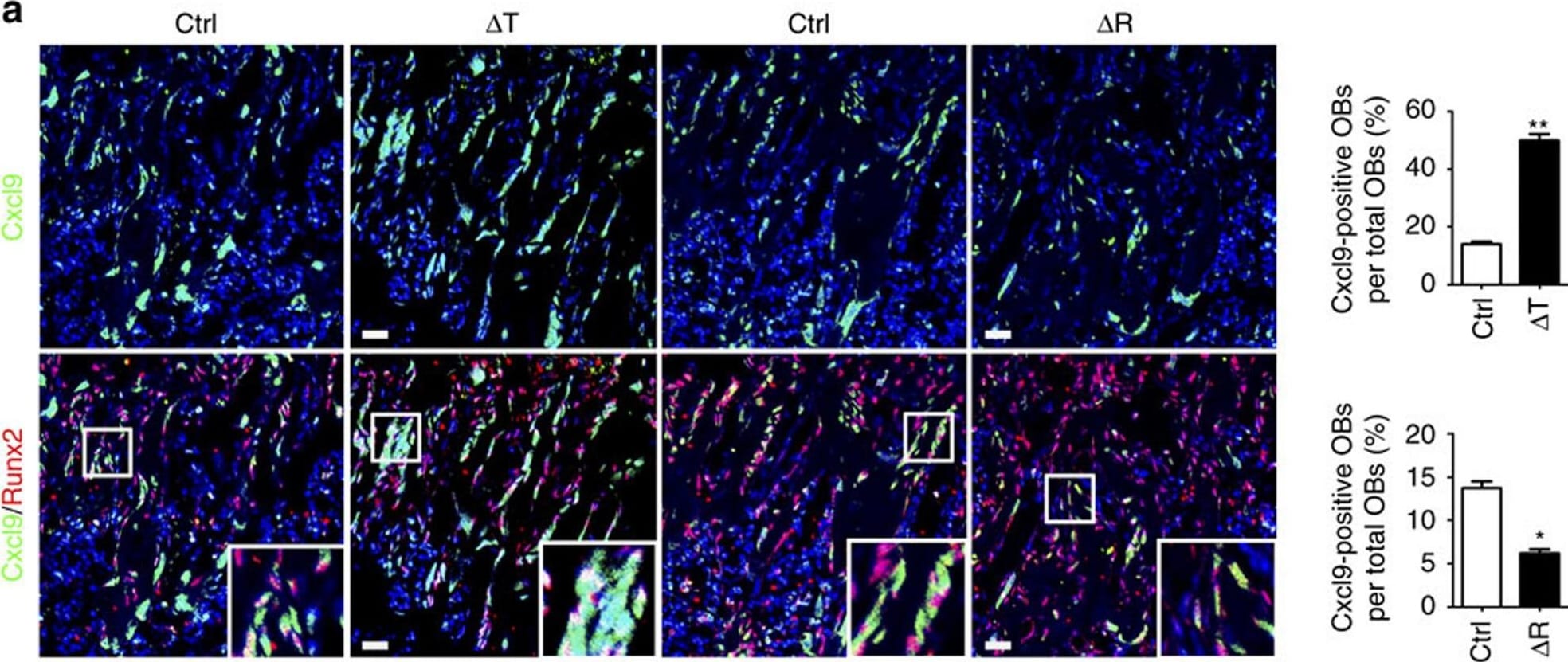
Detection of Mouse CXCL9/MIG by Immunocytochemistry/ Immunofluorescence
mTORC1 regulates Cxcl9 in osteoblasts.(a) Representative images of in situ hybridization of Cxcl9 mRNA in conjunction with immunostaining of Runx2 in femur sections of 12-week-old male mice bone. Boxed area is enlarged in the bottom right corner. Cxcl9+ osteoblasts out of total osteoblasts were also quantified. Scale bar, 50 μm. n=9 per group. (b) Representative photomicrographs of immunostaining of CXCR3 in CD31+ ECs in bone marrow and quantitative analysis of CXCR3+ ECs out of total ECs in 12-week-old male mice bone. Scale bar, 50 μm. n=9 per group. (c) Representative photomicrographs of immunostaining of CXCR3 in cultured HUVECs. Scale bar, 100 μm. (d) Cxcl9 concentrations assessed by ELISA in bone marrow (BM) and serum. n=5 per group. (e) Quantitative PCR analysis of Cxcl9 mRNA in primary osteoblasts. (f) Western blot of Cxcl9 in primary osteoblasts. (g) Concentrations of Cxcl9 in CM of primary osteoblasts assessed by ELISA. n=5 per group. Data are shown as mean±s.d. *P<0.05, **P<0.01 (Student's t-test). Ctrl, control. Image collected and cropped by CiteAb from the following open publication (https://www.nature.com/articles/ncomms13885), licensed under a CC-BY license. Not internally tested by R&D Systems.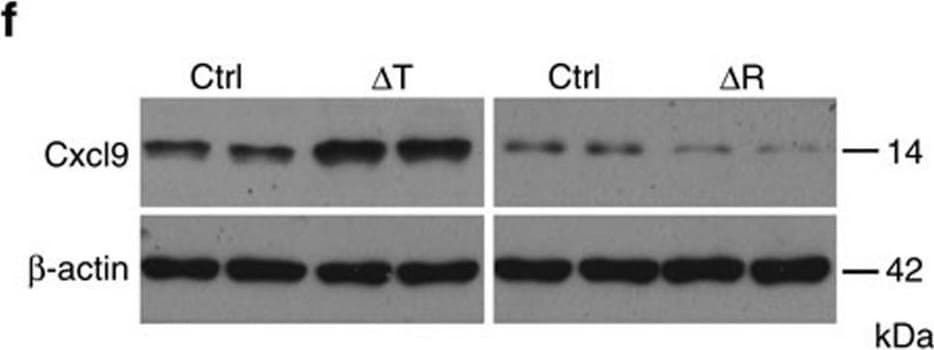
Detection of Mouse CXCL9/MIG by Western Blot
mTORC1 regulates Cxcl9 in osteoblasts.(a) Representative images of in situ hybridization of Cxcl9 mRNA in conjunction with immunostaining of Runx2 in femur sections of 12-week-old male mice bone. Boxed area is enlarged in the bottom right corner. Cxcl9+ osteoblasts out of total osteoblasts were also quantified. Scale bar, 50 μm. n=9 per group. (b) Representative photomicrographs of immunostaining of CXCR3 in CD31+ ECs in bone marrow and quantitative analysis of CXCR3+ ECs out of total ECs in 12-week-old male mice bone. Scale bar, 50 μm. n=9 per group. (c) Representative photomicrographs of immunostaining of CXCR3 in cultured HUVECs. Scale bar, 100 μm. (d) Cxcl9 concentrations assessed by ELISA in bone marrow (BM) and serum. n=5 per group. (e) Quantitative PCR analysis of Cxcl9 mRNA in primary osteoblasts. (f) Western blot of Cxcl9 in primary osteoblasts. (g) Concentrations of Cxcl9 in CM of primary osteoblasts assessed by ELISA. n=5 per group. Data are shown as mean±s.d. *P<0.05, **P<0.01 (Student's t-test). Ctrl, control. Image collected and cropped by CiteAb from the following open publication (https://www.nature.com/articles/ncomms13885), licensed under a CC-BY license. Not internally tested by R&D Systems.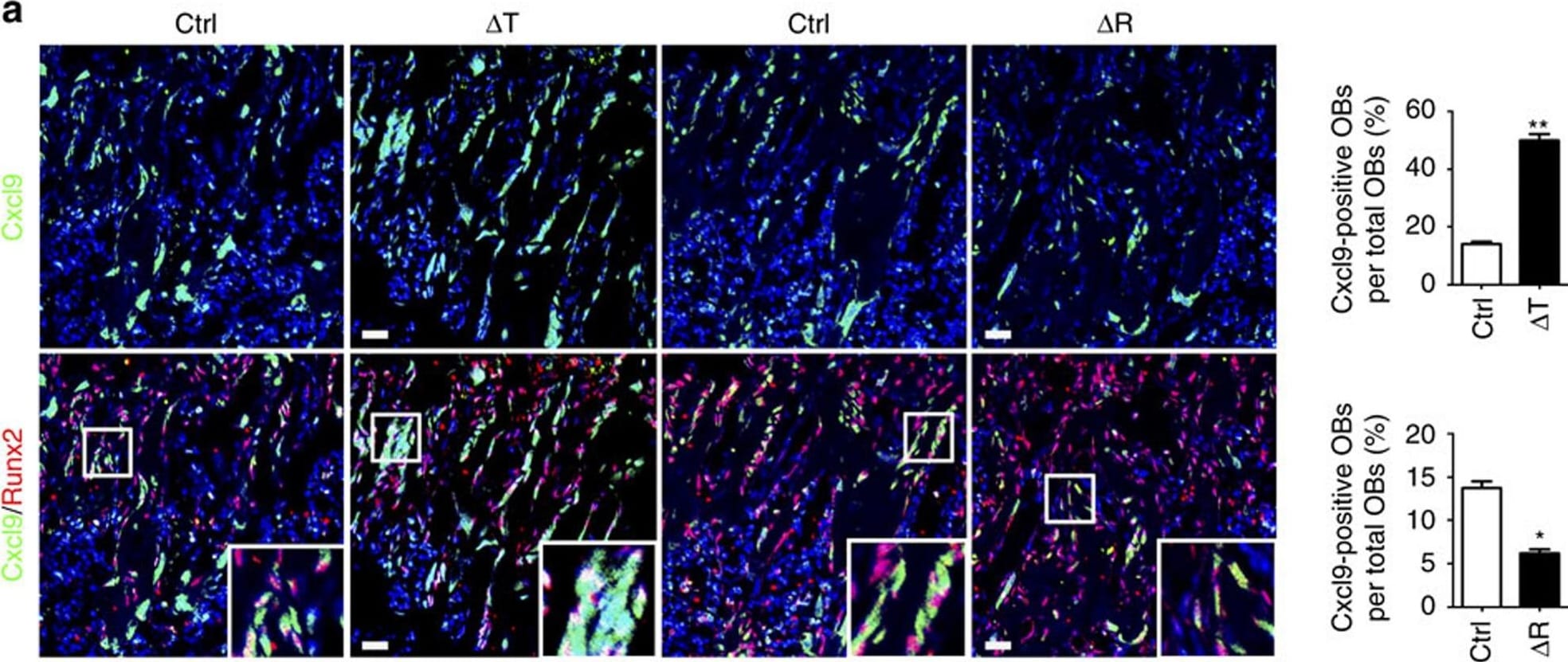
Detection of Mouse CXCL9/MIG by Immunocytochemistry/ Immunofluorescence
mTORC1 regulates Cxcl9 in osteoblasts.(a) Representative images of in situ hybridization of Cxcl9 mRNA in conjunction with immunostaining of Runx2 in femur sections of 12-week-old male mice bone. Boxed area is enlarged in the bottom right corner. Cxcl9+ osteoblasts out of total osteoblasts were also quantified. Scale bar, 50 μm. n=9 per group. (b) Representative photomicrographs of immunostaining of CXCR3 in CD31+ ECs in bone marrow and quantitative analysis of CXCR3+ ECs out of total ECs in 12-week-old male mice bone. Scale bar, 50 μm. n=9 per group. (c) Representative photomicrographs of immunostaining of CXCR3 in cultured HUVECs. Scale bar, 100 μm. (d) Cxcl9 concentrations assessed by ELISA in bone marrow (BM) and serum. n=5 per group. (e) Quantitative PCR analysis of Cxcl9 mRNA in primary osteoblasts. (f) Western blot of Cxcl9 in primary osteoblasts. (g) Concentrations of Cxcl9 in CM of primary osteoblasts assessed by ELISA. n=5 per group. Data are shown as mean±s.d. *P<0.05, **P<0.01 (Student's t-test). Ctrl, control. Image collected and cropped by CiteAb from the following open publication (https://www.nature.com/articles/ncomms13885), licensed under a CC-BY license. Not internally tested by R&D Systems.
Mouse CXCL9 / MIG ELISA Standard Curve
Recombinant Mouse CXCL9/MIG (Catalog # 492-MM) was serially diluted and captured by Goat Anti-Mouse CXCL9/MIG Antigen Affinity-purified Polyclonal Antibody (Catalog # AF-492-NA) coated on a Clear Polystyrene Microplate (Catalog # DY990). Goat Anti-Mouse CXCL9/MIG Antigen Affinity-purified Polyclonal Antibody (Catalog # AF-492-NA) was biotinylated and incubated with the protein captured on the plate. Detection of the standard curve was achieved by incubating Streptavidin-HRP (Catalog # DY998)
Mouse CXCL9 / MIG ELISA Standard Curve
Recombinant Mouse CXCL9/MIG (Catalog # 492-MM) was serially diluted and captured by Goat Anti-Mouse CXCL9/MIG Antigen Affinity-purified Polyclonal Antibody (Catalog # AF-492-NA) coated on a Clear Polystyrene Microplate (Catalog # DY990). Goat Anti-Mouse CXCL9/MIG Antigen Affinity-purified Polyclonal Antibody (Catalog # AF-492-NA) was biotinylated and incubated with the protein captured on the plate. Detection of the standard curve was achieved by incubating Streptavidin-HRP (Catalog # DY998)Applications for Mouse CXCL9/MIG Antibody
Neutralization
Mouse CXCL9/MIG Sandwich Immunoassay
Formulation, Preparation, and Storage
Purification
Reconstitution
Reconstitute at 0.2 mg/mL in sterile PBS. For liquid material, refer to CoA for concentration.
Formulation
Shipping
Stability & Storage
- 12 months from date of receipt, -20 to -70 °C as supplied.
- 1 month, 2 to 8 °C under sterile conditions after reconstitution.
- 6 months, -20 to -70 °C under sterile conditions after reconstitution.
Calculators
Background: CXCL9/MIG
Alternate Names
Gene Symbol
UniProt
Additional CXCL9/MIG Products
Product Documents for Mouse CXCL9/MIG Antibody
Certificate of Analysis
To download a Certificate of Analysis, please enter a lot or batch number in the search box below.
Note: Certificate of Analysis not available for kit components.
Product Specific Notices for Mouse CXCL9/MIG Antibody
For research use only
Citations for Mouse CXCL9/MIG Antibody
 Powered by Bioz
Customer Reviews for Mouse CXCL9/MIG Antibody
There are currently no reviews for this product. Be the first to review Mouse CXCL9/MIG Antibody and earn rewards!
Have you used Mouse CXCL9/MIG Antibody?
Submit a review and receive an Amazon gift card!
$25/€18/£15/$25CAN/¥2500 for a review with an image
$10/€7/£6/$10CAN/¥1110 for a review without an image
Submit a review
Associated Pathways
