
Midkine (MK; also Retinoid acid-induced differentiation facor) is a secreted heparin-binding member of the very small pleiotrophin family of proteins. Although its predicted MW is 13 kDa, it runs anomalously at 15-17 kDa in SDS-PAGE. MK is strongly expressed in the embryo, but is known to be secreted in the adult by endothelium, preadipocytes, proximal renal tubular epithelium, and CD4+ T cells. MK has multiple activities, including the inhibition of regulatory T cell production, the promotion of adipocyte formation, and the induction of chemokine production by smooth muscle, the clustering of Ach receptors on myoblasts, and the migration of embryonic neurons plus neutrophils and macrophages. It has multiple receptors, including heparin and chondroitin sulfate, LRP-1, nucleolin, ALK, and PTP-zeta. Mature mouse midkine is 118 amino acids (aa) in length (aa 23-140). It possesses two distinct domains, an N-terminal domain spanning aa 23-71, and a C-terminal domain that encompasses aa 81-140. The C-terminal domain is further divided into two basic amino acid clusters that bind heparin. There are two splice variants reported for mouse midkine. One shows a deletion of aa 39-103, while another shows a deletion of aa 80-133. Midkine will form a covalent, crosslinked homodimer through the action of tissue type II transglutaminase. Full-length mature mouse MK (aa 23-140) shares 97% and 86% aa sequence with full-length rat and human MK, respectively..
Mouse Midkine Antibody
R&D Systems | Catalog # AF7769

Scientific images may be resized, cropped, or adjusted for brightness or contrast for presentation purposes. These updates are limited to presentation and do not affect the underlying scientific interpretation of the data. Where available, additional source data may be provided upon request.
Key Product Details
Species Reactivity
Validated:
Cited:
Applications
Validated:
Cited:
Label
Antibody Source
Product Specifications
Immunogen
Gly89-Asp140
Accession # P12025
Specificity
Clonality
Host
Isotype
Scientific Data Images for Mouse Midkine Antibody
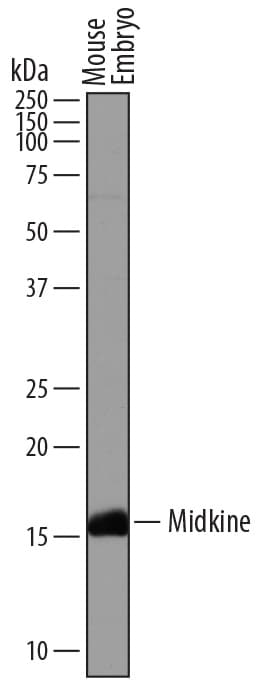
Detection of Mouse Midkine by Western Blot.
Western blot shows lysates of mouse embryo tissue. PVDF membrane was probed with 1 µg/mL of Sheep Anti-Mouse Midkine Antigen Affinity-purified Polyclonal Antibody (Catalog # AF7769) followed by HRP-conjugated Anti-Sheep IgG Secondary Antibody (Catalog # HAF016). A specific band was detected for Midkine at approximately 15-17 kDa (as indicated). This experiment was conducted under reducing conditions and using Immunoblot Buffer Group 1.
Midkine in Mouse Embryo.
Midkine was detected in immersion fixed paraffin-embedded sections of mouse embryo (13 d.p.c.) using Sheep Anti-Mouse Midkine Antigen Affinity-purified Polyclonal Antibody (Catalog # AF7769) at 5 µg/mL overnight at 4 °C. Tissue was stained using the Anti-Sheep HRP-DAB Cell & Tissue Staining Kit (brown; Catalog # CTS019) and counterstained with hematoxylin (blue). Specific staining was localized to cartilage primordium in ribs. View our protocol for Chromogenic IHC Staining of Paraffin-embedded Tissue Sections.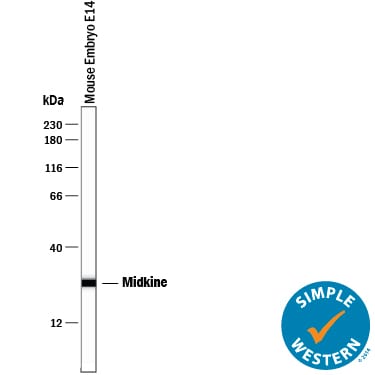
Detection of Human and Mouse Midkine by Simple WesternTM.
Simple Western lane view shows lysates of mouse embryo tissue, loaded at 0.2 mg/mL. A specific band was detected for Midkine at approximately 26 kDa (as indicated) using 20 µg/mL of Sheep Anti-Mouse Midkine Antigen Affinity-purified Polyclonal Antibody (Catalog # AF7769) followed by 1:50 dilution of HRP-conjugated Anti-Goat IgG Secondary Antibody (Catalog # HAF109). This experiment was conducted under reducing conditions and using the 12-230 kDa separation system.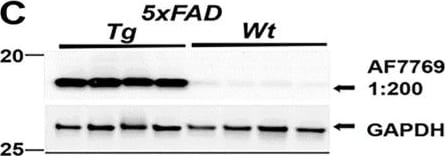
Detection of Midkine by Western Blot
Analysis of Moesin, CD44, Midkine and sFRP-1 protein level in 5XFAD AD mouse model. Representative Western blots (left) and quantification (right). (A) Anti-Moesin; (Abcam #ab52490) reacted in mouse brain homogenate with a predicted molecular weight of 68 kDa and 2.8 times greater expression in 5XFAD relative to WT. (B) Anti-CD44 (Abcam #ab189524) reacted with a band at the predicted size of 82 kDa and 1.9 times greater expression in 5XFAD relative to WT. (C) Anti-Midkine (R&D Systems #AF7769) reacted with a band ~16 kDa with 17.8 times greater expression in 5XFAD relative to WT. (D) Anti-sFRP-1 (Abcam #ab267466) reacted with a band at 35 kDa as predicted with 11.9 times greater expression in 5xFAD relative to WT. Brightness and contrast were adjusted in figure for visualization purposes and were applied equally to entire blot. *P<0.05, **P<0.01, ***P<0.001, ****P<0.0001 by unpairedt-test. Image collected and cropped by CiteAb from the following open publication (https://f1000research.com/articles/12-1070/v2), licensed under a CC-BY license. Not internally tested by R&D Systems.Applications for Mouse Midkine Antibody
Immunohistochemistry
Sample: Immersion fixed paraffin-embedded sections of mouse embryo (13 d.p.c.)
Simple Western
Sample: Mouse embryo tissue
Western Blot
Sample: Mouse embryo tissue
Formulation, Preparation, and Storage
Purification
Reconstitution
Sterile PBS to a final concentration of 0.2 mg/mL. For liquid material, refer to CoA for concentration.
Formulation
Shipping
Stability & Storage
- 12 months from date of receipt, -20 to -70 °C as supplied.
- 1 month, 2 to 8 °C under sterile conditions after reconstitution.
- 6 months, -20 to -70 °C under sterile conditions after reconstitution.
Calculators
Background: Midkine
Alternate Names
Gene Symbol
UniProt
Additional Midkine Products
Product Documents for Mouse Midkine Antibody
Certificate of Analysis
To download a Certificate of Analysis, please enter a lot or batch number in the search box below.
Note: Certificate of Analysis not available for kit components.
Product Specific Notices for Mouse Midkine Antibody
For research use only
Citations for Mouse Midkine Antibody
 Powered by Bioz
Customer Reviews for Mouse Midkine Antibody
There are currently no reviews for this product. Be the first to review Mouse Midkine Antibody and earn rewards!
Have you used Mouse Midkine Antibody?
Submit a review and receive an Amazon gift card!
$25/€18/£15/$25CAN/¥2500 for a review with an image
$10/€7/£6/$10CAN/¥1110 for a review without an image
Submit a review
Protocols
Find general support by application which include: protocols, troubleshooting, illustrated assays, videos and webinars.
- Antigen Retrieval Protocol (PIER)
- Antigen Retrieval for Frozen Sections Protocol
- Appropriate Fixation of IHC/ICC Samples
- Cellular Response to Hypoxia Protocols
- Chromogenic IHC Staining of Formalin-Fixed Paraffin-Embedded (FFPE) Tissue Protocol
- Chromogenic Immunohistochemistry Staining of Frozen Tissue
- ClariTSA™ Fluorophore Kits
- Detection & Visualization of Antibody Binding
- Fluorescent IHC Staining of Frozen Tissue Protocol
- Graphic Protocol for Heat-induced Epitope Retrieval
- Graphic Protocol for the Preparation and Fluorescent IHC Staining of Frozen Tissue Sections
- Graphic Protocol for the Preparation and Fluorescent IHC Staining of Paraffin-embedded Tissue Sections
- Graphic Protocol for the Preparation of Gelatin-coated Slides for Histological Tissue Sections
- IHC Sample Preparation (Frozen sections vs Paraffin)
- Immunofluorescent IHC Staining of Formalin-Fixed Paraffin-Embedded (FFPE) Tissue Protocol
- Immunohistochemistry (IHC) and Immunocytochemistry (ICC) Protocols
- Immunohistochemistry Frozen Troubleshooting
- Immunohistochemistry Paraffin Troubleshooting
- Preparing Samples for IHC/ICC Experiments
- Preventing Non-Specific Staining (Non-Specific Binding)
- Primary Antibody Selection & Optimization
- Protocol for Heat-Induced Epitope Retrieval (HIER)
- Protocol for Making a 4% Formaldehyde Solution in PBS
- Protocol for VisUCyte™ HRP Polymer Detection Reagent
- Protocol for the Preparation & Fixation of Cells on Coverslips
- Protocol for the Preparation and Chromogenic IHC Staining of Frozen Tissue Sections
- Protocol for the Preparation and Chromogenic IHC Staining of Frozen Tissue Sections - Graphic
- Protocol for the Preparation and Chromogenic IHC Staining of Paraffin-embedded Tissue Sections
- Protocol for the Preparation and Chromogenic IHC Staining of Paraffin-embedded Tissue Sections - Graphic
- Protocol for the Preparation and Fluorescent IHC Staining of Frozen Tissue Sections
- Protocol for the Preparation and Fluorescent IHC Staining of Paraffin-embedded Tissue Sections
- Protocol for the Preparation of Gelatin-coated Slides for Histological Tissue Sections
- R&D Systems Quality Control Western Blot Protocol
- TUNEL and Active Caspase-3 Detection by IHC/ICC Protocol
- The Importance of IHC/ICC Controls
- Troubleshooting Guide: Immunohistochemistry
- Troubleshooting Guide: Western Blot Figures
- Western Blot Conditions
- Western Blot Protocol
- Western Blot Protocol for Cell Lysates
- Western Blot Troubleshooting
- Western Blot Troubleshooting Guide
- View all Protocols, Troubleshooting, Illustrated assays and Webinars