
The GDNF family of neurotrophic factors consititute a new family of factors within the TGF-beta superfamily. These proteins are potent survival factors for various central and peripheral neurons during development and in the adult animal. The GDNF family members (GDNF, neurturin and persephin) signal through multicomponent receptors that consist of the Ret receptor tyrosine kinase and one of four glycosyl-phosphatidylinositol (GPI)-linked ligand-binding subunits (GFR alpha ‑1 ‑ 4). GFR alpha -1, -2, and -4 are the preferred ligand-binding subunits for GDNF, neurturin and persephin, respectively. To date, the preferred ligand for GFR alpha ‑3 has not been identified. The Ret tyrosine-kinase receptor is encoded by the c-ret proto-oncogene. Mutations of the ret gene have been associated with various human diseases affecting tissues derived from the neural crest, including Hirschsprung’s disease, multiple endocrine neoplasia MEN2A and MEN2B, and familial medullary thyroid carcinoma. Mouse Ret cDNA encodes a 1115 amino acid (aa) residue transmembrane tyrosine kinase with a 28 aa residue signal peptide, a 609 aa residue cysteine-rich extracellular domain and a 456 aa residue cytoplasmic domain. A cadherin-related sequence is also present in the extracellular domain of Ret. Human and mouse Ret share 83% amino acid sequence homology (77% homology in the extracellular domain and 93% homology in the cytoplasmic domain). Although Ret does not bind GDNF ligands directly, the extracellular domain of Ret binds the GDNF-GFR-alpha complex with high affinity and is a potent GDNF antagonist in the presence of soluble GFR-alpha.

Key Product Details
Species Reactivity
Validated:
Mouse
Cited:
Mouse, Rat, Chicken, Transgenic Mouse
Applications
Validated:
Immunohistochemistry, Western Blot
Cited:
Immunohistochemistry, Immunohistochemistry-Paraffin, Immunohistochemistry-Frozen, Western Blot, Immunocytochemistry, Immunoprecipitation
Label
Unconjugated
Antibody Source
Polyclonal Goat IgG
Loading...
Product Specifications
Immunogen
Mouse myeloma cell line NS0-derived recombinant mouse Ret
Leu29-Arg637 (Phe174Ser)
Accession # P35546
Leu29-Arg637 (Phe174Ser)
Accession # P35546
Specificity
Detects mouse Ret in direct ELISAs and Western blots.
Clonality
Polyclonal
Host
Goat
Isotype
IgG
Scientific Data Images for Mouse Ret Antibody
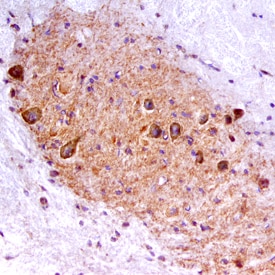
Ret in Mouse Spinal Cord.
Ret was detected in perfusion fixed frozen sections of mouse spinal cord using Goat Anti-Mouse Ret Antigen Affinity-purified Polyclonal Antibody (Catalog # AF482) at 15 µg/mL overnight at 4 °C. Tissue was stained using the Anti-Goat HRP-DAB Cell & Tissue Staining Kit (brown; Catalog # CTS008) and counterstained with hematoxylin (blue). Specific staining was localized to the ventral horn. View our protocol for Chromogenic IHC Staining of Frozen Tissue Sections.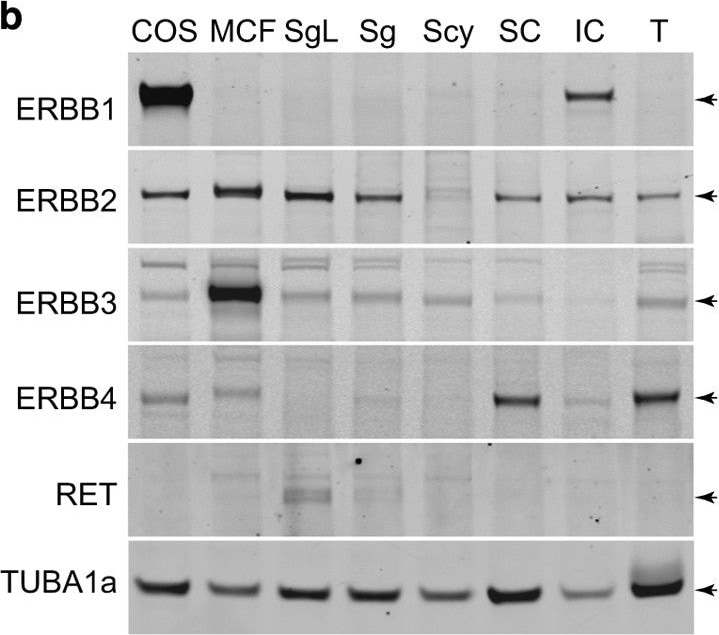
Detection of Porcine Ret by Western Blot
ERBB-family signaling molecules in rat testis cells. (a) Polypeptides in the EGF super-family signal by activating ERBB-family transmembrane receptor tyrosine kinases. ERBB1 is a receptor for ‘classical’ low molecular weight EGF-like peptides. ERBB2 is the primary transducer for ligand-bound ERBB1, ERBB3 and ERBB4. ERBB2’s extracellular domain does not bind known ligands. ERBB3 is a receptor for Neuregulin-1 (NRG1), NRG2 and Neuroglycan-C (CSPG5). Ligand bound ERBB3 displays poor kinase activity and signals most effectively as a heteromer with ERBB1, ERBB2 and/or ERBB4. ERBB4 is a receptor for NRG1, NRG2, NRG3 and NRG4 plus other EGF-like peptides*. (b) Western blotting analysis of ERBB-family proteins in fractions of testis cells from 23-day-old rats. Lysates of type A spermatogonia after proliferating for ~180 days/15 passages in culture (SgL), freshly isolated laminin-binding type A spermatogonia (Sg), laminin non-binding spermatogenic cells (Scy), tubular somatic cells (SC), interstitial somatic cells (IC), MCF7 human mammary gland cells (MCF) and COS7 monkey kidney cells (COS). Arrowheads: ERBBs 1–4 (~185 kDa), RET (~155 and 170 kDa) and TUBA1a (~55 kDa). (c) Relative abundance (qtPCR) of ERBB-family transcripts in testis cells isolated from 23-day-old rats (n=cells from three different rats; ±S.E.M.). Spermatogonia (Sg), Spermatocytes (Scy; differentiating spermatogonia/early spermatocytes), Tubular somatic cells (SC) and Interstitial somatic cells (IC) are cell types described in panel (b). (d) Testis cross-section from 26-day-old tgGCS-EGFP transgenic rats labeled with anti-ERBB2 (Red) overlaying EGFP fluorescence from germ cells (green). Note, cytoplasmic ERBB2 labeling in germ cells resembling differentiating spermatogonia (white arrows) and spermatocytes (yellow arrow). Scale, 40 μm. (e) Rat seminiferous tubule whole mount from 24-day-old wild-type rat labeled using antibodies to ERBB2 (Red) and ZBTB16 (Green). Scale, 20 μm. Note: nuclear ZBTB16 labeling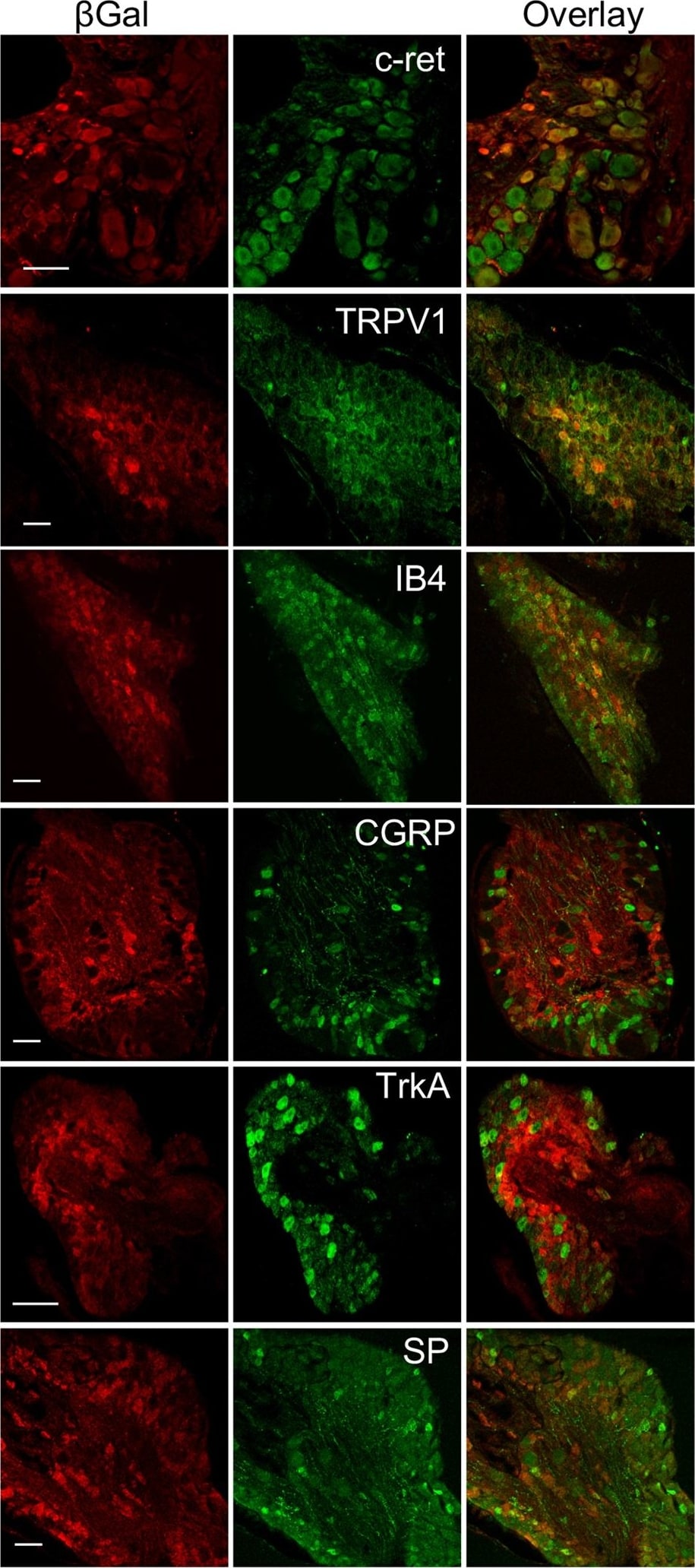
Detection of Mouse Ret by Immunohistochemistry
P2RX4 expression in Dorsal Root Ganglion neurons. (A) Representative cropped western blotting analysis of lumbar DRG extract indicates the presence of a 60 kDa band in P2RX4+/+ DRG that is absent in extracts from P2RX4−/− DRG. N = 3 independent experiments, n = 3 mice per genotype. (B) beta -galactosidase staining was used as a surrogate marker for P2RX4 in DRG sections. Only P2RX4−/− neurons are immuno-positive for beta gal compared to sections from P2RX4+/+ DRG. Scale bar 100 µm. (C) DRG neurons that express beta -gal innervate paw skin. Fluoro-Gold B, a retrograde marker of neurons was injected in paw-skin and L5/L6 DRG were removed for staining a week later. beta gal immunostaining reveals a population of neurons that are labeled for both beta gal and Fluoro-Gold B. Scale bar 50 µm. (D) In nociceptive neurons, beta gal is mainly expressed in c-ret-, TRPV1- and IB4-positive neurons, but scarcely in others populations (CGRP, TrkA or Substance P (SP) expressing cells). Representative images of DRG sections stained with beta gal and makers of nociceptive neurons. Scale bars 50 µm. Image collected and cropped by CiteAb from the following open publication (https://pubmed.ncbi.nlm.nih.gov/29343707), licensed under a CC-BY license. Not internally tested by R&D Systems.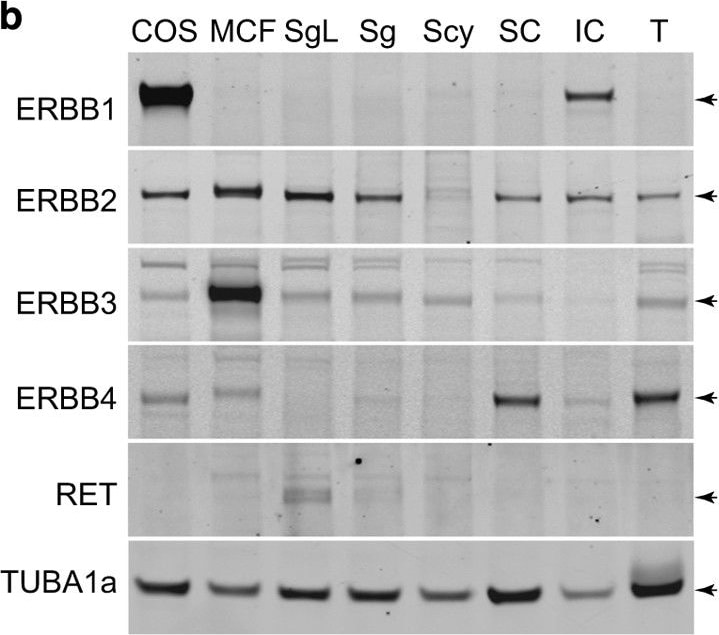
Detection of Rat Ret by Western Blot
ERBB-family signaling molecules in rat testis cells. (a) Polypeptides in the EGF super-family signal by activating ERBB-family transmembrane receptor tyrosine kinases. ERBB1 is a receptor for ‘classical’ low molecular weight EGF-like peptides. ERBB2 is the primary transducer for ligand-bound ERBB1, ERBB3 and ERBB4. ERBB2’s extracellular domain does not bind known ligands. ERBB3 is a receptor for Neuregulin-1 (NRG1), NRG2 and Neuroglycan-C (CSPG5). Ligand bound ERBB3 displays poor kinase activity and signals most effectively as a heteromer with ERBB1, ERBB2 and/or ERBB4. ERBB4 is a receptor for NRG1, NRG2, NRG3 and NRG4 plus other EGF-like peptides*. (b) Western blotting analysis of ERBB-family proteins in fractions of testis cells from 23-day-old rats. Lysates of type A spermatogonia after proliferating for ~180 days/15 passages in culture (SgL), freshly isolated laminin-binding type A spermatogonia (Sg), laminin non-binding spermatogenic cells (Scy), tubular somatic cells (SC), interstitial somatic cells (IC), MCF7 human mammary gland cells (MCF) and COS7 monkey kidney cells (COS). Arrowheads: ERBBs 1–4 (~185 kDa), RET (~155 and 170 kDa) and TUBA1a (~55 kDa). (c) Relative abundance (qtPCR) of ERBB-family transcripts in testis cells isolated from 23-day-old rats (n=cells from three different rats; ±S.E.M.). Spermatogonia (Sg), Spermatocytes (Scy; differentiating spermatogonia/early spermatocytes), Tubular somatic cells (SC) and Interstitial somatic cells (IC) are cell types described in panel (b). (d) Testis cross-section from 26-day-old tgGCS-EGFP transgenic rats labeled with anti-ERBB2 (Red) overlaying EGFP fluorescence from germ cells (green). Note, cytoplasmic ERBB2 labeling in germ cells resembling differentiating spermatogonia (white arrows) and spermatocytes (yellow arrow). Scale, 40 μm. (e) Rat seminiferous tubule whole mount from 24-day-old wild-type rat labeled using antibodies to ERBB2 (Red) and ZBTB16 (Green). Scale, 20 μm. Note: nuclear ZBTB16 labeling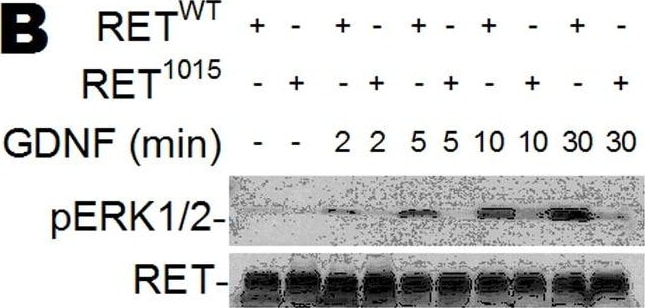
Detection of Mouse Ret by Western Blot
GDNF-induced Ca2+ signaling phosphorylates ERK1/2 and CaMKII.(A–D) Western blot of HeLa cells transfected with RETWT or RET1015 treated with GDNF (100 ng/ml). GDNF triggers time dependent phosphorylation of ERK1/2 (pERK1/2) in RETWT cells that is suppressed by BAPTA (10 µM) (A). Less pERK1/2 is observed in cells transfected with RET1015 than RETWT (B). GDNF-induced phosphorylation of CaMKII (pCaMKII) or pERK1/2 is suppressed when blocking PLC with U73122 (5 µM) (C) or knocking down PLC gamma with siRNA (PLC gamma -siRNA) (D). Treating RETWT cells with the U73122 analogue U73343 (5 µM) had no effect on GDNF-activated pCaMKII or pERK1/2 (C). Increased Caspase-3 cleavage was not detected in cells treated with the inhibitors BAPTA or U73122 (C). Image collected and cropped by CiteAb from the following open publication (https://pubmed.ncbi.nlm.nih.gov/22355350), licensed under a CC-BY license. Not internally tested by R&D Systems.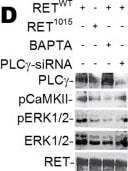
Detection of Mouse Ret by Western Blot
GDNF-induced Ca2+ signaling phosphorylates ERK1/2 and CaMKII.(A–D) Western blot of HeLa cells transfected with RETWT or RET1015 treated with GDNF (100 ng/ml). GDNF triggers time dependent phosphorylation of ERK1/2 (pERK1/2) in RETWT cells that is suppressed by BAPTA (10 µM) (A). Less pERK1/2 is observed in cells transfected with RET1015 than RETWT (B). GDNF-induced phosphorylation of CaMKII (pCaMKII) or pERK1/2 is suppressed when blocking PLC with U73122 (5 µM) (C) or knocking down PLC gamma with siRNA (PLC gamma -siRNA) (D). Treating RETWT cells with the U73122 analogue U73343 (5 µM) had no effect on GDNF-activated pCaMKII or pERK1/2 (C). Increased Caspase-3 cleavage was not detected in cells treated with the inhibitors BAPTA or U73122 (C). Image collected and cropped by CiteAb from the following open publication (https://pubmed.ncbi.nlm.nih.gov/22355350), licensed under a CC-BY license. Not internally tested by R&D Systems.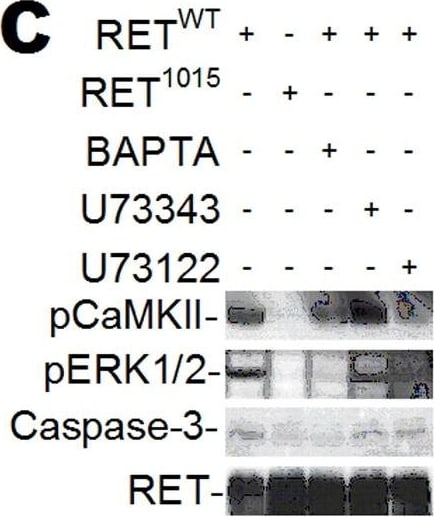
Detection of Mouse Ret by Western Blot
GDNF-induced Ca2+ signaling phosphorylates ERK1/2 and CaMKII.(A–D) Western blot of HeLa cells transfected with RETWT or RET1015 treated with GDNF (100 ng/ml). GDNF triggers time dependent phosphorylation of ERK1/2 (pERK1/2) in RETWT cells that is suppressed by BAPTA (10 µM) (A). Less pERK1/2 is observed in cells transfected with RET1015 than RETWT (B). GDNF-induced phosphorylation of CaMKII (pCaMKII) or pERK1/2 is suppressed when blocking PLC with U73122 (5 µM) (C) or knocking down PLC gamma with siRNA (PLC gamma -siRNA) (D). Treating RETWT cells with the U73122 analogue U73343 (5 µM) had no effect on GDNF-activated pCaMKII or pERK1/2 (C). Increased Caspase-3 cleavage was not detected in cells treated with the inhibitors BAPTA or U73122 (C). Image collected and cropped by CiteAb from the following open publication (https://pubmed.ncbi.nlm.nih.gov/22355350), licensed under a CC-BY license. Not internally tested by R&D Systems.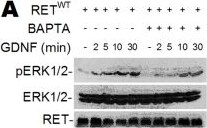
Detection of Mouse Ret by Western Blot
GDNF-induced Ca2+ signaling phosphorylates ERK1/2 and CaMKII.(A–D) Western blot of HeLa cells transfected with RETWT or RET1015 treated with GDNF (100 ng/ml). GDNF triggers time dependent phosphorylation of ERK1/2 (pERK1/2) in RETWT cells that is suppressed by BAPTA (10 µM) (A). Less pERK1/2 is observed in cells transfected with RET1015 than RETWT (B). GDNF-induced phosphorylation of CaMKII (pCaMKII) or pERK1/2 is suppressed when blocking PLC with U73122 (5 µM) (C) or knocking down PLC gamma with siRNA (PLC gamma -siRNA) (D). Treating RETWT cells with the U73122 analogue U73343 (5 µM) had no effect on GDNF-activated pCaMKII or pERK1/2 (C). Increased Caspase-3 cleavage was not detected in cells treated with the inhibitors BAPTA or U73122 (C). Image collected and cropped by CiteAb from the following open publication (https://pubmed.ncbi.nlm.nih.gov/22355350), licensed under a CC-BY license. Not internally tested by R&D Systems.Applications for Mouse Ret Antibody
Application
Recommended Usage
Immunohistochemistry
5-15 µg/mL
Sample: Perfusion fixed frozen sections of mouse brain (hippocampus and cortex) and spinal cord
Sample: Perfusion fixed frozen sections of mouse brain (hippocampus and cortex) and spinal cord
Western Blot
0.1 µg/mL
Sample: Recombinant Mouse Ret Fc Chimera (Catalog # 482-RT)
Sample: Recombinant Mouse Ret Fc Chimera (Catalog # 482-RT)
Formulation, Preparation, and Storage
Purification
Antigen Affinity-purified
Reconstitution
Reconstitute at 0.2 mg/mL in sterile PBS. For liquid material, refer to CoA for concentration.
Loading...
Formulation
Lyophilized from a 0.2 μm filtered solution in PBS with Trehalose. *Small pack size (SP) is supplied either lyophilized or as a 0.2 µm filtered solution in PBS.
Shipping
Lyophilized product is shipped at ambient temperature. Liquid small pack size (-SP) is shipped with polar packs. Upon receipt, store immediately at the temperature recommended below.
Stability & Storage
Use a manual defrost freezer and avoid repeated freeze-thaw cycles.
- 12 months from date of receipt, -20 to -70 °C as supplied.
- 1 month, 2 to 8 °C under sterile conditions after reconstitution.
- 6 months, -20 to -70 °C under sterile conditions after reconstitution.
Calculators
Background: Ret
References
- Trupp, M. et al. (1998) Mol. Cell Neurosci. 11:47.
- Enokido, Y. et al. (1998) Curr. Biol. 8:1019.
- Carlomagno, F. et al. (1998) Endocrinology, 139:3613.
Long Name
Proto-oncogene Tyrosine-protein Kinase Receptor Ret
Alternate Names
CDHF12MTC1, CDHR16, EC 2.7.10, Hirschsprung disease 1, Hirschsprung disease), MEN2A, MEN2B, multiple endocrine neoplasia and medullary thyroid carcinoma 1, ret proto-oncogene, RET transforming sequence
Gene Symbol
RET
UniProt
Additional Ret Products
Product Documents for Mouse Ret Antibody
Certificate of Analysis
To download a Certificate of Analysis, please enter a lot or batch number in the search box below.
Note: Certificate of Analysis not available for kit components.
Product Specific Notices for Mouse Ret Antibody
For research use only
Related Research Areas
Citations for Mouse Ret Antibody
 Powered by Bioz
Customer Reviews for Mouse Ret Antibody
There are currently no reviews for this product. Be the first to review Mouse Ret Antibody and earn rewards!
Have you used Mouse Ret Antibody?
Submit a review and receive an Amazon gift card!
$25/€18/£15/$25CAN/¥2500 for a review with an image
$10/€7/£6/$10CAN/¥1110 for a review without an image
Submit a review
Protocols
Find general support by application which include: protocols, troubleshooting, illustrated assays, videos and webinars.
- Antigen Retrieval Protocol (PIER)
- Antigen Retrieval for Frozen Sections Protocol
- Appropriate Fixation of IHC/ICC Samples
- Cellular Response to Hypoxia Protocols
- Chromogenic IHC Staining of Formalin-Fixed Paraffin-Embedded (FFPE) Tissue Protocol
- Chromogenic Immunohistochemistry Staining of Frozen Tissue
- ClariTSA™ Fluorophore Kits
- Detection & Visualization of Antibody Binding
- Fluorescent IHC Staining of Frozen Tissue Protocol
- Graphic Protocol for Heat-induced Epitope Retrieval
- Graphic Protocol for the Preparation and Fluorescent IHC Staining of Frozen Tissue Sections
- Graphic Protocol for the Preparation and Fluorescent IHC Staining of Paraffin-embedded Tissue Sections
- Graphic Protocol for the Preparation of Gelatin-coated Slides for Histological Tissue Sections
- IHC Sample Preparation (Frozen sections vs Paraffin)
- Immunofluorescent IHC Staining of Formalin-Fixed Paraffin-Embedded (FFPE) Tissue Protocol
- Immunohistochemistry (IHC) and Immunocytochemistry (ICC) Protocols
- Immunohistochemistry Frozen Troubleshooting
- Immunohistochemistry Paraffin Troubleshooting
- Preparing Samples for IHC/ICC Experiments
- Preventing Non-Specific Staining (Non-Specific Binding)
- Primary Antibody Selection & Optimization
- Protocol for Heat-Induced Epitope Retrieval (HIER)
- Protocol for Making a 4% Formaldehyde Solution in PBS
- Protocol for VisUCyte™ HRP Polymer Detection Reagent
- Protocol for the Preparation & Fixation of Cells on Coverslips
- Protocol for the Preparation and Chromogenic IHC Staining of Frozen Tissue Sections
- Protocol for the Preparation and Chromogenic IHC Staining of Frozen Tissue Sections - Graphic
- Protocol for the Preparation and Chromogenic IHC Staining of Paraffin-embedded Tissue Sections
- Protocol for the Preparation and Chromogenic IHC Staining of Paraffin-embedded Tissue Sections - Graphic
- Protocol for the Preparation and Fluorescent IHC Staining of Frozen Tissue Sections
- Protocol for the Preparation and Fluorescent IHC Staining of Paraffin-embedded Tissue Sections
- Protocol for the Preparation of Gelatin-coated Slides for Histological Tissue Sections
- R&D Systems Quality Control Western Blot Protocol
- TUNEL and Active Caspase-3 Detection by IHC/ICC Protocol
- The Importance of IHC/ICC Controls
- Troubleshooting Guide: Immunohistochemistry
- Troubleshooting Guide: Western Blot Figures
- Western Blot Conditions
- Western Blot Protocol
- Western Blot Protocol for Cell Lysates
- Western Blot Troubleshooting
- Western Blot Troubleshooting Guide
- View all Protocols, Troubleshooting, Illustrated assays and Webinars
Loading...