
Semaphorin 3A (Sema3A; previously sem D, sema III or collapsin) is one of six Class 3 secreted semaphorins which share ~40-50% amino acid (aa) identity
(1-3). Class 3 semaphorins are potent chemorepellents that function in axon and/or vascular guidance during development (2, 3). The 772 aa mouse Sema3C contains a 20 aa signal sequence, an ~500 aa N-terminal Sema domain that forms a beta -propeller structure similar to that found in integrin molecules, a PSI domain, a furin-type cleavage site, an Ig-like domain, and a C-terminal basic domain (3, 4). Covalent dimerization plus cleavage at the C-terminus are required for activity of class 3 semaphorins (5, 6). The 95 kDa mature mouse Sema3A shares at least 95% aa identity with human, rat, equine and canine Sema3A, and 90% and 86% aa identity with chick and zebrafish Sema3A, respectively. Type 3 semaphorins transduce signals through transmembrane plexins, either directly or by binding associated neuropilin receptors (3). Sema3A signaling is transduced by plexin A1-4, indirectly via neuropilin-1 (3). Sema3A activity is mediated by small GTPases that influence actin rearrangement and integrin activity (7-9). It is important in developmental organization of central and peripheral nerves, including those in heart, lung, kidneys, bones, teeth, and visual and olfactory systems (1, 2, 10, 11). Gradients of Sema3A repel axons, but attract dendrites (11, 12). Sema3A affect vasculogenesis by inhibiting integrin function and, with Sema3F, promoting apoptosis of endothelial cells (3, 9, 12). It is thought to suppress cancer-related angiogenesis (3). In the immune system, Sema3A influences T cell proliferation, migration, response to activation, and interactions with dendritic cells (7, 13). It negatively regulates platelet activation (14). Expression of Sema3A in relevant parts of the nervous system may be increased in Alzheimer’s disease, multiple sclerosis, ischemia and schizophrenia (2).
Mouse Semaphorin 3A Antibody (2701F)
R&D Systems | Catalog # MAB10903

Scientific images may be resized, cropped, or adjusted for brightness or contrast for presentation purposes. These updates are limited to presentation and do not affect the underlying scientific interpretation of the data. Where available, additional source data may be provided upon request.
Key Product Details
Species Reactivity
Applications
Label
Antibody Source
Product Specifications
Immunogen
Asn21-Lys747
Accession # O08665
Specificity
Clonality
Host
Isotype
Scientific Data Images for Mouse Semaphorin 3A Antibody (2701F)
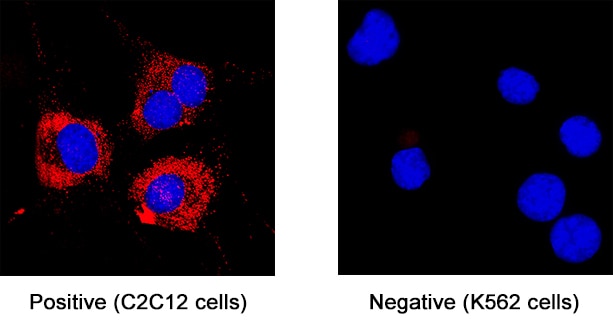
Semaphorin 3A in C2C12 Mouse Cell Line.
Semaphorin 3A was detected in immersion fixed C2C12 mouse myoblast cell line (positive staining) and K562 human chronic myelogenous leukemia cell line (negative staining) using Rabbit Anti-Mouse Semaphorin 3A Monoclonal Antibody (Catalog # MAB10903) at 3 µg/mL for 3 hours at room temperature. Cells were stained using the NorthernLights™ 557-conjugated Anti-Rabbit IgG Secondary Antibody (red; NL004) and counterstained with DAPI (blue). Specific staining was localized to cytoplasm. Staining was performed using our protocol for Fluorescent ICC Staining of Non-adherent Cells.Applications for Mouse Semaphorin 3A Antibody (2701F)
Immunocytochemistry
Sample: Immersion fixed C2C12 mouse myoblast cell line
Formulation, Preparation, and Storage
Purification
Reconstitution
Reconstitute at 0.5 mg/mL in sterile PBS. For liquid material, refer to CoA for concentration.
Formulation
Shipping
Stability & Storage
- 12 months from date of receipt, -20 to -70 °C as supplied.
- 1 month, 2 to 8 °C under sterile conditions after reconstitution.
- 6 months, -20 to -70 °C under sterile conditions after reconstitution.
Calculators
Background: Semaphorin 3A
References
- Puschel, A.W. et al. (1995) Neuron 14:941.
- Roth, L. et al. (2009) Cell. Mol. Life Sci. 66:649.
- Neufeld, G and O. Kessler (2008) Nat. Rev. Cancer 8:632.
- Gherardi, E. et al. (2004) Curr. Opin. Struct. Biol. 14:669.
- Adams, R. H. et al. (1997) EMBO J. 16:6077.
- Klosterman, A. et al. (1998) J. Biol. Sci. 273:7326.
- Lepelletier, Y. et al. (2006) Eur. J. Immunol. 36:1782.
- Schlomann, U. et al. (2009) J. Cell Sci. 122:2034.
- Serini, G. et al. (2003) Nature 424:391.
- Ieda, M. et al. (2007) Nat. Med. 13:604.
- Chen, G. et al. (2008) Nat. Neurosci. 11:36.
- Guttmann-Raviv, N. et al. (2007) J. Biol Chem. 282:26294.
- Lepelletier, Y. et al. (2007) Proc. Natl. Acad. Sci. USA 104:5545.
- Kashiwagi, H. et al. (2005) Blood 106:913.
Alternate Names
Entrez Gene IDs
Gene Symbol
UniProt
Additional Semaphorin 3A Products
Product Documents for Mouse Semaphorin 3A Antibody (2701F)
Certificate of Analysis
To download a Certificate of Analysis, please enter a lot or batch number in the search box below.
Note: Certificate of Analysis not available for kit components.
Product Specific Notices for Mouse Semaphorin 3A Antibody (2701F)
For research use only
Related Research Areas
Customer Reviews for Mouse Semaphorin 3A Antibody (2701F)
There are currently no reviews for this product. Be the first to review Mouse Semaphorin 3A Antibody (2701F) and earn rewards!
Have you used Mouse Semaphorin 3A Antibody (2701F)?
Submit a review and receive an Amazon gift card!
$25/€18/£15/$25CAN/¥2500 for a review with an image
$10/€7/£6/$10CAN/¥1110 for a review without an image
Submit a review
Protocols
Find general support by application which include: protocols, troubleshooting, illustrated assays, videos and webinars.
- Appropriate Fixation of IHC/ICC Samples
- Cellular Response to Hypoxia Protocols
- ClariTSA™ Fluorophore Kits
- Detection & Visualization of Antibody Binding
- ICC Cell Smear Protocol for Suspension Cells
- ICC Immunocytochemistry Protocol Videos
- ICC for Adherent Cells
- Immunocytochemistry (ICC) Protocol
- Immunocytochemistry Troubleshooting
- Immunofluorescence of Organoids Embedded in Cultrex Basement Membrane Extract
- Immunohistochemistry (IHC) and Immunocytochemistry (ICC) Protocols
- Preparing Samples for IHC/ICC Experiments
- Preventing Non-Specific Staining (Non-Specific Binding)
- Primary Antibody Selection & Optimization
- Protocol for VisUCyte™ HRP Polymer Detection Reagent
- Protocol for the Fluorescent ICC Staining of Cell Smears - Graphic
- Protocol for the Fluorescent ICC Staining of Cultured Cells on Coverslips - Graphic
- Protocol for the Preparation and Fluorescent ICC Staining of Cells on Coverslips
- Protocol for the Preparation and Fluorescent ICC Staining of Non-adherent Cells
- Protocol for the Preparation and Fluorescent ICC Staining of Stem Cells on Coverslips
- Protocol for the Preparation of a Cell Smear for Non-adherent Cell ICC - Graphic
- TUNEL and Active Caspase-3 Detection by IHC/ICC Protocol
- The Importance of IHC/ICC Controls
- View all Protocols, Troubleshooting, Illustrated assays and Webinars